

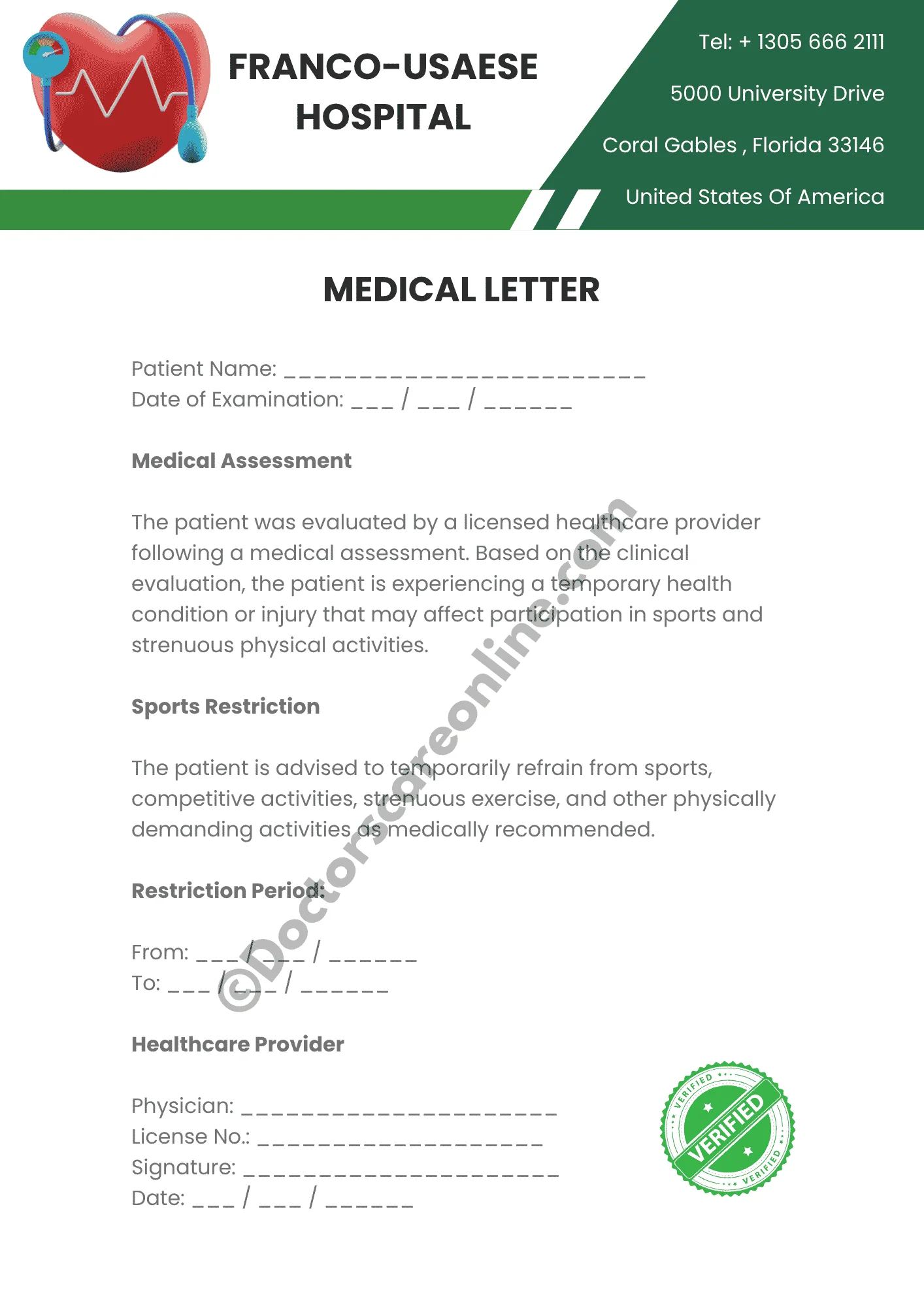
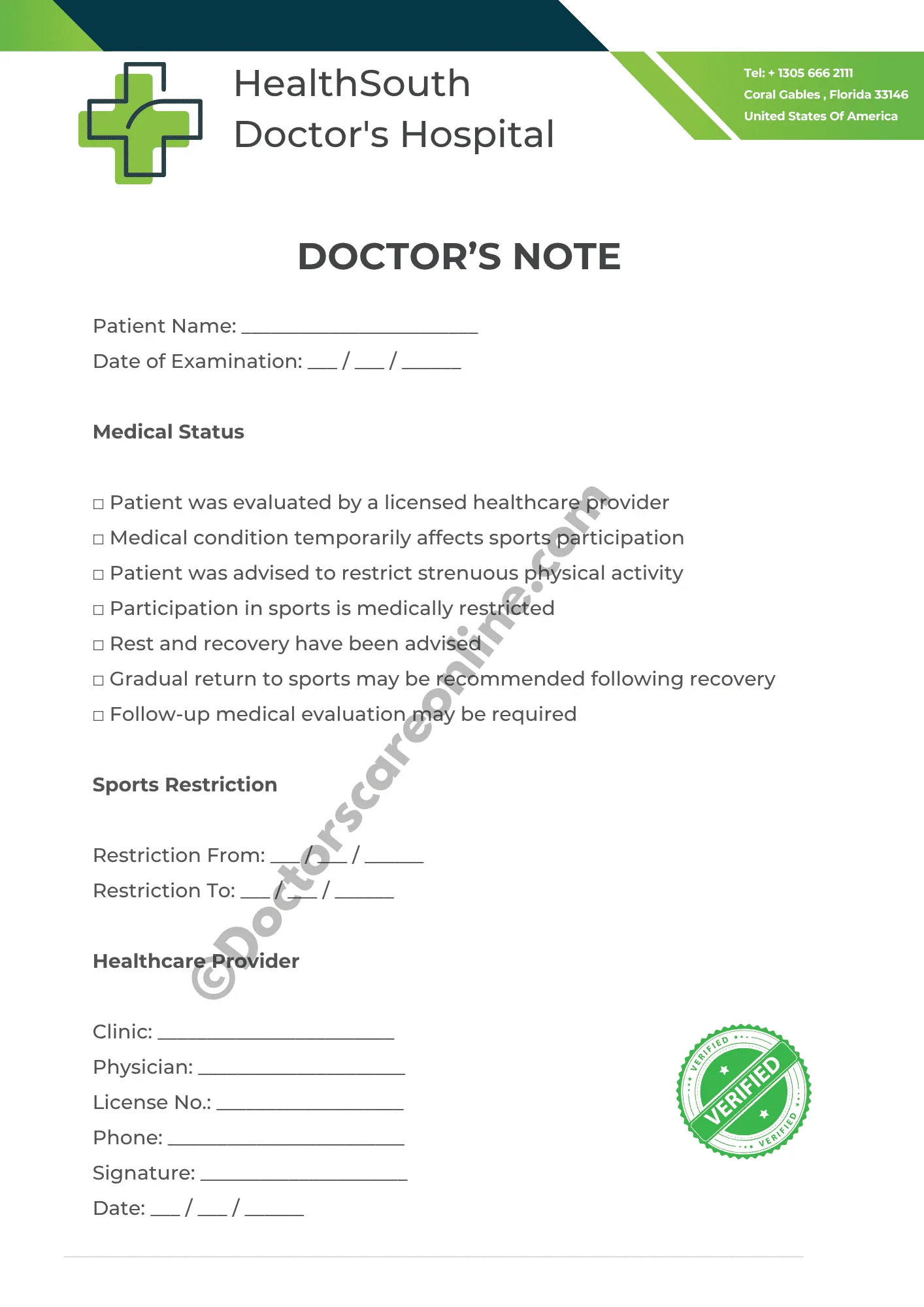
A doctor’s note for sports restriction is medical documentation that a licensed healthcare provider may issue after evaluating an athlete’s injury, illness, symptoms, or physical limitations. Depending on the medical assessment, the documentation may recommend temporarily avoiding sports, reducing physical activity, modifying training, or following specific restrictions until the athlete is medically cleared.
Through an online doctor visit, eligible patients may discuss their symptoms with a licensed healthcare provider through telehealth. If the condition can be appropriately evaluated remotely and the provider determines that documentation is medically appropriate, a sports restriction note may be provided where permitted by applicable laws and clinical requirements.
A sports restriction note provides written medical documentation regarding temporary limitations on physical or athletic activity.
Depending on the situation, a healthcare provider may recommend:
- Temporary removal from sports participation
- Avoiding contact sports
- Limiting running, jumping, or high-intensity exercise
- Avoiding weightlifting or heavy resistance training
- Restricting specific movements that aggravate symptoms
- Participating only in modified training
- Taking time away from athletic activities
- Gradually returning to exercise
- Completing a follow-up evaluation before unrestricted participation
The exact wording depends on the athlete’s condition, symptoms, functional limitations, sport, activity level, and healthcare provider’s clinical judgment.
Related Doctor Note : —–
- Doctor’s Note for Injury
- Doctor’s Note for Torn Muscle
- Doctor’s Note for 3 Days Off Work
- Doctor’s Note for Missing Work
When Might You Need a Doctor’s Note for Sports Restriction?
A medical restriction may be appropriate when an injury or illness interferes with safe participation in physical activity.
Common situations include:
- Muscle strains or sprains
- Joint injuries
- Back or neck pain
- Concussions or suspected concussion
- Fractures or stress injuries
- Tendon or ligament injuries
- Significant swelling or limited range of motion
- Illness affecting exercise tolerance
- Recovery following surgery or another medical procedure
- Symptoms that become worse during physical activity
- Reinjury concerns during the recovery period
For some conditions, returning to sports requires a gradual progression rather than immediately resuming full activity. For example, CDC guidance for concussion recovery recommends healthcare-provider involvement and a stepwise return-to-play process, with athletes progressing only when symptoms do not return at the current level.
What Can a Sports Restriction Include?
A restriction should reflect the athlete’s individual medical needs rather than using a one-size-fits-all approach.
A healthcare provider may specify limitations such as:
- No sports participation: The athlete should temporarily avoid organized sports and strenuous physical activity.
- No contact activity: The athlete may be allowed to perform certain non-contact activities while avoiding physical contact.
- Activity modification: The athlete may participate at a reduced intensity or avoid particular movements.
- No heavy lifting: Resistance training, weightlifting, or heavy physical exertion may be restricted.
- Limited running or jumping: Impact-based activities may be temporarily reduced when appropriate.
- Modified practice: An athlete may attend practice but perform only activities permitted by the healthcare provider.
- Gradual return to activity: Physical activity may be increased progressively as symptoms improve and medical guidance allows.
- Follow-up required: The provider may recommend another evaluation before full participation resumes.
The restriction period and permitted activities should be determined by the healthcare provider rather than copied from another athlete’s medical documentation.
Common Sports and Activities That May Require Temporary Modification
Sports restrictions are not limited to professional or school athletics. They may apply to many recreational and competitive activities, including:
- Football
- Soccer
- Basketball
- Baseball
- Softball
- Hockey
- Wrestling
- Tennis
- Volleyball
- Running
- Cycling
- Swimming
- Gym workouts
- Weightlifting
- Martial arts
- Dance
- Gymnastics
- High-intensity fitness programs
The type of restriction depends on the activity and the medical condition. An athlete may be restricted from one type of movement while remaining able to perform other activities safely.
Sports Injuries That May Require Medical Evaluation
Sports injuries can affect muscles, bones, joints, tendons, ligaments, and other structures. Examples include:
- Sprained ankle
- Knee injury
- Shoulder injury
- Hamstring strain
- Groin strain
- Calf strain
- Muscle pull
- Tendinitis
- Ligament injury
- Stress fracture
- Joint pain
- Back injury
- Neck injury
- Concussion
- Repetitive-use injury
A healthcare provider can assess the reported symptoms and determine whether additional examination, diagnostic testing, in-person care, or specialist evaluation may be necessary.
Symptoms That Should Not Be Ignored
Some symptoms require more than routine sports documentation. Seek appropriate medical care if an injury involves:
- Severe or rapidly increasing pain
- Significant swelling or deformity
- Inability to bear weight
- New or significant weakness
- Loss of sensation
- Difficulty breathing
- Chest pain
- Fainting
- Severe headache following a head injury
- Repeated vomiting after a head injury
- Confusion or unusual behavior after trauma
- Loss of consciousness
- Symptoms that rapidly worsen
A telehealth consultation may not be appropriate for every sports injury. Emergency symptoms should be evaluated through appropriate urgent or emergency medical services rather than waiting for an online appointment.
What Happens During an Online Doctor Visit for Sports Restrictions?
An online medical appointment generally begins with a review of your symptoms and relevant medical information.
During the visit, the healthcare provider may ask about:
- How the injury or illness occurred
- When symptoms began
- The location and severity of symptoms
- Activities that make symptoms better or worse
- Previous injuries or medical conditions
- Current medications
- Athletic activities and training
- Your normal level of physical activity
- Whether you can walk, move, exercise, or perform daily activities normally
- Any treatment already received
The provider may also ask you to demonstrate certain movements when clinically appropriate and feasible through video. However, a remote evaluation cannot replace every type of physical examination or diagnostic test.
If the provider believes an in-person examination or additional testing is necessary, they may recommend that you seek appropriate in-person care.
How to Prepare for Your Online Doctor Visit
Preparing relevant information beforehand can make the appointment more useful.
Have the following information available:
- Your current symptoms
- Date the symptoms began
- How the injury occurred
- The sport or activity involved
- Any previous injuries to the same area
- Current medications and supplements
- Known allergies
- Previous diagnoses or procedures
- Any imaging or medical reports you already have
- Details about your training schedule
- The specific activity you are concerned about
- Any school, team, employer, or athletic-program documentation requirements
For a telehealth visit, use a reliable internet connection and a device that supports the appointment. HHS also recommends preparing questions, checking appointment details, testing your technology, and choosing a private location for the visit.
How Our Online Doctor Visit Can Help
Our online doctor visit service is designed to provide a convenient way for eligible patients to discuss health concerns with a licensed healthcare provider without necessarily traveling to a clinic for an initial consultation.
The service can be useful when you need:
- Convenient access to a medical consultation
- Evaluation of symptoms that may affect sports participation
- Guidance regarding temporary activity limitations
- Medical documentation when clinically appropriate
- Information about whether additional in-person care may be necessary
- Follow-up guidance based on the provider’s assessment
The provider—not the website—determines whether a sports restriction or other medical documentation is appropriate.
Availability of telehealth services and the ability to issue documentation can vary according to the patient’s location, the provider’s licensure, the medical issue, and applicable state and federal requirements.
Why Patients Can Use Our Service With Confidence
Choosing an online medical service involves more than simply finding a convenient appointment. Patients should understand how the service works, who provides the medical evaluation, how information is handled, and where to obtain assistance when questions arise.
Our service is designed to make the process easier by providing an online pathway for scheduling a medical consultation and communicating relevant information to the healthcare provider.
Patients should expect:
- A medical consultation rather than an automatic documentation service
- Evaluation by an appropriately licensed healthcare professional
- Clear communication about the next steps
- Medical documentation only when determined appropriate by the provider
- An online process designed to reduce unnecessary administrative difficulty
- Access to customer support for website-related questions
Telehealth privacy is an important consideration. HHS explains that covered healthcare providers using telehealth must follow applicable HIPAA requirements, while state privacy requirements can also apply depending on the organization and circumstances.
Important: Do not claim that the website itself is HIPAA compliant unless your organization and technology providers have actually verified and documented that status.
Help With Registration, Login, Payment, or Website Questions
If you experience a problem while using our website, you do not have to figure it out on your own.
You can use our website chatbox to ask questions or request assistance with issues such as:
- Creating an account
- Registering for an online doctor visit
- Logging into your account
- Accessing your appointment
- Understanding the booking process
- Payment-related questions
- Problems completing checkout
- Technical difficulties
- Questions about using the website
- General service-related queries
Our chat support is intended to help with website and service-navigation questions. For medical questions, symptoms, diagnosis, treatment, or whether you should participate in sports, the appropriate healthcare professional should provide medical guidance.
What Happens After the Medical Consultation?
After your online consultation, the healthcare provider determines the appropriate next step based on your medical circumstances.
Depending on the evaluation, you may receive:
- Self-care or activity guidance
- A recommendation for temporary restrictions
- A recommendation to avoid certain sports
- A gradual return-to-activity plan
- A recommendation for an in-person examination
- A referral or recommendation for additional medical care
- Medical documentation when clinically appropriate
A restriction note should be followed according to the healthcare provider’s instructions. If your symptoms change or become worse, contact a healthcare professional for further evaluation.
Sports Restriction and Return to Activity
Returning to sports should be based on recovery rather than simply reaching the end of a calendar period.
Depending on the injury or illness, a healthcare provider may recommend returning gradually instead of immediately performing at full intensity.
A return-to-activity plan may involve:
- Resuming normal daily activities as tolerated.
- Beginning light physical activity when medically appropriate.
- Increasing exercise intensity gradually.
- Monitoring for recurring or new symptoms.
- Progressing to sport-specific movements.
- Returning to full participation only when medically cleared when clearance is required.
For certain conditions, such as concussion, formal stepwise return-to-play guidance may apply. CDC guidance emphasizes monitoring symptoms throughout progression and stopping or contacting a healthcare provider if symptoms return.
How Long Can a Sports Restriction Last?
There is no universal duration for a sports restriction.
The appropriate period can depend on:
- Type of injury or illness
- Severity of symptoms
- Functional limitations
- Treatment response
- Age and activity level
- Sport requirements
- Risk of reinjury
- Medical history
- Provider assessment
- Whether additional evaluation is required
Some restrictions may be brief, while others can continue until symptoms improve or the athlete completes a recommended follow-up assessment.
Do not assume that another athlete’s restriction period applies to you.
Can an Online Doctor Provide a Sports Restriction Note?
In some circumstances, a licensed healthcare provider may provide medical documentation following a telehealth consultation if the condition can be appropriately evaluated remotely and the provider determines that documentation is medically justified.
However, online care is not suitable for every injury. A provider may recommend an in-person examination when a physical assessment, imaging, testing, or other evaluation is necessary.
The availability of telehealth and medical documentation can also vary by state and individual circumstances.
What Information May Appear on the Medical Note?
The content of a sports restriction note varies according to the provider and the purpose of the documentation.
When medically appropriate, documentation may include:
- Patient name
- Date of medical evaluation
- Confirmation of medical evaluation
- Relevant activity restrictions
- Recommended period of restriction
- Modified activity instructions
- Follow-up recommendations
- Return-to-activity or clearance information, when appropriate
- Healthcare provider information and signature
The provider determines what information should be included. A patient should never modify, alter, or add information to a medical document after it has been issued.
Medical Privacy During an Online Doctor Visit
Health information is sensitive, so patients should take reasonable steps to protect their privacy during telehealth appointments.
HHS recommends using a private location and taking precautions with devices and networks when discussing health information online. HIPAA protections may apply to covered healthcare providers and their telehealth services, while other privacy laws may also apply depending on the circumstances.
For your appointment:
- Use a private location when possible.
- Avoid discussing sensitive medical information where others can overhear.
- Use your own password-protected device when possible.
- Avoid public Wi-Fi for sensitive communications when possible.
- Verify that you are communicating through the correct healthcare service.
- Follow the provider’s instructions for securely sharing medical information.
When an In-Person Visit May Be More Appropriate
Online medical care can be convenient, but it has limitations. An in-person evaluation may be more appropriate when your condition requires:
- A hands-on physical examination
- Imaging such as an X-ray or MRI
- Laboratory testing
- Assessment of a significant injury
- Evaluation of a suspected fracture
- Treatment of a wound
- Assessment of severe neurological symptoms
- Emergency medical treatment
Your healthcare provider can advise whether additional in-person care is needed based on your symptoms and the information available during the consultation.
Frequently Asked Questions
1. Can a sports restriction note be used for a school athletic program?
It may be accepted when the school’s athletic department or governing organization requires medical documentation for restricted participation. Because individual programs can have their own forms or clearance procedures, check the requirements before your appointment.
2. Can I request restrictions for only one sport or activity?
A healthcare provider can consider the specific physical demands of an activity when determining appropriate restrictions. The final recommendations should be based on your medical condition and the movements or exertion involved.
3. Can a sports restriction note be updated if my recovery changes?
If your symptoms or functional abilities change, you can contact a healthcare provider for reassessment. The provider may determine whether updated documentation or different restrictions are medically appropriate.
4. Will my sports organization automatically accept an online medical note?
Not necessarily. Schools, teams, leagues, colleges, employers, and athletic organizations may have different documentation and medical-clearance requirements. Confirm their requirements before relying on a particular type of note.
5. What if I disagree with a sports restriction recommended during my visit?
Discuss your concerns directly with the healthcare provider. You can ask why the restriction was recommended, what activities may be appropriate, and what conditions would need to be met before returning to unrestricted participation.
Medical Disclaimer: This content is provided for general educational and informational purposes only and is not a substitute for professional medical advice, diagnosis, or treatment. A doctor’s note or sports restriction should be issued only by an appropriately licensed healthcare provider after an appropriate medical evaluation.
Telehealth availability, provider licensure, medical documentation requirements, and sports participation rules can vary by state, organization, school, employer, athletic program, and individual circumstances.





Reviews
There are no reviews yet.