
A doctor’s note for vestibular migraine is medical documentation that may be provided by a licensed healthcare professional after evaluating symptoms associated with vestibular migraine. Depending on the individual’s condition, a healthcare provider may recommend temporary time away from work or school, modified activities, reduced screen exposure, or other restrictions when medically appropriate.
Vestibular migraine can cause episodes of dizziness, vertigo, imbalance, motion sensitivity, visual disturbances, and migraine-related symptoms. These symptoms can interfere with concentration, commuting, driving, work responsibilities, school attendance, and normal daily activities even when a person does not experience a typical headache.
Related Doctor Note : —–
If vestibular migraine symptoms are affecting your ability to work or attend school, an online medical consultation may provide a convenient way to discuss your symptoms with a licensed healthcare provider. After an appropriate evaluation, the provider can determine whether a doctor’s note for vestibular migraine, medical leave, activity restriction, or other documentation is clinically appropriate.
What Is a Doctor’s Note for Vestibular Migraine?
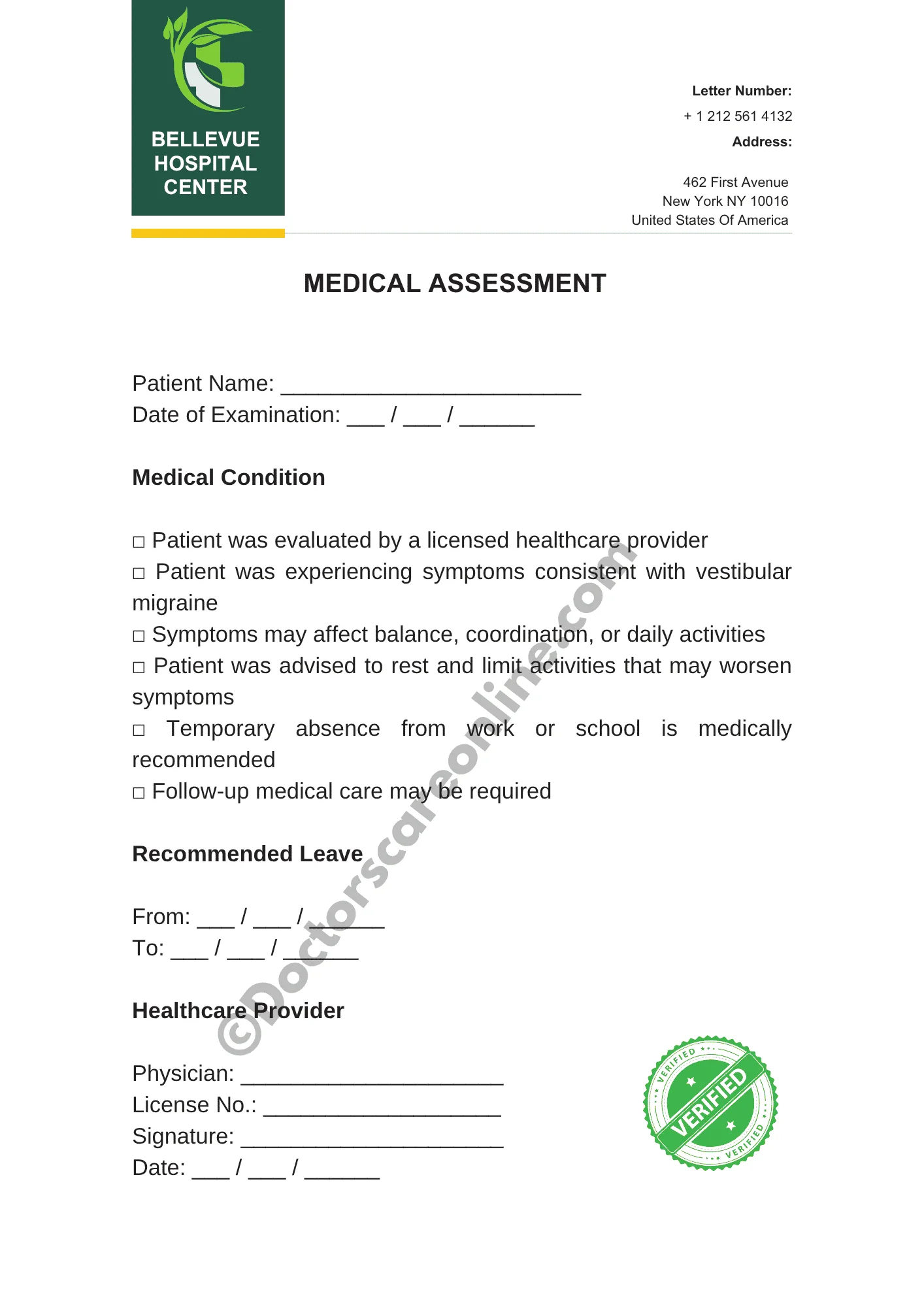
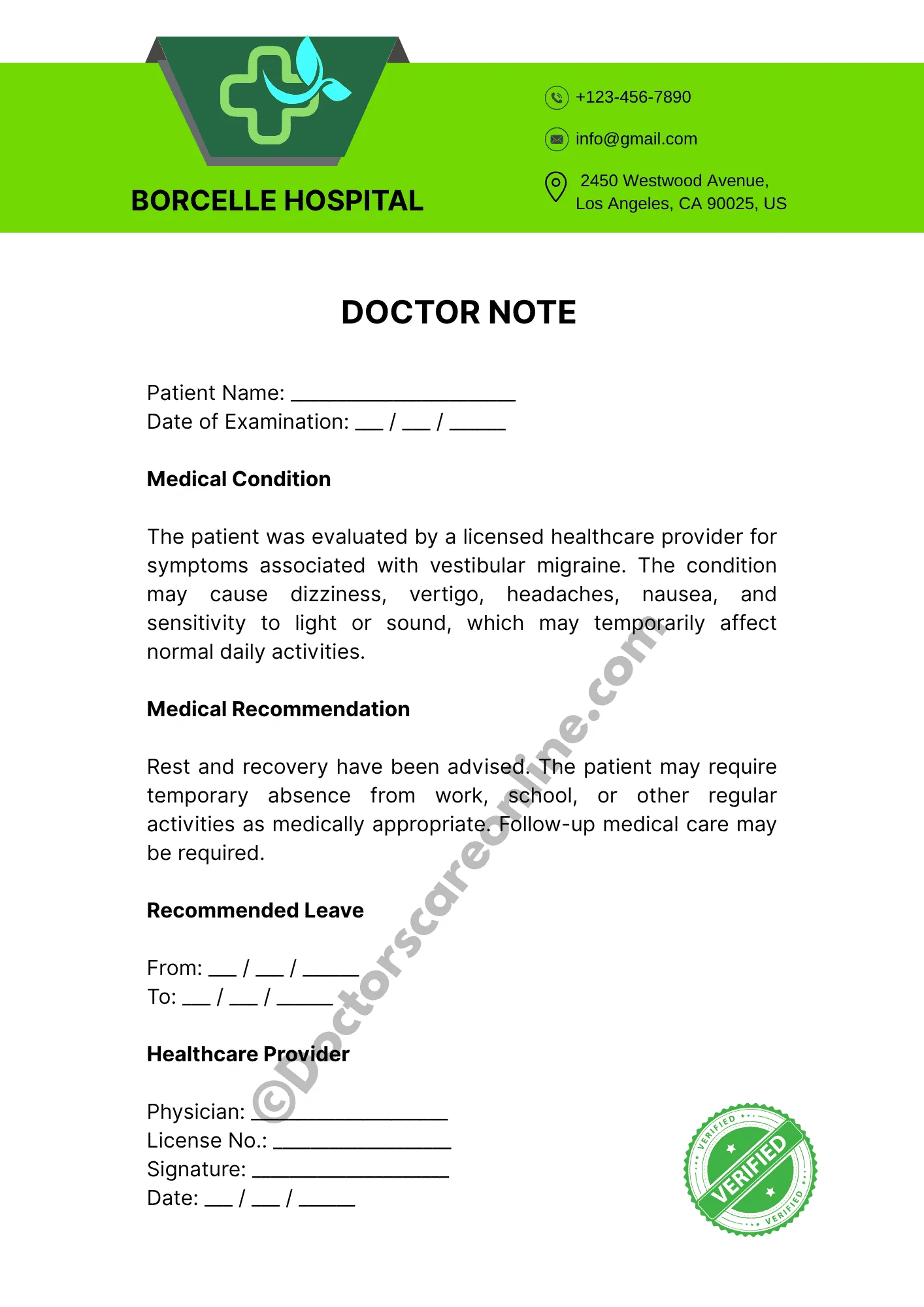
A doctor’s note for vestibular migraine is a formal medical document issued by a healthcare provider following an appropriate medical evaluation. It can confirm that a patient was assessed for symptoms that may affect their ability to perform normal work, school, or daily activities.
Depending on the patient’s circumstances, documentation may include:
- Date of medical evaluation
- Confirmation that the patient was medically assessed
- Recommended time away from work or school, when medically appropriate
- Temporary activity or workplace restrictions
- Recommended return-to-work or return-to-school date, when applicable
- Follow-up recommendations
- Healthcare provider and clinic information
A medical note does not necessarily need to disclose a detailed diagnosis. The information included depends on the provider’s clinical judgment and the documentation requirements of the employer, school, or other organization.
Why Might You Need a Doctor’s Note for Vestibular Migraine?
Vestibular migraine symptoms can occur with or without headache and may significantly affect balance, vision, movement, and concentration. A doctor’s note can help communicate medically supported limitations when symptoms interfere with normal responsibilities.
You may need documentation if vestibular migraine symptoms cause:
- Vertigo or dizziness that makes commuting difficult
- Balance problems that make certain workplace activities unsafe
- Motion sensitivity that makes travel or transportation difficult
- Difficulty concentrating or completing tasks
- Visual sensitivity or sensitivity to bright lights
- Nausea or vomiting during migraine episodes
- Symptoms that require temporary rest at home
- Difficulty attending classes or examinations
- Difficulty safely performing physically demanding work
- A need for temporary workplace accommodations
The healthcare provider determines whether medical leave or restrictions are appropriate based on the individual’s symptoms and clinical assessment.
Common Vestibular Migraine Symptoms
Vestibular migraine can involve both migraine-related and vestibular symptoms. Symptoms vary from person to person and may occur episodically.
Common symptoms include:
- Vertigo or a spinning sensation
- Dizziness or lightheadedness
- Imbalance or unsteadiness
- Motion sensitivity
- Sensitivity to light or sound
- Visual disturbances
- Nausea or vomiting
- Headache or migraine-like head pain
- Difficulty concentrating
- Brain fog
- Increased sensitivity to movement
- Symptoms triggered by busy visual environments
Some people experience vestibular symptoms without a significant headache, which can make vestibular migraine difficult to recognize without professional evaluation.
Vestibular Migraine vs. Other Causes of Vertigo
Dizziness and vertigo can have many possible causes. Vestibular migraine is only one potential explanation for these symptoms.
Other conditions that may cause dizziness or vertigo include:
- Benign paroxysmal positional vertigo (BPPV)
- Ménière’s disease
- Vestibular neuritis
- Labyrinthitis
- Medication-related dizziness
- Dehydration
- Low blood pressure
- Other neurological or medical conditions
Because symptoms can overlap, individuals should not assume that dizziness automatically means vestibular migraine. A healthcare provider can assess the symptoms, medical history, and other relevant factors and determine whether additional evaluation is necessary.
When Should You Seek Medical Attention for Vestibular Migraine Symptoms?
Recurring dizziness or vertigo should be discussed with a healthcare professional, particularly when symptoms interfere with daily activities.
Seek prompt medical evaluation if you experience:
- New or unusually severe dizziness
- Sudden difficulty walking
- New weakness or numbness
- Trouble speaking or understanding speech
- Fainting or loss of consciousness
- New double vision or significant vision changes
- Severe or sudden headache unlike previous headaches
- Symptoms following a significant head injury
- Chest pain or severe shortness of breath
- Persistent vomiting or inability to keep fluids down
Some of these symptoms can indicate a medical emergency rather than vestibular migraine. Sudden neurological symptoms or other severe warning signs require urgent medical assessment.
Can You Get a Doctor’s Note for Vestibular Migraine Online?
In many locations, vestibular migraine symptoms can initially be discussed through a telehealth appointment. Whether an online consultation is appropriate depends on the symptoms, medical history, location, and healthcare provider’s clinical judgment.
During an online appointment, the provider may ask about:
- Frequency and duration of dizziness or vertigo
- Headache history
- Migraine triggers
- Motion sensitivity
- Visual or sensory symptoms
- Nausea or vomiting
- Previous diagnoses
- Current medications
- Previous medical evaluations
- How symptoms affect work, school, or daily activities
If the provider determines that the condition can be appropriately assessed through telehealth and medical documentation is justified, they may provide a doctor’s note where permitted.
An online doctor’s note is not guaranteed simply because it is requested. Legitimate medical documentation should be based on an appropriate healthcare evaluation and the provider’s professional judgment.
How to Get a Doctor’s Note for Vestibular Migraine Online
Getting evaluated online can be convenient when your symptoms are appropriate for telehealth.
1. Choose a Licensed Healthcare Provider
Select a legitimate healthcare service that connects patients with licensed healthcare professionals. Check that the provider operates legally in your location and clearly explains its consultation process.
2. Register or Log In
Create an account or log in to your existing account using the information requested by the service.
3. Book an Online Consultation
Select an available appointment and provide the required information about your symptoms.
4. Describe Your Symptoms Honestly
Explain when your dizziness or vertigo started, how often episodes occur, what triggers them, and how they affect your work, school, or daily activities.
5. Complete the Medical Evaluation
The healthcare provider will review your symptoms and medical history and determine whether telehealth is suitable for your situation.
6. Follow the Provider’s Recommendations
The provider may recommend treatment, lifestyle changes, follow-up care, additional testing, or an in-person evaluation when necessary.
7. Receive Documentation If Medically Appropriate
If the healthcare provider determines that medical documentation is appropriate, they may issue a doctor’s note according to applicable requirements and professional standards.
What Can a Doctor’s Note for Vestibular Migraine Include?
The contents depend on the provider’s assessment and the requirements of the organization receiving the documentation.
A note may include:
| Information | Purpose |
|---|---|
| Patient name | Identifies the patient |
| Examination date | Documents when medical evaluation occurred |
| Medical confirmation | Confirms that the patient was evaluated |
| Leave period | Indicates recommended time away from work or school |
| Activity restrictions | Describes temporary limitations when appropriate |
| Return date | Indicates when normal activities may resume, if determined |
| Follow-up instructions | Identifies whether additional medical care is recommended |
| Provider information | Helps verify the medical documentation |
A provider may limit diagnostic details to protect patient privacy unless additional information is legally or administratively required.
Vestibular Migraine and Work: When May Restrictions Be Appropriate?
Vestibular migraine symptoms may make certain work activities temporarily difficult or unsafe.
Depending on the person’s symptoms and occupation, a healthcare provider may recommend restrictions such as:
- Limiting driving when dizziness makes driving unsafe
- Avoiding heights or hazardous machinery
- Reducing exposure to intense visual stimuli
- Taking periodic rest breaks
- Temporarily limiting physically demanding activities
- Modifying tasks that require prolonged standing
- Adjusting work hours when clinically appropriate
- Working remotely when feasible and medically appropriate
Restrictions should be based on the healthcare provider’s assessment rather than a predetermined list.
Vestibular Migraine and School or College Absences
Students experiencing significant vestibular migraine symptoms may have difficulty attending classes, traveling to campus, concentrating during lectures, or completing examinations.
When medically appropriate, a healthcare provider may recommend temporary absence or academic accommodations. Depending on school or college policies, documentation may support requests such as:
- Excused absence
- Additional recovery time
- Rescheduled examination
- Temporary activity modification
- Other appropriate academic accommodations
Students should check their institution’s specific documentation requirements.
How Long Can a Doctor Excuse You for Vestibular Migraine?
There is no universal number of days that applies to every vestibular migraine episode.
The recommended recovery or leave period may depend on:
- Severity of symptoms
- Frequency and duration of episodes
- Ability to walk or maintain balance
- Ability to concentrate
- Job or school requirements
- Safety-sensitive responsibilities
- Response to treatment
- Healthcare provider’s clinical assessment
Some episodes may resolve relatively quickly, while recurring or severe symptoms may require further evaluation and follow-up.
Treatment and Management of Vestibular Migraine
Treatment varies depending on the individual’s symptoms, medical history, triggers, and healthcare provider’s assessment.
Management may involve:
- Identifying and avoiding individual migraine triggers
- Maintaining consistent sleep
- Staying adequately hydrated
- Eating regular meals
- Managing stress
- Limiting excessive sensory stimulation
- Vestibular rehabilitation when recommended
- Migraine preventive treatment when prescribed
- Medication for acute symptoms when prescribed
- Follow-up with an appropriate healthcare professional
Do not start, stop, or change prescription medication without discussing it with a qualified healthcare provider.
How Our Online Service Can Help
Our service is designed to make the process of seeking an online medical evaluation more convenient and transparent.
- Licensed Healthcare Evaluation: Users can request an online consultation with a healthcare professional where telehealth services are available. Medical documentation is based on the provider’s evaluation and professional judgment rather than being automatically issued.
- Convenient Online Process: You can complete registration, appointment booking, and consultation online without unnecessary in-person steps when your symptoms are suitable for telehealth.
- Clear Medical Documentation Process: If a provider determines that a doctor’s note is medically appropriate, the documentation can reflect the recommended leave, restrictions, or other relevant information according to applicable requirements.
- Privacy-Conscious Approach: Medical information should be handled according to applicable privacy and healthcare requirements. Users should review the service’s privacy policy and terms to understand how their information is collected, used, and protected.
- Customer Support Through Chat: If you experience an issue with registration, login, appointment booking, payment, account access, or another part of the website, or if you simply have a question about the process, you can contact our website chatbox/customer support for assistance.
Our support team can help with service-related questions and technical or account issues. However, medical advice and decisions about whether a doctor’s note is appropriate must come from the licensed healthcare provider.
Why Choose Our Service for an Online Vestibular Migraine Consultation?
Choosing a healthcare service for a medical consultation requires trust. Our approach focuses on making the process straightforward and transparent.
Users can benefit from:
- Access to licensed healthcare professionals where services are available
- A convenient online consultation process
- Clear information about what the service can and cannot provide
- Medical documentation based on professional evaluation
- Transparent appointment and payment processes
- Customer support for registration, login, payment, and technical questions
- A process that does not guarantee documentation before a medical assessment
- Guidance to seek in-person or emergency care when telehealth is not appropriate
The goal is to help users access an appropriate healthcare evaluation conveniently while keeping medical decisions with qualified healthcare professionals.
What to Do If an Online Consultation Is Not Appropriate
Telehealth is not suitable for every medical situation. A provider may recommend an in-person appointment, diagnostic testing, urgent care, or emergency treatment depending on the symptoms.
If the provider believes your symptoms require physical examination or additional testing, follow that recommendation rather than relying solely on an online consultation.
Can a Doctor’s Note Be Used for Work or School?
A doctor’s note may be used as medical documentation for work or school when it meets the requirements of the organization receiving it.
However, employers, schools, colleges, insurers, and other organizations may have different documentation policies. Before submitting a note, check whether they require specific information, a particular form, an original document, or additional verification.
A doctor’s note does not automatically guarantee approval of leave or accommodations. Final decisions may depend on the organization’s policies and applicable laws.
Can a Doctor’s Note for Vestibular Migraine Be Updated?
If symptoms continue or circumstances change, a healthcare provider may reassess the patient and determine whether updated documentation is medically appropriate.
For example, a follow-up evaluation may be appropriate if:
- Symptoms have not improved
- Vertigo episodes are becoming more frequent
- Work restrictions need to be extended
- A return-to-work date needs reassessment
- Additional symptoms have developed
- Further medical evaluation is necessary
Never edit an existing medical note yourself. Request updated documentation from the healthcare provider when needed.
Frequently Asked Questions
1. Can vestibular migraine qualify for a doctor’s note?
It can, depending on the severity of symptoms and how they affect your ability to work, attend school, or safely perform normal activities. A licensed healthcare provider must evaluate your situation and determine whether documentation is medically appropriate.
2. Can vestibular migraine cause enough dizziness to prevent working?
Yes. Vestibular migraine may cause vertigo, imbalance, motion sensitivity, nausea, visual symptoms, or difficulty concentrating. Whether you need time away from work or temporary restrictions depends on your symptoms and the nature of your job.
3. Is a vestibular migraine doctor’s note the same as a disability certification?
No. A doctor’s note confirming a medical evaluation or recommending temporary restrictions is different from formal disability certification. Disability-related documentation may involve additional medical, legal, insurance, or employer requirements.
4. Can I drive with vestibular migraine symptoms?
Driving may be unsafe during an episode involving significant dizziness, vertigo, visual disturbance, or impaired balance. If symptoms affect your ability to drive safely, avoid driving and seek appropriate medical guidance.
5. What if my employer or school asks for more information than my doctor’s note provides?
Ask the organization what documentation it requires and discuss the request with your healthcare provider. The provider can determine what additional information can appropriately be included while considering medical privacy and applicable requirements.
Medical Disclaimer: This content is provided for general educational and informational purposes only and does not replace professional medical advice, diagnosis, or treatment. Vestibular migraine and other causes of dizziness or vertigo can have overlapping symptoms and should be evaluated by an appropriate healthcare professional.
A doctor’s note should only be issued by a licensed healthcare provider following an appropriate medical evaluation. Medical documentation, leave recommendations, work restrictions, telehealth availability, and employer or school requirements may vary by location and individual circumstances.



Reviews
There are no reviews yet.