

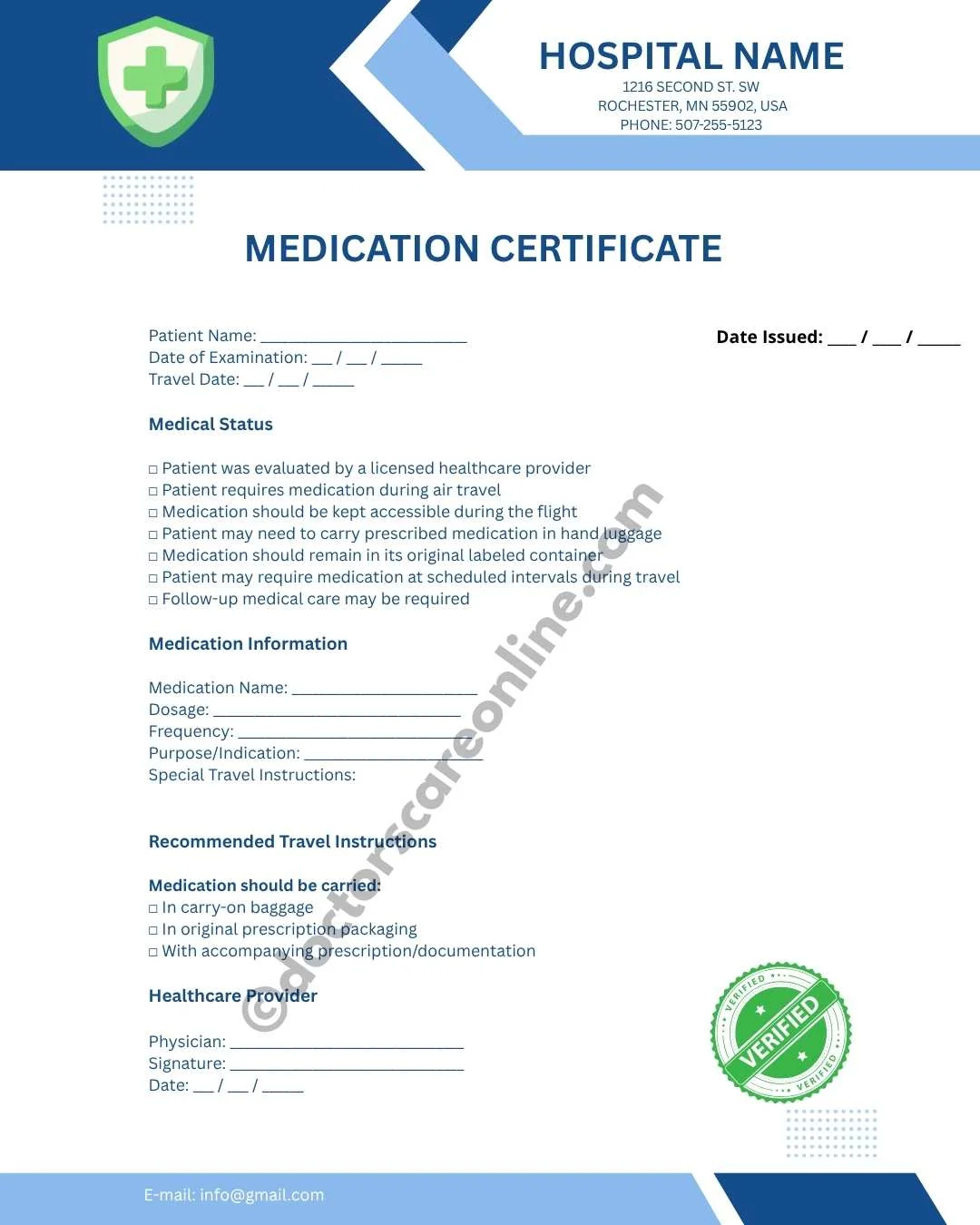
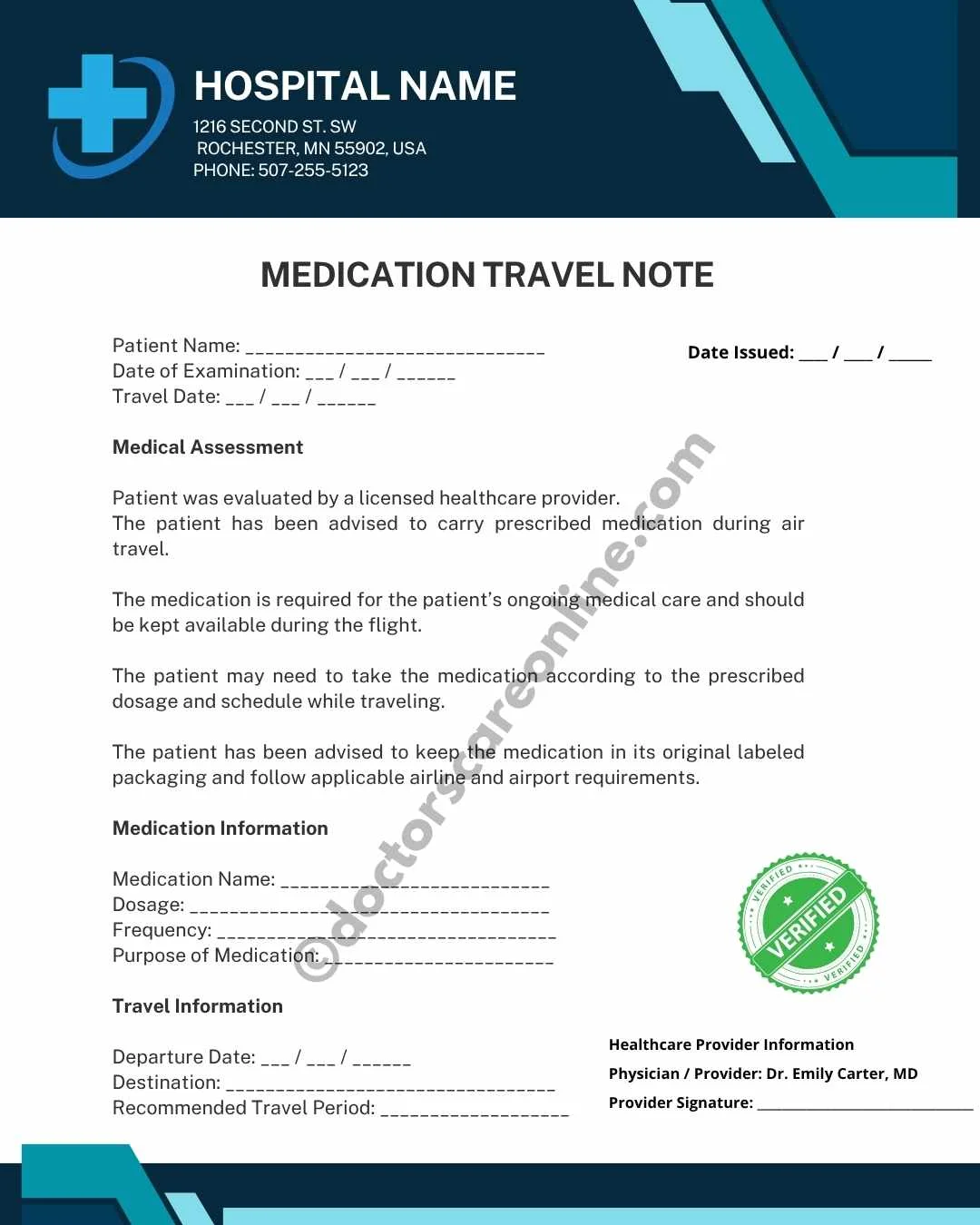
A doctor’s note for medication on flight is a medical document issued by a licensed healthcare provider confirming that a passenger requires prescription medication, medical devices, or injectable treatments during air travel. Depending on the medication, airline policies, airport security procedures, and the destination country’s regulations, this document may help explain why you are carrying certain medicines or medical equipment while traveling.
Many travelers fly with prescription medications every day without any issues. However, a doctor’s note or medical certificate may be especially helpful when traveling with injectable medications (such as insulin), controlled substances, liquid medications exceeding standard carry-on limits, medical oxygen, CPAP machines, syringes, or medications that require refrigeration.
Important: A doctor’s note supports your travel documentation but does not replace airline policies, airport security requirements, customs regulations, or legal documentation required by your destination country.
Why Might You Need a Doctor’s Note for Medication on a Flight?
Although many prescription medications can be transported without special documentation, a doctor’s note can help clarify the medical necessity of certain medications or devices during travel.
You may benefit from carrying a doctor’s note if you:
- Travel with injectable medications such as insulin or biologic therapies.
- Carry syringes, needles, or lancets.
- Need liquid medication in quantities larger than standard carry-on allowances.
- Travel with controlled prescription medications.
- Use medical devices such as a CPAP machine, nebulizer, or portable oxygen concentrator.
- Require refrigerated medication during long flights.
- Have a chronic medical condition that requires medication during travel.
- Are traveling internationally, where customs authorities may request supporting medical documentation.
Having clear medical documentation may help reduce questions during security screening, although it does not guarantee expedited processing.
Common Situations Where a Doctor’s Note May Be Helpful
| Situation | Why Documentation May Be Helpful |
|---|---|
| Traveling with insulin | Explains the need for insulin, needles, and glucose monitoring supplies. |
| Carrying injectable medication | Supports the transport of syringes and prescribed injectable medicines. |
| Traveling with liquid medication | Helps explain medically necessary liquids that exceed standard carry-on limits. |
| Carrying controlled medications | May assist when traveling with regulated prescription drugs, subject to local laws. |
| Traveling after surgery | Confirms the need for prescribed medications and temporary medical devices. |
| Traveling during pregnancy | Supports medications required for pregnancy-related medical conditions. |
| Using a CPAP machine | Explains the medical necessity of carrying respiratory equipment. |
| Severe allergies | Documents the need to carry emergency medications such as an epinephrine auto-injector. |
| Organ transplant recipients | Supports immunosuppressive medication requirements. |
| International travel | May assist when customs officials request proof of prescription medication. |
Benefits of Carrying a Doctor’s Note While Flying
Although it may not always be required, carrying a doctor’s note can provide several advantages during air travel.
- Supports the medical necessity of prescription medication.
- Helps explain the purpose of injectable medicines and syringes.
- May assist during airport security screening.
- Can provide supporting documentation for customs inspections.
- Helps verify the need for medical devices during travel.
- May simplify communication with airline staff.
- Supports travel insurance claims when medical documentation is requested.
- Offers peace of mind when traveling internationally.
How to Get an Online Doctor’s Note for Medication on a Flight
If you need a doctor’s note for medication on a flight, you may be able to obtain one through a licensed telehealth provider. Online consultations allow healthcare professionals to evaluate your medical condition remotely and determine whether a doctor’s note or medical certificate is medically appropriate for your travel needs.
A doctor’s note can be helpful when traveling with prescription medications, injectable medicines, medical devices, or controlled medications that may require additional documentation during airport security screening or international travel. However, the decision to issue a doctor’s note is always based on the healthcare provider’s professional medical judgment.
Step 1: Choose a Licensed Telehealth Provider
Select a trusted telehealth platform that offers virtual medical consultations with licensed healthcare professionals.
Before booking an appointment, make sure the provider:
- Is licensed to practice in your state or country.
- Offers general medical consultations.
- Can evaluate your medical condition remotely.
- Provides medical documentation when clinically appropriate.
Many telehealth services allow appointments through a smartphone, tablet, or computer, making the process convenient for travelers.
Step 2: Create Your Patient Account
Register for an account by providing your:
- Full name
- Email address
- Phone number
- Date of birth
- Home address (if required)
Some providers may also ask you to complete a brief medical history before your appointment.
Step 3: Schedule Your Virtual Appointment
Choose a consultation type that matches your needs, such as:
- General Medical Consultation
- Primary Care Visit
- Travel Health Consultation
- Urgent Care Consultation
Select an available appointment time that allows enough time to obtain your documentation before your scheduled flight.
Step 4: Explain Your Medical Condition
During the consultation, clearly explain your health condition and why you need to travel with medication.
Your healthcare provider may ask about:
- Your diagnosed medical condition
- Current symptoms (if any)
- Prescription medications you are taking
- Dosage and frequency
- How long you have been using the medication
- Whether the medication is injectable
- Whether you use medical devices such as a CPAP machine, insulin pump, or nebulizer
- Your planned travel dates and destination
- Whether you are traveling domestically or internationally
Providing complete and accurate information helps the provider determine whether a doctor’s note is medically appropriate.
Step 5: Provide Supporting Medical Information
Depending on your situation, the healthcare provider may request supporting information, such as:
- Current prescription
- Pharmacy prescription label
- Previous medical records
- Recent clinic visit summary
- Hospital discharge papers
- Specialist reports
- Existing treatment plan
Not every consultation requires additional documentation. Requirements vary depending on the medical condition and the healthcare provider’s assessment.
Step 6: Complete the Online Medical Evaluation
The healthcare provider will review your medical history, current treatment, and travel needs.
During the consultation, they may assess:
- Whether your medication is medically necessary.
- Whether your treatment should continue during travel.
- Whether a doctor’s note is appropriate.
- Whether additional travel precautions are recommended.
If more information is needed, the provider may ask follow-up questions before making a decision.
Step 7: Receive Your Doctor’s Note
If the healthcare provider determines that a doctor’s note is medically appropriate, it may be provided through:
- Secure patient portal
- Telehealth mobile app
- Downloadable PDF
Review the document carefully to ensure all information is accurate before using it for travel.
Tips for a Successful Online Consultation
To help your healthcare provider make an informed decision:
- Schedule your appointment before your departure date.
- Keep your prescription medications nearby during the consultation.
- Have your pharmacy labels available.
- Be honest about your medical history.
- Clearly explain your travel plans.
- Mention any injectable medications or medical devices.
- Ask questions if you are unsure about medication requirements during travel.
Important Things to Remember
Before flying with medication:
- Keep prescription medicines in their original pharmacy-labeled containers.
- Carry medications in your carry-on bag whenever possible.
- Bring enough medication for your entire trip, plus a small extra supply if appropriate.
- Review airline policies before departure.
- Check customs regulations for international destinations.
- Carry copies of prescriptions for extended international travel when appropriate.
TSA and Airport Security Rules for Medications
Most passengers can travel with prescription and over-the-counter medications without any problems. However, airport security agencies and airlines have specific rules regarding how medications should be packed, declared, and transported. Understanding these requirements before your trip can help make the security screening process smoother.
A doctor’s note may support your travel documentation, but travelers should also follow all applicable airline, airport security, and customs regulations.
Traveling with Injectable Medications
Many travelers fly with injectable medications every day. If your treatment requires syringes, needles, or injection devices, keeping them with your prescribed medication can help simplify security screening.
Common injectable medications include:
- Insulin
- GLP-1 medications
- Allergy injections
- Hormone injections
- Biologic medications
- Blood-thinning injections
If requested, explain that the medication has been prescribed by your healthcare provider. A doctor’s note may be helpful in some situations, particularly during international travel.
Traveling with Controlled Medications
Some prescription medications are classified as controlled substances and may be subject to stricter regulations, especially during international travel.
Examples may include:
- Certain ADHD medications
- Some opioid pain medications
- Certain anti-anxiety medications
- Some sleep medications
Before traveling internationally:
- Check whether your medication is legal in your destination country.
- Carry your prescription in its original labeled container.
- Bring a doctor’s note if appropriate.
- Carry only the amount needed for your trip unless local regulations state otherwise.
Failure to follow local laws could result in delays or confiscation of medication.
Medication Packaging Guidelines
Proper packaging makes it easier to identify medications during airport security and customs inspections.
Recommended Practices
- Keep medications in their original pharmacy containers.
- Ensure prescription labels are readable.
- Carry medications in your hand luggage.
- Protect medications from extreme temperatures.
- Store refrigerated medications according to your healthcare provider’s instructions.
- Keep medical devices with their accessories.
Avoid transferring prescription medications into unmarked containers whenever possible.
Traveling with Medical Devices
Many passengers travel with medical devices that support ongoing treatment.
Common examples include:
- CPAP machines
- Insulin pumps
- Continuous glucose monitors (CGMs)
- Nebulizers
- Portable oxygen concentrators
- Mobility aids
A doctor’s note may help explain the medical necessity of these devices, although specific airline requirements vary.
Common Mistakes Travelers Make
Avoid these common mistakes when traveling with medication:
- Packing essential medication only in checked baggage.
- Removing prescription labels from medication containers.
- Carrying expired prescriptions.
- Forgetting emergency medications.
- Bringing more medication than permitted by destination regulations.
- Failing to research international medication laws.
- Waiting until the day of travel to request medical documentation.
- Not checking airline policies for medical devices.
Taking a few extra minutes to prepare can help reduce travel delays.
Tips for a Smooth Airport Security Screening
Following these best practices may help make the airport screening process more efficient.
- Keep medications easily accessible.
- Pack prescription medicines separately if requested.
- Carry medications in original containers.
- Inform security officers if you have injectable medications or medical devices.
- Arrive at the airport early if traveling with specialized medical equipment.
- Keep copies of your prescriptions and travel documents readily available.
- Stay calm and answer questions honestly if additional screening is required.
Comparison Table: Doctor’s Note vs. Prescription vs. Medical Certificate
| Document | Purpose | When It May Be Useful |
|---|---|---|
| Doctor’s Note | Explains the medical need for medication during travel | Airline requests, airport screening, customs support |
| Prescription | Confirms the medication was prescribed | Pharmacy verification, customs, medication identification |
| Medical Certificate | Provides a formal medical statement about the traveler’s condition | International travel, airline documentation, travel insurance |
Each document serves a different purpose, and some travelers may benefit from carrying more than one type of documentation.
Frequently Asked Questions (FAQs)
Q: Do I Need a Doctor’s Note to Fly With Prescription Medication?
A: In many cases, no. Most travelers can carry prescription medication without a doctor’s note. However, medical documentation may be helpful when traveling with injectable medications, controlled substances, large quantities of liquid medication, or specialized medical devices.
Q: Can I Travel With Insulin on a Plane?
A: Yes. Travelers with diabetes are generally permitted to bring insulin, insulin pens, insulin pumps, continuous glucose monitors (CGMs), and related supplies. Keeping these items in your carry-on bag is usually recommended.
Q: Can I Bring Syringes on a Flight?
Passengers who require injectable medication are generally permitted to travel with syringes and needles when they accompany medically necessary medication. Carrying a prescription or doctor’s note may be helpful in some situations.
Q: Can I Travel Internationally With Prescription Medication?
A: Yes, but medication regulations vary by country. Before departure, verify whether your destination allows your medication and determine whether additional documentation is required.
Q: Can an Online Doctor Issue a Doctor’s Note for Travel?
Yes. Licensed telehealth providers may issue a doctor’s note after an appropriate medical evaluation when they determine that documentation is medically justified.
Q: How Long Is a Doctor’s Note Valid for Air Travel?
A: The validity depends on the healthcare provider’s recommendation and the purpose of the documentation. For ongoing medical conditions, some travelers may need updated documentation before future trips.
Q: Can I Bring Medical Devices Such as a CPAP Machine or Nebulizer?
A: Yes. Many airlines allow passengers to travel with medically necessary devices such as CPAP machines, nebulizers, insulin pumps, and portable oxygen concentrators. Check your airline’s specific policies before departure.
Conclusion
Traveling with prescription medication is a routine part of air travel for many passengers, but proper preparation can help prevent unnecessary delays. Keeping medications in their original labeled containers, carrying them in your carry-on baggage, and obtaining a doctor’s note when appropriate can make communication with airline staff, airport security, and customs officials easier. While a doctor’s note may support your travel documentation, it does not replace airline policies or legal requirements. Planning ahead, checking destination-specific medication regulations, and consulting your healthcare provider before departure are the best ways to ensure a safe and hassle-free journey.
Related Doctor’s Note Post




Reviews
There are no reviews yet.