

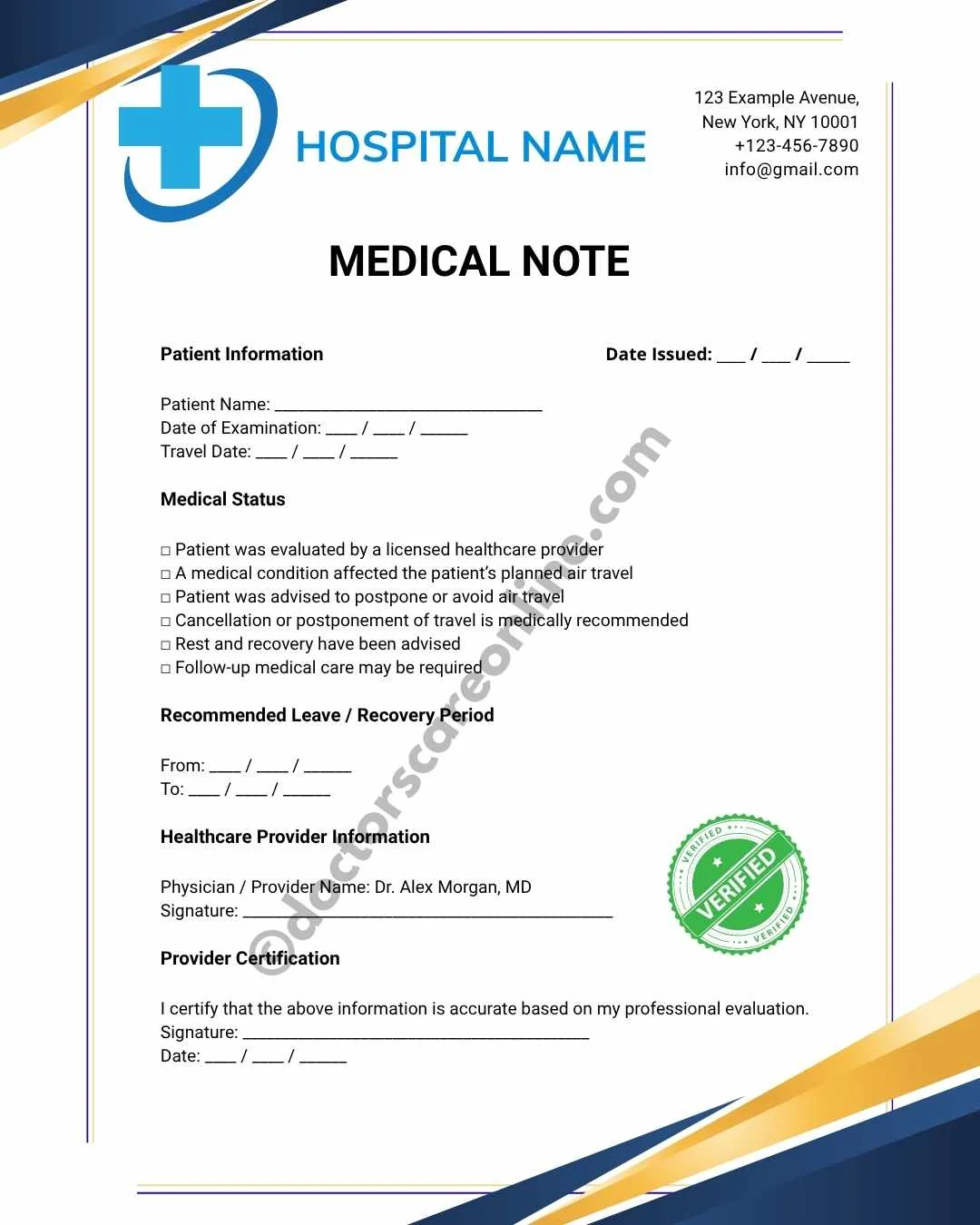
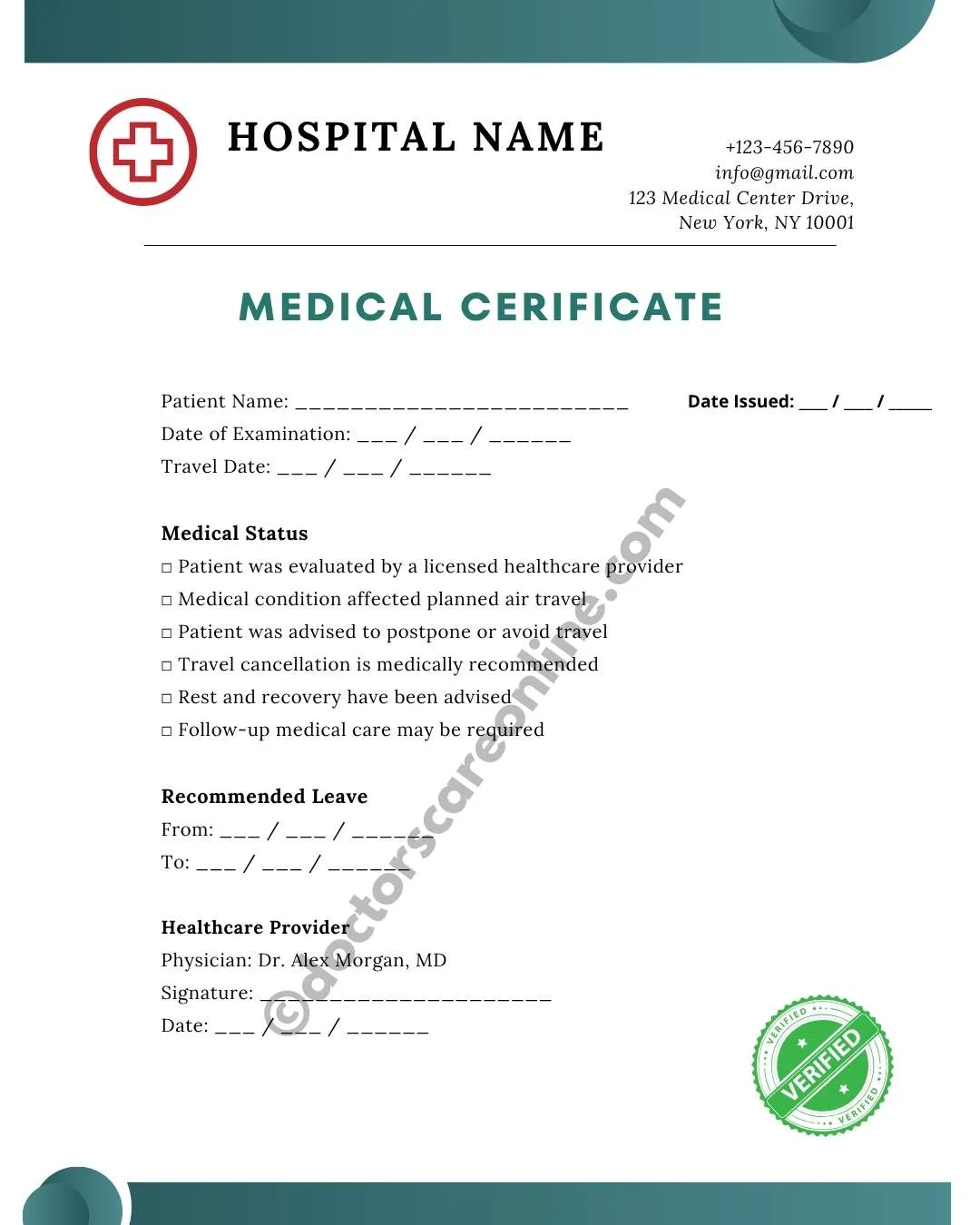
A doctor’s note for an airline refund is an official medical document issued by a licensed healthcare provider confirming that a passenger is medically unable to travel due to an illness, injury, surgery, pregnancy-related condition, or another health concern. Depending on the airline’s policy, this document may support a request for a ticket refund, flight cancellation, travel credit, waiver of change fees, or reimbursement through travel insurance.
Unexpected medical emergencies can happen before a scheduled trip, making it unsafe or impossible to fly. In these situations, many airlines may consider refund or ticket-change requests when passengers provide appropriate medical documentation. While a doctor’s note does not automatically guarantee a refund, it can strengthen your claim by verifying that the cancellation was medically necessary.
What Is a Doctor’s Note for an Airline Refund?
A doctor’s note for an airline refund is a medical certificate confirming that a passenger has been evaluated by a licensed healthcare professional and is temporarily unable to travel because of a medical condition. The document explains that flying could delay recovery, worsen symptoms, or pose health risks, making travel medically inadvisable.
Unlike a general sick note for work or school, an airline medical certificate is typically used to support requests for:
- Flight ticket refunds
- Flight cancellation due to illness
- Travel credits
- Change fee waivers
- Flight rescheduling
- Travel insurance reimbursement
- Refund requests for non-refundable tickets (where permitted by airline policy)
The note usually includes the date of evaluation, the healthcare provider’s recommendation, the expected period during which travel should be avoided, and the provider’s credentials. It generally does not need to disclose detailed medical information unless the passenger chooses to provide additional documentation or the airline specifically requests it.
Common Situations Where a Doctor’s Note for an Airline Refund May Be Needed
| Situation | Why a Doctor’s Note May Be Required |
|---|---|
| Sudden Illness Before Departure | Confirms that the passenger is medically unfit to fly. |
| Hospitalization | Verifies that hospitalization prevented travel. |
| Recent Surgery | Explains that flying could interfere with recovery. |
| Pregnancy Complications | Supports cancellation when travel is considered medically unsafe. |
| Infectious Disease | Confirms that the passenger should avoid travel to reduce transmission risk. |
| Serious Injury | Documents mobility limitations or medical restrictions. |
| Medical Emergency | Provides evidence of an unexpected health condition requiring cancellation. |
| Child’s Illness | Supports refund requests when a dependent is too ill to travel. |
| Elderly Passenger’s Medical Condition | Verifies that travel may worsen existing health problems. |
| Travel Insurance Claim | Serves as supporting medical documentation for reimbursement. |
Typical Refund Processing Timeline
Processing times vary depending on the airline, payment method, and complexity of the medical review.
| Stage | Typical Time |
|---|---|
| Submit Refund Request | Same day |
| Airline Acknowledges Request | 1–3 business days |
| Medical Documentation Review | 3–14 business days |
| Additional Information Request (if needed) | Varies |
| Refund Approval or Decision | 1–4 weeks |
| Refund Issued to Original Payment Method | 5–14 business days after approval |
These timeframes are estimates and may vary by airline and country.
Common Mistakes That Delay Airline Refund Approval
Avoid these common errors when submitting your request.
- Waiting too long to notify the airline
- Missing the airline’s refund deadline
- Uploading blurry or incomplete documents
- Submitting an unsigned doctor’s note
- Incorrect booking reference number
- Missing travel dates
- Providing inconsistent passenger information
- Editing or altering medical documents
- Forgetting to include supporting medical records when requested
- Ignoring follow-up requests from the airline
Taking a few minutes to review your application before submission can help reduce delays.
Airline Refund Policies for Medical Reasons
Many airlines review refund requests on a case-by-case basis when a passenger cannot travel because of a medical condition. While some carriers may offer a full refund, others may provide a travel credit, waive change fees, or allow flight rescheduling. The outcome depends on factors such as the ticket type, fare rules, timing of the cancellation, and the medical documentation provided.
Because airline policies can change over time, always review the official refund policy before submitting your request.
Airline Refund vs. Travel Insurance Claim
Some passengers qualify for reimbursement through travel insurance rather than directly from the airline. Understanding the difference can help you choose the correct claim process.
| Airline Refund | Travel Insurance Claim |
|---|---|
| Submitted directly to the airline | Submitted to your insurance provider |
| Governed by airline fare rules | Governed by your insurance policy |
| May provide a cash refund, travel credit, or voucher | May reimburse eligible prepaid travel expenses |
| Usually requires airline documentation | Usually requires medical records and supporting documents |
| Decision made by the airline | Decision made by the insurance company |
If you purchased travel insurance, review your policy carefully to determine whether illness-related trip cancellation is covered.
Can Family Members Receive a Refund?
In some situations, airlines may consider refund or travel credit requests for accompanying family members if one passenger becomes medically unable to travel.
Examples may include:
- A parent traveling with a sick child
- A caregiver accompanying an ill passenger
- A spouse traveling with someone who has been hospitalized
- A companion required to assist a medically restricted traveler
Approval depends on the airline’s policy, the relationship between travelers, and the supporting documentation provided.
Can You Receive a Refund for a Non-Refundable Ticket?
Some passengers purchase non-refundable airline tickets believing there is no possibility of recovering their money. While fare rules generally limit refunds, certain airlines may review requests involving serious medical circumstances.
A medical emergency does not automatically convert a non-refundable ticket into a refundable one. However, depending on the airline’s policies, you may qualify for:
- Partial refund
- Travel credit
- Flight voucher
- Change fee waiver
- Flight rescheduling
Each request is reviewed individually.
When Might an Airline Deny a Medical Refund Request?
A doctor’s note supports your request but does not guarantee approval. Airlines may decline refund requests for several reasons.
Common reasons include:
- Ticket purchased under a non-refundable fare with no applicable exception
- Insufficient medical documentation
- Missing healthcare provider information
- Cancellation submitted after the flight departed
- Failure to meet refund deadlines
- Altered or incomplete medical documents
- Medical documentation that does not support travel restrictions
- Failure to comply with airline refund procedures
If your request is denied, you may still qualify for a travel credit or reimbursement through travel insurance, depending on your coverage.
Tips to Improve Your Refund Approval Chances
Although every airline has different policies, these best practices can improve the likelihood of a successful claim.
- Seek medical care immediately after symptoms develop.
- Request a doctor’s note from a licensed healthcare provider.
- Contact the airline before your scheduled departure whenever possible.
- Submit all requested documents together.
- Keep copies of your medical records and correspondence.
- Ensure your doctor’s note is signed and dated.
- Explain your situation clearly and honestly.
- Follow up if additional documentation is requested.
- Review your fare conditions before submitting the request.
Medical Documentation Comparison
Different travel situations may require different types of medical documentation.
Yes. Many licensed telehealth providers offer virtual medical consultations for patients who are unable to visit a clinic in person. If a healthcare provider determines that you are medically unfit to travel, they may issue a doctor’s note or medical certificate when appropriate.
Receiving an online consultation does not automatically guarantee that a doctor’s note will be issued. The decision depends on the healthcare provider’s clinical judgment and applicable regulations.
How to Book an Online Doctor’s Appointment
Step 1: Choose a Licensed Telehealth Provider
Select a reputable telehealth service that offers consultations with licensed healthcare professionals.
Step 2: Create Your Patient Account
Register using your:
- Full name
- Email address
- Phone number
- Date of birth
Some providers may also request your medical history.
Step 3: Schedule a Consultation
Choose:
- General consultation
- Primary care
- Urgent care
Book a date and time that works for you.
Step 4: Explain Your Symptoms
Be prepared to discuss:
- Current illness or injury
- Symptoms
- Recent surgery
- Hospitalization
- Pregnancy-related concerns (if applicable)
- Current medications
- Planned travel date
Honest and accurate information helps the healthcare provider make an informed medical assessment.
Step 5: Attend the Virtual Consultation
Join your appointment using:
- Smartphone
- Tablet
- Laptop
- Desktop computer
The healthcare provider may ask follow-up questions to determine whether flying is medically appropriate.
Step 6: Receive Your Medical Documentation
If medically appropriate, your documentation may be delivered through:
- Secure patient portal
- Mobile application
- Printable PDF
Review the document before submitting it to the airline.
What Happens After You Submit Your Request?
Once your request has been submitted, the airline will review:
- Your booking details
- Fare conditions
- Medical documentation
- Refund eligibility
- Applicable travel policies
The airline may:
- Approve a full refund
- Approve a partial refund
- Offer a travel credit
- Waive change fees
- Reschedule your flight
- Request additional documentation
- Deny the request if eligibility requirements are not met
Keep copies of all submitted documents until your request has been resolved.
Frequently Asked Questions
Q: Can I Use a Telehealth Doctor’s Note?
A: Yes, Many airlines accept documentation issued by licensed telehealth providers, provided it meets their documentation requirements. However, acceptance varies by airline and country.
Before submitting your claim:
- Review your airline’s refund policy.
- Confirm whether telehealth documentation is accepted.
- Ensure the note includes the healthcare provider’s credentials and contact information.
Q: Can I Get a Refund for a Non-Refundable Airline Ticket?
A: Possibly. While non-refundable tickets generally cannot be refunded, some airlines may review requests involving serious medical circumstances. Depending on the fare rules, they may offer a travel credit, voucher, or other accommodation instead of a cash refund.
Q: How Long Does an Airline Refund Take?
A: Processing times vary. Many airlines review medical refund requests within 1 to 4 weeks, though complex cases or requests for additional documentation may take longer.
Q: Can I Appeal a Denied Refund Request?
A: Yes. If your request is denied, you may contact the airline to ask whether additional medical documentation or clarification could support a new review. Some travelers may also be eligible to file a claim through their travel insurance provider.
Q: Does Travel Insurance Cover Flight Cancellations Due to Illness?
Many travel insurance policies include trip cancellation coverage for unexpected illness, but benefits vary. Review your policy terms to confirm eligibility, documentation requirements, exclusions, and claim deadlines.
Medical Disclaimer
This article is provided for informational and educational purposes only and should not be considered medical, legal, or travel advice. It does not replace an evaluation by a licensed healthcare professional. A doctor’s note or medical certificate should only be issued after an appropriate medical assessment. Airline refund decisions are made solely by the airline based on its policies, fare conditions, and the documentation submitted. If you experience a medical emergency, seek immediate medical attention or contact your local emergency services.
Related Doctor’s Note Templates
You may also find these medical templates helpful:





Reviews
There are no reviews yet.