
A Patient First Doctor’s Note for Work may refer to medical documentation confirming that an employee was evaluated by a healthcare professional and may be able to return to work, remain off work temporarily, or resume work with specific restrictions. For an e-commerce or online healthcare service, the appropriate process is to connect patients with a licensed healthcare provider for a medical evaluation before any work-related documentation is issued.
A doctor’s note for work can be requested after an illness, injury, surgery, medical treatment, or other health condition that affects an employee’s ability to perform normal job duties. Depending on the individual’s condition and workplace requirements, documentation may include a recommended return date, work restrictions, modified duties, or other medically appropriate information.
Why Do You Need a Patient First Doctor’s Note for Work?
Employers may request medical documentation when an employee has been absent because of an illness or injury or when the employee needs workplace restrictions.
Common reasons include:
- Medical Absence: An employee may need documentation after missing work because of an illness, injury, or other medical condition.
- Return After Illness: Some workplaces may request medical documentation before an employee resumes certain duties after an illness.
- Return After Injury: An employee recovering from an injury may need a return-to-work medical note indicating whether regular or modified duties are appropriate.
- Surgery or Medical Procedure: Recovery following surgery or another procedure may require temporary restrictions or additional time away from work.
- Light-Duty Work: A healthcare professional may recommend modified duties when an employee can work but cannot safely perform certain physical tasks.
- Physically Demanding Jobs: Employees who lift, carry, drive, climb, stand for extended periods, or perform repetitive movements may require an assessment before returning to full duties.
- Employer Documentation Requirements: Some employers have specific policies regarding sick leave, medical clearance, fitness-for-duty documentation, or workplace accommodations.
What Can an Online Medical Note for Work Include?
The information included depends on the healthcare professional’s evaluation and the employer’s legitimate documentation requirements.
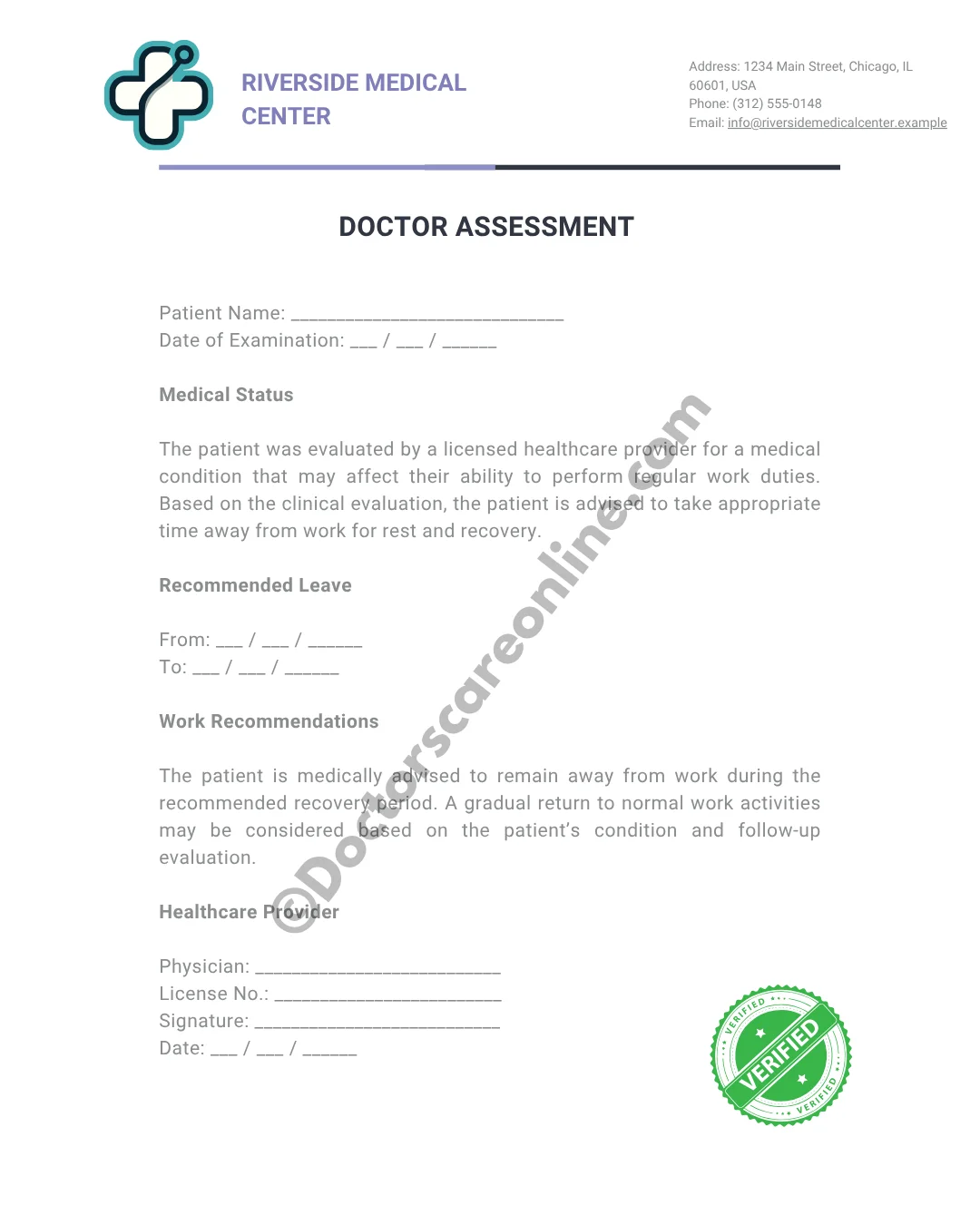
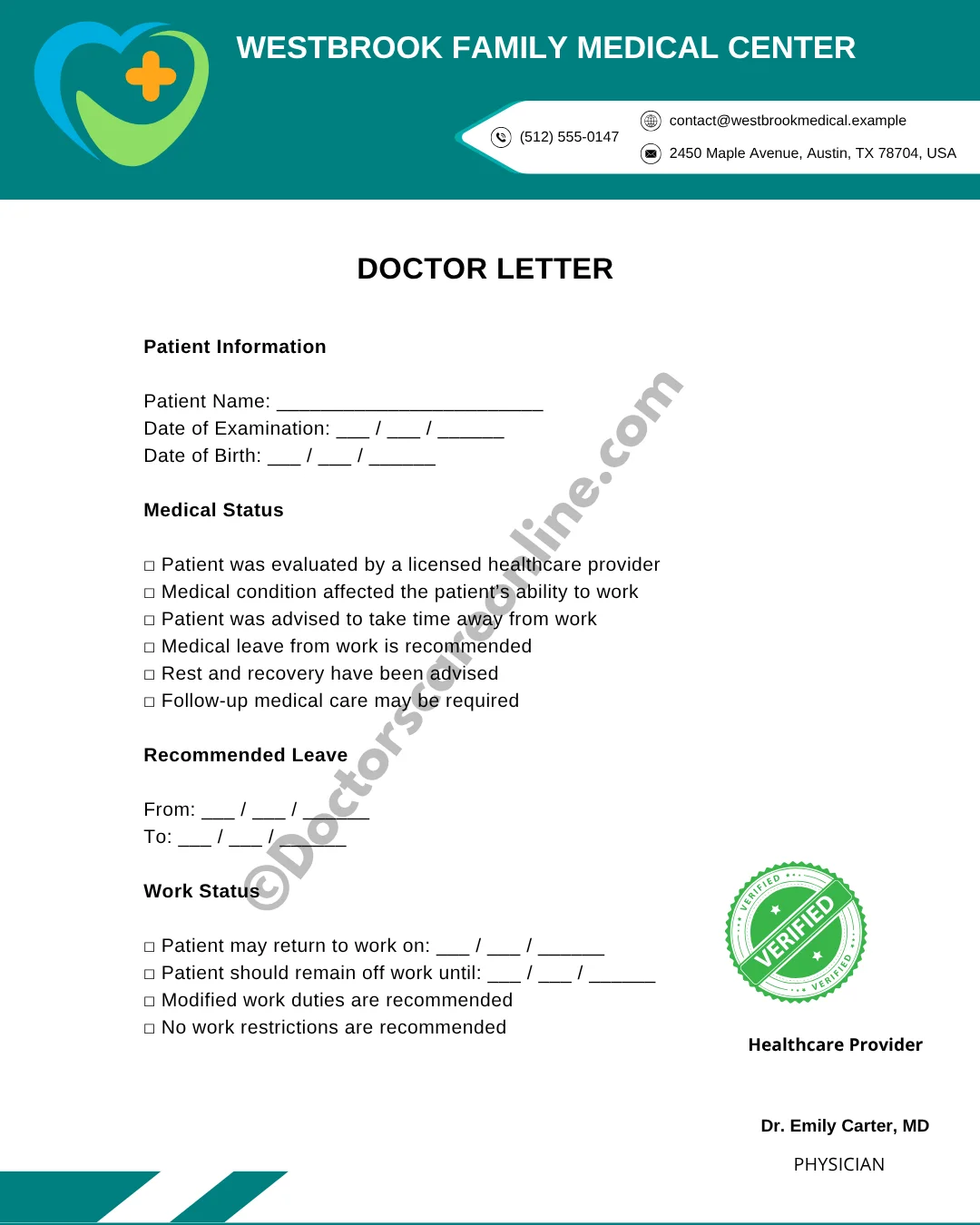
A work medical note may include:
| Information | Purpose |
|---|---|
| Patient name | Identifies the individual |
| Date of evaluation | Confirms when the patient was assessed |
| Work status | Indicates whether work is appropriate |
| Return date | Provides the recommended date for resuming work |
| Restrictions | Identifies temporary limitations |
| Modified duties | Describes medically appropriate work adjustments |
| Follow-up instructions | Indicates whether another evaluation is needed |
| Provider information | Identifies the healthcare professional |
| Signature or authentication | Verifies the medical documentation |
A medical note does not necessarily need to disclose a detailed diagnosis. The provider determines what information is appropriate based on the patient’s circumstances and applicable requirements.
Can You Get a Doctor’s Note for Work Online?
In many situations, telehealth may be an option for an appropriate medical evaluation, depending on the patient’s condition, location, provider availability, and applicable rules.
During an online appointment, a healthcare professional may review:
- Your current symptoms
- Medical history
- Recent illness or injury
- Treatment and medications
- Recovery progress
- Functional limitations
- Job responsibilities
- Employer documentation requirements
Telehealth is not suitable for every condition. If a physical examination, diagnostic testing, or additional assessment is necessary, the provider may recommend an in-person appointment.
U.S. Health Resources & Services Administration guidance recommends preparing relevant questions, medications, allergies, and other health information before a telehealth visit.
How to Get an Online Doctor’s Note for Work
Getting legitimate medical documentation online generally involves a healthcare evaluation rather than simply purchasing a document.
1. Check Your Employer’s Requirements
Review your workplace policy to determine whether you need a doctor’s note, return-to-work clearance, fitness-for-duty documentation, or information about temporary restrictions.
2. Choose a Licensed Healthcare Provider
Select a legitimate healthcare provider or telehealth service that is authorized to provide care in your location.
3. Book an Online Appointment
Choose an available consultation time and provide the information requested during registration.
4. Prepare Your Medical Information
Be ready to discuss your symptoms, medical history, medications, treatment, recovery progress, and any relevant previous diagnosis.
5. Explain Your Job Duties
Tell the provider what your work involves, particularly if your position requires lifting, driving, prolonged standing, physical activity, repetitive movements, or operating equipment.
6. Complete the Medical Evaluation
The provider will determine whether your condition can be appropriately assessed through telehealth and whether you are medically fit for work.
7. Discuss Restrictions if Necessary
If you can work but have temporary limitations, the provider may recommend modified duties or other restrictions when medically appropriate.
8. Receive Documentation if Medically Appropriate
If the provider determines that a work note or other medical documentation is justified, they may issue it according to applicable professional and legal requirements.
9. Submit the Documentation
Provide the note to your employer using the company’s required process, such as HR, a manager, employee portal, or secure document system.
What Should You Have Ready for an Online Work Note Appointment?
Preparing information before your consultation can make the appointment easier and more efficient.
Have these details available:
- Reason for your medical absence
- Date symptoms started
- Current symptoms
- Date you last worked
- Treatment received
- Current medications
- Relevant medical history
- Recent procedures or surgery
- Job title and primary responsibilities
- Physical requirements of your job
- Expected return date
- Employer’s documentation requirements
- Any requested work restrictions or forms
During a telehealth visit, use a private location and avoid participating while driving. HHS guidance also recommends keeping information about medications, allergies, questions, and other relevant health details available for the appointment.
Return-to-Work Note vs. Sick Note vs. Fit-for-Work Note
These terms are sometimes used interchangeably, but their meaning can vary by location and employer.
- Doctor’s Note for Work: A general term for medical documentation supporting an employee’s absence, work restrictions, or return to work.
- Sick Note: Often used to describe documentation confirming that a person is unable to work because of a medical condition.
- Return-to-Work Note: Documentation relating specifically to an employee’s ability to resume employment following illness, injury, or medical leave.
- Fit-for-Work or Fitness-for-Duty Note: Documentation concerning whether an employee is medically capable of performing particular work duties.
The terminology and legal requirements differ between jurisdictions. For example, official UK guidance uses the term “fit note” and distinguishes between being unfit for work and being potentially fit with support.
Can a Doctor Put Work Restrictions on a Medical Note?
Yes. When medically appropriate, a healthcare provider may recommend temporary restrictions based on the patient’s condition and functional abilities.
Possible restrictions may include:
- No heavy lifting
- Limited lifting weight
- Reduced repetitive movements
- Limited bending or twisting
- Reduced prolonged standing
- Limited walking
- Additional rest breaks
- Modified job duties
- Reduced physical activity
- Gradual return to normal duties
The restrictions should be based on the healthcare professional’s assessment rather than simply requested by the employee.
What Is a Return-to-Work Clearance?
A return-to-work clearance is documentation or medical advice indicating that an employee may resume work after an illness, injury, surgery, or other health-related absence.
Depending on the situation, the provider may recommend:
- Full return to regular duties
- Return with temporary restrictions
- Modified or light-duty work
- Additional recovery time
- Follow-up evaluation before resuming unrestricted duties
Some employers have specific return-to-work procedures, so employees should check their workplace requirements before scheduling an evaluation.
How Long Is a Doctor’s Note for Work Valid?
There is no single validity period that applies to every doctor’s note.
The documentation may specify:
- A particular date of return
- A period of medical leave
- A temporary restriction period
- A date for reassessment
- A gradual return-to-work schedule
The appropriate duration depends on the medical condition, recovery, job duties, provider’s assessment, and applicable workplace requirements.
If your condition changes, contact your healthcare provider for reassessment instead of changing the original note yourself.
Can an Employer Reject a Doctor’s Note?
An employer may have specific policies governing medical documentation, leave, return-to-work procedures, and workplace accommodations.
Employers may request clarification or additional documentation where permitted by applicable rules. A doctor’s note also does not necessarily override an employer’s legitimate workplace procedures.
Because requirements vary, employees should check their employee handbook or speak with HR if they are unsure what documentation is required.
Online Medical Note and Privacy
Medical information is sensitive, so patients should use legitimate healthcare services and secure communication methods.
When using telehealth:
- Use a private location.
- Avoid public Wi-Fi when sharing sensitive health information.
- Use a secure patient portal when available.
- Confirm that you are communicating with the legitimate healthcare provider.
- Avoid sharing unnecessary medical information through unsecured channels.
HHS guidance recommends secure telehealth practices and emphasizes privacy and protection of health information.
What You Should Never Do With a Doctor’s Note
For legitimate medical documentation, never:
- Create a fake doctor’s note
- Purchase documentation without a medical evaluation
- Change the dates on a medical document
- Add a diagnosis that was not provided
- Alter work restrictions
- Change a provider’s signature
- Misrepresent your medical condition
- Submit documentation that does not accurately represent your healthcare encounter
A legitimate work note should reflect an actual healthcare evaluation and the provider’s professional judgment.
When Should You Seek Urgent Medical Care?
A work note should never replace necessary medical treatment.
Seek urgent or emergency medical attention when you have serious symptoms such as:
- Severe difficulty breathing
- Chest pain
- Loss of consciousness
- Sudden severe weakness
- New confusion
- Severe symptoms after a serious accident
- Uncontrolled bleeding
- Other symptoms that may indicate a medical emergency
If you believe you have a medical emergency, seek appropriate emergency care instead of waiting for an online appointment.
Why Choose a Licensed Online Healthcare Provider?
A legitimate online medical service should prioritize clinical evaluation, patient safety, privacy, and appropriate documentation.
Look for a service that:
- Connects you with licensed healthcare professionals
- Clearly explains how consultations work
- Provides transparent pricing
- Protects patient information
- Explains telehealth limitations
- Does not guarantee documentation before an evaluation
- Provides appropriate follow-up guidance
- Uses secure methods for delivering medical information
These factors help distinguish a legitimate healthcare service from websites offering documentation without appropriate medical assessment.
Patient First Doctor’s Note for Work – Key Takeaways
A Patient First Doctor’s Note for Work search may reflect a need for a work excuse, medical note, return-to-work documentation, or online healthcare evaluation.
A legitimate process should involve:
Online appointment → Medical evaluation → Provider’s assessment → Appropriate work recommendation → Medical documentation when justified
The provider may recommend full-duty work, modified duties, temporary restrictions, or additional recovery depending on the patient’s condition.
Always check your employer’s documentation requirements before your appointment and provide accurate medical information to the healthcare professional.
Frequently Asked Questions
1. Can I get a Patient First doctor’s note for work online?
A: If you are referring to an online medical note, you generally need an evaluation by an appropriately licensed healthcare professional. Whether telehealth is suitable and whether documentation can be issued depends on your medical condition, location, provider, and applicable requirements. Patient First’s own current telehealth information states that its telehealth service does not handle work injuries or other employer services, so patients should not assume that every Patient First service provides online work documentation.
2. Can I get a doctor’s note for work the same day online?
A: A same-day medical appointment may be available through some online healthcare services, but a same-day doctor’s note is not guaranteed.
The healthcare provider must first determine whether:
- The patient can be appropriately evaluated.
- The medical condition supports the requested documentation.
- Telehealth is suitable for the situation.
- Any required work restrictions can be assessed safely.
If an in-person examination is necessary, the provider may recommend an in-person visit instead.
3. Does a Doctor’s Note for Work Include Your Diagnosis?
A: Not necessarily. A medical note may focus on information relevant to employment, such as:
- Confirmation of medical evaluation
- Recommended leave period
- Return-to-work date
- Temporary restrictions
- Modified-duty recommendations
Whether a diagnosis is included depends on the circumstances, provider, employer requirements, and applicable privacy rules. Patients can ask their healthcare provider what information will appear on the documentation.
4. Can a doctor give me a return-to-work note with restrictions?
A: Yes. When medically appropriate, a healthcare provider may recommend temporary restrictions such as avoiding heavy lifting, reducing physical activity, limiting prolonged standing, or performing modified duties.
5. Is an online doctor’s note for work legitimate?
A: A legitimate medical note should be based on an actual evaluation by an appropriately licensed healthcare professional. Online documentation should accurately reflect the healthcare encounter and the provider’s clinical assessment. A document obtained without a legitimate medical evaluation should not be represented as authentic medical documentation.
Medical Disclaimer: This content is provided for general educational and informational purposes only. It is not a substitute for professional medical advice, diagnosis, or treatment.
A doctor’s note, work excuse, return-to-work clearance, or medical certificate should only be issued by an appropriately licensed healthcare professional following an appropriate medical evaluation. Telehealth availability and documentation requirements vary by location, healthcare provider, employer, occupation, and individual circumstances.
Related Post :—–
Reviews
There are no reviews yet.