
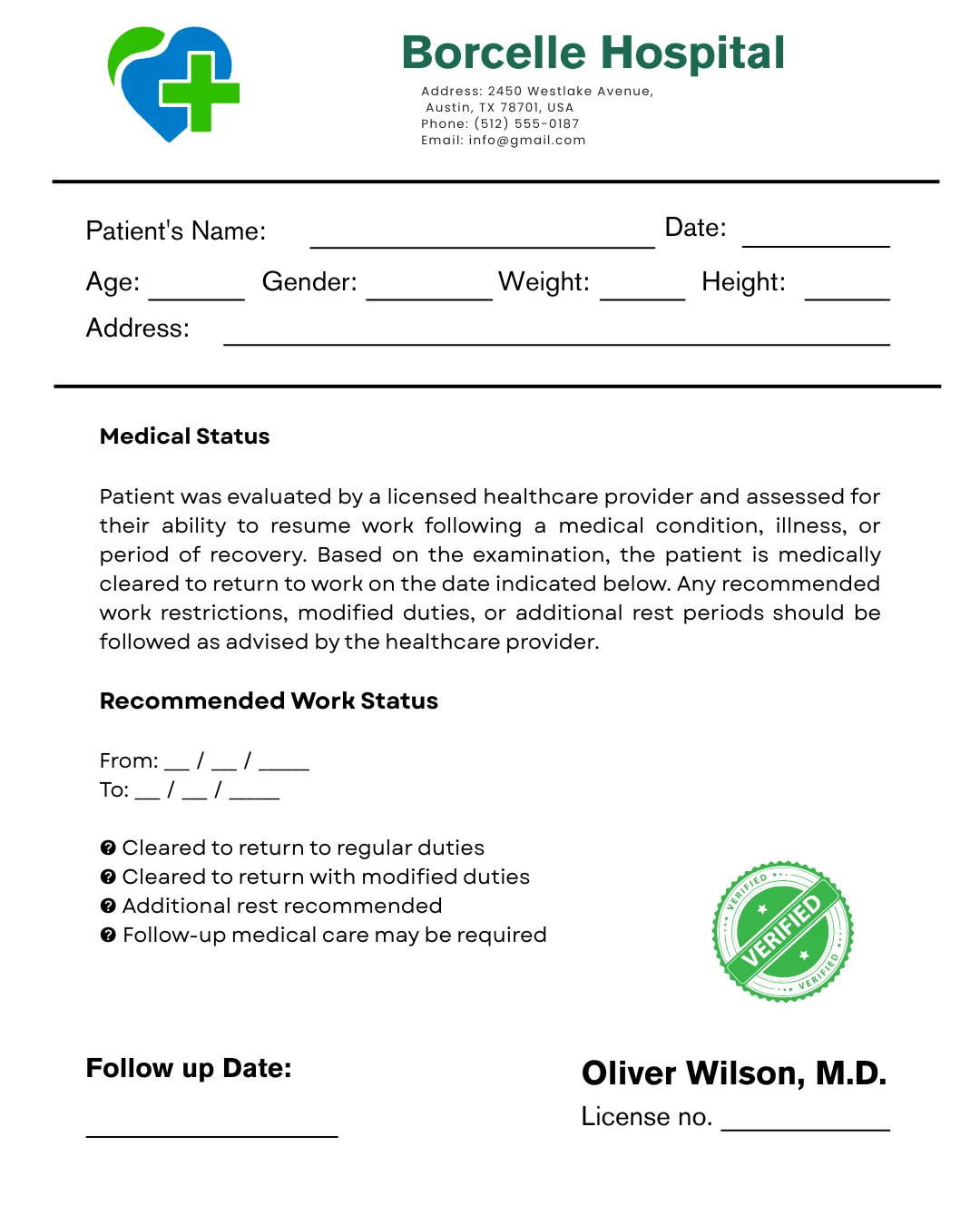
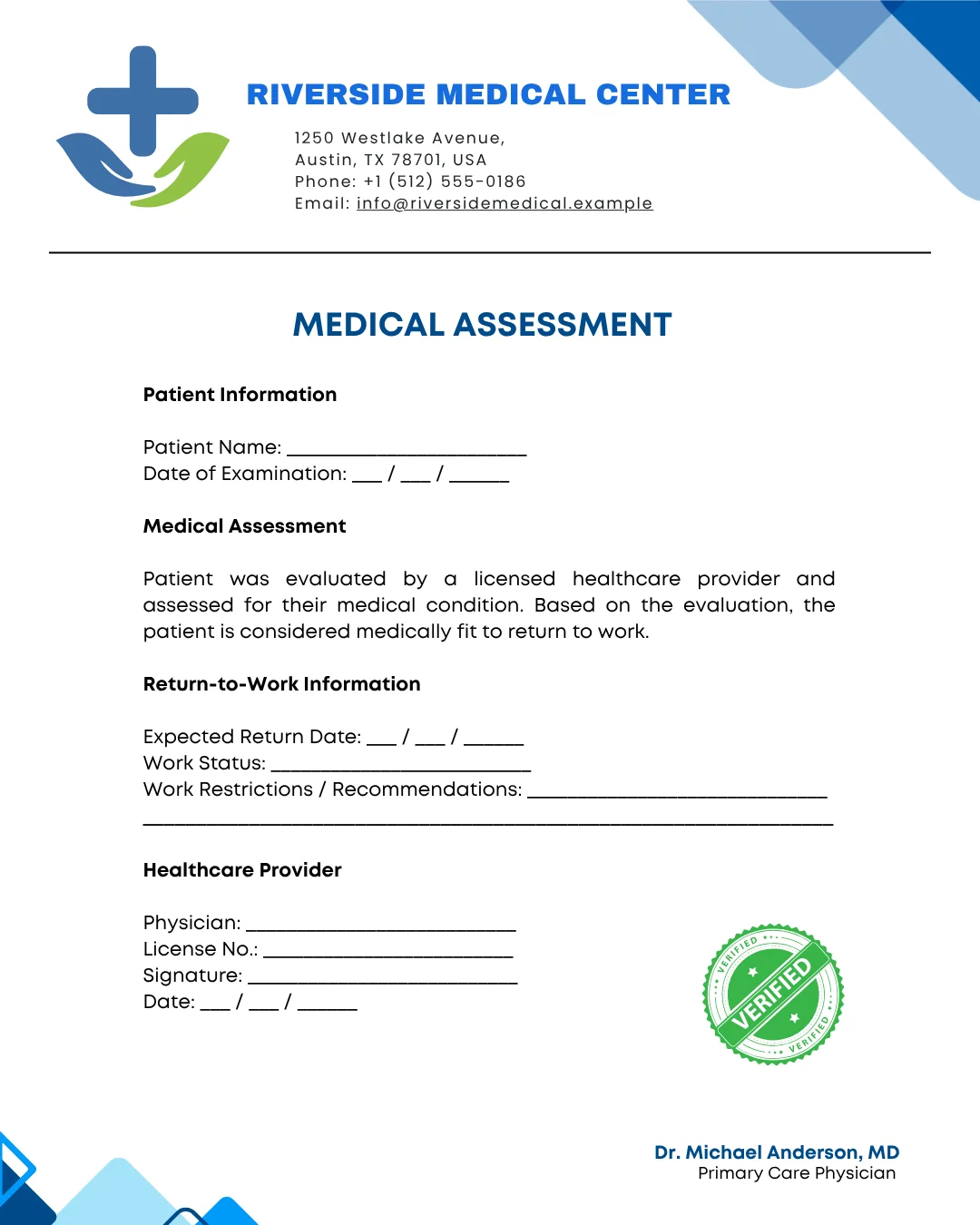
A return to work doctor’s note is medical documentation provided by a licensed healthcare professional after evaluating an employee’s health condition and ability to safely resume work. Depending on the situation, the note may confirm that an employee can return to work, specify a recommended return date, or outline temporary work restrictions or modified duties.
Employees may need a doctor’s note for returning to work after an illness, injury, surgery, medical procedure, hospitalization, or other health-related absence. Some employers may also require medical clearance before an employee returns to certain physically demanding or safety-sensitive duties.
A healthcare provider determines whether a patient is medically fit to return to work based on their symptoms, diagnosis when relevant, recovery progress, job responsibilities, and individual circumstances. A return-to-work note should only be issued when medically appropriate following an evaluation.
What Is a Return to Work Doctor’s Note?
A return to work doctor’s note is a medical document that communicates information about an employee’s ability to resume employment following a period of illness, injury, or medical treatment.
Depending on the patient’s condition and workplace requirements, the documentation may indicate:
- The date the employee was medically evaluated
- The recommended return-to-work date
- Whether the employee can resume regular duties
- Temporary work restrictions
- Recommended modified or light-duty work
- Limitations involving lifting, standing, walking, bending, or other activities
- Whether a follow-up appointment is recommended
- Healthcare provider and clinic information
A return-to-work note does not necessarily need to disclose detailed medical information. The amount of information included depends on the healthcare provider’s judgment, applicable requirements, and the documentation requested by the employer.
When Do You Need a Return to Work Doctor’s Note?
A return-to-work medical note may be requested after an employee has been away from work because of a medical condition or injury.
Common situations include:
- After an Illness: An employee may need documentation confirming that they have been medically evaluated and can safely resume their regular duties after recovering from an illness.
- After an Injury: A healthcare provider may recommend a specific return date or temporary restrictions following an injury that affected the employee’s ability to work.
- After Surgery: Recovery following surgery may require temporary work restrictions, reduced activity, or a gradual return to normal duties.
- After Hospitalization: An employee returning after hospitalization may require medical clearance or documentation describing any necessary workplace limitations.
- After a Workplace Injury: Employees recovering from workplace injuries may require documentation regarding their ability to return to their normal job or perform modified duties.
- After a Prolonged Medical Absence: Some employers may request a doctor’s note after an extended absence before allowing an employee to resume work.
- When the Job Is Physically Demanding: Employees whose work involves heavy lifting, climbing, repetitive movement, driving, prolonged standing, or other physical activities may need medical assessment before returning.
- When Workplace Policies Require Medical Documentation: Some organizations have internal policies requiring medical documentation after certain types or lengths of medical leave.
What Information Is Included in a Return to Work Doctor’s Note?
The exact information varies depending on the healthcare provider, medical situation, and employer requirements.
A return-to-work medical note may include:
| Information | Purpose |
|---|---|
| Patient’s name | Identifies the employee |
| Examination date | Confirms when the medical evaluation occurred |
| Return-to-work date | Indicates when the employee may resume work |
| Work status | Indicates whether regular or modified duties are appropriate |
| Restrictions | Describes temporary limitations when medically necessary |
| Follow-up instructions | Indicates whether additional evaluation may be needed |
| Provider information | Identifies the licensed healthcare professional or clinic |
| Provider signature | Authenticates the medical documentation where required |
The provider generally determines what medical information is necessary. Employees should avoid adding, removing, or changing information on medical documentation after it has been issued.
Full Duty vs. Modified Duty Return to Work
A healthcare provider may recommend either a full return to work or a temporary modified-duty arrangement depending on the employee’s condition.
Full Duty
A full-duty return generally means the employee can resume their usual job responsibilities without medically necessary restrictions.
Modified or Light Duty
Modified duty may be recommended when an employee can work but temporarily needs changes to certain responsibilities.
Possible restrictions may include:
- No heavy lifting
- Reduced lifting limits
- Limited repetitive bending or twisting
- Reduced prolonged standing
- Limited walking
- Additional rest or movement breaks
- Reduced physical activity
- Temporary changes to job responsibilities
- Reduced working hours when clinically appropriate
The restrictions should be based on the healthcare provider’s assessment rather than the employee’s preference alone.
What Is a Fit-to-Work or Fitness-for-Duty Note?
A fit-to-work note, return-to-work clearance, or fitness-for-duty note may be used to document an employee’s ability to resume employment after a medical absence.
The terminology varies between employers and healthcare settings.
Depending on the situation, the documentation may communicate that an employee:
- Can return to regular duties
- Can return with temporary restrictions
- Can perform modified duties
- Should remain away from work temporarily
- Requires additional medical evaluation before returning
The employer may have specific requirements regarding the information that must appear in the documentation.
How to Get an Online Return to Work Doctor’s Note
The appropriate way to obtain a return-to-work doctor’s note is through an evaluation by a licensed healthcare provider.
- Check Your Employer’s Requirements: Find out whether your employer needs a return-to-work note, fitness-for-duty certificate, or details about temporary work restrictions.
- Choose a Licensed Healthcare Provider: Book an appointment with a qualified doctor, clinic, urgent care center, or telehealth provider that offers online consultations.
- Schedule an Online Appointment: Select a convenient date and time for a video, phone, or virtual consultation, depending on the provider’s services.
- Provide Your Medical Information: Share details about your illness, injury, surgery, treatment, current symptoms, and recovery progress.
- Explain Your Job Duties: Tell the provider about your work responsibilities, especially if your job involves lifting, standing, driving, operating equipment, or other physical tasks.
- Complete the Medical Evaluation: The healthcare provider will assess whether you are medically fit to return to work and whether any restrictions are needed.
- Discuss Work Restrictions (If Needed): If appropriate, the provider may recommend light duty, lifting limits, reduced hours, or temporary modifications.
- Receive Your Return-to-Work Note: If medically justified, the provider may issue a digital return-to-work note or fitness-for-duty certificate. Documentation is often delivered by email, secure portal, or downloadable PDF.
- Submit the Note to Your Employer: Provide the documentation according to your company’s HR policy or return-to-work procedures.
- Follow Any Medical Recommendations: Continue treatment, attend follow-up appointments if needed, and follow any temporary restrictions until fully recovered.
Can You Get a Return to Work Doctor’s Note Online?
In many locations, telehealth may be an option for discussing a medical condition and evaluating whether a patient can safely return to work.
During an online medical appointment, the healthcare provider may ask about:
- Current symptoms
- Medical history
- Recent illness or injury
- Treatment received
- Recovery progress
- Medication
- Physical limitations
- Job responsibilities
- Employer documentation requirements
However, an online appointment does not automatically guarantee a return-to-work note. The healthcare provider must determine whether the condition can be appropriately assessed through telehealth and whether medical documentation is justified.
If an in-person physical examination, diagnostic testing, or additional assessment is necessary, the provider may recommend an in-person visit.
What to Prepare Before an Online Return-to-Work Appointment
Preparing relevant information can make your appointment more efficient and help the healthcare provider understand your situation.
Have the following information available:
- Date your symptoms began
- Date of your last working day
- Reason for your medical absence
- Current symptoms
- Previous medical treatment
- Medications you are taking
- Relevant medical records, if available
- Previous diagnosis or procedure information
- Your expected return date
- Your regular job responsibilities
- Physical requirements of your position
- Employer’s documentation requirements
- Any restrictions you believe your employer needs to know about
Provide accurate information throughout the consultation. Medical documentation should reflect the healthcare provider’s professional assessment.
Can a Doctor Put Restrictions on a Return-to-Work Note?
Yes. When clinically appropriate, a healthcare provider may recommend temporary restrictions based on an employee’s condition and functional abilities.
For example, a provider may recommend:
- Avoiding heavy lifting
- Limiting repetitive movements
- Avoiding prolonged standing
- Limiting prolonged sitting
- Avoiding strenuous physical activity
- Taking additional breaks
- Performing temporary light-duty work
- Reducing certain physical tasks
- Gradually increasing activity as recovery progresses
The specific restrictions and their duration should be determined by the healthcare provider.
How Long Is a Return-to-Work Doctor’s Note Valid?
There is no single universal validity period for every return-to-work doctor’s note.
The documentation may specify:
- A specific return date
- A period during which restrictions apply
- A date for reassessment
- A gradual return-to-work schedule
- A requirement for follow-up clearance
Employer policies and applicable laws may also affect how medical documentation is handled.
If your symptoms change or your recovery takes longer than expected, contact your healthcare provider for reassessment rather than changing the documentation yourself.
Can a Doctor Change or Update a Return-to-Work Date?
If your medical condition changes, your healthcare provider may reassess your situation and determine whether the original return date or restrictions should be updated.
For example, a provider may recommend additional recovery time if symptoms have not improved as expected or may remove restrictions when the employee has recovered sufficiently.
An updated medical note should come from the healthcare provider rather than being altered by the patient.
Return to Work After an Illness
Returning to work after an illness depends on the individual’s recovery and the nature of their job.
Before returning:
- Follow your healthcare provider’s recommendations.
- Make sure you understand any temporary restrictions.
- Communicate with your employer about your expected return.
- Ask whether modified duties are available if needed.
- Continue recommended treatment.
- Monitor for worsening or recurring symptoms.
- Attend follow-up appointments when advised.
Do not return to strenuous or safety-sensitive duties before you are medically ready.
Return to Work After an Injury
An injury may affect an employee’s ability to perform specific job duties even when the employee feels generally well enough to work.
For example, an employee recovering from an injury may temporarily have difficulty with:
- Lifting
- Carrying
- Walking
- Climbing
- Bending
- Reaching
- Standing
- Driving
- Repetitive physical movements
A healthcare provider can evaluate functional limitations and determine whether full duties, modified duties, or additional recovery time are appropriate.
Return to Work After Surgery
Recovery after surgery varies depending on the procedure, the individual’s health, complications, treatment plan, and job requirements.
A healthcare provider may recommend:
- Additional recovery time
- Temporary physical restrictions
- Modified duties
- Reduced activity
- A gradual return to work
- Follow-up evaluation before unrestricted duties
Employees should follow their surgeon’s or healthcare provider’s instructions rather than using a general recovery timeline as a substitute for personalized medical advice.
Can an Employer Require a Doctor’s Note?
Employer requirements vary by workplace, location, and applicable employment policies or laws.
An employer may have a policy requiring medical documentation after certain absences or before returning to specific types of work.
If you are unsure what documentation is required, check your employee handbook or contact your HR department before your appointment.
A healthcare provider can document medically appropriate information, but the employer determines how documentation is handled under its applicable policies and requirements.
Common Mistakes to Avoid
When requesting or submitting return-to-work documentation, avoid these common mistakes:
- Waiting until the last minute to check employer requirements
- Providing inaccurate medical information
- Assuming a doctor’s note is automatically guaranteed
- Altering medical documentation
- Using documentation that does not accurately reflect your medical evaluation
- Ignoring temporary work restrictions
- Returning to strenuous duties before being medically cleared
- Failing to notify your employer about an updated return date
- Assuming every employer accepts digital documentation
- Ignoring worsening symptoms because you have already received a return-to-work note
When Should You Seek Medical Attention Before Returning to Work?
Do not rely solely on workplace documentation if you are experiencing serious or worsening symptoms.
Seek prompt medical evaluation if you experience concerning symptoms such as:
- Severe or rapidly worsening pain
- Difficulty breathing
- Fainting or significant confusion
- New severe weakness
- Loss of bladder or bowel control
- Significant bleeding
- Severe symptoms following major trauma
- Other symptoms that your healthcare provider has identified as requiring urgent evaluation
For a medical emergency, seek appropriate emergency medical care rather than waiting for a routine appointment or return-to-work documentation.
Why Choose a Professional Online Medical Evaluation?
An online medical consultation can provide a convenient way to discuss certain health concerns with a licensed healthcare professional when telehealth is clinically appropriate.
Potential benefits include:
- Convenient appointment scheduling
- Remote access to healthcare
- Discussion of symptoms from home
- Professional medical assessment
- Guidance regarding recovery and work activity
- Medical documentation when clinically appropriate
Telehealth is not suitable for every medical condition. A healthcare provider may recommend an in-person evaluation when a physical examination, testing, or additional assessment is necessary.
Frequently Asked Questions
Q. Can I get a doctor’s note to return to work?
A licensed healthcare provider may issue return-to-work documentation when medically appropriate after evaluating your condition. The provider determines whether you can safely return and whether restrictions are necessary.
Q. Can I get a return-to-work note online?
Telehealth may be available for certain conditions and locations. If the provider determines that your condition can be appropriately evaluated remotely and documentation is medically justified, they may issue appropriate documentation where permitted.
Q. What is the difference between a fit-to-work note and a return-to-work note?
The terms may overlap. Both can describe medical documentation concerning an employee’s ability to resume work. The exact terminology and requirements vary by healthcare provider and employer.
Q. Can a doctor recommend light duty?
Yes. When medically appropriate, a healthcare provider may recommend temporary modified or light-duty work based on the employee’s condition and functional limitations.
Q. Does my return-to-work note need to include my diagnosis?
Not necessarily. The documentation may focus on work status, return dates, and restrictions. The exact information required varies depending on the circumstances and applicable requirements.
Q. How long does a return-to-work note last?
The duration depends on the dates and restrictions specified by the healthcare provider and any applicable workplace requirements. Additional evaluation may be needed if the employee does not recover as expected.
Q. Can a doctor change my return-to-work date?
A healthcare provider may update the recommended return date after reassessing your medical condition. Patients should not modify the original documentation themselves.
Q. What should I do if I am not ready to return to work?
Contact your healthcare provider for reassessment. They can determine whether additional recovery time, modified duties, or further treatment is medically appropriate.
Medical Disclaimer: This information is provided for general educational purposes and is not a substitute for professional medical advice, diagnosis, or treatment. A return-to-work doctor’s note should only be issued by a licensed healthcare professional following an appropriate medical evaluation. Medical documentation, telehealth availability, return-to-work requirements, and workplace restrictions may vary by location, employer, occupation, and individual circumstances.
Do not purchase, create, alter, or use medical documentation that does not accurately reflect a legitimate healthcare evaluation. If you have a serious or worsening medical condition, seek appropriate medical care rather than relying on documentation alone.
Related Post :—-
Reviews
There are no reviews yet.