

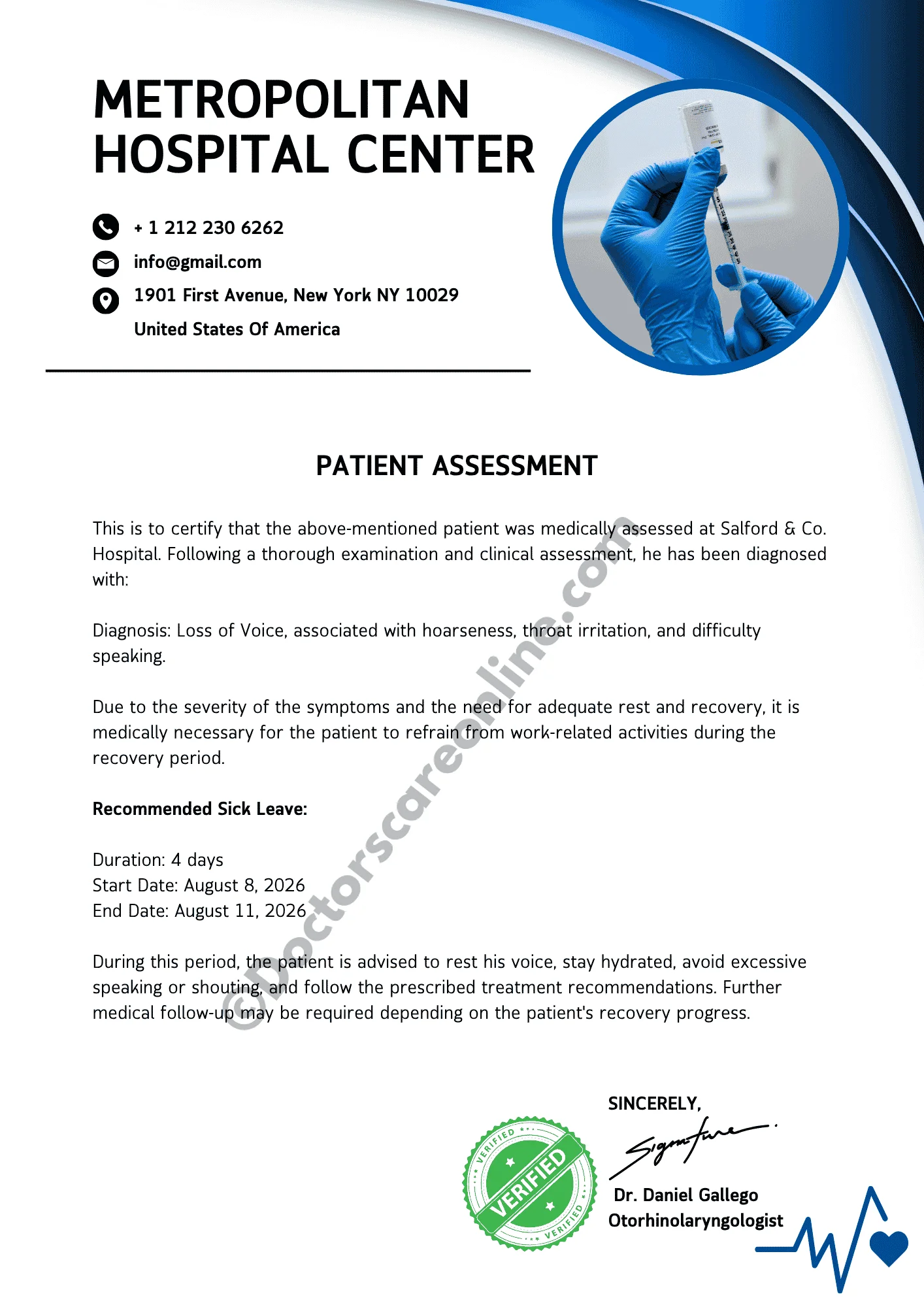
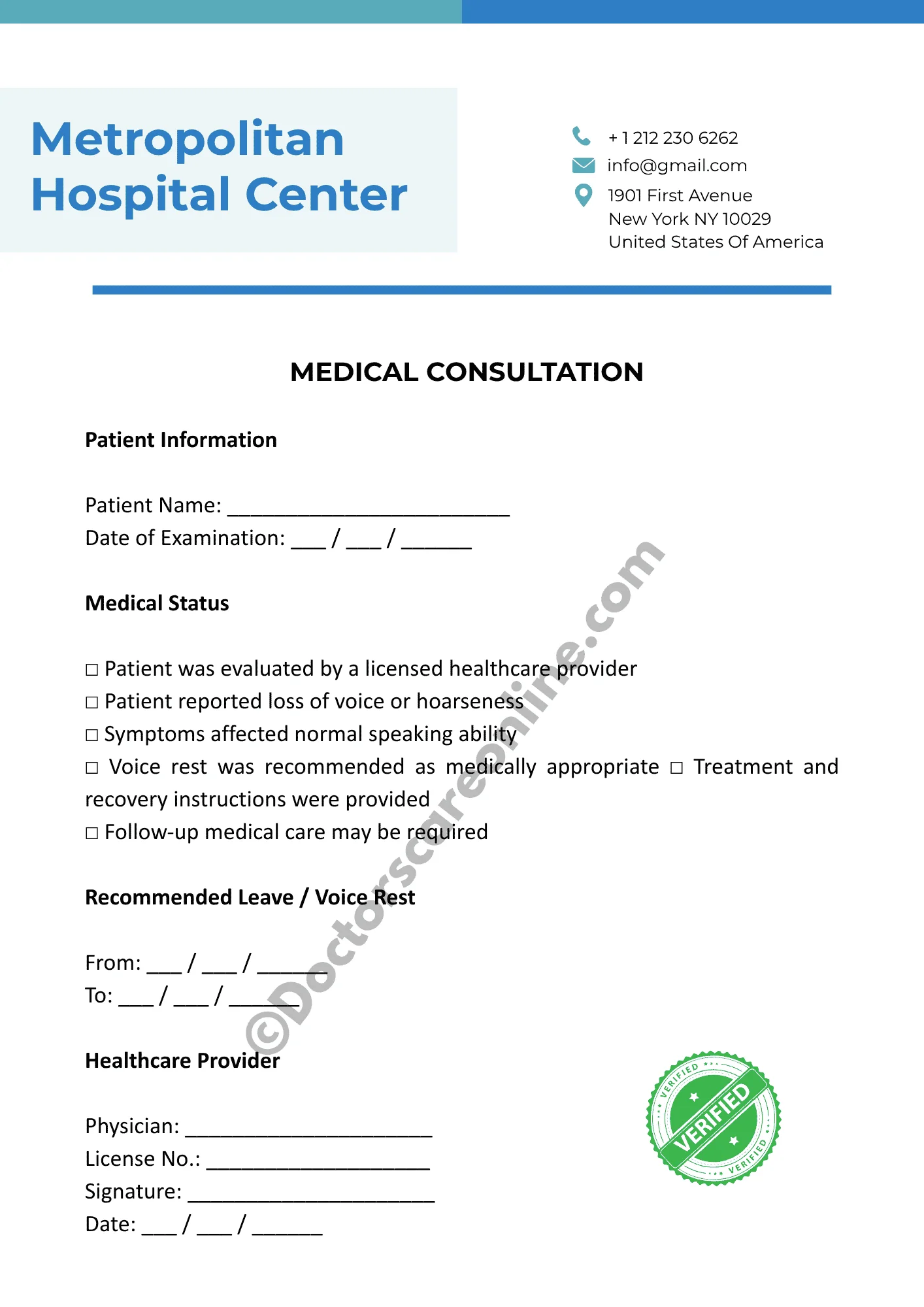
A doctor’s note for loss of voice is medical documentation that may be provided by a licensed healthcare professional after evaluating symptoms such as temporary voice loss, hoarseness, a weak or strained voice, or difficulty speaking. Depending on the individual’s condition, the provider may recommend rest, temporary activity limitations, time away from work or school, or additional medical evaluation.
Loss of voice can occur for several reasons, including laryngitis, an upper respiratory infection, vocal overuse, irritation, acid reflux, or other conditions affecting the larynx and vocal folds. Because the appropriate recommendation depends on the underlying cause and severity of symptoms, medical documentation should be based on an appropriate healthcare evaluation.
If your voice symptoms are interfering with your ability to perform your job, attend classes, communicate safely, or complete normal responsibilities, an online medical consultation may be an option where telehealth is available and appropriate.
Related Doctor Note :—
You can also visit:
- Doctor’s Note for Laryngitis
- Online Doctor’s Note for Sore Throat
- Doctors Note for Strep Throat
- 6 Months of Unlimited Doctor’s Notes
When You May Need a Doctor’s Note for Loss of Voice
A temporary loss of voice can make certain responsibilities difficult, particularly when speaking is an essential part of work or education. A healthcare provider may determine that medical documentation is appropriate when symptoms interfere with normal activities.
You may need documentation when:
- Your employer requires proof of a medically related absence.
- Your job depends heavily on speaking or communicating with customers, patients, students, or colleagues.
- You need temporary restrictions because speaking aggravates your symptoms.
- Your school or college requires documentation for an absence.
- You need a recommended recovery period before resuming normal duties.
- Your healthcare provider advises temporary changes to your usual activities.
- You need documentation for an employer’s medical leave or attendance process.
Whether a note is appropriate, what it should contain, and how long any restriction should last are determined by the healthcare provider and applicable workplace or institutional requirements.
Common Causes of Temporary Voice Loss
Loss of voice is not a diagnosis by itself. It is a symptom that can have different underlying causes. NIDCD identifies conditions such as laryngitis, vocal misuse or overuse, reflux, vocal-fold growths, and certain neurological or structural problems among possible causes of voice changes.
Common possibilities include:
- Laryngitis: Laryngitis occurs when the larynx becomes inflamed. Viral respiratory infections are a common cause of acute laryngitis, although irritation and other factors can also contribute. Hoarseness or temporary voice loss may occur.
- Vocal Overuse: Speaking loudly, shouting, singing extensively, or using the voice for prolonged periods can strain the vocal folds. People whose occupations depend heavily on their voices may be particularly affected.
- Upper Respiratory Infection: Colds and other respiratory infections can cause inflammation around the voice box and contribute to hoarseness or temporary loss of voice.
- Acid Reflux: Gastroesophageal reflux and laryngopharyngeal reflux can irritate tissues around the larynx and contribute to persistent voice changes in some people.
- Vocal-Fold Nodules, Polyps, or Cysts: Growths affecting the vocal folds can alter voice quality and may require evaluation by a healthcare professional, particularly when symptoms persist.
- Other Medical Conditions: Persistent voice changes can sometimes be associated with vocal-fold paralysis, neurological conditions, thyroid problems, laryngeal injury, or other disorders. Persistent or unexplained symptoms should therefore be medically evaluated rather than assumed to be simple laryngitis.
Symptoms That Can Occur With Loss of Voice
Complete voice loss is not the only type of voice problem. Depending on the underlying cause, you may experience:
- Hoarseness or raspiness
- A weak or breathy voice
- A strained voice
- Reduced speaking volume
- Changes in pitch
- A scratchy or raw throat
- Dry throat
- Sore throat
- Dry cough
- Frequent throat clearing
- Difficulty speaking for extended periods
Mayo Clinic notes that laryngitis may cause hoarseness, short-term voice loss, throat irritation, dry throat, cough, and an urge to clear the throat.
How Loss of Voice Can Affect Work and School
The practical impact of voice loss depends heavily on what you are expected to do.
For example, a temporary voice problem may make normal duties difficult for:
- Teachers and instructors
- Call-center employees
- Customer service representatives
- Healthcare professionals
- Sales professionals
- Receptionists
- Public speakers
- Performers and singers
- Coaches
- Students participating in presentations or oral examinations
Someone working primarily on a computer may be able to continue working with fewer limitations than someone whose occupation requires continuous speaking. A healthcare provider can consider these functional differences when determining whether work restrictions or time away from work are medically appropriate.
When Should Loss of Voice Be Medically Evaluated?
Many short-term voice problems improve as the underlying irritation or illness resolves. However, persistent, unexplained, or severe voice changes should not simply be ignored.
- NIDCD recommends medical evaluation when hoarseness continues for more than three weeks, particularly when there has been no recent cold or flu. It also identifies difficulty breathing or swallowing, coughing up blood, a lump in the neck, pain while speaking or swallowing, and complete voice loss lasting more than a few days as reasons to seek medical attention.
- Mayo Clinic similarly advises medical evaluation for persistent voice changes and urgent care for symptoms such as difficulty breathing or swallowing, coughing blood, persistent fever, worsening pain, or unexplained weight loss.
How a Healthcare Provider Evaluates Voice Loss
A medical evaluation helps determine whether the symptoms are consistent with a temporary condition or whether additional assessment is needed.
Depending on your symptoms, a provider may:
- Review when the voice change began.
- Ask about recent respiratory illness.
- Ask about vocal overuse or strenuous speaking.
- Review smoking or environmental exposure history when relevant.
- Ask about reflux symptoms.
- Evaluate associated throat or respiratory symptoms.
- Listen to the quality of your voice.
- Assess whether an in-person examination is necessary.
- Refer you to an ENT specialist when appropriate.
For persistent or unexplained voice problems, an otolaryngologist (ENT specialist) may examine the larynx and vocal folds using specialized equipment such as a laryngoscope or endoscope.
What Can Help While Your Voice Recovers?
Care depends on the underlying cause. For uncomplicated laryngitis and some temporary voice problems, healthcare professionals may recommend measures such as voice rest, adequate fluids, and humidified air. Mayo Clinic also advises avoiding excessive talking or singing and avoiding whispering because whispering can place additional strain on the voice.
General supportive measures may include:
- Resting your voice when possible.
- Drinking adequate fluids.
- Avoiding shouting and prolonged speaking.
- Avoiding smoking and irritating fumes.
- Using a humidifier when appropriate.
- Following the treatment plan provided by your healthcare professional.
- Taking medications only as directed.
The appropriate treatment depends on the cause. Antibiotics, prescription medicines, voice therapy, or procedures are not appropriate for every case.
Can You Work With a Lost Voice?
Whether you can work depends on your symptoms, occupation, medical condition, and healthcare provider’s recommendations.
For example, someone whose job requires continuous speaking may need different temporary arrangements from someone who performs mostly nonverbal computer-based tasks.
Depending on the circumstances, a provider may recommend:
- Temporary time away from work
- Reduced speaking requirements
- Modified duties
- Remote work when feasible
- Limited customer-facing responsibilities
- A gradual return to normal duties
Any restrictions should be based on the individual’s medical situation rather than a predetermined number of days.
How to Get a Medical Note for Loss of Voice Online
If online medical care is available in your location and appropriate for your symptoms, you can begin by scheduling a consultation with a licensed healthcare provider.
Step 1: Choose an Appropriate Appointment
- Select an available healthcare provider and appointment time that fits your schedule.
Step 2: Create an Account or Log In
- If you are a new patient, follow the registration process. Returning users can log in using their existing account information.
Step 3: Describe Your Voice Symptoms
- Provide accurate information about when your voice changed, whether you have complete or partial voice loss, and any associated symptoms.
Step 4: Complete the Medical Consultation
- The healthcare provider will review your symptoms and determine whether your condition can be appropriately assessed through telehealth.
Step 5: Follow the Provider’s Recommendation
- The provider may recommend home care, treatment, an in-person examination, additional testing, or referral to a specialist depending on the situation.
Step 6: Receive Documentation When Medically Appropriate
- If the healthcare provider determines that medical documentation is justified, they may issue a doctor’s note or other appropriate documentation in accordance with applicable requirements.
A medical note is not automatically issued simply because it is requested. The decision should be based on the provider’s clinical assessment.
Why Our Website Can Be Useful for Your Medical Documentation Needs
Finding appropriate healthcare documentation can be stressful when you are already dealing with illness or difficulty speaking. Our platform is designed to make the process of connecting with healthcare services more convenient by allowing eligible users to arrange an online medical consultation from a suitable location.
Our service can be useful when you:
- Need a convenient way to request an online medical consultation.
- Want to explain your symptoms before speaking with a healthcare professional.
- Need to discuss how voice loss is affecting work or school.
- Prefer an online appointment when an in-person visit is not necessary.
- Need medically appropriate documentation after an evaluation.
The purpose of the service is to connect you with appropriate healthcare evaluation—not to replace the provider’s medical judgment. Any diagnosis, treatment recommendation, work restriction, or doctor’s note should come from a qualified healthcare professional following an appropriate assessment.
Why You Can Use Our Platform With Confidence
Trust is particularly important when dealing with health information and medical documentation. Our website is designed around a healthcare-evaluation process rather than simply providing an unauthenticated document.
Important principles include:
- Healthcare evaluation: Medical documentation should be based on an appropriate provider assessment.
- Clear process: Users can review the appointment and documentation process before proceeding.
- Privacy-conscious approach: Health-related information should be handled responsibly and only as required for the service.
- Professional involvement: A licensed healthcare provider determines whether documentation is medically appropriate.
- User support: Assistance is available when users have questions about using the website.
Users should always provide truthful and complete information during their consultation. This helps the healthcare professional make an appropriate clinical decision.
Need Help With Registration, Login, Payment, or Your Order?
If you experience an issue while using our website, you do not have to figure it out alone.
If you have a question or encounter a problem with:
- Registering for an account
- Logging into your account
- Booking an appointment
- Completing payment
- Understanding the ordering process
- Accessing your documentation
- Using any website feature
you can contact our website chatbox for assistance. Our support team can help guide you through the website process and answer service-related questions.
For medical questions about your symptoms, treatment, diagnosis, or whether you need urgent care, consult an appropriate healthcare professional rather than relying on customer support.
What Information May Be Included in a Doctor’s Note?
The exact contents depend on the provider, the patient’s situation, and the requirements of the organization receiving the documentation.
When appropriate, medical documentation may include:
- Patient identification information
- Date of medical evaluation
- Confirmation that the patient was evaluated
- Recommended period away from work or school
- Temporary functional restrictions
- Recommended return date, when medically appropriate
- Follow-up recommendations
- Healthcare provider information and signature
A healthcare provider decides what information should be included. A patient should never modify, falsify, or add information to a medical document after it has been issued.
How Long Can a Doctor’s Note for Loss of Voice Last?
There is no universal validity period for a doctor’s note for voice loss.
The duration of any recommended absence or restriction depends on factors such as:
- The underlying cause
- Severity of symptoms
- Functional limitations
- Type of occupation
- Response to treatment
- Need for additional evaluation
- Provider’s clinical judgment
- Employer or school documentation requirements
If symptoms continue beyond the period originally recommended, a follow-up evaluation may be necessary before documentation is extended or restrictions are changed.
Protecting Your Voice During Recovery
Once a healthcare professional has evaluated your symptoms, following the recommended recovery plan can help reduce additional vocal strain.
Helpful habits may include:
- Give your voice regular rest periods.
- Avoid shouting or prolonged speaking.
- Avoid repeatedly clearing your throat.
- Stay adequately hydrated.
- Reduce exposure to smoke and irritating fumes.
- Use appropriate voice techniques if your work requires frequent speaking.
- Follow recommended treatment or voice therapy when prescribed.
People who regularly depend on their voices professionally may benefit from evaluation by an ENT specialist or speech-language pathologist when voice problems repeatedly occur.
When Loss of Voice Requires Urgent Medical Care
Do not rely on an online doctor’s note service when symptoms indicate a potentially serious medical problem.
Seek urgent or emergency medical care if you have:
- Difficulty breathing
- Significant difficulty swallowing
- Coughing up blood
- Rapidly worsening symptoms
- Severe throat or neck symptoms
- Complete voice loss accompanied by concerning symptoms
- Other symptoms suggesting an emergency
NIDCD and Mayo Clinic both identify breathing or swallowing difficulties and other serious symptoms as reasons for prompt medical evaluation.
Frequently Asked Questions
1. Can I request a doctor’s note if my job depends on speaking?
A healthcare provider can assess whether your voice condition affects your ability to perform speaking-related duties and determine whether temporary restrictions or leave are medically appropriate.
2. Can voice loss be caused by stress?
Voice problems can have multiple causes, and psychological trauma or stress can be associated with some voice disorders. However, persistent or unexplained voice changes should be evaluated by a healthcare professional rather than automatically attributed to stress.
3. Should I whisper if I completely lose my voice?
Whispering is not necessarily a better alternative to speaking. Mayo Clinic notes that whispering can place additional strain on the voice, so following appropriate voice-rest guidance from a healthcare professional is preferable.
4. Can an ENT specialist evaluate ongoing voice loss?
Yes. Otolaryngologists, commonly called ENT specialists, specialize in disorders involving the ears, nose, and throat and can evaluate persistent voice problems and the vocal folds when necessary.
5. What happens if my voice returns but becomes hoarse repeatedly?
Repeated voice changes can have different causes, including vocal overuse, reflux, or vocal-fold conditions. If the problem keeps returning, discussing it with a healthcare professional can help identify the underlying cause and determine whether specialist evaluation is appropriate.
Medical Disclaimer: This content is provided for general educational and informational purposes only and does not replace professional medical advice, diagnosis, or treatment. A doctor’s note should only be issued by a licensed healthcare professional after an appropriate medical evaluation. Telehealth suitability, medical documentation requirements, treatment recommendations, and work or school restrictions can vary by state, employer, educational institution, and individual circumstances.
Do not use this information to delay emergency medical care. If you have difficulty breathing or swallowing, cough up blood, or develop other serious or rapidly worsening symptoms, seek appropriate urgent or emergency medical care.





Reviews
There are no reviews yet.