
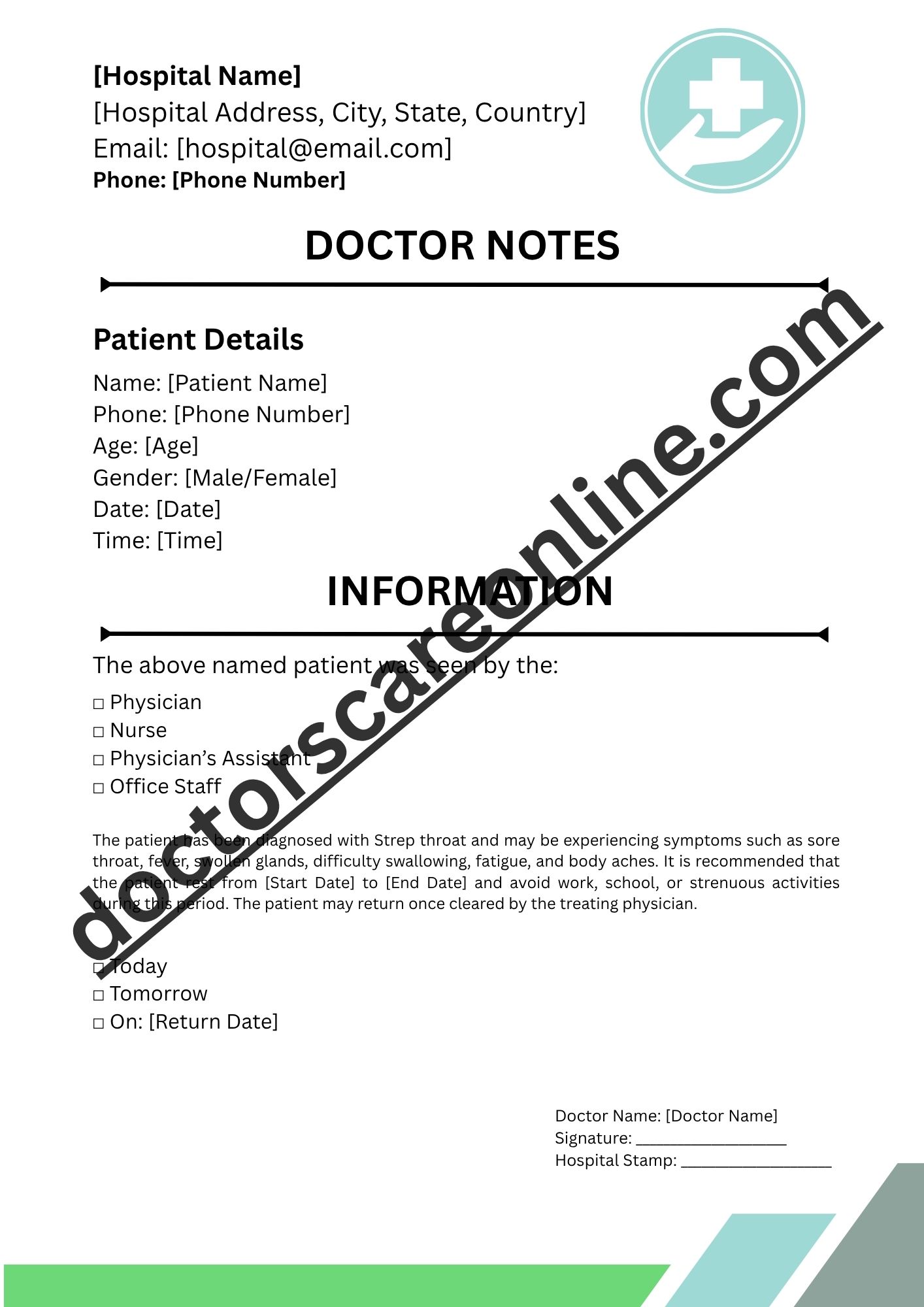
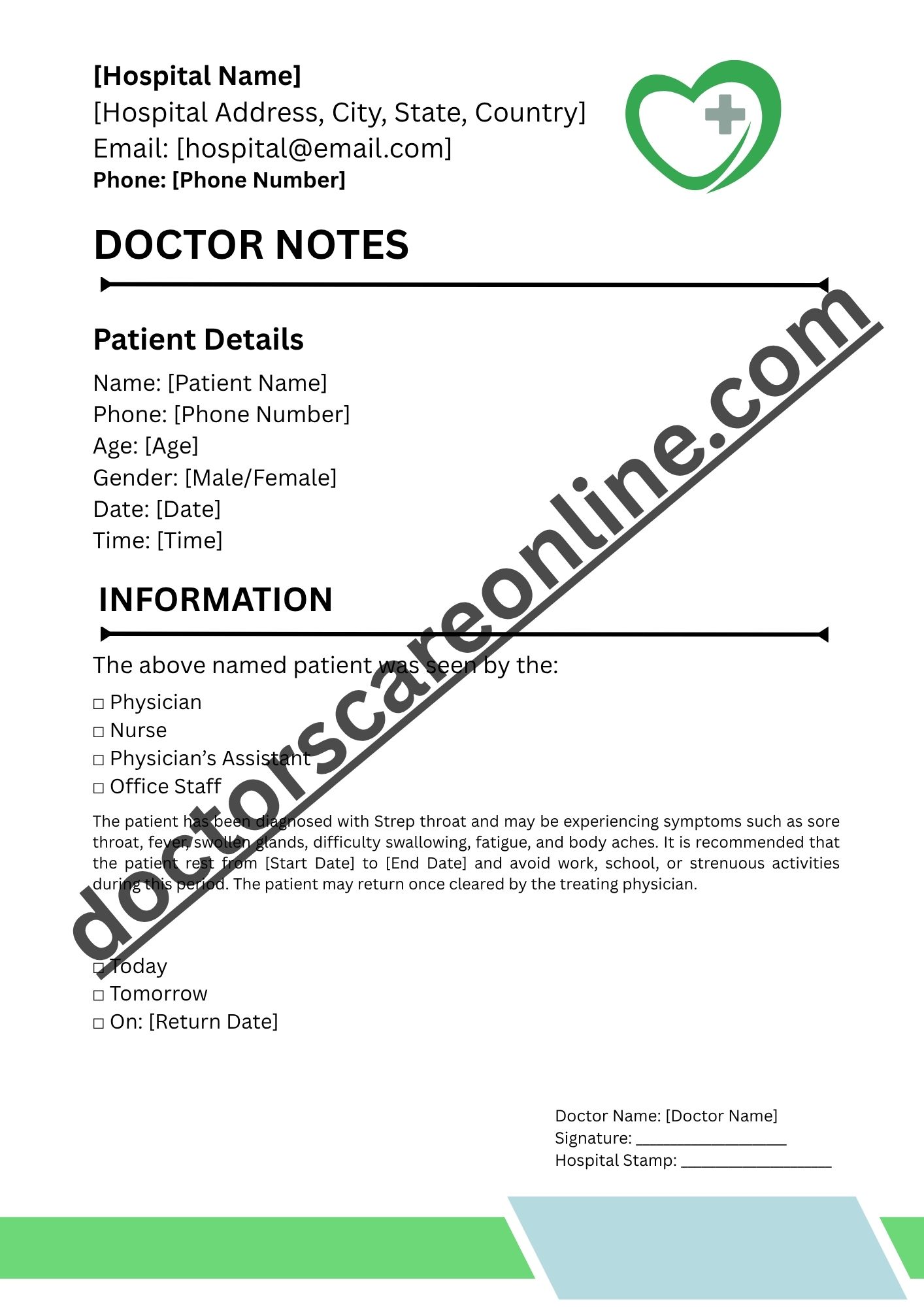
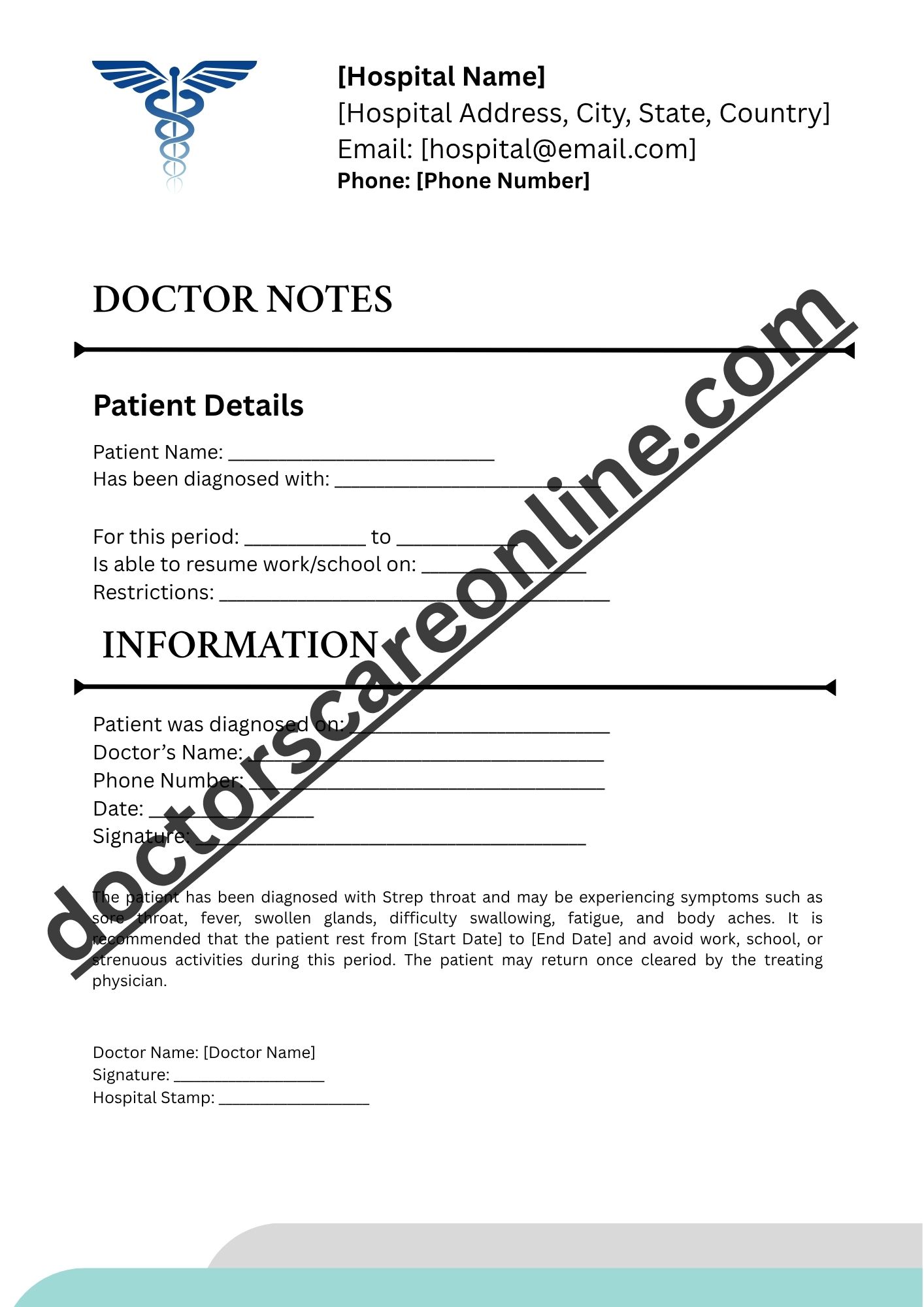
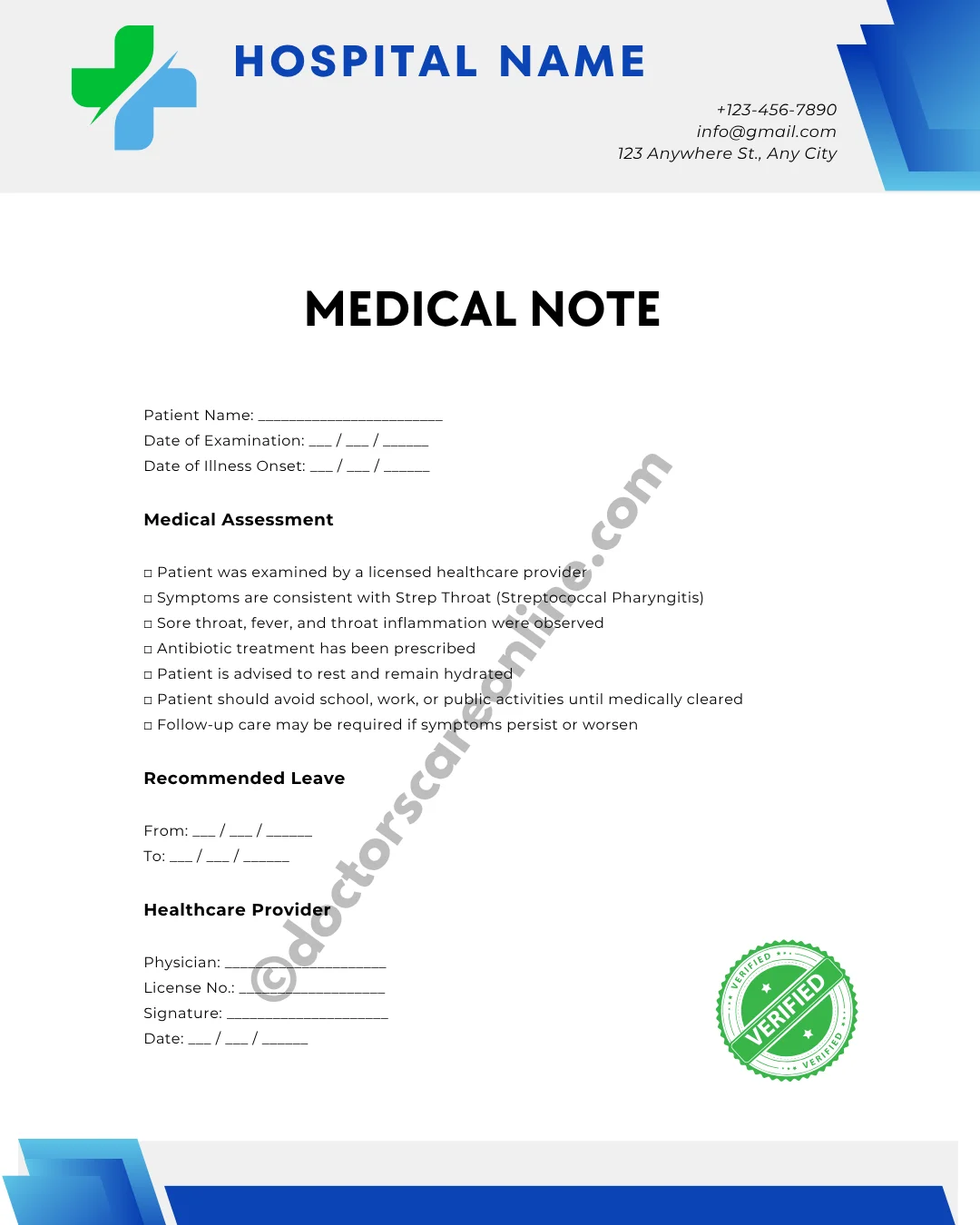
A Doctor’s Note for Strep Throat is an official medical document issued by a licensed healthcare provider after examining and diagnosing a patient with strep throat, a bacterial throat infection caused by Group A Streptococcus. The note verifies that the patient received medical care and may need temporary leave from work, school, college, or other daily responsibilities while recovering. It also helps explain that the absence is medically necessary and may reduce the risk of spreading the infection to classmates, coworkers, or others.
A doctor’s note typically includes the patient’s name, the date of the medical visit, the recommended recovery period, return-to-work or school instructions, any temporary activity restrictions, and the healthcare provider’s signature or clinic details. Depending on privacy policies and employer or school requirements, the note may or may not mention the specific diagnosis. Many employers and educational institutions request this document when an illness-related absence extends beyond their attendance policy or requires official medical verification.
Common Symptoms That May Require a Doctor’s Note
Symptoms of strep throat can develop quickly and may become severe enough to interfere with work, school, or daily activities. If these symptoms make it difficult to perform normal responsibilities, a healthcare provider may recommend taking time off and issue a doctor’s note.
Common symptoms include:
- Severe sore throat that begins suddenly
- Pain or difficulty while swallowing
- Fever, often above 101°F (38.3°C)
- Red, swollen tonsils with white patches or streaks of pus
- Swollen and tender lymph nodes in the neck
- Headache and body aches
- Chills and general fatigue
- Loss of appetite
- Nausea or vomiting, especially in children
- Small red spots on the roof of the mouth (petechiae)
Not everyone experiences the same symptoms, so a medical evaluation is the best way to confirm the infection.
When Should You Visit a Doctor?
Although some sore throats improve on their own, strep throat usually requires medical treatment because it is caused by bacteria. Seeking medical care early can help reduce recovery time and lower the risk of complications.
You should consider visiting a healthcare provider if you experience:
- A sore throat lasting longer than 48 hours
- High fever with severe throat pain
- Difficulty swallowing food or liquids
- Swollen tonsils with white patches
- Swollen glands in the neck
- Rash along with a sore throat
- Trouble breathing or opening the mouth
- Recurrent episodes of strep throat
- Symptoms that worsen despite home care
Prompt medical attention helps ensure accurate diagnosis and timely treatment.
How Doctors Confirm Strep Throat
Because the symptoms of strep throat can resemble viral infections, doctors use specific tests to make an accurate diagnosis before prescribing antibiotics.
Common diagnostic methods include:
- Physical Examination: The doctor checks the throat, tonsils, lymph nodes, and overall symptoms to look for signs of bacterial infection.
- Rapid Strep Test: A cotton swab is used to collect a sample from the back of the throat. Results are usually available within 10–20 minutes.
- Throat Culture: If the rapid test is negative but strep throat is still suspected, the sample may be sent to a laboratory for a throat culture. Results typically take 24–48 hours.
- Medical History: The healthcare provider may ask about recent exposure to someone with strep throat, previous infections, and current symptoms before making a diagnosis.
How to Book an Online Doctor’s Appointment for a Strep Throat Note
If you have symptoms of strep throat and need a doctor’s note for work, office, school, or college, you can schedule an online medical consultation through a licensed telehealth provider. After evaluating your symptoms, the healthcare provider may recommend testing, prescribe treatment if appropriate, and issue a doctor’s note when medically justified.
Step 1: Choose a Licensed Telehealth Provider
Select a trusted online healthcare platform that offers virtual consultations with licensed doctors or nurse practitioners.
Step 2: Book an Appointment
Choose a convenient date and time, then complete the appointment booking by providing your basic personal and contact information.
Step 3: Describe Your Symptoms
During the virtual consultation, explain your symptoms, such as:
- Severe sore throat
- Fever
- Pain while swallowing
- Swollen tonsils
- White patches in the throat
- Swollen lymph nodes
Step 4: Complete the Medical Evaluation
The healthcare provider will assess your symptoms and medical history. If necessary, they may recommend an in-person examination or a rapid strep test to confirm the diagnosis before prescribing antibiotics.
Step 5: Receive Your Doctor’s Note
If the provider determines that you need time off to recover, they can issue a digital doctor’s note stating your recommended leave period and expected return date. The note is usually sent by email, patient portal, or downloadable PDF.
Step 6: Submit the Note
Download or print the doctor’s note and submit it to your employer, office, school, college, or university, following their attendance or leave policy.
Information Commonly Included in the Doctor’s Note
A doctor’s note for strep throat is designed to verify that the patient was medically evaluated and may need temporary leave. The exact format may differ between healthcare providers, but most notes include similar information.
Typical details include:
| Information | Purpose |
|---|---|
| Patient’s name | Identifies the individual receiving medical care |
| Date of examination | Confirms when the patient was evaluated |
| Medical recommendation | Advises rest or temporary absence |
| Recommended leave period | Indicates how long the patient should stay home |
| Return-to-work or school date | Suggests when it is safe to resume normal activities |
| Activity restrictions | Lists any temporary limitations if needed |
| Healthcare provider’s name | Identifies the issuing medical professional |
| Clinic or hospital details | Verifies the source of the document |
| Signature or official stamp | Confirms authenticity |
Some providers may omit the specific diagnosis to protect patient privacy unless disclosure is required.
How Long Is a Doctor’s Note for Strep Throat Valid?
The validity of a doctor’s note for strep throat depends on your healthcare provider’s recommendation and the attendance policy of your workplace, school, or college. In most cases, the note covers the medically recommended recovery period rather than having a fixed expiration date.
| Organization | Typical Validity |
|---|---|
| Workplace / Office | Usually 1–3 days of medical leave, depending on symptom severity and company policy. Some employers may approve a longer leave if recommended by the doctor. |
| School | Commonly valid for 1–3 school days. Students can usually return after taking antibiotics for at least 24 hours, being fever-free, and feeling well enough to attend classes. |
| College / University | Typically accepted for 2–5 days, depending on the institution’s attendance policy and the doctor’s recommendation. Additional documentation may be required for extended absences. |
Note: A doctor’s note does not have a universal validity period. Employers, schools, and colleges may have different policies, so always follow the instructions provided by your healthcare provider and the attendance requirements of your organization.
Causes of Strep Throat
Strep throat is caused by Group A Streptococcus (GAS) bacteria, which spread easily from one person to another through close contact and respiratory droplets. Understanding how the infection spreads can help you take preventive measures and reduce the risk of getting sick.
- Infection with Group A Streptococcus (GAS) bacteria.
- Close contact with someone who has strep throat.
- Breathing in respiratory droplets from coughing or sneezing.
- Sharing food, drinks, utensils, or water bottles with an infected person.
- Touching contaminated surfaces and then touching your mouth, nose, or eyes.
- Spending time in crowded places such as schools, daycare centers, or offices.
- Living with an infected family member or roommate.
- Having a weakened immune system, which can increase the risk of infection.
- Poor hand hygiene that allows bacteria to spread more easily.
- Frequent exposure to people with untreated strep throat.
Common Symptoms of Strep Throat
Strep throat symptoms usually appear 2 to 5 days after exposure to the bacteria and often develop suddenly. While the severity can vary from person to person, recognizing these common signs early can help you seek timely medical treatment and reduce the risk of spreading the infection.
- Sudden, severe sore throat
- Pain or difficulty when swallowing
- Fever, often above 101°F (38.3°C)
- Red and swollen tonsils
- White patches or streaks of pus on the tonsils
- Tiny red spots on the roof of the mouth (petechiae)
- Swollen and tender lymph nodes in the neck
- Headache
- Body aches and muscle pain
- Chills
- Fatigue or feeling unusually tired
- Loss of appetite
- Nausea or vomiting, especially in children
- Bad breath caused by throat infection
- Swollen or inflamed throat
How Strep Throat Is Diagnosed
Because the symptoms of strep throat are similar to those of viral sore throats, a healthcare provider uses specific tests to confirm the infection. An accurate diagnosis helps determine whether antibiotics are needed and prevents unnecessary treatment.
- Physical Examination: The doctor examines your throat, tonsils, and neck for signs such as redness, swelling, white patches, and enlarged lymph nodes. They will also ask about your symptoms, medical history, and recent exposure to someone with strep throat.
- Rapid Strep Test: A cotton swab is used to collect a sample from the back of your throat. This test can detect Group A Streptococcus bacteria within 10–20 minutes, making it the quickest way to diagnose strep throat.
- Throat Culture: If the rapid strep test is negative but the doctor still suspects strep throat, the throat swab may be sent to a laboratory for a throat culture. This test is more accurate and usually provides results within 24–48 hours.
- Additional Evaluation: In some cases, your healthcare provider may consider your age, symptoms, recent outbreaks, or exposure history before recommending further testing or treatment.
Treatment Options for Strep Throat
The primary treatment for strep throat is a course of antibiotics prescribed by a healthcare provider. Antibiotics help eliminate the bacteria, reduce symptoms, shorten the duration of the illness, and lower the risk of complications. Along with medication, supportive care plays an important role in recovery.
Treatment options may include:
- Prescription antibiotics
- Over-the-counter pain relievers and fever reducers
- Plenty of fluids to stay hydrated
- Warm saltwater gargles to soothe the throat
- Warm tea, soup, or other soft foods
- Adequate rest and sleep
- Using a humidifier to reduce throat irritation
Most people begin to feel better within 24 to 48 hours after starting antibiotics, but it is important to complete the entire prescribed course.
Antibiotics for Strep Throat: What to Know
Antibiotics are recommended only when strep throat has been confirmed or is strongly suspected to be caused by Group A Streptococcus bacteria. They do not treat viral sore throats or the common cold. Starting antibiotics promptly can help you recover faster and reduce the chance of spreading the infection to others.
Important points to remember:
- Take the medication exactly as prescribed.
- Complete the full course, even if you feel better.
- Symptoms often improve within 1–2 days of starting treatment.
- Most people are no longer contagious after 24 hours of taking antibiotics.
- Contact your healthcare provider if symptoms worsen or do not improve after 48 hours of treatment.
Home Care Tips for Faster Recovery
Along with taking prescribed antibiotics, proper self-care can help relieve symptoms and support a quicker recovery from strep throat. Following these simple home care tips may reduce discomfort and help your body heal more effectively.
- Get plenty of rest to allow your body to recover.
- Drink plenty of water and warm fluids to stay hydrated.
- Gargle with warm salt water several times a day to soothe your throat.
- Eat soft foods such as soup, yogurt, mashed potatoes, and oatmeal.
- Drink warm herbal tea with honey (for adults and children over one year old).
- Use a cool-mist humidifier to keep the air moist.
- Take over-the-counter pain relievers or fever reducers as directed by your healthcare provider.
- Avoid smoking and secondhand smoke, which can irritate the throat.
- Replace your toothbrush after 24–48 hours of starting antibiotics to reduce the risk of reinfection.
- Complete the full course of antibiotics, even if you start feeling better.
How Long Should You Stay Home From Work or School?
To help prevent the spread of strep throat and allow your body to recover, it’s important to stay home until you are no longer contagious. Follow your healthcare provider’s advice and these general recommendations:
- Stay home for at least 24 hours after starting antibiotics.
- Return only after you have been fever-free for at least 24 hours without using fever-reducing medicine.
- Make sure your sore throat and other symptoms are improving before resuming normal activities.
- Get enough rest and avoid strenuous activities until you feel better.
- Complete the full course of antibiotics, even if symptoms improve quickly.
- If you are not taking antibiotics, you may remain contagious for 2–3 weeks.
- Children should return to school only when they feel well enough to participate in normal classroom activities.
- Adults should return to work only when they can perform their duties comfortably and are no longer likely to spread the infection.
- If symptoms worsen or do not improve after 48 hours of antibiotic treatment, contact your healthcare provider before returning.
Is Strep Throat Contagious?
Yes, strep throat is highly contagious and can spread easily from one person to another through close contact. The infection is caused by Group A Streptococcus (GAS) bacteria and is most contagious before treatment begins. Taking antibiotics significantly reduces the risk of spreading the bacteria, usually within 24 hours of starting treatment.
Strep throat can spread through:
- Coughing or sneezing that releases infected respiratory droplets.
- Close contact with someone who has strep throat.
- Sharing food, drinks, utensils, or water bottles.
- Kissing or other direct personal contact.
- Touching contaminated surfaces and then touching your mouth, nose, or eyes.
- Living or working in crowded places, such as schools, daycare centers, or offices.
- Sharing personal items like towels or toothbrushes.
- Being around an infected person before they begin antibiotic treatment.
To reduce the risk of transmission, wash your hands regularly, avoid sharing personal items, cover your coughs and sneezes, and stay home until you have taken antibiotics for at least 24 hours and are fever-free.
Preventing the Spread of Strep Throat
Taking a few simple precautions can significantly reduce the risk of passing strep throat to others. Good hygiene and early treatment are the most effective ways to stop the spread of the infection.
- Wash your hands frequently with soap and water.
- Cover your mouth and nose when coughing or sneezing.
- Avoid sharing food, drinks, utensils, towels, or toothbrushes.
- Stay home while you are contagious.
- Begin antibiotics as prescribed and complete the full course.
- Clean frequently touched surfaces such as doorknobs, phones, and keyboards.
- Replace your toothbrush after starting antibiotic treatment.
- Avoid close contact, kissing, or sharing personal items with others until you are no longer contagious.
- Dispose of used tissues properly and wash your hands afterward.
When to Seek Immediate Medical Attention
While most cases of strep throat improve with proper treatment, some symptoms may indicate a more serious condition that requires urgent medical care. Do not ignore severe or worsening symptoms.
Seek immediate medical attention if you experience:
- Difficulty breathing or severe trouble swallowing.
- Inability to drink fluids due to throat pain.
- High fever that does not improve with medication.
- Swelling of the neck or severe throat swelling.
- Drooling because swallowing is too painful.
- Symptoms that worsen after starting antibiotics.
- No improvement after 48 hours of antibiotic treatment.
- Severe dehydration, dizziness, or confusion.
- A widespread rash along with a sore throat.
- Signs of complications, such as ear pain, joint pain, or swelling around the throat.
FAQs
1. Can I Go to Work if I Have Strep Throat?
It is generally not recommended to go to work if you have strep throat because the infection is highly contagious. Most healthcare providers advise staying home until you have taken antibiotics for at least 24 hours, are fever-free without medication, and feel well enough to return. This helps protect your coworkers and prevents the spread of the infection.
2. Do I Need Antibiotics for Strep Throat?
Yes, if your healthcare provider confirms that you have strep throat caused by Group A Streptococcus bacteria, antibiotics are usually recommended. They help shorten the duration of symptoms, reduce the risk of complications, and prevent the infection from spreading to others. Always complete the full course of antibiotics exactly as prescribed.
3. How Long Is Strep Throat Contagious?
Without treatment, strep throat can remain contagious for 2 to 3 weeks, even if symptoms begin to improve. However, after starting antibiotics, most people are no longer contagious after 24 hours. You should avoid close contact with others until you have completed at least one full day of antibiotic treatment and your fever has resolved.
4. Can I Get a Doctor’s Note Online?
Yes. Many licensed telehealth providers offer online medical consultations for strep throat. After evaluating your symptoms, the healthcare provider may recommend treatment and, if medically appropriate, issue a digital doctor’s note for work, school, or college. The note is typically delivered by email or through a secure patient portal.
5. Will My Employer Accept a Digital Doctor’s Note?
In many cases, yes. Most employers, schools, and colleges accept digital doctor’s notes issued by licensed healthcare providers. However, acceptance depends on your organization’s attendance or leave policy. If you are unsure, check with your employer or school to confirm whether electronic medical documentation is accepted.
Related Post-
Reviews
There are no reviews yet.