
Doctor’s Note for BPPV – Benign paroxysmal positional vertigo (BPPV) is a common inner-ear condition that can cause brief episodes of dizziness or a spinning sensation when you change your head position. Symptoms may interfere with walking, driving, working, studying, exercising, or performing everyday activities safely.
If BPPV symptoms are affecting your ability to work or attend school, an online medical consultation can provide an opportunity to discuss your symptoms with a licensed healthcare provider. After an appropriate evaluation, the provider may determine whether medical treatment, activity restrictions, time away from work or school, or a doctor’s note is medically appropriate.
Related Doctor Note : —–
A doctor’s note for BPPV is not simply a document requested or purchased without medical assessment. Legitimate medical documentation should be issued by a qualified healthcare professional based on their clinical judgment and applicable requirements.
What Is a Doctor’s Note for BPPV?
A doctor’s note for BPPV is medical documentation provided by a licensed healthcare professional after evaluating a patient’s symptoms and condition.
Depending on the situation, the documentation may confirm that the patient was medically evaluated and may include recommendations such as:
- Temporary absence from work or school
- A recommended recovery period
- Temporary activity restrictions
- Avoiding activities that trigger significant dizziness
- Modified or light-duty work
- A recommended return-to-work or school date
- Follow-up medical evaluation when necessary
The exact information included depends on the healthcare provider’s assessment and the requirements of the employer, school, or other organization.
A medical note does not necessarily need to disclose the patient’s detailed diagnosis. In many situations, documentation can focus on the functional limitations and recommended period of leave while respecting medical privacy.
Why Might You Need a Doctor’s Note for BPPV?
BPPV episodes can occur unexpectedly and may make certain activities difficult or unsafe. A doctor’s note may be useful when symptoms temporarily interfere with normal responsibilities.
You may need medical documentation if:
- Vertigo prevents you from safely performing your normal job duties.
- You need time away from work while receiving treatment.
- Your employer requires documentation for a medical absence.
- You are unable to attend school or college because of dizziness.
- Your work involves driving, operating machinery, climbing, working at heights, or other safety-sensitive activities.
- You need temporary work restrictions because head movement triggers vertigo.
- You require modified or light-duty work during recovery.
- Your school or employer requests confirmation of a medical evaluation.
Whether leave or restrictions are appropriate is determined by a healthcare provider based on your symptoms, occupation, functional limitations, and medical assessment.
Common BPPV Symptoms That May Affect Work or School
BPPV typically causes short episodes of positional vertigo, particularly when the head moves in certain ways. Symptoms can vary from person to person.
Common symptoms include:
- A spinning sensation when turning the head
- Dizziness when getting out of bed
- Vertigo when lying down or sitting up
- Dizziness when looking upward or downward
- Loss of balance
- Unsteadiness while walking
- Nausea associated with vertigo
- Difficulty concentrating after repeated vertigo episodes
- Fear of triggering another episode through movement
For people whose jobs require physical activity, driving, climbing, or operating equipment, these symptoms may create additional safety concerns.
When Should BPPV Symptoms Be Medically Evaluated?
BPPV can often be treated effectively, but dizziness should not automatically be assumed to be BPPV. Other medical conditions can cause vertigo and dizziness.
Seek medical evaluation if:
- Vertigo repeatedly interferes with daily activities.
- Dizziness keeps returning.
- You have difficulty maintaining your balance.
- Symptoms are affecting your ability to work safely.
- You are experiencing repeated nausea or vomiting.
- You have fallen or nearly fallen because of dizziness.
- Symptoms began after a head injury.
- You are unsure whether your symptoms are caused by BPPV.
A healthcare provider can determine whether your symptoms are consistent with BPPV and whether further evaluation is necessary.
BPPV Red Flags: When to Seek Emergency Care
Some symptoms associated with dizziness or vertigo may indicate a more serious medical problem and should not be managed solely through an online appointment.
Seek urgent or emergency medical care if vertigo occurs with symptoms such as:
- Sudden weakness or numbness
- Facial drooping
- Difficulty speaking or understanding speech
- New severe headache
- Double vision or significant vision changes
- Chest pain
- Fainting
- Severe difficulty walking
- New severe hearing loss
- Persistent vomiting or severe dehydration
- Vertigo following significant head trauma
These symptoms can have causes other than BPPV and require prompt medical assessment.
Can You Get a Doctor’s Note for BPPV Online?
In many locations, you may be able to discuss BPPV symptoms through a telehealth appointment. Whether an online evaluation is appropriate depends on your symptoms, medical history, location, and the healthcare provider’s clinical judgment.
During an online consultation, the provider may ask about:
- When your dizziness started
- What movements trigger the spinning sensation
- How long each episode lasts
- Whether you have nausea or balance problems
- Previous episodes of vertigo
- Recent falls or injuries
- Current medications
- Other medical symptoms
- How BPPV affects your work, school, or daily activities
If the provider determines that your condition can be appropriately evaluated through telehealth and that medical documentation is justified, they may issue a doctor’s note where permitted.
An online doctor’s note is not guaranteed simply because it is requested. A licensed healthcare provider must determine whether documentation is medically appropriate.
How to Get an Online Medical Note for BPPV
Getting evaluated for BPPV online can be convenient when your symptoms are suitable for telehealth.
Step 1: Choose an Online Healthcare Service
Use a healthcare platform that connects patients with licensed healthcare professionals and clearly explains its consultation process.
Step 2: Register or Log In
Create an account or log in using the information requested by the healthcare platform.
Step 3: Book an Online Consultation
Choose an available appointment time and provide the required information about your symptoms.
Step 4: Describe Your BPPV Symptoms
Explain when your vertigo started, which head movements trigger it, how long episodes last, and how the symptoms affect your work, school, or daily activities.
Step 5: Complete the Medical Evaluation
The healthcare provider will review your symptoms and medical history and determine whether your condition can be appropriately assessed through telehealth.
Step 6: Follow the Provider’s Recommendation
The provider may recommend treatment, additional evaluation, an in-person examination, activity modifications, or other appropriate medical care.
Step 7: Receive Documentation If Medically Appropriate
If the healthcare provider determines that a doctor’s note is justified, medical documentation may be provided according to applicable requirements and professional standards.
What Information May Be Included in a BPPV Doctor’s Note?
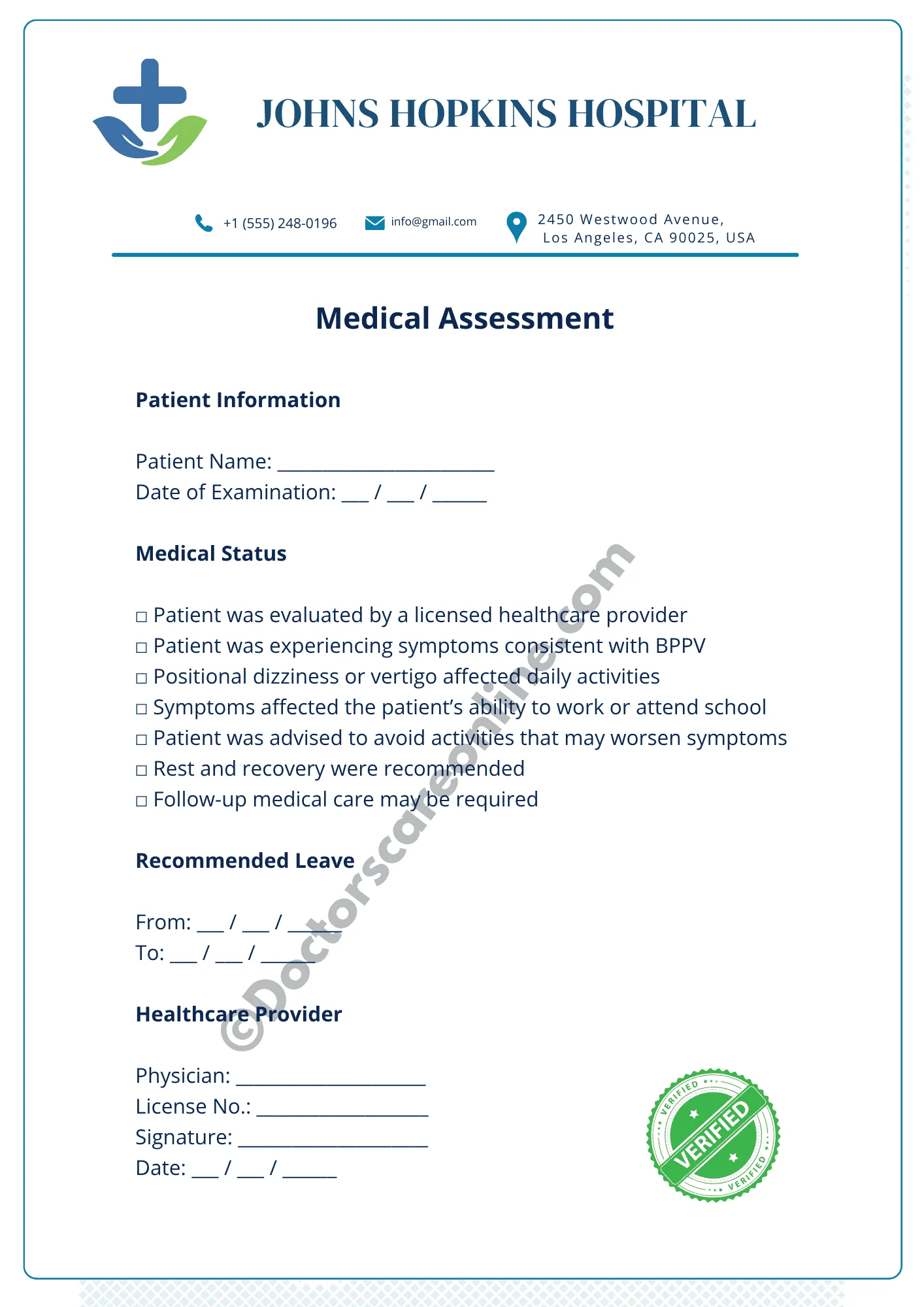
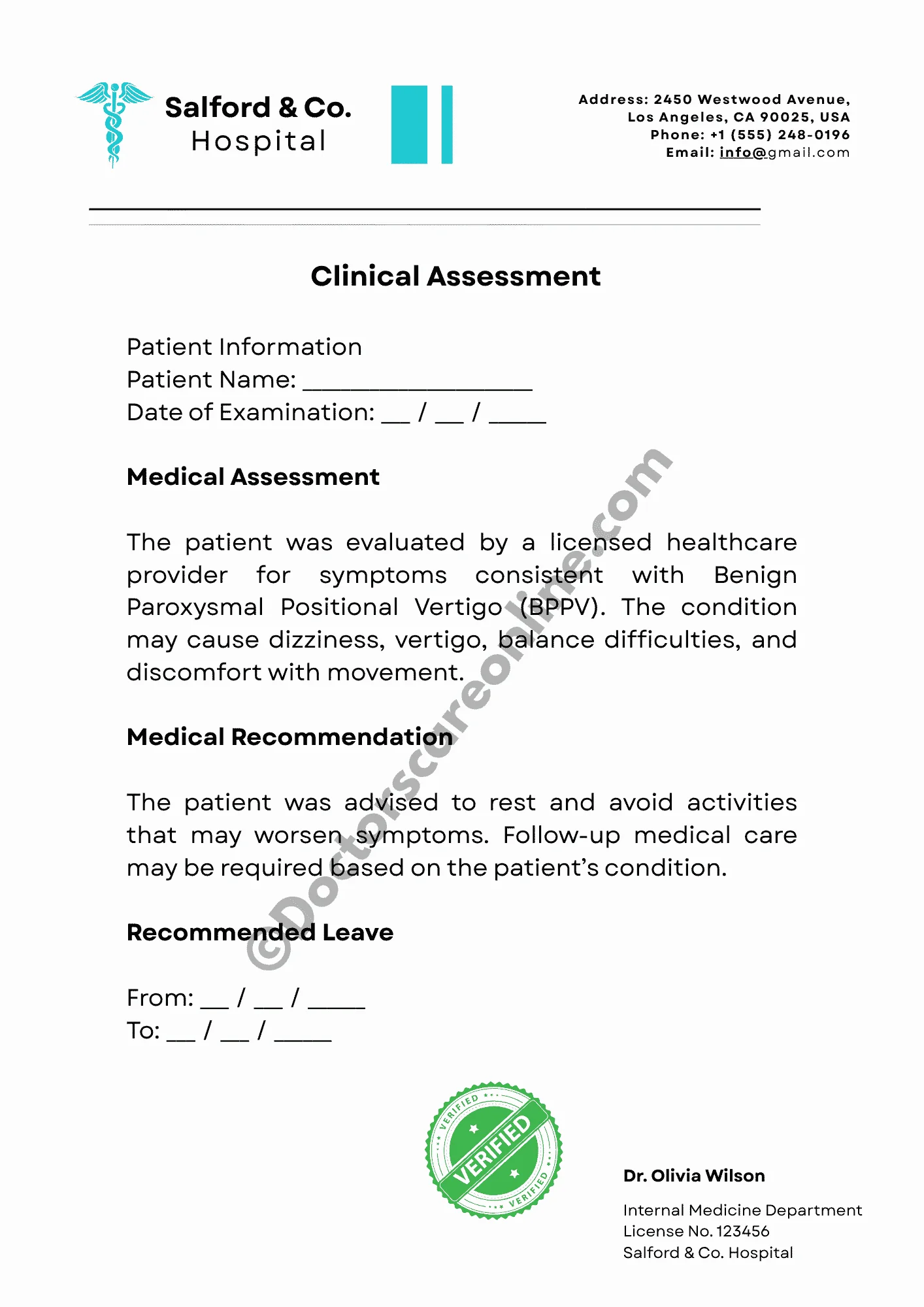
The content of a doctor’s note varies depending on the provider and the reason for documentation. It may include:
- Patient’s name
- Date of medical evaluation
- Confirmation of medical evaluation
- Recommended period of absence
- Temporary activity or work restrictions
- Recommended return-to-work or school date
- Follow-up instructions
- Healthcare provider’s name and credentials
- Clinic or healthcare service information
- Provider’s signature or authorized verification, where applicable
The healthcare provider determines what information is appropriate to include.
BPPV Work Restrictions and Workplace Accommodations
Some occupations can become particularly difficult or unsafe when a person is experiencing vertigo.
Depending on the medical assessment and job responsibilities, a healthcare provider may recommend temporary restrictions such as:
- Avoiding work at heights
- Avoiding climbing ladders
- Avoiding operating heavy machinery
- Avoiding safety-sensitive tasks
- Limiting activities involving rapid head movements
- Taking appropriate breaks
- Performing temporary light-duty work
- Adjusting certain physical tasks
The appropriate restriction depends on the individual’s symptoms and occupation. Employers may also have specific procedures for reviewing medical documentation and arranging workplace accommodations.
BPPV and Driving or Safety-Sensitive Work
Vertigo can affect balance, concentration, and spatial awareness. If BPPV symptoms make driving or operating machinery unsafe, it is important to discuss these activities with a healthcare professional.
Do not rely on a doctor’s note alone to determine whether you are safe to drive or perform a safety-sensitive job. Follow the healthcare provider’s medical advice and applicable workplace or driving requirements.
How Is BPPV Diagnosed?
Healthcare providers generally diagnose BPPV using a combination of symptom history and physical examination.
The evaluation may involve:
- Reviewing your medical history
- Discussing the timing and triggers of vertigo
- Assessing balance and coordination
- Evaluating eye movements
- Performing positional testing when appropriate
- Determining whether additional testing or an in-person assessment is necessary
One commonly used positional assessment is the Dix-Hallpike maneuver, which can help identify certain forms of BPPV.
Not every case of dizziness is BPPV. A healthcare professional may consider other possible causes based on the patient’s symptoms.
BPPV Treatment Options
Treatment depends on the individual’s symptoms and medical assessment.
A healthcare professional may recommend:
- Canalith repositioning procedures
- Vestibular rehabilitation
- Balance exercises
- Activity modification
- Follow-up evaluation
- Additional testing when another cause is suspected
The Epley maneuver is one commonly used canalith repositioning technique for certain types of BPPV. However, patients should follow appropriate professional guidance, particularly if they have neck or back problems, vascular conditions, recent injuries, or other circumstances that could make certain movements unsuitable.
Medication is not always the primary treatment for BPPV, and treatment should be based on the underlying cause and individual circumstances.
How Long Does BPPV Last?
The duration of BPPV varies. Some people experience improvement relatively quickly after appropriate treatment, while others may have persistent or recurring symptoms.
Recovery can depend on:
- The type of BPPV
- Severity and frequency of symptoms
- Response to treatment
- Whether symptoms recur
- Presence of other balance or inner-ear conditions
- Whether another medical cause is contributing to dizziness
There is no universal number of days that a doctor must excuse someone from work or school. A healthcare provider determines whether leave or restrictions are appropriate based on the individual assessment.
Returning to Work or School After BPPV
Returning to normal activities depends on symptom improvement and the requirements of your job or school environment.
Before resuming normal activities:
- Follow your healthcare provider’s recommendations.
- Avoid activities that remain unsafe because of dizziness.
- Follow temporary restrictions if provided.
- Ask about modified duties if your job involves physical or safety-sensitive tasks.
- Attend recommended follow-up appointments.
- Report persistent or worsening symptoms to your healthcare provider.
If your symptoms continue to interfere with work or school, you may need reassessment and updated medical documentation.
How Our Online Medical Service Helps You
When you are dealing with dizziness or vertigo, finding the right healthcare service should be straightforward and transparent. Our platform is designed to make the process of connecting with an online healthcare provider more convenient.
- Licensed Healthcare Evaluation: Our service is designed around consultation with healthcare professionals rather than simply providing a document without medical assessment. A healthcare provider reviews your symptoms and determines what medical care or documentation is appropriate.
- Convenient Online Access: An online consultation can reduce the need to travel when your symptoms are suitable for telehealth and the provider determines that remote evaluation is appropriate.
- Clear Consultation Process: We aim to make the appointment process easy to understand, from registration and scheduling through consultation and follow-up recommendations.
- Medical Documentation When Appropriate: If a healthcare provider determines that a doctor’s note is medically justified, documentation may be provided according to applicable requirements and the provider’s professional judgment.
- Privacy-Conscious Approach: Medical information should be handled responsibly. Only provide the information necessary for your consultation, and review the platform’s privacy and data-handling information before using the service.
- Transparent Customer Support: If you have a question or experience an issue with registration, login, appointment booking, payment, accessing your account, or another service-related matter, you can contact our chatbox support for assistance.
Our support team can help with website or account-related questions, while medical questions and clinical decisions should be addressed by the healthcare provider.
What Makes Our Service Useful and Trustworthy?
Choosing an online medical service is an important decision, especially when you need healthcare documentation. A trustworthy service should make it clear that a medical note comes from a healthcare evaluation—not from simply purchasing a document.
Our approach focuses on:
- Connecting users with healthcare professionals for appropriate evaluation
- Clearly explaining that medical documentation is subject to clinical judgment
- Avoiding guarantees that every user will receive a doctor’s note
- Providing a straightforward online consultation process
- Offering customer support for registration, login, payment, and technical questions
- Encouraging users to seek in-person or emergency care when telehealth is not appropriate
- Helping users understand what information they may need for their consultation
- Keeping medical and customer-support responsibilities clearly separated
These practices help users understand what they can expect before booking an appointment.
What to Have Ready Before Your Online BPPV Appointment
Preparing relevant information can make your consultation more useful.
Consider having the following details available:
- Date your symptoms began
- Description of the spinning or dizziness
- Head movements that trigger symptoms
- Approximate duration of each episode
- Frequency of episodes
- Nausea or vomiting
- Balance problems or falls
- Recent head injury
- Previous vertigo diagnosis
- Current medications
- Existing medical conditions
- Previous treatment for dizziness
- Your job or school requirements
- Any workplace or school documentation requirements
Providing accurate information helps the healthcare provider make a more informed assessment.
Common Mistakes to Avoid When Requesting a BPPV Doctor’s Note
Avoid these common mistakes:
- Assuming every episode of dizziness is BPPV
- Waiting to seek medical attention when serious symptoms are present
- Providing inaccurate information during a medical consultation
- Assuming an online consultation is appropriate for every type of vertigo
- Expecting a doctor’s note without a medical evaluation
- Editing or altering medical documentation
- Ignoring temporary work restrictions
- Returning to safety-sensitive duties while still experiencing significant vertigo
- Failing to check your employer’s or school’s documentation requirements
- Ignoring persistent or worsening symptoms
Medical Documentation and Your Privacy
A doctor’s note generally provides only the information necessary for its intended purpose. Depending on the situation, it may confirm that you were medically evaluated and provide recommended leave or restrictions without including extensive medical details.
The information that can or should be included may vary according to local laws, professional requirements, employer policies, school policies, and the purpose of the documentation.
Before submitting medical documentation, check what your employer, school, insurer, or other organization actually requires.
Frequently Asked Questions
1. Can BPPV be confirmed during an online appointment?
Some cases of suspected BPPV may be assessed through telehealth using symptom history and guided discussion, but an online appointment cannot replace an in-person examination when the provider believes one is necessary. The healthcare provider determines whether remote evaluation is appropriate.
2. Is BPPV considered a disability?
BPPV is not automatically considered a disability. Whether a condition qualifies for disability-related protection or accommodation depends on the individual’s symptoms, functional limitations, applicable laws, and circumstances. A healthcare provider can document functional limitations when medically appropriate.
3. Can BPPV come back after treatment?
Yes. BPPV can recur after treatment. If episodes return, particularly if the symptoms change or become more severe, medical reassessment may be appropriate to confirm the cause and determine the next step.
4. Can anxiety cause symptoms that feel like BPPV?
Anxiety can cause dizziness or sensations of unsteadiness, but those symptoms do not necessarily mean a person has BPPV. Because several conditions can cause dizziness, a healthcare professional should evaluate persistent or concerning symptoms rather than assuming the cause.
5. What happens if an online provider cannot safely evaluate my vertigo?
If a healthcare provider determines that your symptoms require an in-person examination, additional testing, or urgent care, they may recommend that you seek appropriate in-person medical attention. For emergency warning signs, seek emergency medical care rather than waiting for a routine telehealth appointment.
Medical Disclaimer: This content is provided for general educational and informational purposes only and is not a substitute for professional medical advice, diagnosis, or treatment.
A doctor’s note for BPPV should be issued only by a qualified healthcare provider after an appropriate medical evaluation. An online consultation or medical note is not guaranteed, and the provider determines whether telehealth evaluation and medical documentation are appropriate based on the individual’s symptoms, circumstances, clinical judgment, applicable laws, and professional requirements.




Reviews
There are no reviews yet.