

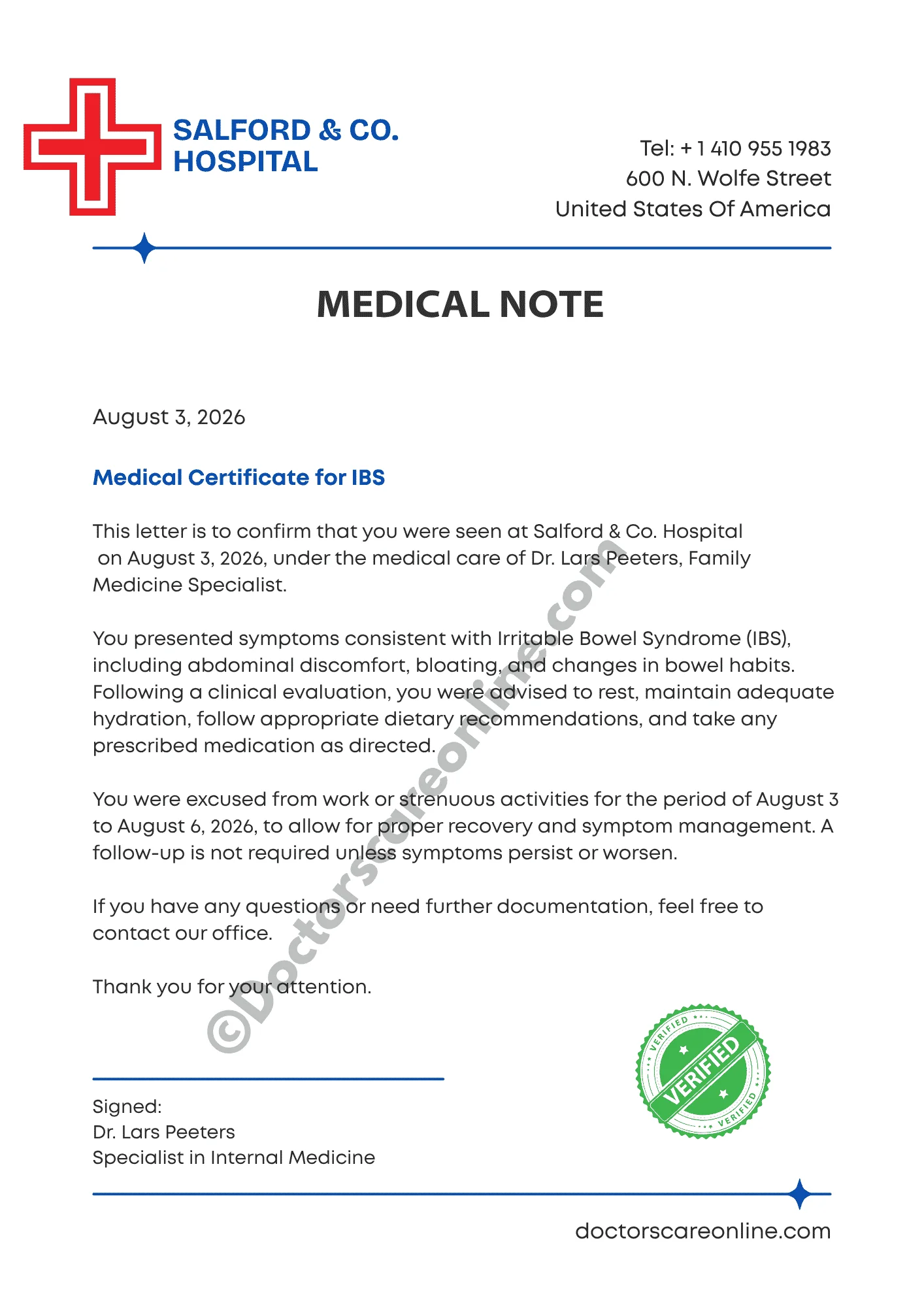
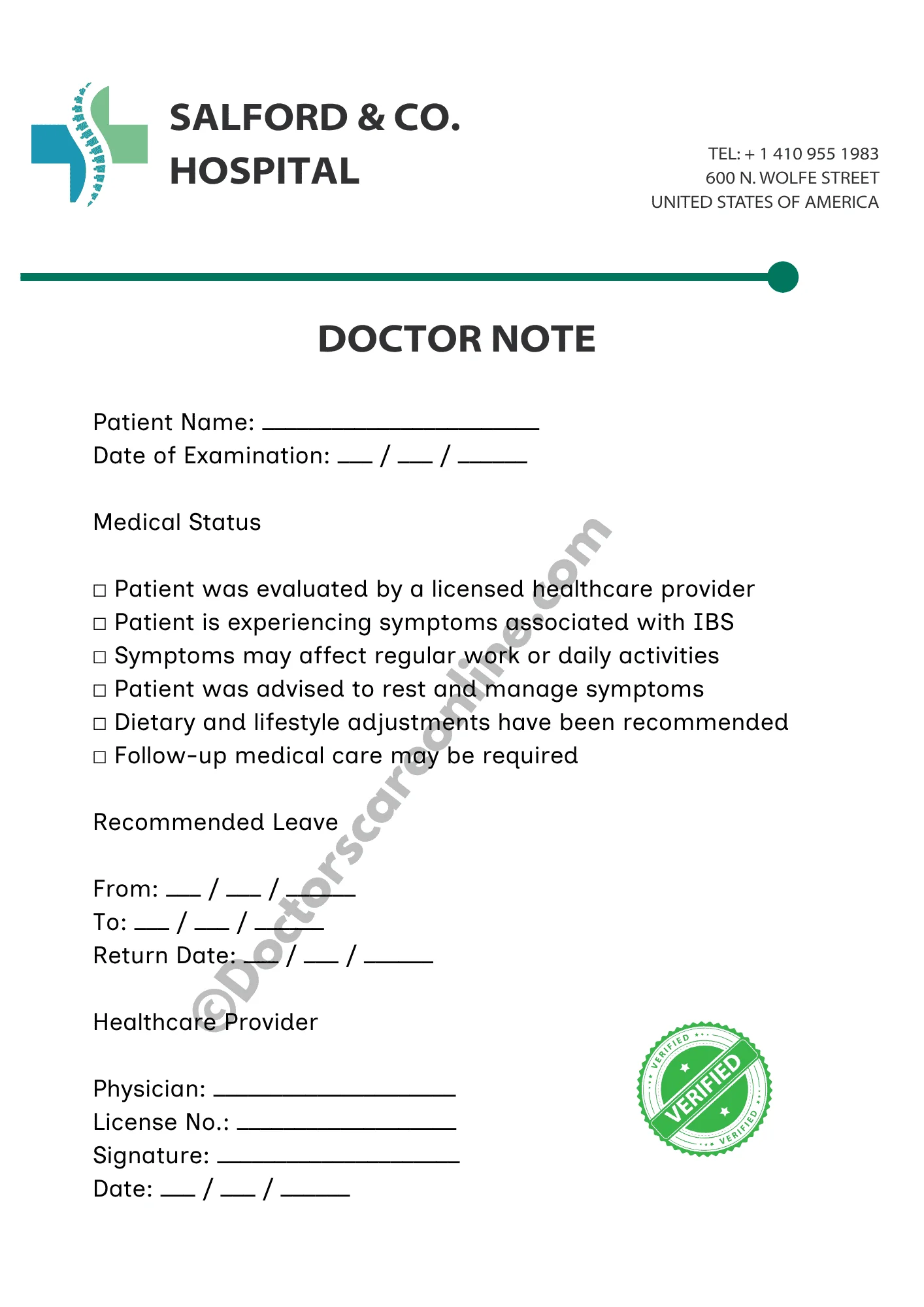
Doctors Note for IBS (Irritable Bowel Syndrome) is a medical document issued by a healthcare professional to confirm that a person is experiencing symptoms related to IBS. It is often used for work or school to justify absence or request flexibility due to digestive discomfort. IBS is a common condition that affects the large intestine and can cause ongoing digestive issues. While it is not life-threatening, it can impact daily routine. A doctor’s note usually mentions the condition, recommended rest, and any necessary accommodations for better management.
Related Doctor Note :—
You can also visit:
- Doctor’s Note for Work From Home
- Unlimited Doctor’s Notes for 1 Year
- Doctors Note for Gastroenteritis
- Doctors Note for Upset Stomach
Irritable bowel syndrome (IBS) can cause recurring abdominal pain, bloating, diarrhea, constipation, or changes in bowel habits that may interfere with work, school, travel, and everyday responsibilities. When IBS symptoms affect your ability to perform normal activities, medical documentation may be useful for explaining an absence, requesting temporary workplace accommodations, or documenting a healthcare evaluation.
Printable Doctors Note for IBS
A doctor’s note for IBS is a medical document that can confirm that a patient was evaluated for symptoms associated with irritable bowel syndrome and, when medically appropriate, may document recommended leave or temporary activity restrictions.
IBS is a disorder of gut-brain interaction characterized by recurring abdominal pain together with changes in bowel movements. Symptoms may include diarrhea, constipation, bloating, and changes in stool appearance or frequency.
The documentation provided after an evaluation may vary according to the patient’s situation. A healthcare provider may focus on functional limitations rather than providing unnecessary details about the patient’s private medical history.
A medical note may be relevant when IBS symptoms interfere with:
- Regular work responsibilities
- School or college attendance
- Extended meetings or classes
- Commuting or travel
- Physically demanding activities
- Access to frequent restroom breaks
- Normal daily activities
A doctor’s note is not automatically issued simply because it is requested. Medical documentation should be based on an appropriate healthcare evaluation and the provider’s professional judgment.
When Might You Need an IBS Medical Note?
IBS symptoms can fluctuate, meaning a person may feel relatively well on one day and experience significant digestive symptoms on another. Because symptoms can be unpredictable, an individual may occasionally need documentation explaining a temporary absence or limitation.
An IBS medical note may be relevant when:
- Severe abdominal discomfort makes normal activities difficult.
- Frequent diarrhea requires repeated restroom access.
- Constipation and abdominal symptoms interfere with daily functioning.
- IBS symptoms make attending work or school impractical.
- A person needs temporary workplace flexibility.
- Symptoms require a healthcare evaluation before returning to normal activities.
- An employer or educational institution requests medical documentation.
- A healthcare provider recommends temporary modifications based on symptoms.
The exact documentation requirements are determined by the organization requesting the note and applicable rules in the relevant U.S. location.
Common IBS Symptoms That Can Affect Work or School
IBS symptoms vary from person to person and may change over time. Common symptoms include:
- Abdominal Pain: Recurring abdominal pain or discomfort is one of the primary symptoms associated with IBS. The discomfort may be related to bowel movements and can vary in intensity.
- Diarrhea: IBS with diarrhea, commonly called IBS-D, can involve frequent loose or watery stools. The need for repeated restroom visits can make certain work environments, classes, meetings, or travel more difficult.
- Constipation: IBS with constipation, or IBS-C, may involve hard or lumpy stools and difficulty passing bowel movements. Symptoms may interfere with concentration, comfort, and normal routines.
- Alternating Bowel Habits: Some individuals experience both constipation and diarrhea. This pattern is commonly referred to as mixed IBS or IBS-M.
- Bloating and Abdominal Fullness: Bloating may occur alongside changes in bowel habits and abdominal discomfort. It can make prolonged sitting, commuting, or completing a normal workday uncomfortable.
- Urgency and Frequent Bathroom Needs: Some people with IBS experience a strong or frequent need to use the restroom. This can be particularly challenging in jobs, classrooms, meetings, or other situations where restroom access is limited.
IBS Types and What They Mean
Healthcare providers may describe IBS according to the predominant bowel pattern.
- IBS-C: IBS in which constipation is the predominant bowel pattern.
- IBS-D: IBS in which diarrhea is the predominant bowel pattern.
- IBS-M: IBS in which both constipation and diarrhea occur as part of the bowel pattern.
The classification can help healthcare professionals understand the patient’s symptoms and consider appropriate management.
How Is IBS Evaluated by a Healthcare Provider?
There is no single test that confirms every case of IBS. Healthcare providers generally consider the patient’s symptoms, medical history, family history, and physical examination when evaluating possible IBS. Additional testing may be considered when another condition needs to be ruled out.
During an appointment, a provider may ask about:
- The location and pattern of abdominal pain
- Changes in bowel frequency
- Stool consistency
- Duration of symptoms
- Food-related symptoms
- Previous gastrointestinal problems
- Medications and supplements
- Recent infections
- Family history of digestive diseases
- Symptoms that may suggest another condition
Depending on the clinical situation, a provider may recommend blood tests, stool testing, or other diagnostic procedures.
This evaluation is important because symptoms that resemble IBS can also occur with other gastrointestinal conditions.
Symptoms That Should Not Be Assumed to Be IBS
Some symptoms warrant additional medical evaluation because they may indicate a condition other than uncomplicated IBS.
Seek medical advice if you experience symptoms such as:
- Rectal bleeding
- Bloody or black stools
- Unexplained weight loss
- Anemia or low iron levels
- New digestive symptoms later in life
- A significant family history of colorectal cancer or inflammatory bowel disease
- Persistent or unusually severe symptoms
The American College of Gastroenterology identifies these types of findings as warning signs that may require further evaluation.
If you experience severe symptoms, significant bleeding, fainting, severe dehydration, or another potentially serious medical problem, seek urgent or emergency medical care rather than relying on an online medical-note service.
How IBS Can Affect Your Ability to Work
IBS can affect different occupations in different ways. A person working at a desk may struggle with abdominal discomfort or repeated restroom trips, while someone working in a warehouse, healthcare setting, construction environment, or other physically demanding position may experience additional challenges.
Depending on the individual’s circumstances, IBS symptoms may interfere with:
- Maintaining a regular work schedule
- Remaining in meetings for extended periods
- Traveling to and from work
- Performing duties without frequent restroom access
- Maintaining concentration during significant symptoms
- Completing physically demanding tasks while experiencing abdominal discomfort
A healthcare provider can assess whether temporary leave, modified duties, or other recommendations are medically appropriate.
IBS and School or College Absences
Students may also experience difficulty attending classes, examinations, or other academic activities when IBS symptoms become disruptive.
Depending on the institution’s requirements, appropriate medical documentation may help explain a medically related absence or support a request for reasonable academic arrangements.
Students should check their school’s or college’s documentation policy before requesting a medical note because requirements can vary between institutions.
What May Be Included in an IBS Doctor’s Note?
The information included in medical documentation depends on the healthcare provider, the patient’s circumstances, and the requirements of the organization receiving the document.
A note may include:
- Patient’s name
- Date of medical evaluation
- Confirmation of a healthcare assessment
- Recommended absence period, when medically appropriate
- Temporary activity or work restrictions
- Recommended return date, when applicable
- Follow-up recommendations
- Healthcare provider’s name and professional information
- Clinic or practice information
- Provider signature or other required authentication
The note does not necessarily need to disclose every detail of the patient’s medical history. The amount of information provided should be appropriate for the purpose of the documentation and applicable requirements.
Can an IBS Doctor’s Note Recommend Work Accommodations?
A healthcare provider may recommend temporary workplace modifications when symptoms affect the patient’s ability to perform certain duties.
Depending on the person’s medical needs and job responsibilities, possible recommendations may involve:
- Access to restroom facilities when needed
- Temporary schedule modifications
- Additional breaks
- Temporary changes to certain duties
- Short-term leave
- Other medically appropriate workplace adjustments
Whether a particular accommodation can be provided depends on the individual’s circumstances, employer policies, applicable law, and the healthcare provider’s recommendations.
Employees should discuss accommodation procedures with their employer or HR department when appropriate.
How to Book an Online Medical Appointment for IBS
If you are experiencing symptoms that may be related to IBS and want to discuss them with a healthcare professional, an online medical appointment may be an option when telehealth is appropriate and available in your location.
Step 1: Select an Available Appointment
- Choose an available online appointment with an appropriate licensed healthcare professional.
Step 2: Create or Access Your Account
- Register for an account or sign in using the information requested by the website.
Step 3: Provide Your Health Information
- Describe your symptoms accurately, including abdominal pain, diarrhea, constipation, bloating, urgency, or other digestive concerns.
Step 4: Complete the Medical Consultation
- Discuss your symptoms and relevant medical history with the healthcare provider. Answer questions honestly so the provider can determine whether your condition can be appropriately evaluated through telehealth.
Step 5: Follow the Provider’s Recommendations
- The provider may recommend treatment, additional evaluation, an in-person examination, diagnostic testing, or other medical care depending on your symptoms.
Step 6: Receive Documentation If Medically Appropriate
- If the provider determines that medical documentation is appropriate after the evaluation, they may issue a doctor’s note in accordance with applicable professional requirements and local rules.
Online evaluation does not guarantee that a doctor’s note will be issued. The healthcare provider makes that decision based on the medical assessment.
What Information Should You Have Ready for an Online IBS Appointment?
Preparing relevant information can make your consultation more productive.
Consider having the following available:
- When your symptoms began
- How frequently symptoms occur
- Your typical bowel pattern
- Recent changes in stool consistency
- Abdominal pain location and severity
- Foods that appear to trigger symptoms
- Current medications and supplements
- Previous digestive diagnoses
- Previous test results, if available
- Relevant family medical history
- Your work or school requirements
- Any documentation requirements you have been given
Accurate information helps the healthcare provider understand your situation and determine the appropriate next steps.
IBS Treatment and Symptom Management
Treatment for IBS is individualized. Depending on the symptoms and subtype, healthcare professionals may recommend dietary changes, lifestyle adjustments, medications, probiotics, or certain behavioral therapies.
Possible approaches include:
- Gradual dietary adjustments
- Increasing appropriate forms of fiber
- Physical activity
- Improving sleep habits
- Stress-management strategies
- Low-FODMAP dietary approaches under appropriate guidance
- Medicines targeted toward specific IBS symptoms
- Psychological therapies such as cognitive behavioral therapy when appropriate
Not every treatment works for every person. A healthcare professional can help determine which approach is appropriate for your symptoms.
For example, NIDDK notes that dietary changes such as increasing fiber or trying a low-FODMAP approach may help some people, while the appropriate dietary strategy varies between individuals.
How to Manage IBS During the Workday
If your healthcare provider has confirmed that your symptoms are consistent with IBS, practical planning may help reduce disruption during work or school.
Consider:
- Knowing where nearby restrooms are located
- Keeping a symptom and food diary if recommended
- Taking prescribed medications as directed
- Maintaining appropriate hydration
- Following the dietary plan recommended by your healthcare professional
- Taking movement breaks when appropriate
- Communicating medically necessary restrictions through the proper workplace or school process
Avoid making major dietary or medication changes solely based on online information without discussing them with an appropriate healthcare professional.
How Our Online Medical Note Service Helps Users
Our website is designed to make the process of seeking an online medical evaluation more convenient for users who need to discuss a health concern and potentially obtain appropriate medical documentation.
Instead of relying on a self-written explanation of symptoms, users can use the platform to connect with the appropriate online consultation process and provide relevant information about their health concerns.
Our service is designed around:
- A convenient online appointment process
- Clear steps for submitting relevant information
- Access to healthcare evaluation where available
- Medical documentation only when clinically appropriate
- A straightforward digital experience
- Support for users who need help navigating the website
A medical note is not simply a product that should be issued without an evaluation. Appropriate documentation depends on the healthcare professional’s assessment and applicable requirements.
Why Users Can Trust Our Online Medical Note Process
Trust is especially important when using an online healthcare service. Users should understand what they are receiving, how the process works, and when medical evaluation is required.
Our approach is designed to prioritize:
- Healthcare evaluation: Medical documentation should be connected to an appropriate healthcare assessment rather than being issued solely on request.
- Clear communication: The service should clearly explain the consultation and documentation process before the user completes it.
- Professional judgment: Healthcare providers determine whether documentation is medically appropriate based on the information available to them.
- User privacy: Health information should be handled according to the service’s applicable privacy practices and legal requirements.
- Transparent support: Users can contact our support team when they need assistance with the website process.
- Responsible medical information: Educational information should not replace personalized medical advice from a qualified healthcare professional.
For stronger transparency and E-E-A-T, healthcare content on this page should be medically reviewed and periodically updated by an appropriately credentialed U.S. healthcare professional.
Need Help With Registration, Login, Payment, or Your Order?
If you experience a problem while using our website, you do not have to figure it out alone.
If you have questions or issues related to:
- Registering for an account
- Logging into your account
- Booking an appointment
- Completing payment
- Understanding the ordering process
- Accessing your account or documentation
- Website navigation
- Another service-related question
you can contact us through the chatbox on our website for assistance.
Our support team can help with website-related questions and guide you through the appropriate process. For medical questions or decisions about your symptoms, treatment, diagnosis, or need for medical documentation, you should communicate directly with the healthcare professional handling your consultation.
Important Things to Know Before Requesting an IBS Doctor’s Note
Keep the following points in mind before requesting medical documentation:
- A doctor’s note should be based on a healthcare evaluation.
- Documentation is not guaranteed simply because it is requested.
- Requirements can differ between employers, schools, and organizations.
- Telehealth may not be appropriate for every medical situation.
- A provider may recommend an in-person examination when necessary.
- Do not change, edit, or alter a medical document after it has been issued.
- Follow the medical and workplace instructions provided by your healthcare professional.
- Seek urgent medical care when serious or rapidly worsening symptoms occur.
Frequently Asked Questions
Q: Can IBS qualify for a medical leave of absence?
It can, depending on the severity of symptoms, functional limitations, medical documentation, workplace policies, and applicable employment rules. A healthcare provider can evaluate whether leave is medically appropriate for an individual situation.
Q: Can I use an IBS doctor’s note for an employer?
A medical note may be submitted to an employer when documentation is required, but acceptance and documentation requirements vary by employer and applicable rules. Check your company’s leave or attendance policy for specific requirements.
Q: Can IBS symptoms qualify for disability accommodations?
Some individuals with significant IBS-related limitations may be eligible for workplace accommodations depending on their circumstances and applicable law. Eligibility is not determined solely by having an IBS diagnosis, so employees should discuss their situation with the appropriate workplace or legal resources.
Q: Can a healthcare provider diagnose IBS during a telehealth visit?
In some cases, a healthcare provider may be able to evaluate symptoms through telehealth, but whether an online assessment is sufficient depends on the individual’s symptoms and clinical circumstances. The provider may recommend an in-person evaluation or testing when necessary.
Q: How often should IBS symptoms be medically evaluated?
There is no single schedule that applies to everyone. Follow-up depends on symptom severity, changes over time, treatment response, and your healthcare provider’s recommendations. New or unusual warning signs should be medically assessed rather than automatically attributed to IBS.
Medical Disclaimer: This content is provided for general educational and informational purposes only. It is not a substitute for professional medical advice, diagnosis, or treatment.
Telehealth availability, prescribing practices, documentation requirements, workplace policies, school policies, and other healthcare rules may vary by state and individual circumstances.
Editorial and Medical Information Sources: This page is intended to provide user-friendly educational information based on established medical resources. Information regarding IBS symptoms, diagnosis, warning signs, and treatment is consistent with guidance and educational materials from the National Institute of Diabetes and Digestive and Kidney Diseases (NIDDK) and the American College of Gastroenterology (ACG).
For publication, the page should be reviewed by a qualified U.S. healthcare professional and periodically updated when relevant medical guidance or applicable requirements change.



Reviews
There are no reviews yet.