
A doctor’s note for work from home is medical documentation from a licensed healthcare provider that may support an employee’s request to temporarily work remotely because of a medical condition, recovery period, injury, or other health-related limitation.
If your health condition makes commuting, sitting in an office, standing for long periods, traveling, or performing your usual workplace activities difficult, a healthcare provider can evaluate your situation and determine whether temporary work-from-home or modified-work recommendations are medically appropriate.
Depending on your condition and employer’s requirements, medical documentation may recommend temporary remote work, modified duties, reduced activity, additional breaks, or a period away from work.
Important: A work-from-home doctor’s note is not automatically issued simply because it is requested. A licensed healthcare provider must evaluate your circumstances and determine whether medical documentation or work restrictions are clinically appropriate.
What Is a Doctor’s Note for Work From Home?
A doctor’s note for working from home is a form of medical documentation that communicates a healthcare provider’s recommendation regarding an employee’s ability to work remotely or with temporary workplace modifications.
The documentation may be relevant when an employee is medically able to work but traveling to or working from a traditional workplace could interfere with recovery or worsen symptoms.
Depending on the circumstances, a healthcare provider may recommend:
- Temporary work from home
- Modified work duties
- Reduced physical activity
- Additional rest or movement breaks
- Reduced working hours, when medically appropriate
- Temporary restrictions on commuting or travel
- A specific period for remote work
- Follow-up evaluation before returning to regular workplace arrangements
The provider determines what recommendation is appropriate based on the individual’s medical condition, symptoms, job responsibilities, and clinical assessment.
When Might You Need a Work-From-Home Doctor’s Note?
A medical note supporting temporary remote work may be relevant in situations where an employee can perform their job but their health condition makes the normal workplace environment difficult or unsafe.
Common situations include:
- Recovery From an Illness: An employee may be recovering from an illness while still being medically capable of completing certain job responsibilities from home.
- Back or Neck Pain: Pain may make commuting, prolonged sitting, standing, or traveling to the workplace difficult. A healthcare provider may recommend temporary modifications when appropriate.
- Injury Recovery: Employees recovering from an injury may be able to work but may need to avoid commuting, physical activity, or workplace tasks that could interfere with recovery.
- Recovery After Surgery: Following certain procedures, a patient may require temporary activity restrictions while remaining capable of performing appropriate remote work.
- Migraine or Severe Headache: Certain conditions may make bright office environments, commuting, noise, or prolonged workplace activity difficult during recovery.
- Pregnancy-Related Limitations: Some pregnancy-related symptoms or medical restrictions may make commuting or certain workplace activities difficult. Any work-from-home recommendation should be based on individual medical circumstances.
- Chronic Condition Flare-Ups: A temporary worsening of a chronic condition may affect an employee’s ability to commute or work in a traditional office while still allowing some work activities from home.
- Mental or Behavioral Health Conditions: Some health conditions may affect concentration, stress tolerance, commuting, or the ability to work effectively in a particular environment. A qualified healthcare provider determines whether remote work or another accommodation is clinically appropriate.
Can a Doctor Recommend Working From Home?
A healthcare provider may recommend temporary remote work when, after an appropriate evaluation, the patient’s medical condition supports such a recommendation.
However, a doctor does not automatically determine an employer’s final work arrangement.
The healthcare provider can document medically appropriate recommendations or restrictions. The employer then reviews that documentation under its workplace policies and any applicable employment laws.
For example, a medical recommendation might state that an employee should temporarily avoid commuting or certain workplace activities while remaining capable of performing their essential job functions remotely.
What Can a Work-From-Home Doctor’s Note Include?
The information included depends on the medical situation, healthcare provider, and employer’s documentation requirements.
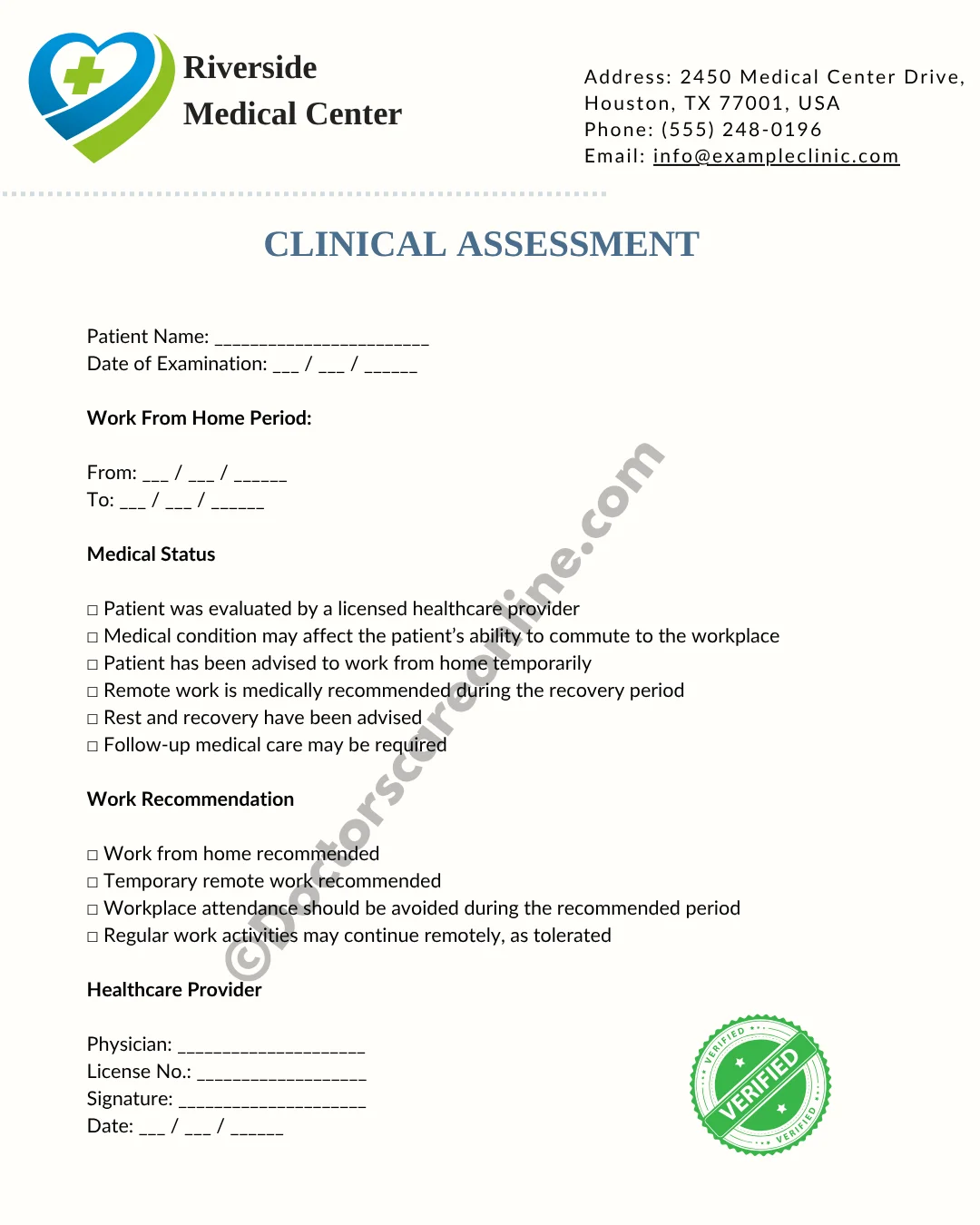
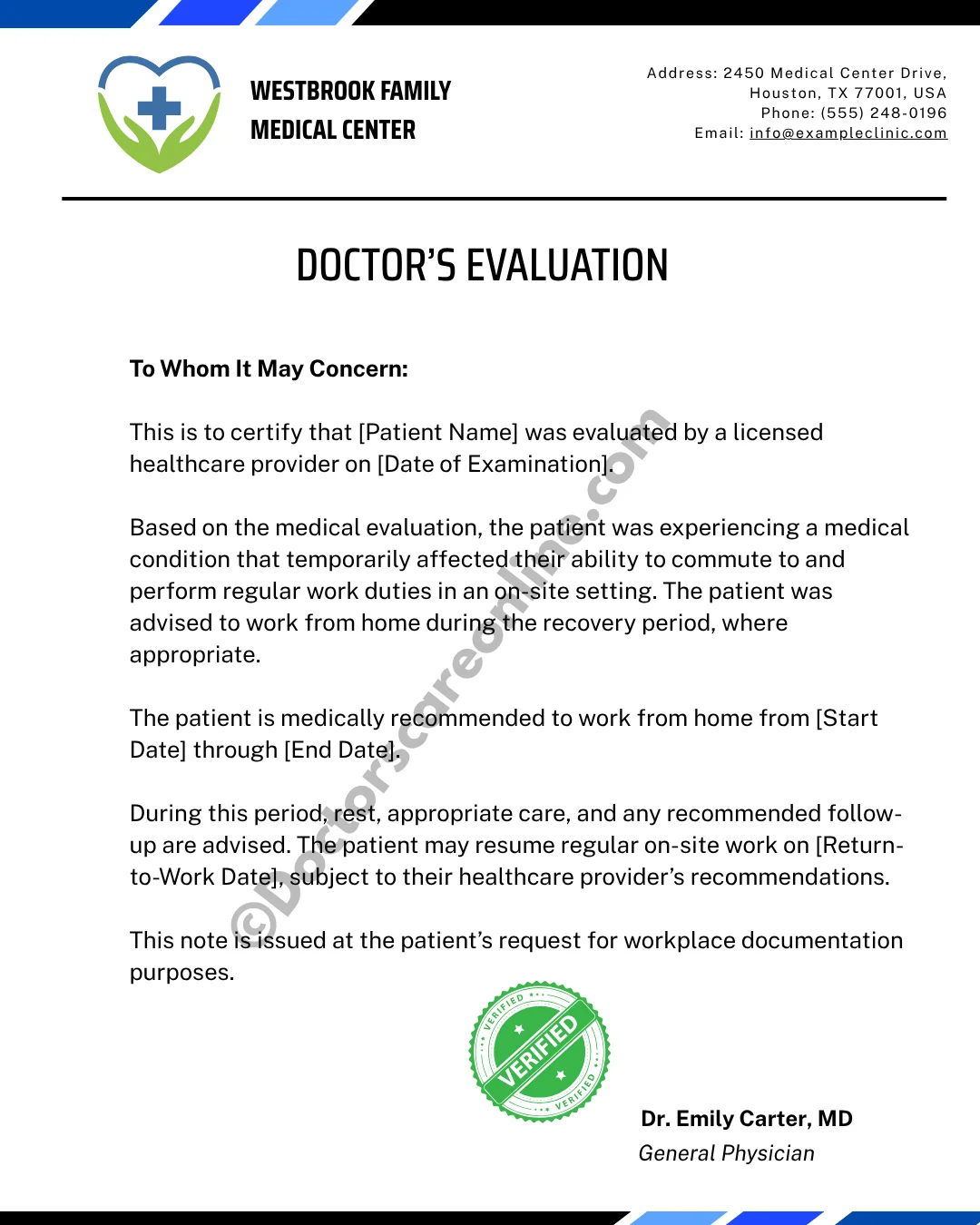
A medical note may include:
| Information | Purpose |
|---|---|
| Patient’s name | Identifies the employee |
| Date of evaluation | Confirms when the medical assessment occurred |
| Medical work recommendation | Explains the recommended work arrangement |
| Remote-work period | Indicates the recommended duration, when appropriate |
| Work restrictions | Identifies relevant temporary limitations |
| Return-to-office date | Provides a recommended date when applicable |
| Follow-up instructions | Indicates whether reassessment may be required |
| Provider information | Identifies the healthcare professional or practice |
| Provider signature | Authenticates the documentation where required |
Not every note needs to contain a detailed diagnosis. The amount of medical information required can depend on the employer’s request and applicable rules.
For example, under the FMLA, medical certification generally needs sufficient medical facts to establish the need for leave, but a diagnosis itself is not necessarily required.
Does a Work-From-Home Note Guarantee Remote Work?
No.
A doctor’s note is medical documentation or a medical recommendation, not a guarantee that an employer must approve permanent or temporary remote work in every situation.
Your employer may have its own policies regarding:
- Remote work
- Medical documentation
- Workplace accommodations
- Attendance
- Leave
- Modified duties
- Fitness-for-duty requirements
Before requesting documentation, review your company’s policy or speak with HR so you understand what information is required.
How to Get a Doctor’s Note for Work From Home Online
If you need medical documentation supporting temporary remote work, the appropriate process is to have your condition evaluated by a licensed healthcare provider.
Step 1: Check Your Employer’s Requirements
Before scheduling an appointment, check whether your employer requires a doctor’s note, medical certification, accommodation documentation, or a specific company form.
Step 2: Book an Online Medical Appointment
Choose a legitimate telehealth service or licensed healthcare provider that offers online consultations in your location.
Telehealth licensing requirements can vary by state and location, so providers must meet applicable licensing or practice requirements.
Step 3: Explain Your Medical Situation
During the consultation, describe your symptoms, diagnosis if already known, treatment, recovery status, and how your condition affects your ability to commute or work at your usual location.
Step 4: Explain Your Job Responsibilities
Tell the healthcare provider what your work involves.
For example:
- Computer-based work
- Office attendance
- Commuting
- Driving
- Standing
- Walking
- Lifting
- Physical activity
- Customer-facing responsibilities
- Other essential job functions
This information can help the provider understand your functional limitations.
Step 5: Complete the Medical Evaluation
The healthcare provider will determine whether your condition can be appropriately evaluated through telehealth and whether remote work, modified duties, leave, or another recommendation is medically appropriate.
Step 6: Discuss Work Restrictions
If appropriate, the provider may recommend temporary remote work or other restrictions based on your medical needs.
Step 7: Receive Documentation When Medically Appropriate
If the provider determines that documentation is justified, they may issue an appropriate doctor’s note or medical certification according to applicable requirements.
An online consultation does not guarantee that a work-from-home note will be issued.
Step 8: Submit the Documentation to Your Employer
Provide the documentation through your employer’s required HR, leave-management, or accommodation process.
What Should You Tell the Doctor During an Online Appointment?
To help the healthcare provider understand your situation, be prepared to explain:
- When your symptoms started
- Your current symptoms
- Severity and frequency of symptoms
- Any diagnosis you already have
- Recent illness, injury, surgery, or treatment
- Medications you are taking
- How commuting affects your condition
- How working at the office affects your symptoms
- What tasks you can perform from home
- Your normal job responsibilities
- Your expected recovery period
- Your employer’s documentation requirements
Be honest and accurate. The medical documentation should reflect the provider’s actual evaluation and professional judgment.
Can a Doctor Recommend Temporary Work From Home?
Yes, when medically appropriate.
A provider may recommend temporary remote work when an employee remains capable of performing their job but has a medical limitation that makes regular workplace attendance difficult.
The recommendation might include a specific period, such as:
- Temporary remote work during recovery
- Remote work until a follow-up appointment
- Remote work while a temporary restriction remains in place
- A gradual return to the workplace
The appropriate duration depends on the individual’s medical condition and recovery rather than a universal number of days.
Work From Home vs. Medical Leave
These are not necessarily the same.
Work from home generally means the employee continues working remotely while following medically appropriate restrictions.
Medical leave means the employee is temporarily unable to work or needs time away from work for medical reasons.
A healthcare provider determines whether the employee is medically capable of working and whether restrictions are appropriate. The employer’s policies and applicable laws determine how the resulting documentation is handled.
For qualifying FMLA situations, employers may require medical certification, and certain employees may also be required to provide fitness-for-duty certification before returning to work when the applicable requirements are met.
Can a Doctor Recommend Work Restrictions Instead of Working From Home?
Yes.
Remote work is only one possible workplace recommendation. Depending on the condition and job, a healthcare provider may recommend other temporary modifications, such as:
- Avoiding heavy lifting
- Limiting prolonged standing
- Limiting prolonged walking
- Reducing repetitive movements
- Taking additional breaks
- Avoiding certain physical activities
- Modified work duties
- Reduced hours when medically appropriate
- A gradual return to normal duties
The provider should recommend restrictions based on the medical evaluation and the employee’s functional limitations.
How Long Can a Doctor Recommend Working From Home?
There is no universal period that applies to every medical condition.
The recommended duration can depend on:
- The medical condition
- Severity of symptoms
- Treatment and recovery progress
- Job requirements
- Functional limitations
- Whether the condition is temporary or recurring
- Need for follow-up evaluation
A provider may recommend a specific period and reassessment if the employee’s condition requires continued restrictions.
If your symptoms change, do not alter the doctor’s note yourself. Contact the healthcare provider for an updated evaluation.
How to Protect Your Medical Privacy
Before submitting medical documentation, check exactly what your employer requires.
A medical note does not necessarily need to contain every detail of your medical history.
When appropriate, documentation can focus on information relevant to:
- Your ability to work
- Recommended work restrictions
- Recommended remote-work period
- Expected return date
- Need for follow-up
Under FMLA certification rules, for example, an employer may request sufficient medical facts supporting the need for protected leave, while the employee is not generally required to provide complete medical records.
If you have concerns about privacy, discuss them with your healthcare provider and HR department.
Why Choose an Online Medical Evaluation?
An online consultation can be convenient for people who need to discuss a health concern without immediately traveling to a clinic, when telehealth is clinically appropriate.
Potential benefits include:
- Convenient appointment scheduling
- Remote access to a licensed healthcare professional
- Consultation from a private location
- Discussion of symptoms and work limitations
- Professional medical guidance
- Documentation when medically appropriate
- Follow-up recommendations
Telehealth is not suitable for every medical condition. If a physical examination, diagnostic testing, or urgent assessment is necessary, the healthcare provider may recommend an in-person visit.
What Makes Our Online Process Trustworthy?
When choosing an online healthcare service, trust and transparency matter.
A responsible service should make it clear that:
- Medical documentation is not guaranteed before an evaluation.
- A licensed healthcare professional makes the clinical decision.
- Patient information should be handled securely and appropriately.
- Telehealth may not be suitable for every condition.
- Documentation should accurately reflect the medical evaluation.
- Employer requirements may differ.
- Patients should receive appropriate medical care when symptoms require in-person evaluation.
Our goal is to connect users with an appropriate healthcare evaluation rather than promise a predetermined medical outcome.
When Should You Seek In-Person Medical Care?
An online consultation may not be appropriate when symptoms require physical examination, testing, or urgent treatment.
Seek appropriate in-person or emergency medical care for serious symptoms such as:
- Severe or rapidly worsening symptoms
- Difficulty breathing
- Chest pain
- Loss of consciousness
- Severe weakness
- New neurological symptoms
- Serious injury or trauma
- Uncontrolled bleeding
- Other symptoms that may indicate a medical emergency
Do not delay emergency medical care simply because you need a work-from-home note.
Common Mistakes to Avoid
Avoid these mistakes when requesting medical documentation for remote work:
- Buying or using a note without a genuine medical evaluation
- Providing inaccurate information to a healthcare provider
- Assuming a doctor’s note automatically guarantees remote work
- Ignoring your employer’s documentation requirements
- Editing or altering medical documentation
- Requesting a predetermined restriction without medical justification
- Failing to explain your actual job responsibilities
- Ignoring symptoms that require medical attention
- Assuming telehealth is appropriate for every condition
- Waiting until the last minute to check your employer’s policy
Key Takeaways
A doctor’s note for work from home may provide medical documentation supporting temporary remote work when a healthcare provider determines that it is clinically appropriate.
The process generally involves:
- Checking your employer’s requirements.
- Booking an appointment with a licensed healthcare provider.
- Explaining your medical condition and work limitations.
- Completing an appropriate medical evaluation.
- Following the provider’s recommendation.
- Receiving documentation if medically justified.
- Submitting the documentation according to your employer’s process.
A medical note should accurately reflect a legitimate healthcare evaluation. It should not be altered, fabricated, or purchased without appropriate medical assessment.
Frequently Asked Questions
1. Can I get a doctor’s note to work from home online?
Yes, an online medical consultation may be available when telehealth is appropriate in your location. A licensed healthcare provider must evaluate your situation and determine whether temporary work-from-home documentation is medically appropriate. An online consultation does not guarantee that a note will be issued.
2. What conditions can qualify for a work-from-home doctor’s note?
A provider may consider temporary remote work for various medical circumstances, including recovery from illness or injury, post-surgical recovery, pain conditions, pregnancy-related limitations, or certain chronic-condition flare-ups. Eligibility is not automatic; the recommendation depends on the individual’s medical assessment and job requirements.
3. Does a doctor’s note guarantee that my employer will let me work from home?
No. A doctor’s note provides medical documentation or a recommendation. Your employer may have separate policies concerning remote work, accommodations, leave, and medical documentation. Check your employer’s requirements before submitting the note.
4. Can an Employer Verify a Doctor’s Note?
An employer may have procedures for verifying or authenticating medical documentation.
For example, under federal FMLA rules, an employer may be able to seek authentication or clarification of medical certification in certain circumstances.
If an employer contacts a healthcare provider directly, privacy rules may apply. HHS explains that a covered healthcare provider generally cannot disclose protected health information to an employer without the patient’s authorization unless an applicable exception or law permits the disclosure.
This is one reason it is important to use accurate, legitimate medical documentation from an actual healthcare evaluation.
5. Can I get a work-from-home doctor’s note without seeing a doctor?
A legitimate medical note should be based on an appropriate evaluation by a licensed healthcare provider. If telehealth is clinically suitable, that evaluation may take place online. A note should not be issued simply because someone requests or purchases one without a medical assessment.
Medical Disclaimer: This content is provided for general informational and educational purposes only and does not constitute medical advice, diagnosis, or treatment.
A doctor’s note for work from home should only be issued by a qualified healthcare professional after an appropriate medical evaluation. Telehealth availability, provider licensing, medical documentation requirements, workplace policies, and employment laws vary by location and individual circumstances.
Related Post :——

Reviews
There are no reviews yet.