
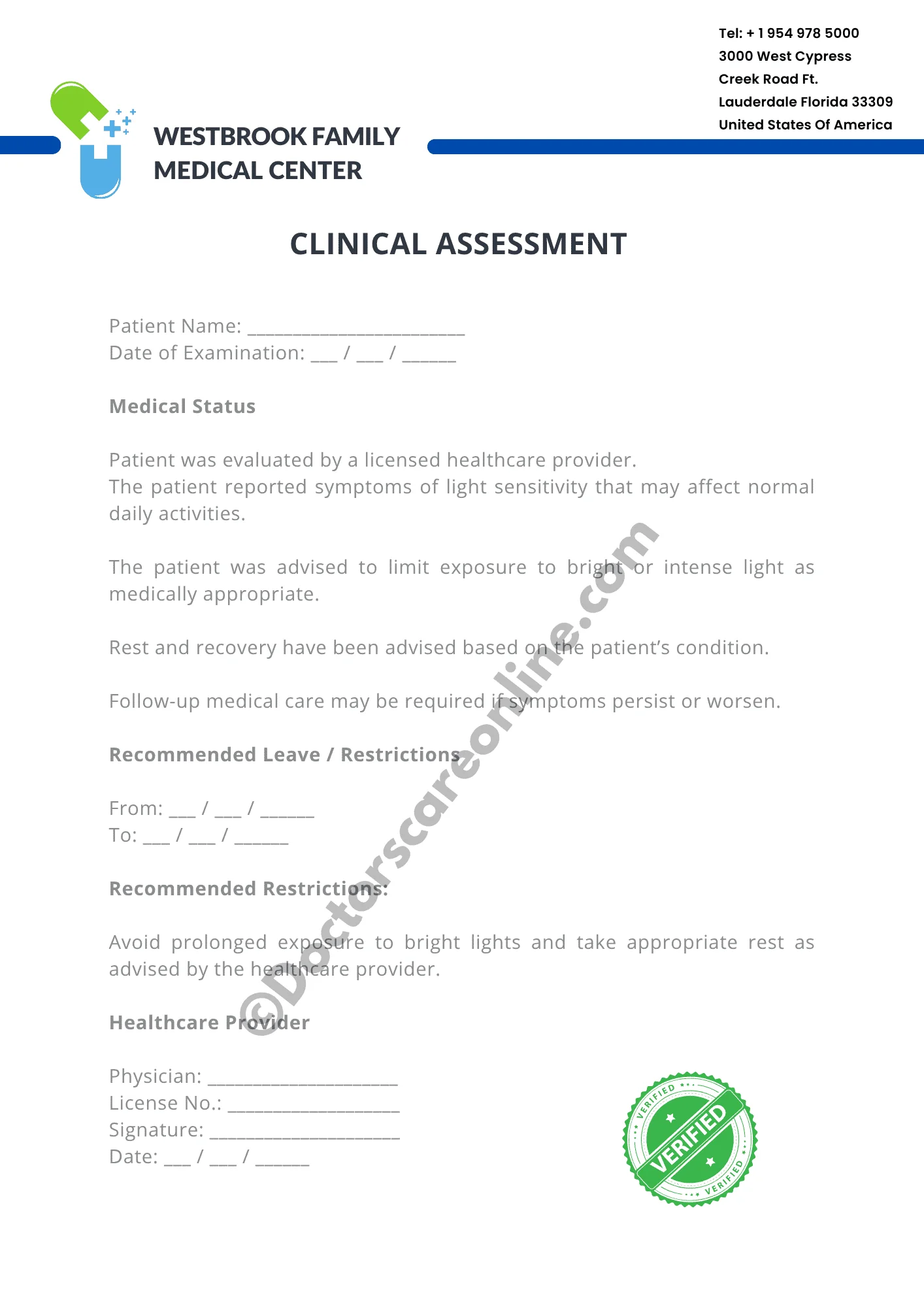
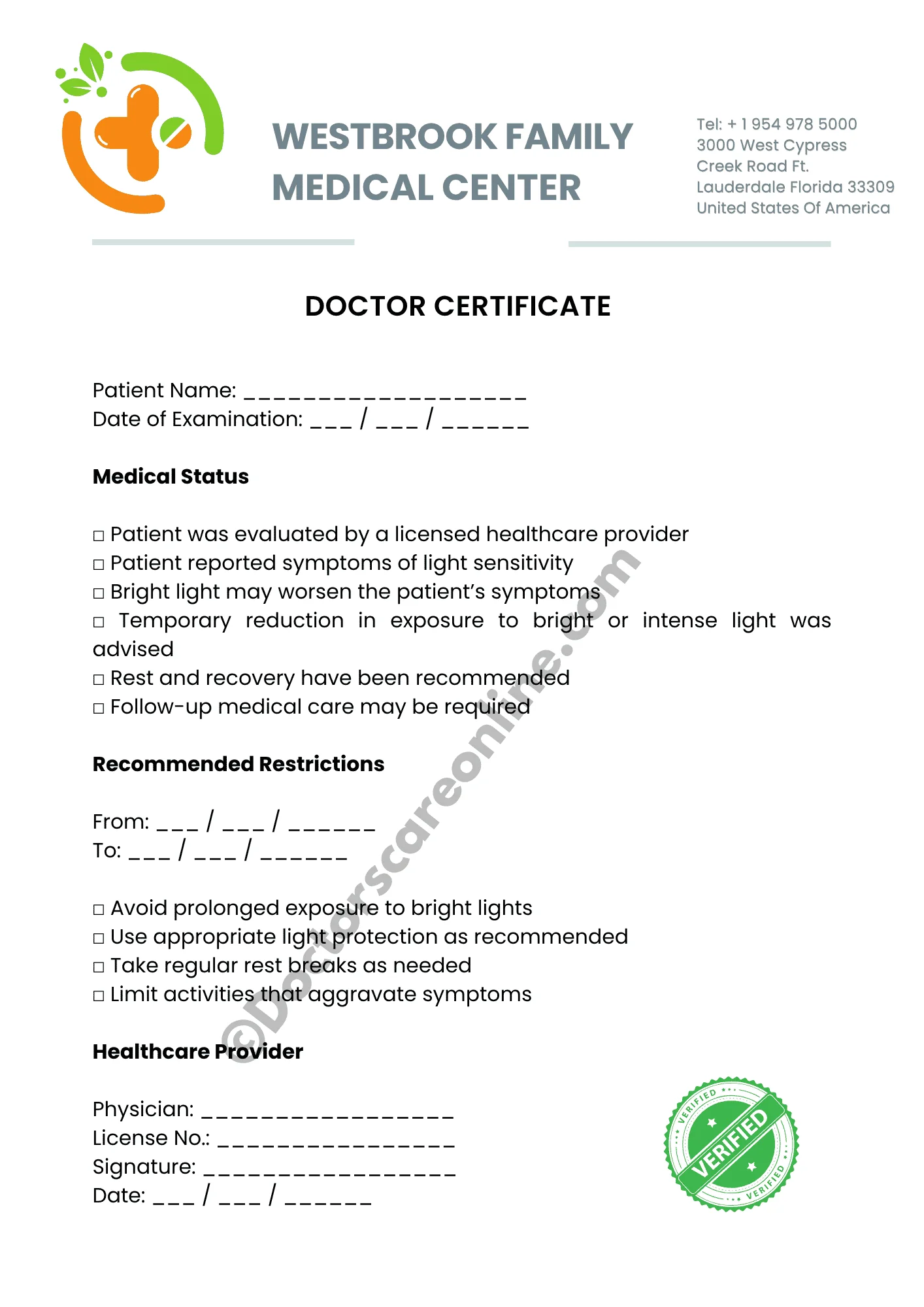
Doctor’s Note for Light Sensitivity (Photophobia) is a medical document provided by a healthcare professional to confirm that an individual is experiencing discomfort or pain when exposed to bright light. This condition can be linked to issues such as migraines, eye infections, dry eyes, or neurological conditions. It may affect the ability to work on screens, stay in bright environments, or perform daily tasks. The doctor’s note is often used for workplace or school accommodations, such as reduced screen time, dim lighting, or rest periods. It usually includes the condition, recommended precautions, and duration of limitations.
Light sensitivity, medically known as photophobia, is a symptom in which bright light causes discomfort, irritation, or pain in the eyes. It may occur with eye conditions, migraine, dry eyes, certain medications, or other medical issues. Because the underlying cause can vary, new, persistent, or worsening light sensitivity should be evaluated by an appropriate healthcare professional.
Related Doctor Note :——
- Doctor’s Note for Dark Tint
- Doctors Note for Limited Work
- Doctor Excuse Note for Work
- Unlimited Doctor’s Notes for 1 Year
The exact information included in a medical note can vary. A provider may focus on functional limitations rather than unnecessarily disclosing a specific diagnosis.
For example, documentation may address limitations related to:
- Bright or intense lighting
- Prolonged computer or screen exposure
- Outdoor light exposure
- Visually demanding activities
- Work or school attendance
- Temporary activity modifications
A doctor’s note is not simply a personal statement of symptoms. It should be based on a healthcare provider’s professional assessment and issued only when medically appropriate.
Why You Might Need a Doctor’s Note for Light Sensitivity
Light sensitivity can interfere with everyday responsibilities, particularly when your work or school environment involves bright lights, computer screens, prolonged visual concentration, or outdoor exposure.
A medical note may be relevant when:
- Light sensitivity makes it difficult to work safely or comfortably.
- You need temporary workplace accommodations.
- Your school or college requires documentation for an absence.
- You need modified lighting or reduced screen exposure.
- Your healthcare provider recommends temporary rest or activity restrictions.
- You need documentation supporting a medically necessary absence.
- Your symptoms are affecting your ability to perform normal responsibilities.
Whether a note is appropriate, what it should say, and how long any restrictions should last depend on your individual medical assessment and the requirements of the organization requesting documentation.
Common Causes and Conditions Associated With Light Sensitivity
Photophobia can be associated with several eye-related and neurological conditions. It is a symptom rather than a diagnosis by itself.
Possible causes and associated conditions include:
- Migraine: Light can trigger or worsen symptoms for some people with migraine. Photophobia may occur together with headache, nausea, or other migraine symptoms.
- Dry Eye: Dry eyes can cause irritation and increased sensitivity to light. Treatment depends on the underlying cause and should be discussed with a healthcare professional when symptoms persist.
- Eye Inflammation: Conditions involving inflammation inside or around the eye can cause pain, redness, vision changes, and light sensitivity. Uveitis, for example, can be associated with photophobia and requires appropriate medical evaluation.
- Eye Infection or Irritation: Certain infections and eye-irritation conditions may cause discomfort, redness, discharge, and sensitivity to light. Severe or sudden symptoms should be assessed promptly.
- Corneal Problems: A corneal abrasion or other corneal condition may cause eye pain and sensitivity to light and may require professional treatment.
- Medication-Related Light Sensitivity: Certain medications can contribute to photophobia or increased sensitivity to light. Do not stop a prescribed medication on your own; discuss possible side effects with your healthcare provider.
- Head or Brain Injury: Photophobia may occur following traumatic brain injury or other neurological conditions. New symptoms following an injury should be medically evaluated.
Symptoms That May Occur With Light Sensitivity
People experiencing photophobia may notice:
- Discomfort or pain in bright light
- Frequent squinting or blinking
- Difficulty looking at screens
- Preference for dimly lit environments
- Eye irritation or watering
- Headache or migraine symptoms
- Difficulty working under bright office lighting
- Difficulty spending time outdoors
- Increased discomfort from sunlight or artificial lighting
The severity and combination of symptoms vary from person to person.
When Should Light Sensitivity Be Evaluated by a Healthcare Provider?
New or worsening light sensitivity should not automatically be assumed to be harmless. A healthcare provider or eye-care professional can help determine whether further evaluation is needed.
Seek prompt medical attention if light sensitivity occurs with symptoms such as:
- Significant or severe eye pain
- Sudden changes in vision
- Sudden vision loss
- A very red eye
- New flashes or a sudden increase in floaters
- Severe headache or neurological symptoms
- Eye injury
- Chemical exposure to the eye
- Significant symptoms after a head injury
Sudden vision changes, severe eye pain, or serious eye injuries may require urgent or emergency medical care rather than an online appointment.
How an Online Medical Appointment for Light Sensitivity Works
An online consultation may be appropriate for some symptoms, although not every eye condition can be fully evaluated through telehealth.
Step 1: Choose an Available Provider
Select an available licensed healthcare provider who offers online consultations in your location.
Step 2: Book Your Appointment
Choose a suitable date and time and provide the information requested during registration.
Step 3: Describe Your Symptoms
Tell the provider:
- When your light sensitivity began
- Whether it is getting better or worse
- Whether one or both eyes are affected
- Whether bright light causes pain or discomfort
- Whether you have headaches or migraine symptoms
- Whether you have blurred or changing vision
- Any recent eye injury or illness
- Current medications
- Any relevant medical history
Step 4: Complete Your Medical Evaluation
The provider will ask questions and determine whether your symptoms can be appropriately assessed through telehealth. Depending on your symptoms, they may recommend an in-person eye examination or additional medical evaluation.
Step 5: Follow the Provider’s Recommendations
Your provider may recommend appropriate treatment, monitoring, activity changes, or further evaluation.
Step 6: Receive Medical Documentation When Appropriate
If the healthcare provider determines that a doctor’s note or other medical documentation is medically appropriate, the provider may issue documentation according to applicable requirements and professional judgment.
Important: Requesting a doctor’s note does not guarantee that one will be issued. Medical documentation should be based on an appropriate healthcare evaluation.
What Information May Be Included in a Doctor’s Note for Light Sensitivity?
Depending on the situation, a doctor’s note may include:
- Patient’s name
- Date of medical evaluation
- Confirmation of the medical consultation
- Recommended absence period, when appropriate
- Temporary activity or workplace restrictions
- Recommended accommodations
- Return-to-work or return-to-school date, if applicable
- Follow-up recommendations
- Healthcare provider’s name and credentials
- Provider or clinic contact information
- Provider’s signature or electronic verification
The provider determines what information is appropriate to include. Patients should not modify or alter medical documentation after it has been issued.
Light Sensitivity and Work: When Might Restrictions Be Helpful?
Some jobs require prolonged computer use, exposure to bright lighting, outdoor work, driving, or visually demanding tasks. If light sensitivity affects your ability to perform these responsibilities safely, a healthcare provider may recommend temporary modifications when medically appropriate.
Possible recommendations may include:
- Reduced exposure to bright lighting
- Temporary screen-time modifications
- More frequent breaks from visually demanding tasks
- Working in a lower-light environment
- Temporary changes to job duties
- Modified work hours
- Temporary time away from work
The appropriate restriction depends on your symptoms, job duties, medical assessment, and workplace requirements.
Light Sensitivity and School or College
Students may also experience difficulty attending classes or completing assignments when photophobia is severe or associated with another medical condition.
Depending on the evaluation, documentation may support:
- A medically necessary absence
- Temporary classroom accommodations
- Reduced screen exposure
- Adjustments to lighting
- Additional breaks
- Rescheduling certain academic activities
Schools and colleges may have their own documentation requirements, so students should check their institution’s policies.
How Long Can a Doctor Excuse You for Light Sensitivity?
There is no universal number of days for medical leave related to light sensitivity.
The appropriate duration depends on factors such as:
- The underlying cause
- Severity of symptoms
- Effect on normal activities
- Work or school responsibilities
- Response to treatment
- Whether further evaluation is required
- The healthcare provider’s clinical judgment
A provider may recommend a specific period of leave or temporary restrictions and may request follow-up evaluation if symptoms continue.
What Can You Do While Waiting for Medical Evaluation?
Until you receive professional guidance, you may find it helpful to reduce exposure to unusually bright environments and adjust screen brightness to a comfortable level.
Depending on the cause, healthcare professionals may recommend measures such as reducing glare, adjusting indoor lighting, or using sunglasses outdoors. However, persistent or new light sensitivity should be discussed with a healthcare provider rather than managed indefinitely without evaluation.
Do not start, stop, or change prescription medication based solely on information online.
How Our Online Service Can Help
Our website is designed to make the process of connecting with healthcare services and obtaining appropriate medical documentation more convenient.
- Convenient Online Access: You can start the process online without needing to visit a clinic simply to begin a consultation.
- Licensed Healthcare Evaluation: Your symptoms are reviewed through a medical consultation with a licensed healthcare provider where services are available. Any medical recommendation or documentation is based on the provider’s clinical judgment.
- Clear Documentation Process: If documentation is medically appropriate, the provider can determine what information should be included based on your circumstances.
- Privacy-Conscious Experience: We understand that health information is personal. The consultation and documentation process is designed to handle your information appropriately and provide documentation relevant to your needs without unnecessary disclosure.
- Helpful Customer Support: If you have a question about registration, login, payment, booking, your account, or how the website works, you can contact us through our chatbox. Our support team can help with website-related questions and guide you through the available process.
For medical questions or concerns about your symptoms, a licensed healthcare provider should be consulted.
Why Users Can Trust Our Service
Choosing an online healthcare service involves more than simply finding a convenient way to request documentation. Users should know how the process works and what to expect.
Our service focuses on:
- Connecting users with healthcare professionals where online care is available.
- Providing a clear consultation process.
- Keeping medical decisions with the licensed healthcare provider.
- Avoiding guarantees that a medical note will be issued without an evaluation.
- Helping users understand what information may be required.
- Providing customer support for registration, login, payment, and website-related questions.
- Encouraging users to seek in-person or emergency care when symptoms require physical evaluation.
This approach helps users make informed decisions while keeping medical documentation connected to an appropriate healthcare assessment.
When an Online Appointment May Not Be Appropriate
Telehealth is convenient for many healthcare concerns, but it cannot replace every type of physical examination or emergency assessment.
An in-person eye or medical evaluation may be more appropriate when you have:
- Sudden vision loss
- Severe eye pain
- A serious eye injury
- Chemical exposure
- Significant eye redness with severe symptoms
- New flashes or numerous floaters
- Major vision changes
- Severe neurological symptoms
- Symptoms following significant trauma
If you believe you are experiencing a medical emergency, seek emergency medical care rather than waiting for an online consultation.
Frequently Asked Questions
1. Can light sensitivity be a sign of an eye problem?
Yes. Light sensitivity can occur with various eye conditions as well as neurological conditions and other health issues. The cause cannot be determined from light sensitivity alone, so persistent or new symptoms may need professional evaluation.
2. Can I ask for workplace accommodations because of light sensitivity?
You can discuss your functional limitations with a healthcare provider and ask whether temporary accommodations may be medically appropriate. Your employer’s policies and applicable requirements will determine how accommodation requests are handled.
3. Can light sensitivity affect my ability to use a computer?
It can. Some people with photophobia find bright screens or prolonged visual tasks uncomfortable. A healthcare provider can help determine whether screen-related limitations or other adjustments are appropriate for your situation.
4. Should I see an eye doctor or a general healthcare provider for photophobia?
It depends on your symptoms and medical history. A general healthcare provider may evaluate your overall symptoms and determine whether an eye-care specialist or another type of evaluation is needed. New vision changes or significant eye symptoms may warrant prompt eye-care assessment.
5. Can light sensitivity go away on its own?
It depends on the underlying cause. Some temporary causes may improve, while other conditions can require ongoing management. If your light sensitivity is persistent, worsening, painful, or accompanied by vision changes, seek professional medical evaluation.
Medical Disclaimer: This content is provided for general educational and informational purposes only. It is not a substitute for professional medical advice, diagnosis, or treatment.
A doctor’s note for light sensitivity should only be issued by a licensed healthcare provider after an appropriate medical evaluation. Availability of telehealth services, medical documentation, workplace accommodations, school requirements, and leave policies may vary by location and individual circumstances.
Do not use online information to diagnose yourself or change prescribed medication. If you experience severe eye pain, sudden vision loss, significant vision changes, serious eye injury, or other potentially urgent symptoms, seek appropriate medical or emergency care.



Reviews
There are no reviews yet.