
A doctor’s note for Meniere’s disease is not simply a document purchased on request. Legitimate medical documentation should be based on an evaluation by a qualified healthcare professional and issued according to applicable laws, professional standards, and the provider’s clinical judgment.
Meniere’s disease is a chronic inner-ear disorder that can cause episodes of vertigo, hearing loss, tinnitus, and a feeling of pressure or fullness in the affected ear. During a flare-up, these symptoms may make it difficult to work, attend school, drive, travel, or safely perform normal daily activities.
Related Doctor Note : —–
If Meniere’s disease symptoms are affecting your ability to meet your usual responsibilities, an online medical consultation may provide a convenient way to discuss your symptoms with a licensed healthcare provider. After an appropriate medical evaluation, the provider can determine whether medical leave, activity restrictions, or other documentation is medically appropriate.
What Is a Doctor’s Note for Meniere’s Disease?
A doctor’s note for Meniere’s disease is medical documentation provided by a healthcare professional after evaluating symptoms and determining that temporary leave, modified duties, or other restrictions may be appropriate.
Depending on the individual situation, documentation may confirm that the patient was medically evaluated and may include:
- Recommended time away from work or school
- Temporary activity or workplace restrictions
- A recommended return-to-work or return-to-school date
- Follow-up recommendations
- Relevant healthcare provider and clinic information
A doctor’s note does not necessarily need to disclose the patient’s complete medical history or every detail of their diagnosis. The information included depends on the purpose of the documentation and applicable requirements.
Why Might You Need a Doctor’s Note for Meniere’s Disease?
Meniere’s disease symptoms can occur unpredictably and may temporarily interfere with responsibilities that require balance, concentration, mobility, or safe physical performance.
You may need medical documentation when:
- A vertigo episode prevents you from safely working.
- Tinnitus or hearing difficulties interfere with communication.
- Dizziness makes standing, walking, or operating equipment unsafe.
- You need temporary workplace accommodations.
- You need to miss school, college, or an examination because of symptoms.
- Your healthcare provider recommends rest or activity modification.
- You need documentation for an absence or return-to-work process.
- Your employer or educational institution has a medical documentation requirement.
The appropriate documentation depends on your symptoms, medical evaluation, and the requirements of the organization requesting the note.
Common Meniere’s Disease Symptoms That May Affect Work or School
Meniere’s disease symptoms can vary considerably between people. Common symptoms include:
- Vertigo Episodes: Sudden spinning sensations or a feeling that the environment is moving can make walking, standing, driving, or performing safety-sensitive tasks difficult.
- Hearing Loss: Meniere’s disease can cause fluctuating hearing loss, commonly affecting one ear. Hearing difficulties may interfere with communication and workplace or classroom activities.
- Tinnitus: Ringing, buzzing, roaring, or other sounds in the ear may become distracting and can affect concentration or sleep.
- Ear Fullness or Pressure: A feeling of fullness, pressure, or blockage in the ear may occur before or during an episode.
- Nausea and Vomiting: Severe vertigo may cause nausea or vomiting, making normal work, school, or daily activities difficult.
- Balance Problems: Unsteadiness or difficulty maintaining balance may create additional safety concerns, particularly for jobs involving heights, machinery, driving, or physical activity.
When Meniere’s Disease May Make Work Difficult
Whether you can safely work during a Meniere’s disease flare depends on your symptoms and the type of work you perform.
Work may become difficult if you:
- Experience sudden vertigo
- Have difficulty maintaining balance
- Work around machinery or moving equipment
- Drive as part of your job
- Work at heights
- Need to stand or walk for long periods
- Work in an environment where sudden dizziness creates a safety risk
- Have significant hearing difficulties affecting communication
- Experience severe nausea or vomiting
- Cannot concentrate because of tinnitus or dizziness
A healthcare provider can evaluate your symptoms and determine whether temporary leave, modified duties, or other restrictions are medically appropriate.
Meniere’s Disease and Workplace Restrictions
Depending on the individual’s symptoms and occupation, a healthcare provider may recommend temporary restrictions such as:
- Avoiding heights
- Avoiding heavy machinery
- Avoiding driving when vertigo makes driving unsafe
- Limiting physically demanding activities
- Taking appropriate breaks
- Temporarily performing modified duties
- Reducing activities that increase safety risks
- Working remotely when medically appropriate and feasible
Restrictions should be individualized rather than based solely on the diagnosis. Your healthcare provider can determine what limitations are appropriate after evaluating your symptoms and functional abilities.
Can You Get a Doctor’s Note for Meniere’s Disease Online?
In many locations, an online healthcare consultation may be an option for discussing Meniere’s disease symptoms.
During a telehealth appointment, you may be asked about:
- Your vertigo episodes
- How frequently symptoms occur
- How long episodes last
- Hearing changes
- Tinnitus
- Ear pressure or fullness
- Nausea or vomiting
- Balance problems
- Previous medical diagnoses
- Current medications
- Previous treatments
- How symptoms affect work, school, driving, or daily activities
The healthcare provider will determine whether your symptoms can be appropriately assessed through telehealth. If an in-person examination, hearing test, vestibular evaluation, imaging, or specialist assessment is needed, the provider may recommend additional care.
If medical leave or restrictions are clinically appropriate, the provider may issue documentation where permitted.
How to Get a Doctor’s Note for Meniere’s Disease Online
The process typically involves these steps:
1. Choose an Appropriate Healthcare Service
Select a legitimate healthcare provider or telehealth service that connects patients with licensed healthcare professionals.
2. Register or Log In
Create an account or sign in using the information requested by the service.
3. Select an Appointment
Choose an available consultation time that works for you.
4. Explain Your Symptoms
Provide accurate information about your Meniere’s disease symptoms, including vertigo, hearing loss, tinnitus, ear pressure, nausea, and balance difficulties.
5. Complete the Medical Consultation
Speak with the healthcare provider and answer questions about your medical history, symptoms, medications, and functional limitations.
6. Follow the Provider’s Recommendation
The provider may recommend treatment, an in-person evaluation, specialist care, activity modification, or medical leave depending on your situation.
7. Receive Documentation if Medically Appropriate
If the provider determines that a doctor’s note is appropriate, the documentation may include recommended leave, temporary restrictions, or a return date based on the medical assessment.
A doctor’s note is not guaranteed solely because it is requested. The decision to issue medical documentation belongs to the healthcare provider.
What Information Should You Have Ready for an Online Meniere’s Disease Consultation?
Having relevant information ready can make your appointment more useful.
Consider preparing:
- When your symptoms began
- How often vertigo episodes occur
- How long episodes typically last
- Whether symptoms affect one or both ears
- Changes in hearing
- Tinnitus symptoms
- Ear fullness or pressure
- Nausea or vomiting
- Balance or walking difficulties
- Previous Meniere’s disease diagnosis
- Previous hearing or vestibular testing
- Current medications
- Previous treatments
- Recent changes in symptoms
- Your work or school responsibilities
- Any restrictions requested by your employer or school
Do not exaggerate or minimize symptoms. Accurate information helps the healthcare provider make an appropriate clinical assessment.
What May Be Included in a Meniere’s Disease Doctor’s Note?
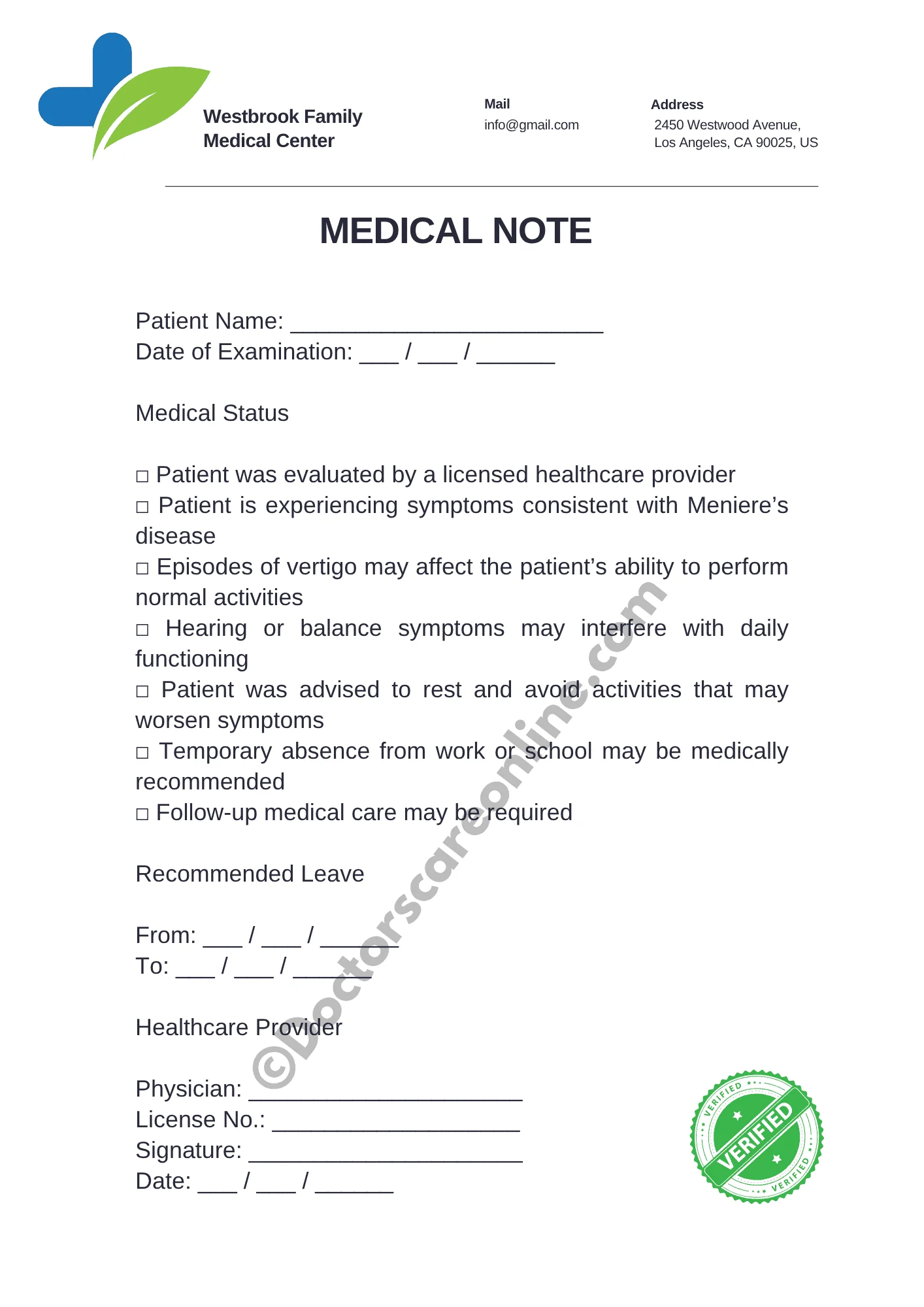
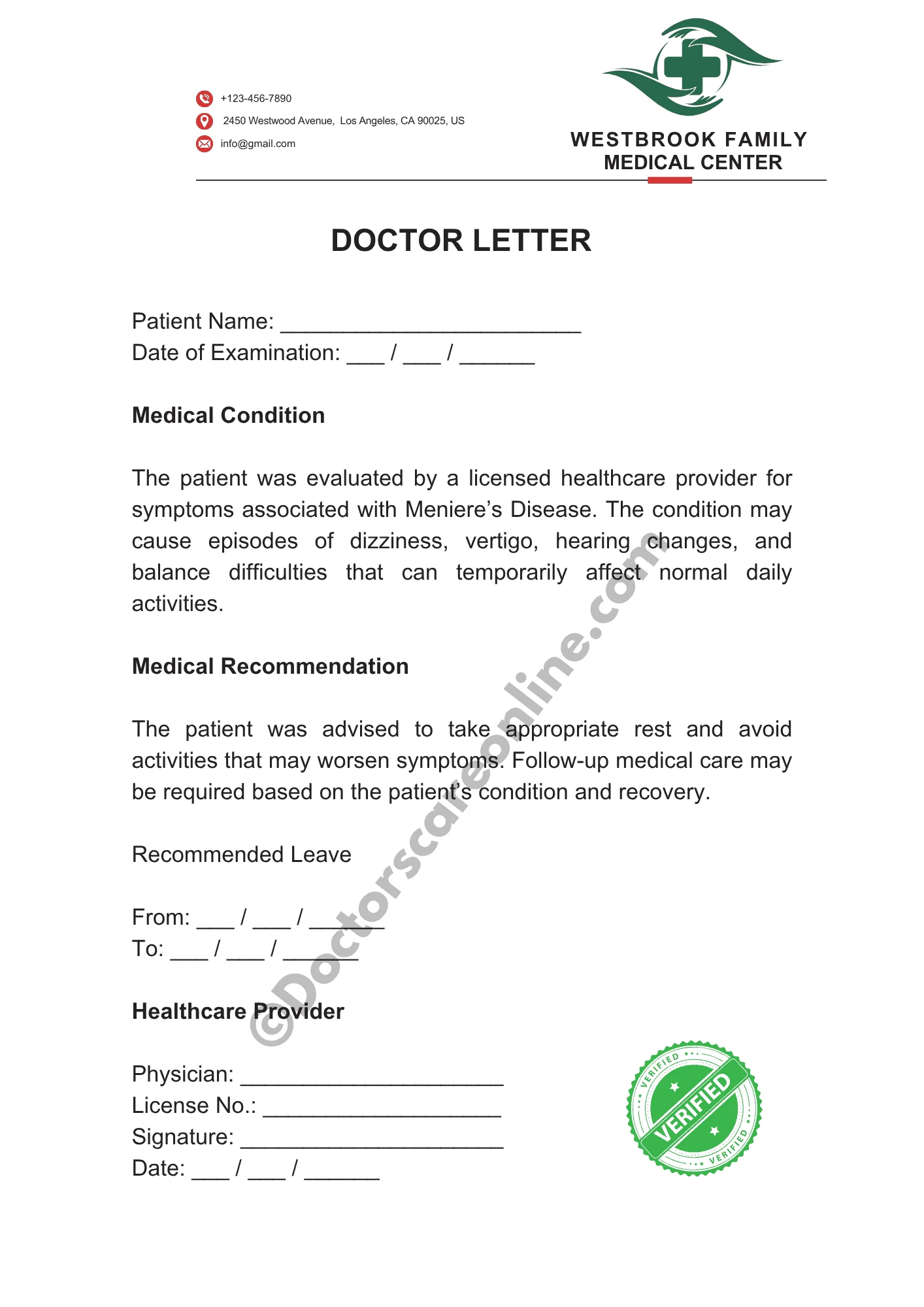
The exact format varies by provider and purpose. A medical note may include:
| Information | Purpose |
|---|---|
| Patient name | Identifies the person evaluated |
| Examination date | Confirms when the medical assessment occurred |
| Medical confirmation | Documents that a healthcare evaluation took place |
| Recommended leave | Specifies an appropriate absence period when medically justified |
| Temporary restrictions | Describes relevant activity or workplace limitations |
| Return date | Indicates when the patient may resume activities, when appropriate |
| Follow-up recommendation | Indicates whether additional evaluation is needed |
| Provider details | Identifies the healthcare professional or practice |
A doctor’s note should contain only information that is appropriate and permitted for the particular situation.
Does a Doctor’s Note Have to Reveal Meniere’s Disease?
Not necessarily.
Depending on the circumstances, medical documentation may focus on the fact that the individual was evaluated and requires specific leave or restrictions without providing unnecessary diagnostic details.
However, documentation requirements vary between employers, schools, insurers, jurisdictions, and individual circumstances. If a specific organization requires certain information, check its medical documentation policy.
Never alter or add information to a medical document after it has been issued.
How Long Can You Be Excused From Work for Meniere’s Disease?
There is no universal number of days that applies to everyone with Meniere’s disease.
The appropriate period of leave depends on factors such as:
- Severity of symptoms
- Frequency and duration of vertigo episodes
- Hearing or balance problems
- Type of work performed
- Safety risks associated with the job
- Response to treatment
- Functional limitations
- Healthcare provider’s clinical assessment
Some people may need short-term time away from work during a severe flare-up, while others may require temporary restrictions or additional follow-up rather than complete leave.
The healthcare provider should determine the appropriate recommendation based on the individual medical assessment.
Meniere’s Disease Diagnosis and Medical Evaluation
Meniere’s disease can have symptoms that overlap with other vestibular and neurological conditions. A healthcare professional may consider the person’s medical history, symptom pattern, hearing changes, and examination findings when evaluating the condition.
Depending on the situation, evaluation may involve:
- Medical history
- Physical examination
- Hearing assessment or audiometry
- Balance or vestibular testing
- Neurological assessment
- Review of previous medical records
- Additional testing when clinically indicated
Not every patient requires every test. The appropriate evaluation depends on the individual’s symptoms and clinical circumstances.
Treatment and Management of Meniere’s Disease
Treatment for Meniere’s disease is individualized. Depending on the person’s symptoms and medical assessment, management may involve:
- Lifestyle and dietary modifications
- Medication prescribed by a healthcare professional
- Vestibular rehabilitation
- Hearing-related management
- Treatment of associated symptoms
- Specialist care
- Additional interventions for persistent or severe cases
Patients should follow recommendations from their healthcare provider and should not start, stop, or change prescription medication without appropriate medical guidance.
Meniere’s Disease Flare-Up and Recovery
Meniere’s disease can involve periods of symptoms followed by periods when symptoms are less noticeable. The course varies from person to person.
During a flare-up, reducing activities that could create safety risks may be appropriate. For example, someone experiencing active vertigo should avoid driving or operating dangerous machinery until it is safe to do so.
If symptoms become more frequent, severe, or different from your usual pattern, contact a healthcare professional for reassessment.
When Should You Seek Urgent Medical Care?
Not every episode of dizziness or vertigo is caused by Meniere’s disease. Some symptoms can indicate a medical emergency.
Seek urgent medical attention if dizziness or vertigo occurs with warning signs such as:
- Sudden weakness or numbness
- Difficulty speaking
- New facial drooping
- Severe difficulty walking
- New severe headache
- Fainting or loss of consciousness
- Chest pain
- Severe shortness of breath
- Sudden significant neurological changes
- New symptoms following a serious injury
Sudden hearing loss also requires prompt medical assessment because some causes are time-sensitive.
If you are unsure whether symptoms are an emergency, seek appropriate medical advice rather than relying solely on an online consultation.
How Our Online Service Can Help
Our online service is designed to make the process of seeking medical evaluation more convenient when an online consultation is clinically appropriate.
- Convenient Online Access: You can request an online consultation without needing to begin the process with an in-person visit, where telehealth is available and appropriate.
- Professional Medical Evaluation: Your symptoms are reviewed by a healthcare professional who can determine what medical advice or documentation is appropriate based on the consultation.
- Clear Documentation Process: If the provider determines that medical documentation is medically justified, the appropriate documentation can be provided according to applicable requirements.
- Privacy-Conscious Approach: Medical information should be handled according to applicable privacy and healthcare requirements. Only claim specific certifications or regulatory compliance on your website if your service actually meets those requirements.
- Transparent Process: We aim to clearly explain the consultation process, required information, payment steps, and documentation expectations so users understand what they are receiving.
- Support When You Need Help: If you have a question or experience an issue with registration, login, payment, appointment booking, or another part of the service, you can contact our support team through the website chatbox.
You can use the chatbox to ask questions about the service or report technical and account-related issues. Do not send passwords, payment-card numbers, or other sensitive credentials through chat.
Why Choose Our Online Service?
Choosing a healthcare service involves more than convenience. Users should be able to understand how the process works before booking an appointment.
Our approach focuses on:
- Connecting users with appropriate healthcare professionals
- Explaining that documentation depends on medical evaluation
- Providing a straightforward online appointment process
- Making the service process easier to understand
- Offering support for registration, login, payment, and technical questions
- Avoiding promises that a doctor’s note will be issued regardless of medical need
- Encouraging appropriate in-person or emergency care when telehealth is not sufficient
A trustworthy medical service should prioritize appropriate clinical evaluation rather than treating medical documentation as an automatic purchase.
What to Do If Your Doctor’s Note Needs an Update
If your symptoms continue beyond the period covered by your documentation, do not change the dates yourself.
Instead:
- Contact a healthcare provider.
- Explain that your symptoms have continued or changed.
- Complete any recommended follow-up evaluation.
- Follow the provider’s updated medical advice.
- Request updated documentation if the provider determines that it is medically appropriate.
This helps ensure that medical documentation accurately reflects your current medical situation.
Common Mistakes to Avoid
When requesting medical documentation for Meniere’s disease, avoid:
- Requesting documentation without seeking appropriate medical evaluation
- Exaggerating symptoms to obtain leave
- Editing or changing an issued doctor’s note
- Ignoring severe or unusual symptoms
- Driving during an active episode of disabling vertigo
- Operating machinery when dizziness creates a safety risk
- Assuming an online consultation is appropriate for every situation
- Waiting for a routine appointment when emergency symptoms are present
- Assuming an employer or school will accept every type of documentation without checking its policy
Frequently Asked Questions
1. Can Meniere’s disease qualify for a work excuse?
It may, depending on the severity of symptoms and how they affect your ability to safely perform your job. A healthcare provider can determine whether medical leave or temporary work restrictions are appropriate after evaluating your condition.
2. Can a telehealth doctor evaluate Meniere’s disease symptoms?
A healthcare provider may be able to discuss and assess some Meniere’s disease symptoms through telehealth. However, certain cases may require an in-person examination, hearing test, vestibular testing, or specialist evaluation.
3. Can I work with Meniere’s disease?
Some people with Meniere’s disease can continue working, while others may need temporary restrictions during symptomatic periods. The answer depends on your symptoms, job duties, safety risks, and healthcare provider’s recommendations.
4. Can a doctor’s note for Meniere’s disease include work restrictions?
Yes, when medically appropriate. A healthcare provider may recommend restrictions such as avoiding heights, driving, heavy machinery, or other activities that could become unsafe because of vertigo or balance problems.
5. What if my Meniere’s disease symptoms suddenly become much worse?
Suddenly worsening or unusual symptoms should be medically assessed. If symptoms include neurological warning signs, severe difficulty walking, fainting, chest pain, or other emergency symptoms, seek immediate medical care rather than relying on routine telehealth documentation.
Medical Disclaimer: This content is provided for general educational and informational purposes only. It does not replace professional medical advice, diagnosis, or treatment.
Meniere’s disease and other causes of vertigo can require different types of evaluation and treatment. A doctor’s note should only be issued by a licensed healthcare provider after an appropriate medical assessment. Medical leave, work restrictions, return-to-work recommendations, and documentation requirements vary according to the individual’s condition, location, employer, school, and applicable regulations.


Reviews
There are no reviews yet.