

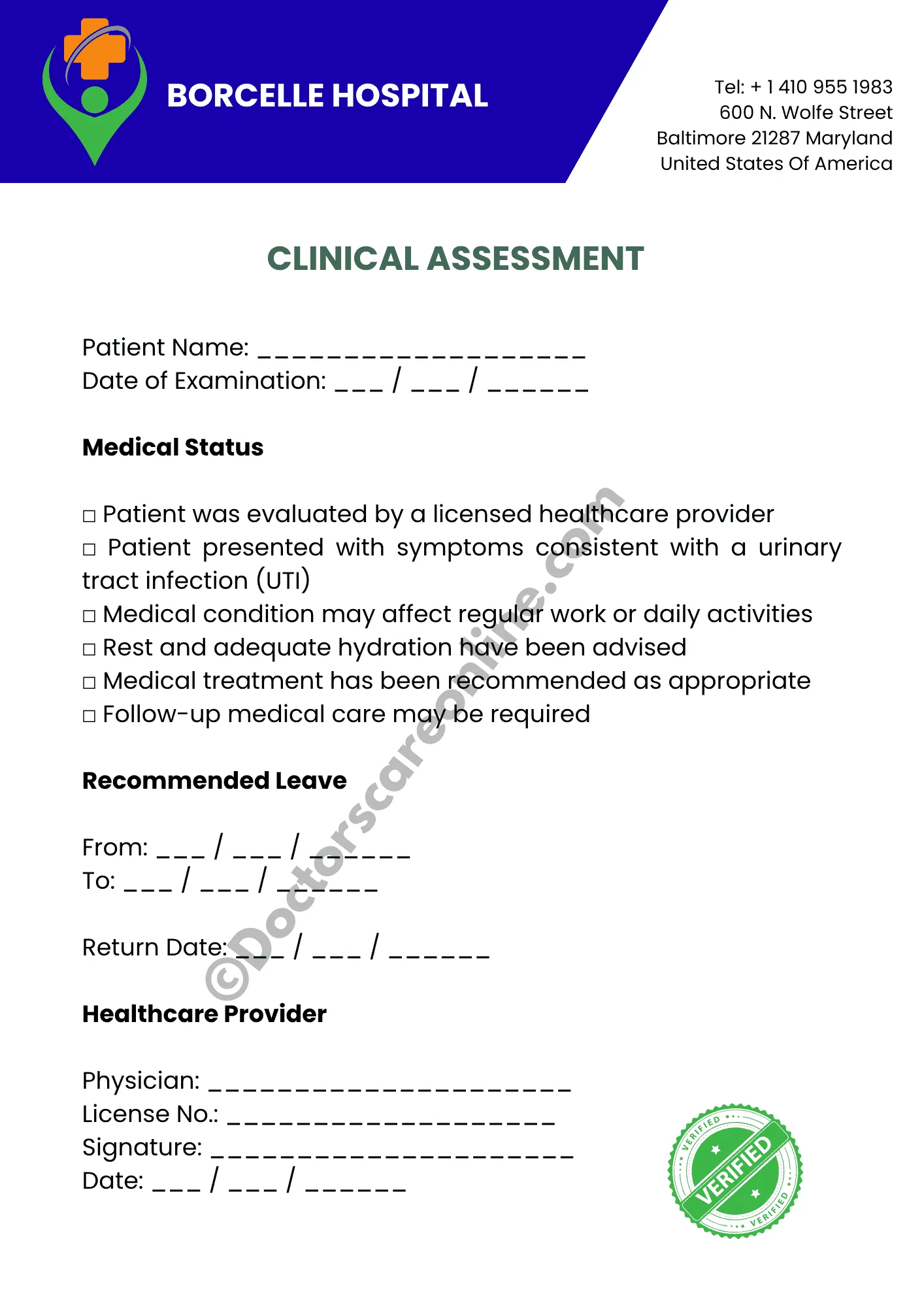
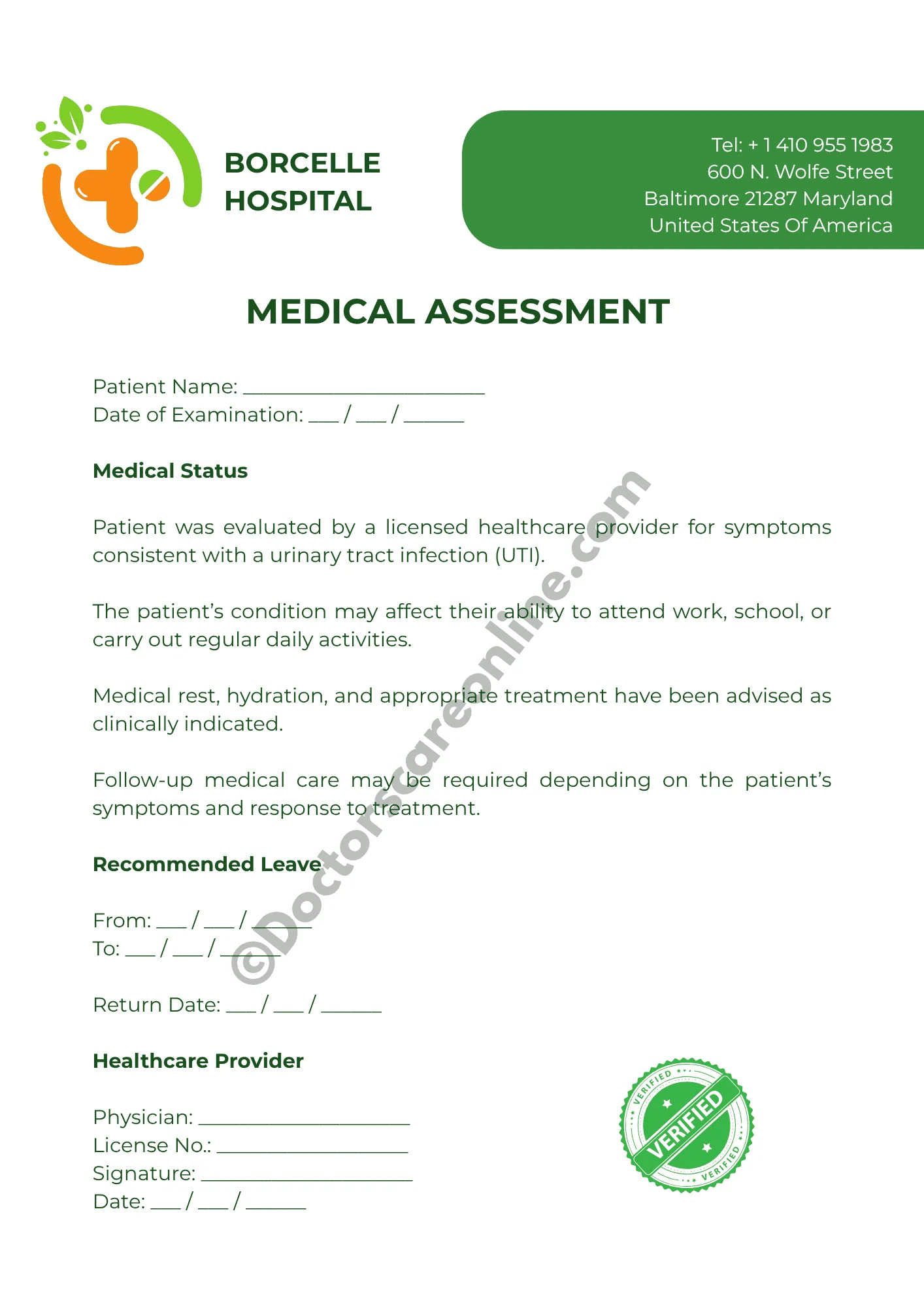
A Doctor’s Note for UTI is medical documentation that a licensed healthcare provider may provide after evaluating symptoms consistent with a urinary tract infection (UTI). Depending on the individual situation, the documentation may confirm that a patient was medically evaluated and may recommend time away from work or school, modified activities, or other temporary accommodations.
Urinary Tract Infection (UTI) is a common infection that affects parts of the urinary system, including the bladder, urethra, or kidneys. It usually happens when bacteria enter the urinary tract, often due to poor hygiene, dehydration, or holding urine for too long. UTIs are more common in women, but can affect anyone. If treated early, it can be managed easily with proper medication and care. Ignoring a UTI may lead to more serious kidney problems, so timely treatment, drinking enough water, and maintaining hygiene are very important.
Important: A medical note should be issued only when a healthcare professional determines that it is medically appropriate after an evaluation.
Related Doctor Note :—
You can also visit:
- Doctors Note for Kidney Stones
- Doctors Note for Medication on Flight
- Doctor’s Note for Work From Home
- Unlimited Doctor’s Notes for 1 Year
When Might You Need a Doctor’s Note for UTI ?
UTI symptoms can make frequent bathroom access, prolonged sitting, commuting, physical activity, or concentration difficult. Medical documentation may therefore be relevant when symptoms interfere with normal responsibilities.
You may need documentation when:
- Your employer requires medical verification for an absence.
- You need time away from work because of significant symptoms.
- Your school or college requires documentation for an absence.
- You need temporary workplace accommodations.
- Your job makes frequent bathroom access difficult.
- You are experiencing symptoms that interfere with concentration or productivity.
- A healthcare provider recommends temporary activity modification.
- You need documentation following a medical consultation.
The purpose of the note is to communicate medically appropriate recommendations rather than simply provide proof that a person requested documentation.
Common UTI Symptoms That Can Affect Work or School
Recognizing symptoms can help you decide when professional medical evaluation is appropriate. Common bladder-infection symptoms include:
- Burning or pain during urination
- Frequent urination
- A strong or persistent urge to urinate
- Passing only a small amount of urine
- Lower abdominal discomfort or pressure
- Cloudy urine
- Bloody urine
- Strong-smelling urine
These symptoms can have causes other than a UTI, so symptoms alone do not establish a diagnosis. A healthcare professional can determine whether further evaluation or testing is appropriate.
UTI Symptoms That May Need Prompt Medical Attention
Some symptoms can indicate that an infection may have progressed beyond the bladder. A kidney infection can cause symptoms such as fever, chills, nausea or vomiting, and pain in the back, side, or groin.
Seek prompt medical care if you develop:
- Fever or chills
- Pain in your back or side
- Nausea or vomiting
- Significant weakness or feeling seriously unwell
- Symptoms that are becoming substantially worse
- Symptoms that return after treatment
A kidney infection can become serious if it is not treated appropriately. If you have severe symptoms or believe you may have a medical emergency, seek urgent or emergency medical care rather than relying on an online appointment alone.
How a Healthcare Provider Evaluates a Possible UTI
A healthcare professional may begin by reviewing your symptoms, medical history, medications, previous urinary infections, and other relevant health information.
Depending on your symptoms and circumstances, the evaluation may involve:
- Reviewing the timing and severity of symptoms
- Asking about urinary frequency and discomfort
- Reviewing previous UTI history
- Considering other possible causes of similar symptoms
- Performing a physical examination when appropriate
- Ordering a urinalysis
- Ordering a urine culture
- Using blood tests or additional testing when clinically necessary
Urinalysis can identify findings associated with infection, while a urine culture can help identify certain bacteria and inform treatment decisions.
An online consultation may be appropriate for some situations, but a healthcare provider may recommend an in-person evaluation or laboratory testing when symptoms cannot be adequately assessed remotely.
Can You Get a UTI Doctor’s Note Online?
In many parts of the U.S., telehealth can provide access to licensed healthcare professionals for appropriate medical concerns. Whether an online consultation is suitable depends on your symptoms, medical history, location, and the provider’s clinical judgment.
During an online appointment, you may be asked about:
- Your current symptoms
- When the symptoms began
- Previous UTIs
- Current medications
- Allergies
- Relevant medical conditions
- Pregnancy status when applicable
- Previous treatment
- Any warning signs such as fever, vomiting, or back/side pain
If the provider determines that your condition can be appropriately evaluated through telehealth and medical documentation is justified, the provider may issue a note where permitted.
An online appointment does not guarantee a doctor’s note, prescription, diagnosis, or specific treatment. Those decisions belong to the licensed healthcare professional conducting the evaluation.
How to Request an Online Medical Note for UTI
The process can be straightforward when online medical consultation is available in your location.
1. Choose an Appropriate Online Medical Service
- Select a service that connects patients with licensed healthcare professionals and clearly explains its consultation and documentation process.
2. Register or Log In
- Create an account or sign in using the information requested by the website.
3. Select an Available Appointment
- Choose an appointment time that works for you and provide the required information.
4. Explain Your UTI Symptoms
- Describe your symptoms accurately, including when they started and whether they are affecting your ability to work, attend school, or perform normal activities.
5. Complete the Medical Evaluation
- Answer the healthcare professional’s questions honestly and provide relevant medical information.
6. Follow the Provider’s Recommendations
- The provider may recommend additional testing, an in-person visit, treatment, hydration, activity changes, or follow-up care depending on the evaluation.
7. Receive Documentation If Medically Appropriate
- If the provider determines that a medical note is appropriate, documentation may be issued according to applicable requirements and the provider’s professional judgment.
What Can a UTI Doctor’s Note Include?
The contents of medical documentation vary by provider and purpose. A UTI-related doctor’s note may contain information such as:
- Patient identification
- Date of evaluation
- Date of the recommended absence
- Work or school restrictions
- Recommended return date
- Follow-up instructions
- Healthcare provider’s name and credentials
- Clinic or practice information
- Provider signature, where applicable
The document should contain only information that is appropriate and authorized by the healthcare professional.
If an employer or school has specific documentation requirements, check those requirements before your appointment.
How Long Can a Doctor Excuse You for a UTI?
There is no universal number of days that applies to every UTI.
The recommended absence or restriction period depends on factors such as:
- Severity of symptoms
- Type and suspected location of infection
- Response to treatment
- Job responsibilities
- Functional limitations
- Other medical conditions
- Whether additional testing or follow-up is needed
Your healthcare provider determines whether time away from work or school is medically appropriate and, if so, the recommended duration.
Avoid assuming that a UTI automatically qualifies for a particular number of sick days.
UTI Treatment and Medical Follow-Up
Treatment depends on the cause and clinical assessment. Bacterial bladder infections are commonly treated with antibiotics when a healthcare professional determines antibiotics are appropriate. Treatment decisions can depend on factors such as symptoms, test results, allergies, previous infections, and other health considerations.
A healthcare professional may also recommend measures to manage discomfort and support recovery.
If antibiotics are prescribed, take them exactly as directed by your healthcare professional. Do not use leftover antibiotics or someone else’s prescription.
If symptoms do not improve, become worse, or return after treatment, contact a healthcare professional for reassessment.
UTI and Work: When Temporary Accommodation May Help
Some jobs can be particularly difficult to perform while experiencing urinary symptoms.
For example, temporary adjustments may be relevant when a person’s work involves:
- Limited access to restrooms
- Long periods away from bathroom facilities
- Extended driving
- Physically demanding activities
- Long periods of standing
- Extended meetings or customer-facing duties
When medically appropriate, a healthcare provider may recommend temporary modifications based on the individual’s symptoms and job requirements.
Possible accommodations can include reasonable restroom access, temporary schedule adjustments, modified duties, or time away from work when clinically justified. The specific recommendation depends on the healthcare provider and applicable workplace policies.
UTI Considerations for Travel and Daily Activities
UTI symptoms may be inconvenient during commuting, travel, school, or other situations where restroom access is limited.
If you are experiencing symptoms, consider discussing your plans with a healthcare professional, particularly if you expect limited access to medical care or bathrooms.
If symptoms include fever, chills, vomiting, or back or side pain, do not treat the situation as a routine inconvenience. These symptoms can be associated with kidney infection and warrant prompt medical attention.
Who May Need Additional Medical Evaluation?
Certain situations may require more careful assessment rather than relying only on an online medical note.
Additional evaluation may be appropriate for people who:
- Have recurrent urinary infections
- Have symptoms that do not improve
- Have symptoms that return after treatment
- Have significant blood in the urine
- Have known urinary tract abnormalities
- Have a urinary blockage or kidney stone
- Are pregnant or may be pregnant
- Have conditions that affect immune function
- Develop symptoms suggesting a kidney infection
Repeated or complicated urinary symptoms may require additional testing to identify the underlying cause. Healthcare professionals may use urine testing, imaging, or other investigations depending on the situation.
How Our Online Medical Note Service Can Help
Our website is designed to make the process of connecting with an online medical consultation more convenient for users who need professional evaluation for concerns such as UTI symptoms.
Instead of relying on self-diagnosis, users can provide information about their symptoms to a healthcare professional and receive guidance based on an individual medical assessment.
Our service can be useful when you need:
- Convenient access to an online consultation
- A structured way to describe your symptoms
- Professional medical evaluation
- Guidance about whether additional care may be necessary
- Medical documentation when a provider determines it is appropriate
- A convenient online process for users who cannot easily visit a clinic immediately
We focus on providing a clear process so users understand that medical documentation is connected to a healthcare evaluation and professional judgment.
Your Privacy and Medical Information
Health information is personal and should be handled carefully. When using an online healthcare service, review the website’s privacy policy and understand how your information is collected, used, stored, and protected.
Only provide accurate information that is necessary for your consultation. Your healthcare provider may need relevant medical details to make an appropriate assessment.
If your employer or school requests documentation, ask what information is actually required so that unnecessary personal medical details do not have to be shared.
Need Help With Registration, Login, Payment, or Your Order?
If you have a question or experience a problem while using our website, you can contact us through the chatbox available on the site.
Our chat support can help with general website and service-related questions, such as:
- Registration problems
- Login difficulties
- Payment-related questions
- Trouble completing an order
- Questions about the online consultation process
- General questions about using the website
- Technical issues during checkout
- Questions about your order or account
For medical questions, symptoms, diagnosis, treatment, or whether a doctor’s note is medically appropriate, please discuss the issue with the licensed healthcare professional providing your consultation.
The chatbox is intended to make it easier to get assistance with the website and service process when you need it.
Why Users Can Use Our Service With Confidence
Choosing an online medical service involves more than simply finding a convenient website. Users should understand how the process works and what they can expect before submitting personal information or booking a consultation.
Our approach is designed around:
- Licensed healthcare evaluation: Medical decisions and documentation are handled by an appropriate healthcare professional rather than being automatically generated.
- Clear service expectations: Users can review the consultation process and understand that documentation depends on clinical judgment.
- Convenient online access: Users can complete the available service steps online where telehealth is permitted and appropriate.
- Support when needed: Website-related questions can be directed to the site’s chatbox.
- Privacy awareness: Users can review applicable privacy information before providing personal or health details.
- Responsible medical documentation: A doctor’s note should reflect an actual healthcare evaluation and medically appropriate recommendations.
Users should always review the site’s current terms, privacy information, pricing, and service policies before booking.
What to Do After Receiving a UTI Medical Note
After receiving medical documentation, follow the recommendations provided by your healthcare professional.
If your note includes an absence period, work restriction, or follow-up recommendation:
- Provide the documentation according to your employer or school’s procedure.
- Follow any activity restrictions.
- Take prescribed medication exactly as directed.
- Attend recommended follow-up appointments.
- Seek further medical care if symptoms worsen.
- Do not modify the information on the medical document.
If your employer or educational institution requests additional documentation, contact the appropriate administrative or HR department to understand its requirements.
When an Online Appointment May Not Be Enough
Telehealth can be convenient, but it is not appropriate for every medical situation.
An in-person assessment may be necessary when a healthcare professional needs to perform an examination, obtain a urine sample, conduct laboratory testing, or investigate symptoms that cannot be safely assessed remotely.
Seek urgent medical care if you have serious symptoms such as significant fever or chills, vomiting, severe back or side pain, confusion, or other symptoms suggesting a potentially serious infection. Kidney infections can require prompt treatment and, in severe cases, hospital-level care.
Frequently Asked Questions
1. Can a UTI cause you to miss work?
Yes. UTI symptoms can interfere with normal activities, particularly when frequent or painful urination, abdominal discomfort, or other symptoms make it difficult to perform your usual responsibilities. Whether you need time away from work should be determined by a healthcare professional based on your individual condition.
2. Can a UTI doctor’s note be used for school or college?
Medical documentation may be submitted to a school or college when its policies allow it. Whether the institution accepts a particular document and what information it requires depends on its own attendance and documentation policies.
3. Can UTI symptoms be caused by something other than an infection?
Yes. Symptoms such as painful urination, urinary frequency, or bladder discomfort can have different causes. A healthcare professional can assess your symptoms and determine whether testing is appropriate rather than assuming that every urinary symptom is a UTI.
4. What happens if UTI symptoms return after treatment?
Recurring symptoms should be discussed with a healthcare professional. The provider may reassess your symptoms and determine whether another urine test, culture, treatment, or additional evaluation is necessary.
5. Can men get UTIs?
Yes. Anyone with a urinary tract can develop a UTI. However, UTIs and their evaluation can differ depending on factors such as sex, age, medical history, and urinary tract conditions, so individual symptoms should be assessed by a healthcare professional.
Medical Disclaimer: This content is provided for general educational and informational purposes only. It does not replace professional medical advice, diagnosis, or treatment.
A Doctor’s Note for UTI should be issued only by a licensed healthcare professional following an appropriate medical evaluation. An online consultation does not guarantee a diagnosis, prescription, medical note, work excuse, school excuse, or any particular treatment outcome.





Reviews
There are no reviews yet.