

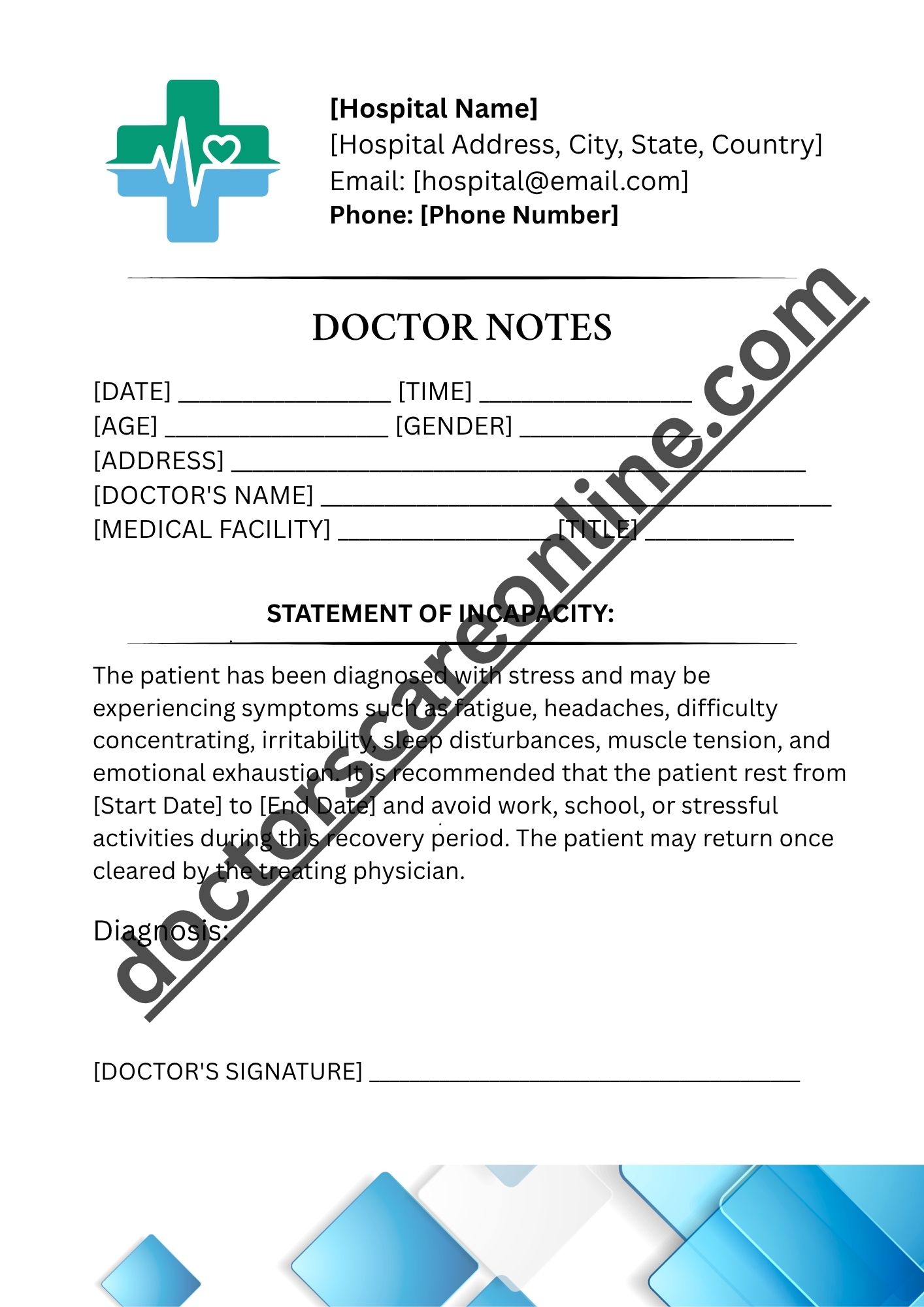
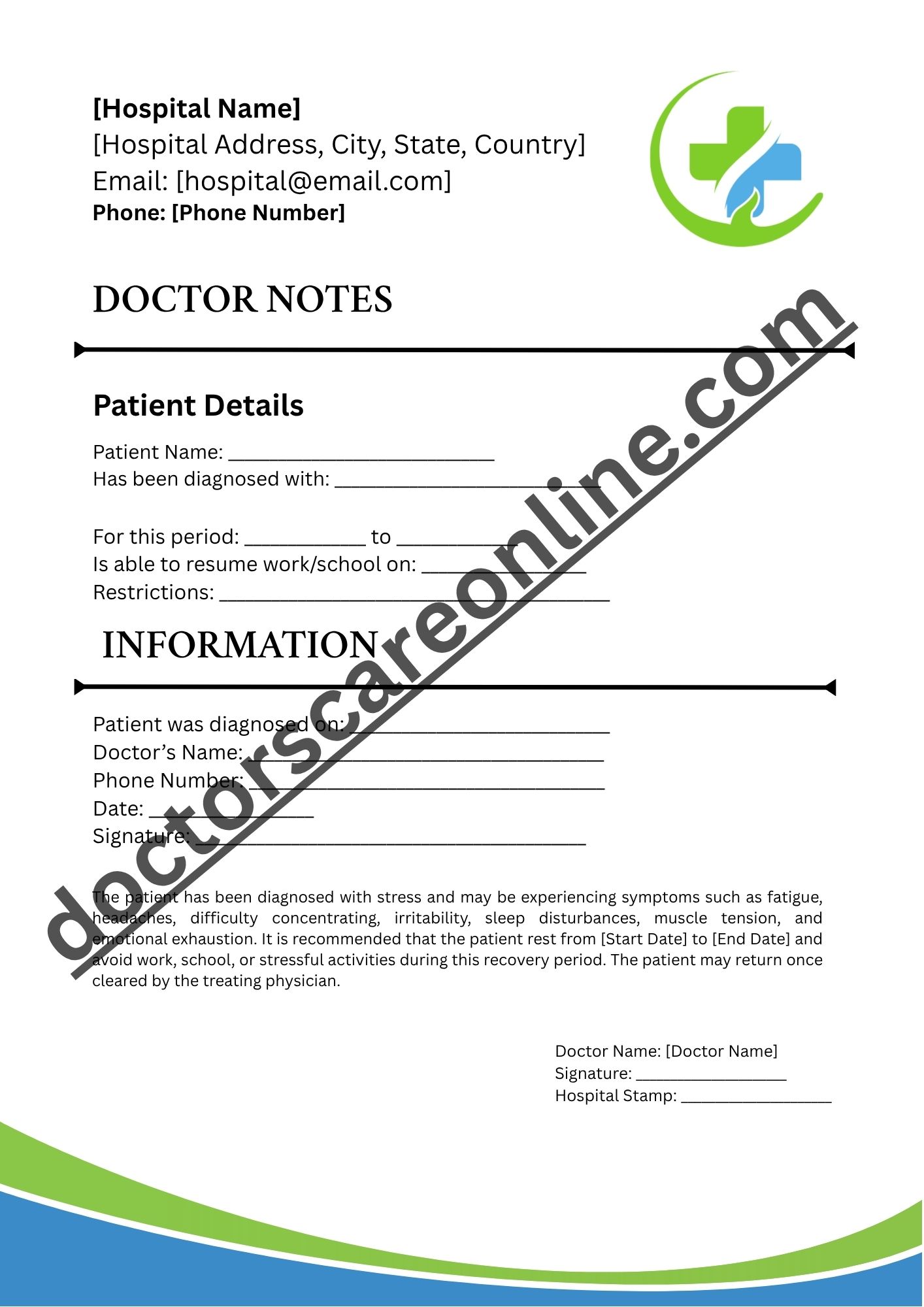
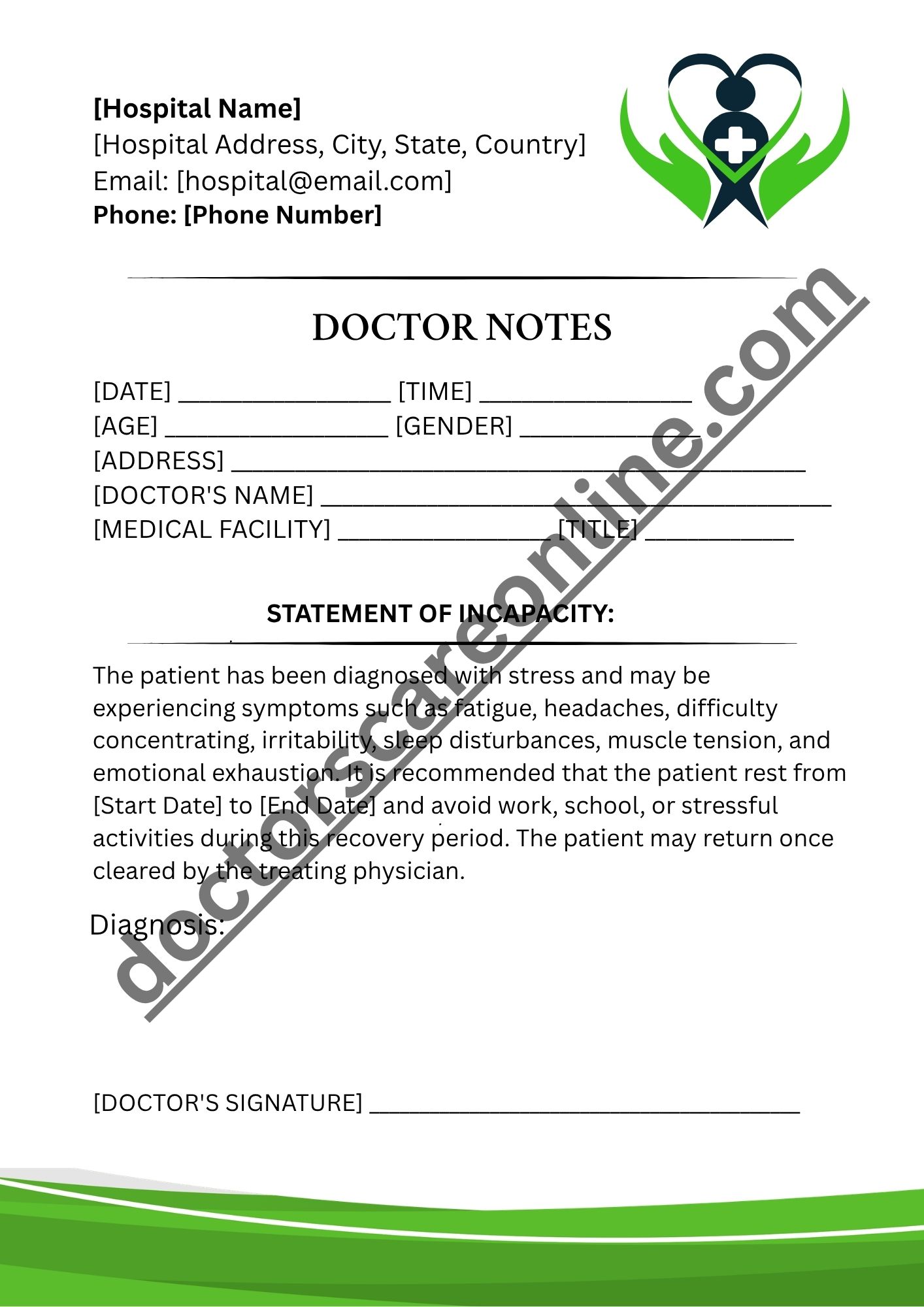
A doctors note for stress is medical documentation provided by a qualified healthcare professional following an evaluation. Depending on the circumstances, it may confirm that a person was assessed and may recommend time away from work or school, modified duties, reduced workload, workplace accommodations, or a return-to-work plan.
Stress can affect your sleep, concentration, emotions, physical health, work performance, and ability to manage everyday responsibilities. When stress becomes severe enough to interfere with work, school, or normal daily activities, a licensed healthcare provider may determine that time away from those responsibilities or temporary adjustments are medically appropriate.
Who Can Issue a Doctors Note for Stress?
The healthcare professional who can provide medical documentation depends on local laws, professional scope of practice, and the requirements of the organization requesting the note.
Depending on the jurisdiction and circumstances, documentation may be provided by:
- Primary care physicians
- Family physicians
- General practitioners
- Internal medicine physicians
- Psychiatrists
- Nurse practitioners
- Physician assistants, where permitted
- Licensed psychologists, where legally authorized and accepted for the specific documentation
Before arranging an appointment, check whether your employer, school, college, university, or other organization has specific requirements regarding who can provide medical documentation.
Common Symptoms of Stress That May Affect Work or School
Stress can produce both emotional and physical symptoms. People may experience symptoms differently depending on the source and severity of stress.
Emotional and Mental Symptoms
Common symptoms may include:
- Feeling overwhelmed
- Irritability
- Persistent worry
- Difficulty relaxing
- Reduced motivation
- Emotional exhaustion
- Difficulty concentrating
- Feeling unable to cope with everyday responsibilities
Physical Symptoms
Stress can also be associated with:
- Muscle tension
- Headaches
- Fatigue
- Sleep problems
- Stomach discomfort
- Changes in appetite
- Increased heart rate during stressful situations
- General physical tension
Persistent, severe, or unusual physical symptoms should be evaluated by a healthcare professional because they can sometimes have causes unrelated to stress.
How to Get a Doctors Note for Stress Online
If stress is affecting your ability to work, attend school, or manage normal activities, you may be able to arrange a consultation with a licensed healthcare provider through telehealth.
The exact process varies by provider and location, but it commonly involves the following steps.
Step 1: Choose a Qualified Healthcare Provider
Look for a licensed healthcare professional who is authorized to provide care in your location.
Depending on your needs, this may include a:
- Primary care provider
- Family doctor
- General practitioner
- Psychiatrist
- Nurse practitioner
- Other eligible telehealth provider
For ongoing, severe, or complex mental health symptoms, a healthcare provider may recommend additional assessment or specialized mental health care.
Step 2: Schedule a Medical Consultation
Appointments may be available through:
- A healthcare provider’s official website
- A hospital or clinic
- A patient portal
- A legitimate telehealth service
- A health insurance provider directory
- An authorized healthcare application
Availability varies. Some providers offer same-day, evening, or weekend appointments, while others require advance scheduling.
Step 3: Provide Your Information
Before the consultation, you may be asked for information such as:
- Name
- Date of birth
- Contact information
- Location
- Insurance information, if applicable
- Identification, if required
- Reason for the consultation
Describe your symptoms accurately rather than trying to provide answers that you believe will guarantee a doctor’s note.
Step 4: Attend the Consultation
During the appointment, the healthcare provider may ask about:
- What is causing or contributing to your stress
- How long symptoms have been present
- How symptoms affect your daily life
- Sleep patterns
- Concentration and productivity
- Physical symptoms
- Work or school responsibilities
- Previous relevant medical history
- Current medications, where relevant
- Mental health symptoms
- Previous treatment or counseling
Telehealth consultations may take place by video, telephone, or another approved method depending on the provider and applicable regulations.
Step 5: Receive Medical Guidance
After evaluating your situation, the provider may recommend:
- Self-care and stress-management strategies
- Counseling or therapy
- Follow-up care
- Temporary work or school adjustments
- Medical leave, when clinically appropriate
- A return-to-work or return-to-school plan
- Additional medical or mental health evaluation
If the provider determines that documentation is medically appropriate, they may issue a doctor’s note or other medical documentation according to applicable requirements.
Can a Doctor’s Note for Stress Be Used for Work?
A doctor’s note for stress may be used to support a workplace absence when a healthcare provider determines that medical leave is appropriate.
Depending on workplace policy and applicable law, documentation may also support requests involving:
- Temporary medical leave
- Modified duties
- Reduced workload
- Flexible working hours
- Additional breaks
- Gradual return to work
- Temporary work restrictions
- Other workplace accommodations
A doctor’s note does not automatically guarantee that an employer must approve every requested accommodation. Employer policies, applicable employment laws, and the specific medical recommendation all matter.
Always review your company’s HR or leave policy before submitting medical documentation.
Can You Use a Stress Doctor’s Note for School or College?
A healthcare provider may provide medical documentation when stress significantly interferes with school or college attendance or academic responsibilities.
Depending on institutional policies, documentation may be used to support:
- Excused absences
- Assignment extensions
- Exam rescheduling
- Temporary academic accommodations
- Medical leave
- Return-to-school documentation
Schools, colleges, and universities have different requirements. Some may specify who can provide documentation, what information must be included, and when the documentation must be submitted.
Examples of Possible Leave Periods
| Situation | Possible Recommendation | Important Consideration |
|---|---|---|
| Short-term stress symptoms | A brief period away from work or school | Depends on the provider’s assessment |
| Significant stress or burnout | Additional recovery time may be considered | Follow-up may be recommended |
| Persistent symptoms | Extended leave or modified duties may be considered | Ongoing clinical evaluation may be needed |
| Continuing impairment | Updated documentation may be necessary | Requirements vary by employer or institution |
These are general examples, not standard medical leave periods. Only a qualified healthcare provider can determine whether leave is appropriate and for how long.
How Long Is a Doctor’s Note for Stress Valid?
The validity of medical documentation depends on the dates and recommendations specified by the healthcare provider and the policies of the organization receiving the document.
For example:
| Situation | Documentation Consideration |
| Short-term absence | May cover specific dates recommended by the provider |
| Extended leave | May require follow-up documentation |
| Return to work | Employer may request confirmation of fitness or restrictions |
| Additional leave | A new or updated assessment may be required |
| School absence | Institution-specific submission rules may apply |
If additional time away is needed, do not alter the original document. Contact the healthcare provider for a follow-up assessment and updated documentation when appropriate.
Does a Doctor’s Note for Stress Have to Mention Your Diagnosis?
Not always.
Many medical notes are designed to confirm that a person was evaluated and may need time away from work or school without unnecessarily disclosing detailed health information.
Whether a diagnosis must be included depends on:
- Local privacy requirements
- Employer or school policies
- The purpose of the documentation
- The healthcare provider’s judgment
- Patient authorization
- Applicable laws and regulations
If your employer or institution requests specific medical information, ask what documentation is actually required before providing additional health details.
Can a Doctor Refuse to Issue a Stress Note?
Yes.
A healthcare provider may decline to issue medical documentation if, after evaluation, they determine that:
- Medical leave is not clinically appropriate
- The requested dates are not medically justified
- Additional evaluation is required
- An in-person examination is necessary
- The provider cannot verify the information needed
- The request falls outside their scope of practice
- Another type of care or documentation is more appropriate
A medical note should reflect the provider’s actual assessment rather than a predetermined outcome.
Can a Doctor’s Note for Stress Include Work Restrictions?
When medically appropriate, a healthcare provider may recommend temporary restrictions or adjustments.
Examples may include:
- Reduced workload
- Flexible scheduling
- Gradual return to work
- Temporary modification of duties
- Additional rest breaks
- Reduced exposure to specific workplace demands
The provider determines what medical recommendations are appropriate. Whether an employer can implement a particular accommodation depends on workplace circumstances, applicable laws, and organizational policies.
Stress Leave vs. Mental Health Leave
The terms stress leave and mental health leave may overlap, but they are not necessarily identical.
| Stress Leave | Mental Health Leave |
| May relate to significant stress, burnout, or stress-related symptoms | May involve a broader range of mental health conditions |
| Can be short-term or extended depending on circumstances | Duration depends on the individual’s condition and treatment |
| May involve rest or temporary work adjustments | May involve ongoing treatment or specialized care |
| Based on a healthcare provider’s assessment | Based on clinical evaluation and applicable requirements |
Terminology varies between employers, healthcare systems, and jurisdictions.
Stress, Anxiety, and Burnout: What’s the Difference?
These terms are sometimes used interchangeably, but they describe different concepts.
- Stress is often a response to demanding or challenging circumstances.
- Anxiety can involve excessive or persistent fear, worry, or apprehension that may occur even when an immediate stressor is not present.
- Burnout is commonly associated with prolonged occupational or other chronic stress and may involve emotional exhaustion, reduced effectiveness, and detachment or cynicism.
Because symptoms can overlap, a healthcare professional can help determine what may be contributing to your difficulties and whether additional evaluation or treatment is appropriate.
Treatment and Management for Stress
Treatment depends on the severity, duration, and underlying causes of stress.
A healthcare provider may recommend one or more approaches.
| Treatment or Support | How It May Help |
| Stress-management techniques | May help reduce physical and emotional tension |
| Counseling or psychotherapy | Can help identify stressors and develop coping strategies |
| Sleep improvement | Supports physical and emotional recovery |
| Regular physical activity | May support overall well-being and stress management |
| Relaxation techniques | Breathing and mindfulness practices may reduce tension |
| Work or school adjustments | May reduce demands during recovery |
| Medication, when appropriate | A healthcare professional may consider medication for specific symptoms or conditions |
| Follow-up care | Allows progress and treatment needs to be reassessed |
Treatment should be individualized. Do not start, stop, or change prescription medication without discussing it with a qualified healthcare professional.
Returning to Work After Stress Leave
Returning to work after significant stress may be easier when the transition is appropriate for your circumstances.
A healthcare provider may recommend:
- A gradual return-to-work schedule
- Temporary reduction in workload
- Modified duties
- Flexible working hours
- Regular breaks
- Continued counseling or therapy
- Follow-up appointments
- Ongoing stress-management strategies
If symptoms return or worsen after resuming work, speak with a healthcare professional rather than simply extending your absence without an assessment.
Returning to School After Stress Leave
Students returning after stress-related medical leave may benefit from discussing their needs with their healthcare provider and educational institution.
Depending on the situation, possible recommendations may include:
- Gradual return to classes
- Assignment extensions
- Exam adjustments
- Reduced academic workload
- Counseling support
- Attendance accommodations
- Follow-up appointments
Institutional policies determine which accommodations are available.
When Stress Requires Urgent Medical Attention
Some symptoms should not automatically be attributed to stress.
Seek urgent medical attention for severe or rapidly worsening symptoms such as:
- Severe or unexplained chest pain
- Significant difficulty breathing
- Fainting
- Severe confusion
- New neurological symptoms
- A medical emergency
- Feeling unable to keep yourself safe
- Thoughts of suicide or self-harm
If you believe you are experiencing a medical emergency, seek immediate emergency medical care rather than relying on an online doctor’s note service.
Tips for a Smooth Stress Leave Documentation Process
You can reduce unnecessary delays by following these steps:
- Arrange a medical consultation early if stress is interfering with your responsibilities.
- Describe your symptoms honestly and accurately.
- Explain how your symptoms affect work, school, or daily activities.
- Check your employer or school’s documentation requirements.
- Confirm whether a particular type of healthcare professional is accepted.
- Ask about the required submission deadline.
- Keep a copy of any medical documentation you submit.
- Do not modify or alter a medical document.
- Attend recommended follow-up appointments.
- Follow the treatment and recovery recommendations provided by your healthcare professional.
What If Your Stress Leave Needs to Be Extended?
If you continue experiencing significant symptoms after your recommended leave ends, arrange a follow-up consultation.
The healthcare provider can reassess your condition and determine whether:
- Additional leave is medically appropriate
- Your existing restrictions should continue
- A gradual return is preferable
- Additional treatment is needed
- A referral to a mental health professional is appropriate
- Another medical condition should be evaluated
An extension should be based on a new medical assessment rather than changing the dates on an existing note.
Frequently Asked Questions
Q: How many days can a doctor give you off work for stress?
A: There is no universal number of days. The healthcare provider determines the recommended duration based on your symptoms, functional limitations, clinical assessment, and applicable requirements.
Q: Can I get a doctor’s note for burnout?
A: A healthcare provider can evaluate symptoms associated with burnout and determine whether medical leave, workplace adjustments, treatment, or further assessment is appropriate.
Q: Can I get a doctors note for stress online?
A: Yes, Some licensed healthcare providers offer telehealth consultations for stress-related concerns. Whether a provider can issue documentation remotely depends on the clinical situation, licensing requirements, and local regulations.
Q: Can a doctor refuse to give me a stress note?
A: Yes. A healthcare provider may determine that a note is not medically appropriate or that additional evaluation is necessary.
Q: Can a doctors note for stress request workplace accommodations?
A: A healthcare provider may recommend appropriate work restrictions or accommodations when clinically justified. Implementation depends on workplace policies and applicable laws.
Q: Can I use a stress doctor’s note for an extended absence?
A: Potentially, but extended absences may require additional assessments, updated documentation, or other procedures depending on the employer or educational institution.
Q: What should I tell a doctor about my stress?
A: Be honest about your symptoms, when they began, their severity, sleep, concentration, physical symptoms, work or school impact, and any treatment you are already receiving. Accurate information helps the healthcare provider make an appropriate assessment.
Medical Disclaimer: This information is provided for general educational purposes only and is not a substitute for professional medical advice, diagnosis, or treatment. Stress can have many causes, and symptoms that appear stress-related may sometimes indicate another medical or mental health condition. A licensed healthcare professional should evaluate persistent, severe, or concerning symptoms.
Related Post-


Reviews
There are no reviews yet.