
A doctor’s note for sore throat is medical documentation that may be provided by a licensed healthcare professional after evaluating your symptoms and determining that medical leave, activity restrictions, or an excused absence is appropriate.
A sore throat can make it difficult to work, attend school, speak comfortably, eat, drink, or complete normal daily activities. In many cases, sore throats are caused by viral infections and improve on their own, while some cases may be related to conditions such as strep throat and require further medical evaluation or testing.
If you need medical documentation for a sore throat absence from work or school, you can schedule an online consultation with a licensed healthcare provider where telehealth is available. After reviewing your symptoms and medical history, the provider can determine whether a doctor’s note is medically appropriate.
A doctor’s note is not automatically guaranteed by purchasing or requesting a service. It should only be issued following an appropriate medical evaluation and according to applicable requirements.
Why You Might Need a Doctor’s Note for a Sore Throat
A sore throat can temporarily interfere with normal responsibilities, particularly when symptoms include significant throat pain, fever, fatigue, or difficulty swallowing.
You may need a sore throat doctor’s note if:
- Your employer requires documentation for a sick day.
- Your school or college requires an excused-absence note.
- Your symptoms make it difficult to perform your normal job duties.
- You work in a setting where illness may create additional health or safety concerns.
- You need documentation of a medical evaluation.
- Your healthcare provider recommends staying home while you recover.
- You need temporary work or activity restrictions.
Employer and school requirements can vary, so check the relevant policy before your appointment.
Common Causes of a Sore Throat
A sore throat is a symptom rather than a specific diagnosis. Several conditions can cause throat pain or irritation.
- Viral Infection: Viruses are the most common cause of sore throat. A viral sore throat may occur with symptoms such as cough, runny nose, or hoarseness. Most viral sore throats improve without antibiotics.
- Strep Throat: Strep throat is a bacterial infection caused by group A Streptococcus. Symptoms can include sudden sore throat, pain when swallowing, fever, swollen tonsils, and swollen lymph nodes. Healthcare providers may use a rapid strep test or throat culture when appropriate.
- Tonsillitis: Inflamed tonsils can cause throat pain, difficulty swallowing, swelling, and sometimes fever. Tonsillitis can have viral or bacterial causes.
- Allergies and Irritation: Allergies, smoke exposure, dry air, and other environmental irritants can also contribute to throat irritation.
Sore Throat Symptoms to Discuss During an Online Consultation
Tell your healthcare provider about all relevant symptoms rather than focusing only on throat pain.
Important symptoms may include:
- Scratchy or irritated throat
- Pain when swallowing
- Red or swollen throat
- Swollen tonsils
- White patches or streaks on the tonsils
- Fever
- Swollen neck glands
- Cough
- Runny nose
- Hoarseness
- Headache
- Fatigue
- Rash
- Nausea or vomiting
Some symptoms can help a healthcare professional determine whether additional evaluation or testing may be necessary. For example, cough, runny nose, and hoarseness are more suggestive of a viral cause, while certain symptoms may raise concern for strep throat.
Can You Get a Doctor’s Note for a Sore Throat Online?
In many situations, you may be able to discuss a sore throat through telehealth. Whether an online doctor’s note can be issued depends on the healthcare provider’s assessment, your symptoms, your location, applicable regulations, and whether your condition can be appropriately evaluated remotely.
During an online appointment, the provider may:
- Review your symptoms and medical history.
- Ask questions about the severity and duration of your sore throat.
- Discuss relevant symptoms and possible causes.
- Determine whether telehealth is appropriate.
- Recommend testing or an in-person evaluation if necessary.
- Provide treatment or self-care guidance when appropriate.
- Issue medical documentation if clinically justified and permitted.
Telehealth should not be treated as a guaranteed way to obtain documentation. If a physical examination or throat testing is necessary, the provider may recommend an in-person visit.
How to Get an Online Doctor’s Note for Sore Throat
Getting an online doctor’s note for a sore throat is a simple process when you consult a licensed healthcare provider through a legitimate telehealth service. The steps below explain how to register, book your consultation, complete the medical evaluation, and receive documentation if it is medically appropriate.
Step 1: Choose a Healthcare Provider
Select a healthcare service that connects you with a licensed healthcare professional and offers online consultations in your location.
Step 2: Register for an Account
Enter the information requested during registration, such as your name, contact details, and other required information.
Step 3: Select an Online Consultation
Choose the appropriate appointment option and select an available date and time.
Step 4: Describe Your Sore Throat Symptoms
Provide accurate information about your symptoms, including when they started, how severe they are, and whether you have fever, cough, swollen tonsils, or difficulty swallowing.
Step 5: Complete the Medical Consultation
Speak with the healthcare provider through the available online consultation method. Answer medical questions honestly and provide any relevant medical history.
Step 6: Follow the Provider’s Recommendation
The provider may recommend rest, symptomatic care, testing, medication when appropriate, or an in-person examination.
Step 7: Receive Documentation When Medically Appropriate
If the provider determines that medical documentation is justified, they may issue a doctor’s note for sore throat, subject to applicable laws, regulations, and workplace or school requirements.
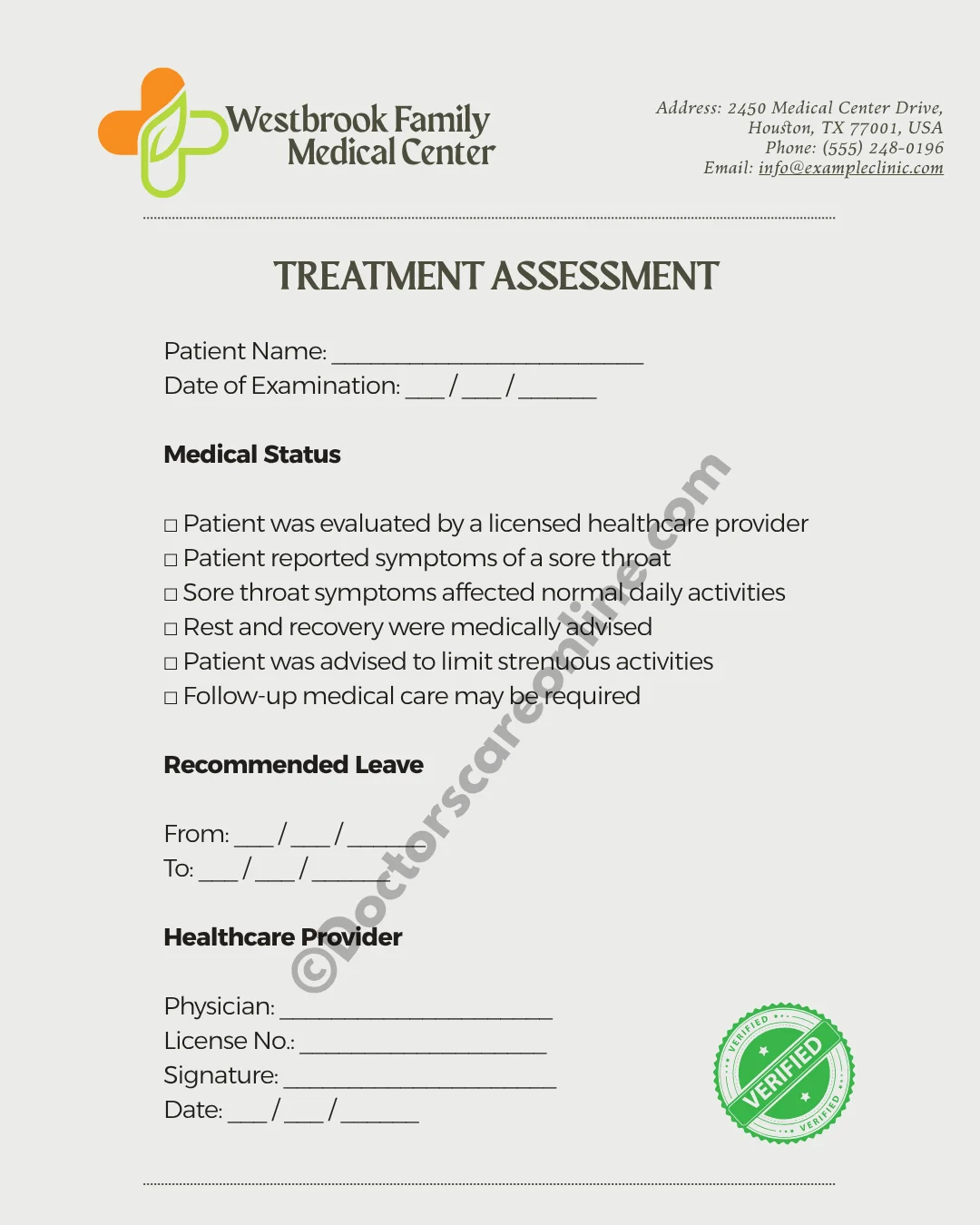
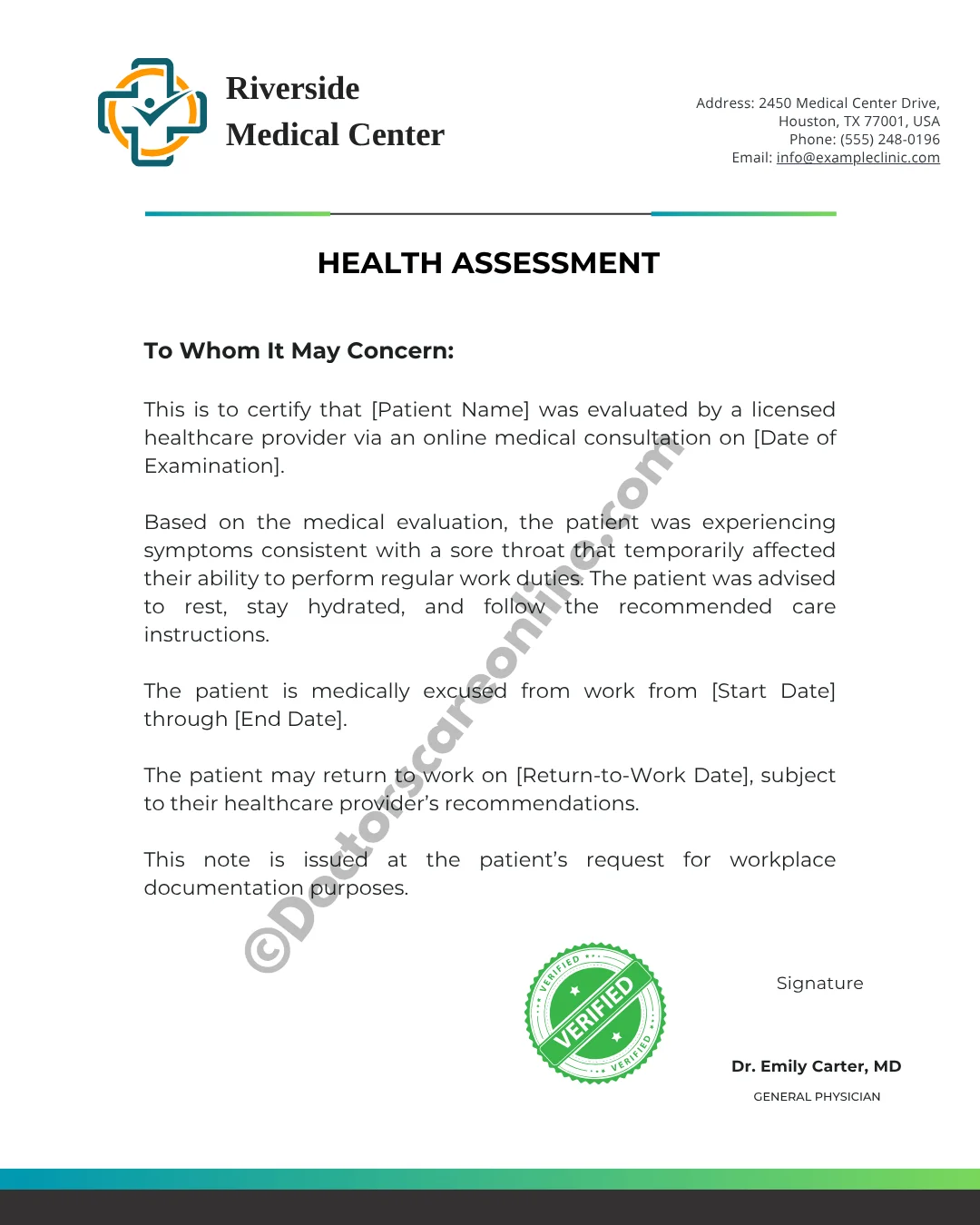
What Information May Be Included in a Sore Throat Doctor’s Note?
The exact information varies by provider and situation. A medical note may include:
| Information | Purpose |
|---|---|
| Patient name | Identifies the patient |
| Date of evaluation | Confirms when the consultation occurred |
| Medical evaluation confirmation | Documents that the patient was assessed |
| Recommended absence period | Indicates medically recommended time away |
| Return-to-work or school date | Provides a recommended return date when appropriate |
| Temporary restrictions | Identifies relevant limitations |
| Follow-up instructions | Indicates whether further care is recommended |
| Provider details | Identifies the healthcare professional or clinic |
| Signature or authentication | Verifies the medical documentation |
A note does not necessarily need to disclose a detailed diagnosis. The provider determines what information is appropriate to include.
Doctor’s Note for Sore Throat for Work
If a sore throat makes it difficult to perform your job, your employer may require medical documentation depending on workplace policy.
A healthcare provider may recommend temporary absence or restrictions when medically appropriate.
For example, depending on your condition and job, documentation may address:
- Temporary sick leave
- Recommended return date
- Work restrictions
- Modified duties
- Reduced physical activity
- Follow-up evaluation
If your workplace has specific documentation requirements, check them before your consultation.
Doctor’s Note for Sore Throat for School or College
Students may sometimes need a sore throat excuse note or medical documentation when illness results in an absence from school, college, an examination, or another academic activity.
Requirements differ between educational institutions. Before requesting documentation, check whether your school requires:
- A doctor’s note
- Date of medical evaluation
- Dates of absence
- Expected return date
- Healthcare provider information
- Specific school forms
The healthcare provider should determine what medical information is appropriate to document.
What to Prepare Before Your Online Sore Throat Consultation
Having the following information ready can make your consultation easier:
- Date your symptoms began
- Current temperature, if available
- Severity of throat pain
- Difficulty swallowing
- Presence of cough or runny nose
- Tonsil swelling or white patches
- Any fever, chills, or rash
- Recent exposure to someone with strep or another infection
- Current medications
- Allergies
- Relevant medical history
- Employer or school documentation requirements
Be honest and complete when describing your symptoms. Accurate information helps the healthcare provider make a more appropriate clinical assessment.
Will You Need a Strep Test?
Not every sore throat requires a strep test. A healthcare provider determines whether testing is appropriate based on symptoms and clinical assessment.
When strep throat is suspected, healthcare professionals may use a rapid antigen detection test or throat culture.
Because symptoms alone cannot always distinguish strep throat from viral pharyngitis when clear viral symptoms are absent, testing may be recommended in appropriate cases.
If testing or an examination is necessary, an online provider may recommend an in-person healthcare visit.
How Long Should You Stay Home With a Sore Throat?
There is no universal number of days that applies to everyone.
The appropriate return-to-work or school timing depends on the cause of the illness, severity of symptoms, recovery, job or school requirements, and healthcare provider’s recommendations.
For confirmed strep throat, CDC guidance states that people should stay home until they are fever-free and have been taking antibiotics for at least 12–24 hours, with healthcare-provider guidance considered.
Do not use a general timeline as a substitute for personalized medical advice.
What Can Help Relieve a Sore Throat?
For many uncomplicated sore throats, supportive care may help with symptoms.
Depending on your age and individual circumstances, general measures may include:
- Drinking plenty of fluids
- Warm beverages
- Gargling with salt water
- Using a humidifier or cool-mist vaporizer
- Lozenges when appropriate
- Rest
- Over-the-counter medications when appropriate and used according to label directions
CDC notes that most sore throats are viral and generally improve without antibiotics. Antibiotics do not treat viral infections.
Always ask a healthcare professional or pharmacist if you are unsure whether a medication is appropriate for you.
When Should You Seek Medical Attention?
Most sore throats are not emergencies, but certain symptoms require prompt medical attention.
Seek urgent medical care if you experience:
- Difficulty breathing
- Significant difficulty swallowing
- Dehydration
- Blood in saliva or phlegm
- Severe or rapidly worsening symptoms
- A concerning rash
- Symptoms that are not improving or are getting worse
These warning signs are consistent with CDC guidance on when sore throat symptoms warrant medical evaluation.
If you are experiencing a medical emergency, seek emergency medical care rather than waiting for an online doctor’s note.
Why Choose Our Online Doctor’s Note Service?
Choosing an online healthcare service is about more than convenience. Trust, legitimate medical evaluation, transparent communication, and patient support matter.
Our process is designed to make the experience straightforward:
- Licensed healthcare professionals: Consultations are handled by qualified healthcare providers where services are available.
- Online convenience: Discuss eligible health concerns without unnecessary travel.
- Secure process: Provide your information through the designated secure platform.
- Transparent consultation: Understand what the consultation involves before proceeding.
- Medical-first approach: Documentation is issued only when a healthcare provider determines it is medically appropriate.
- Patient support: Our team is available to help with registration, payment, appointment, and general service questions.
- Clear communication: We aim to make each step easy to understand.
Our service does not promise or sell a guaranteed medical outcome. The healthcare provider makes the clinical decision after evaluating the information provided.
Having Trouble Registering, Paying, or Booking?
We understand that sometimes you may experience a problem while using an online healthcare service.
If you have any issue with:
- Creating or registering your account
- Logging in
- Booking an appointment
- Completing payment
- Understanding the consultation process
- Receiving your documentation
- Technical problems
- General questions about the service
Please use the chat box on our website to contact our support team.
Tell us what you are experiencing, and our team will help you with the next steps. If the issue is related to a medical concern, our support team can help direct you to the appropriate healthcare service, but medical questions should be addressed by a licensed healthcare professional.
Our Approach to Your Privacy and Trust
Your healthcare information is personal. We encourage you to use the information requested by the platform only for its intended medical and administrative purposes.
A healthcare provider may need relevant medical history and symptom information to assess your situation appropriately. Telehealth providers should maintain appropriate clinical documentation and follow applicable professional and legal requirements.
Before submitting sensitive information, review the website’s privacy policy and terms of service so you understand how your information is handled.
What Makes a Legitimate Online Doctor’s Note Different?
A legitimate medical note should reflect a genuine healthcare evaluation and should be issued by an appropriately licensed healthcare professional.
Be cautious of any service that:
- Promises a doctor’s note without a medical evaluation
- Guarantees a specific diagnosis
- Encourages you to provide false medical information
- Allows you to edit or change a medical document
- Guarantees approval by your employer or school
- Makes unrealistic medical promises
A trustworthy service should prioritize appropriate medical evaluation, clear communication, patient privacy, and responsible documentation.
Frequently Asked Questions
1. Can I get an online doctor’s note for a sore throat?
You may be able to receive a sore throat doctor’s note after an online consultation if a licensed healthcare provider determines that your condition can be appropriately evaluated remotely and medical documentation is justified. A note is not guaranteed simply by requesting or purchasing a consultation.
2. Can I get a sore throat doctor’s note for work or school?
Yes, a healthcare provider may issue appropriate medical documentation for work or school when medically justified. Your employer or educational institution may have specific requirements, so check its policy before your appointment.
3. What if I have trouble registering or making a payment?
If you experience a registration, login, payment, booking, or technical issue, contact us through the website chat box. Our support team can help you troubleshoot the service and explain the next steps. For medical questions, a licensed healthcare professional should provide the appropriate guidance.
4. Can I get a doctor’s note online without seeing a doctor?
A legitimate medical note should be based on an appropriate healthcare evaluation. Depending on your condition and location, that evaluation may be possible through telehealth. If an online assessment is not sufficient, the healthcare provider may recommend an in-person examination or testing.
Medical Disclaimer
This content is provided for general educational and informational purposes only and does not replace professional medical advice, diagnosis, or treatment.
A doctor’s note for sore throat should only be issued by a licensed healthcare professional after an appropriate medical evaluation. Availability of telehealth services, medical documentation, testing, treatment, and return-to-work or school recommendations may vary by location, provider, employer, school, and individual circumstances.
Related Post :—-

Reviews
There are no reviews yet.