
A doctor’s note for vertigo and dizziness is medical documentation that may be provided by a licensed healthcare professional after evaluating your symptoms. Vertigo can create a sensation that you or your surroundings are spinning, while dizziness may involve lightheadedness, imbalance, or feeling unsteady. These symptoms can sometimes make it difficult to work, attend school, drive, exercise, or perform normal daily activities safely.
If vertigo or dizziness is affecting your ability to meet your regular responsibilities, an online medical consultation may provide a convenient way to discuss your symptoms with a licensed healthcare provider. Depending on your symptoms, medical history, location, and the provider’s clinical assessment, the healthcare professional may recommend treatment, activity restrictions, time away from work or school, or additional in-person evaluation.
Related Doctor Note :——
- Doctors Sick Note for Work
- Doctor Excuse Note for Work
- Doctors Note for Menstrual Cramps
- Doctors Note for Medication on Flight
Why You Might Need a Doctor’s Note for Vertigo or Dizziness
Vertigo and dizziness can interfere with activities that require balance, concentration, movement, or safe operation of equipment. A healthcare provider may recommend temporary leave or restrictions when symptoms make normal responsibilities difficult or unsafe.
You may need medical documentation if:
- Vertigo prevents you from safely performing your job.
- Dizziness makes commuting or traveling difficult.
- You need temporary leave from work or school.
- Your job requires climbing, operating machinery, driving, or working at heights.
- You need temporary restrictions on physically demanding activities.
- Your school or employer requires documentation for a medical absence.
- You are recovering from an episode of severe dizziness or vertigo.
- Your healthcare provider recommends follow-up evaluation before returning to normal activities.
A doctor’s note can help communicate medically recommended limitations without requiring unnecessary disclosure of private health information.
Common Symptoms of Vertigo & Dizziness
Vertigo and dizziness can occur in different ways. Common symptoms may include:
- Spinning or room-spinning sensation
- Feeling lightheaded or faint
- Loss of balance
- Unsteadiness while walking
- Nausea or vomiting
- Difficulty concentrating
- Blurred or unusual visual sensations
- Head movement making symptoms worse
- Feeling as though the surroundings are moving
- Difficulty standing or walking normally
- Ringing in the ears in some conditions
- Hearing changes in some cases
Symptoms can have many possible causes, so persistent, severe, or recurring dizziness should be medically evaluated.
Common Causes of Vertigo and Dizziness
Vertigo and dizziness are symptoms rather than a single diagnosis. A healthcare provider may consider several possible causes based on the individual’s symptoms and medical history.
Common causes may include:
- Benign Paroxysmal Positional Vertigo (BPPV): BPPV is a common inner-ear condition that can cause brief episodes of spinning triggered by changes in head position, such as turning over in bed or looking upward.
- Vestibular Disorders: Problems affecting the vestibular system, which helps control balance and spatial orientation, can contribute to dizziness or vertigo.
- Inner Ear Conditions: Certain inner-ear disorders can cause vertigo, imbalance, hearing changes, or ringing in the ears.
- Vestibular Migraine: Some people experience dizziness or vertigo as part of migraine-related symptoms, sometimes with or without a typical headache.
- Dehydration: Insufficient fluid intake or fluid loss can contribute to lightheadedness and dizziness.
- Medication Effects: Some medications can cause dizziness or balance problems as a side effect. Do not stop prescribed medication without discussing it with a healthcare professional.
- Low Blood Pressure: A drop in blood pressure, particularly when standing, can sometimes cause lightheadedness or an unsteady feeling.
- Other Medical Conditions: Dizziness can also be associated with neurological, cardiovascular, metabolic, or other medical conditions. A healthcare professional can help determine whether further testing or an in-person assessment is needed.
When Should You See a Doctor for Vertigo or Dizziness?
Occasional mild dizziness may resolve on its own, but medical evaluation is important when symptoms are severe, persistent, recurrent, or interfering with normal activities.
Consider contacting a healthcare professional if you experience:
- Repeated episodes of vertigo
- Dizziness that does not improve
- Difficulty walking or maintaining balance
- Frequent nausea or vomiting
- New hearing changes
- Persistent ringing in the ears
- Symptoms that interfere with work or school
- Dizziness after starting a medication
- Vertigo following an injury
- Symptoms that are becoming more frequent or severe
A healthcare provider can determine whether your symptoms can be evaluated through telehealth or whether an in-person examination is more appropriate.
Vertigo and Dizziness Warning Signs: When to Seek Emergency Care
Some symptoms associated with dizziness or vertigo can indicate a medical emergency. Seek immediate emergency medical care if dizziness or vertigo occurs with symptoms such as:
- Sudden weakness or numbness, especially on one side of the body
- Difficulty speaking or understanding speech
- New severe difficulty walking or coordination problems
- Sudden severe headache unlike your usual headaches
- Fainting or loss of consciousness
- Chest pain
- Severe shortness of breath
- New severe vision problems
- Sudden neurological changes
- Vertigo following significant head trauma
Do not rely on an online doctor’s note or telehealth consultation when emergency symptoms are present. Emergency evaluation should take priority.
Can You Get a Doctor’s Note for Vertigo Online?
In many locations, you may be able to discuss vertigo or dizziness with a licensed healthcare professional through a telehealth appointment.
During an online consultation, the provider may ask about:
- When your symptoms began
- What the dizziness or vertigo feels like
- How long each episode lasts
- Whether movement triggers the symptoms
- Nausea or vomiting
- Hearing or vision changes
- Headaches
- Medications and supplements
- Previous episodes
- Existing medical conditions
- Recent injuries or illnesses
- How the symptoms affect your work or school activities
The healthcare provider will determine whether your condition can be appropriately assessed remotely. If an in-person examination, testing, or urgent care is necessary, the provider may recommend that instead.
If medical leave or restrictions are clinically appropriate, the provider may issue documentation in accordance with applicable laws, regulations, professional standards, and their clinical judgment.
How to Get a Doctor’s Note for Vertigo & Dizziness Online
Getting evaluated online can be convenient when your symptoms are suitable for telehealth.
Step 1: Choose a Healthcare Provider
Select a legitimate healthcare service that connects patients with appropriately licensed healthcare professionals.
Step 2: Create or Access Your Account
Register for an account or log in using the information requested by the healthcare service.
Step 3: Book an Online Consultation
Choose an available appointment and provide the required information about your symptoms.
Step 4: Describe Your Symptoms Clearly
Tell the healthcare provider when your symptoms started, how frequently they occur, what triggers them, and how they affect your normal activities.
Step 5: Complete the Medical Evaluation
Answer the provider’s questions accurately and provide relevant medical history.
Step 6: Follow the Provider’s Recommendation
The provider may recommend treatment, monitoring, an activity restriction, an in-person visit, or additional testing depending on the evaluation.
Step 7: Receive Documentation if Medically Appropriate
If the healthcare provider determines that a doctor’s note is appropriate, the documentation may specify recommended leave, restrictions, or a return date.
Important: A doctor’s note should never be guaranteed in advance. The decision to issue medical documentation belongs to the licensed healthcare professional after evaluation.
What May Be Included in a Doctor’s Note for Vertigo and Dizziness?
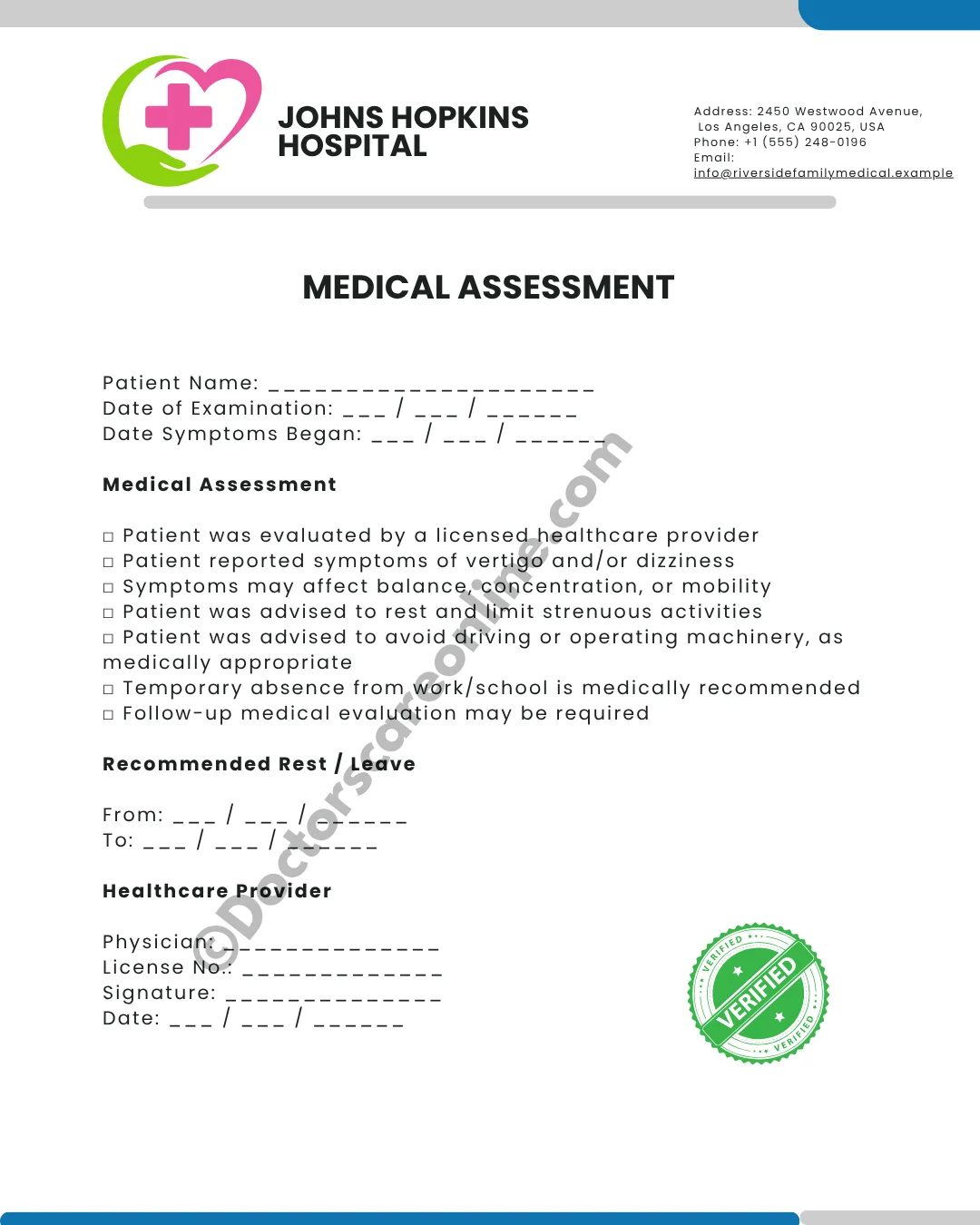
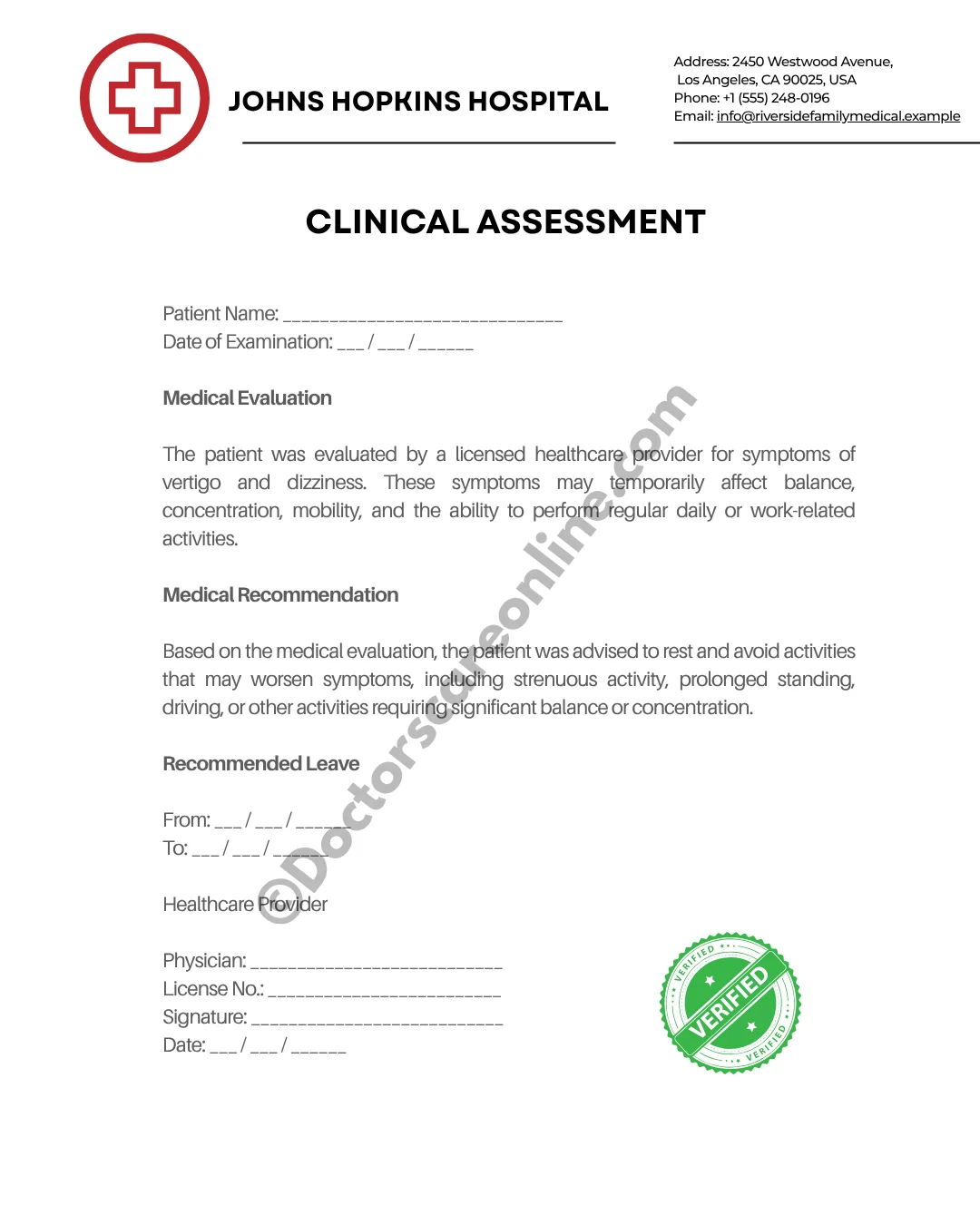
The contents vary depending on the provider and the purpose of the documentation. A note may include:
| Information | Purpose |
|---|---|
| Patient name | Identifies the person evaluated |
| Examination date | Documents when medical evaluation occurred |
| Medical confirmation | Confirms that an evaluation took place |
| Leave period | States recommended absence dates when applicable |
| Work restrictions | Identifies temporary limitations |
| Return date | Indicates the recommended return date when appropriate |
| Follow-up instructions | Explains whether additional evaluation is recommended |
| Provider information | Identifies the licensed healthcare professional |
A doctor’s note does not necessarily need to disclose a detailed diagnosis. The provider determines what information is appropriate to include.
Can a Doctor Recommend Work Restrictions for Vertigo?
Yes. Depending on the symptoms and job requirements, a healthcare provider may recommend temporary restrictions when dizziness or vertigo creates a safety concern.
Possible restrictions may include:
- Avoiding driving for work
- Avoiding ladders or elevated work areas
- Avoiding machinery or hazardous equipment
- Limiting strenuous physical activity
- Reducing activities that worsen symptoms
- Taking additional breaks
- Temporary light-duty assignments
- Modified work responsibilities
Restrictions should be individualized according to the patient’s medical condition and the requirements of the job.
Vertigo, Dizziness, and Work: When May Time Off Be Necessary?
Some occupations become particularly difficult or unsafe when balance or spatial orientation is impaired.
Examples include jobs involving:
- Driving
- Operating machinery
- Construction
- Working at heights
- Heavy physical labor
- Climbing ladders
- Patient handling
- Safety-sensitive equipment
- Rapid movement or frequent changes in position
If symptoms interfere with essential job duties, a healthcare provider can assess whether temporary leave or modified duties may be appropriate.
How Is Vertigo Diagnosed?
The diagnostic process depends on the symptoms and suspected cause. A healthcare professional may review:
- Medical history
- Symptom duration and frequency
- Triggers
- Medication history
- Balance and coordination
- Eye movements
- Hearing symptoms
- Neurological symptoms
- Blood pressure or other vital signs when appropriate
Depending on the findings, additional evaluation may include hearing tests, vestibular testing, imaging, blood tests, or an in-person neurological or ear examination.
Not every person with dizziness needs imaging or laboratory testing. The appropriate evaluation depends on the individual clinical situation.
Treatment Options for Vertigo and Dizziness
Treatment depends on the underlying cause.
Depending on the diagnosis, a healthcare professional may recommend:
- Hydration when appropriate
- Activity modification
- Vestibular rehabilitation
- Specific repositioning maneuvers for certain types of positional vertigo
- Treatment of an underlying medical condition
- Medication when clinically appropriate
- Management of migraine-related symptoms
- Evaluation of medication side effects
- Referral to an appropriate specialist
Do not begin, stop, or change prescription medication based solely on online information. Follow the recommendations of your healthcare professional.
What to Do While Recovering From Vertigo or Dizziness
If you are experiencing dizziness or vertigo:
- Move slowly when changing positions.
- Sit or lie down if you feel unsteady.
- Avoid driving when symptoms could make driving unsafe.
- Avoid ladders and other fall-risk activities.
- Stay hydrated unless a healthcare professional has advised fluid restriction.
- Follow your treatment recommendations.
- Keep track of recurring episodes and possible triggers.
- Ask for assistance if you have difficulty walking safely.
- Seek medical care if symptoms become severe, persistent, or unusual.
Avoid assuming that every episode of dizziness has the same cause.
How Our Online Service Can Help
Our online service is designed to make the process of seeking a medical evaluation more convenient when telehealth is appropriate.
Users can:
- Request an online medical consultation.
- Share information about their symptoms securely through the available process.
- Connect with a licensed healthcare professional where services are available.
- Discuss how vertigo or dizziness is affecting work, school, or daily activities.
- Receive professional medical guidance based on the evaluation.
- Receive medical documentation if the healthcare provider determines it is appropriate.
Our goal is to make access to legitimate medical evaluation more straightforward while keeping the healthcare provider’s clinical judgment at the center of the process.
Why Users Can Trust Our Service
Choosing an online healthcare service involves more than convenience. Users should be able to understand how the service works and what they can expect.
Our service focuses on:
- Licensed healthcare professionals: Medical evaluations are handled by appropriately licensed providers where services are available.
- Clinical evaluation: Documentation is based on a healthcare professional’s assessment rather than an automatic purchase.
- Clear process: Users can understand the consultation, evaluation, and documentation process before proceeding.
- Privacy-conscious communication: Medical information should be handled through the secure systems provided by the service.
- User support: Assistance is available for account, registration, payment, and general service questions.
- Responsible documentation: A doctor’s note is provided only when medically appropriate and permitted.
- Patient-centered convenience: Online consultations can reduce unnecessary travel when telehealth is suitable.
Users should always provide accurate health information and follow the healthcare provider’s recommendations.
Need Help With Registration, Login, Payment, or Your Order?
If you experience a problem while using our website, you do not have to figure it out alone.
You can use our chatbox to ask questions about:
- Registering for an account
- Logging in
- Booking an appointment
- Payment-related issues
- Order or consultation questions
- Website navigation
- General service-related concerns
Our support team can help with service and account-related questions. However, medical decisions, diagnoses, treatment recommendations, and whether documentation should be issued are determined by the licensed healthcare professional.
For your security, never share passwords, payment-card numbers, or other highly sensitive credentials through a general support chat.
Doctor’s Note for Vertigo & Dizziness: Important Considerations
Before requesting medical documentation, remember:
- A doctor’s note requires appropriate medical evaluation.
- Documentation is not guaranteed.
- The healthcare provider determines whether leave or restrictions are medically appropriate.
- Employer and school requirements can vary.
- Telehealth may not be suitable for every dizziness or vertigo complaint.
- Serious or emergency symptoms require appropriate urgent medical care.
- Never alter or falsify a medical document.
- Follow the dates and restrictions provided by your healthcare professional.
Frequently Asked Questions
1. Can vertigo qualify for medical leave from work?
It can, depending on the severity of the symptoms and how they affect your ability to perform your job safely. A healthcare provider can assess your condition and determine whether medical leave or temporary restrictions are appropriate.
2. Can I get a doctor’s note for dizziness without a diagnosis?
A healthcare provider may be able to document that you were medically evaluated and provide appropriate recommendations without including a detailed diagnosis. What appears on the note depends on the provider and applicable requirements.
3. Is telehealth appropriate for every type of vertigo?
No. Some dizziness and vertigo symptoms can be discussed through telehealth, but certain symptoms require an in-person examination, testing, or urgent evaluation. The healthcare provider will determine the appropriate level of care.
4. Can vertigo affect my ability to drive?
Yes. Dizziness, spinning sensations, impaired balance, or visual disturbances can make driving unsafe. If you are experiencing active symptoms, avoid driving and discuss your situation with a healthcare professional.
5. What happens if my employer does not accept an online doctor’s note?
Employer requirements vary. If your workplace does not accept a particular type of documentation, ask HR or your employer what medical documentation they require. You may need additional documentation or an in-person evaluation depending on their policy and applicable rules.
Medical Disclaimer: This information is provided for general educational purposes and is not a substitute for professional medical advice, diagnosis, or treatment. Vertigo and dizziness can have many possible causes, including conditions that require in-person evaluation or urgent medical care.
A doctor’s note should only be issued by a licensed healthcare professional after an appropriate medical evaluation. The availability of online consultations, medical documentation, work or school recommendations, and telehealth services may vary by location and individual circumstances.
Do not use this information to self-diagnose or delay necessary medical care. If dizziness or vertigo occurs with sudden weakness or numbness, difficulty speaking, severe new headache, fainting, chest pain, severe breathing difficulty, significant coordination problems, or other emergency warning signs, seek immediate medical attention.



Reviews
There are no reviews yet.