
BPPV vs Vestibular Migraine vs Meniere’s Disease – Dizziness and vertigo can have many causes, and three conditions that are often confused are benign paroxysmal positional vertigo (BPPV), vestibular migraine, and Ménière’s disease. Although all three can cause vertigo, they differ in their typical triggers, duration, associated symptoms, and evaluation.
Understanding these differences can help you recognize when your symptoms may need medical evaluation. However, symptoms alone cannot reliably confirm a diagnosis. A healthcare professional may need to review your medical history, perform specific examinations, and sometimes recommend hearing, balance, or imaging tests.
Related Doctor Note : ——
If vertigo is affecting your ability to work, attend school, drive, or perform everyday activities, an online medical consultation may be an option when your symptoms are appropriate for telehealth. A licensed healthcare provider can determine whether remote evaluation is suitable and whether additional in-person care is necessary.
BPPV vs Vestibular Migraine vs Ménière’s Disease at a Glance
| Feature | BPPV | Vestibular Migraine | Ménière’s Disease |
| Main characteristic | Position-triggered vertigo | Vertigo/dizziness associated with migraine | Recurrent spontaneous vertigo with hearing-related symptoms |
| Typical trigger | Head or body-position changes | May occur spontaneously or with various sensory/migraine triggers | Usually spontaneous rather than specifically position-triggered |
| Episode duration | Usually brief, often seconds | Typically minutes to hours; diagnostic criteria allow episodes from 5 minutes to 72 hours | Typically 20 minutes to 12 hours for definite Ménière’s disease |
| Hearing loss | Not a typical feature of BPPV | Not a defining feature | A key diagnostic feature when documented |
| Tinnitus | Not typical | May occur, but not defining | Common |
| Ear fullness | Not typical | May occur in some people | Common |
| Migraine history/features | Not required | Important diagnostic clue | Not required |
| Common evaluation | Positional testing such as Dix-Hallpike | Clinical history and migraine/vestibular assessment | Clinical history plus hearing evaluation |
| Typical treatment approach | Canalith repositioning maneuver | Migraine-focused management | Individualized management of vertigo and hearing symptoms |
The table summarizes typical clinical patterns; individual symptoms can overlap, so it should not be used as a self-diagnostic tool.
What Is BPPV?
Benign paroxysmal positional vertigo, commonly called BPPV, is a common vestibular disorder involving tiny calcium carbonate particles called otoconia. When these particles move into a semicircular canal, certain head movements can produce an incorrect signal about head position, resulting in vertigo.

BPPV is particularly associated with position changes, such as:
- Rolling over in bed
- Sitting up or lying down
- Looking upward
- Bending down
- Turning the head
- Changing from one position to another
The vertigo is generally brief and triggered by movement rather than occurring randomly.
Common BPPV Symptoms
People with BPPV may experience:
- A sudden spinning sensation
- Brief episodes of positional vertigo
- Dizziness when turning in bed
- Nausea
- Balance problems
- Unsteadiness after an episode
Hearing loss and tinnitus are not typical features of classic BPPV. When significant hearing symptoms accompany vertigo, another diagnosis may need to be considered.
How Is BPPV Diagnosed?
A healthcare professional may use positional testing to evaluate suspected BPPV.
The Dix-Hallpike maneuver is commonly used when posterior-canal BPPV is suspected. If the history suggests BPPV but the Dix-Hallpike test is negative, a clinician may consider a supine roll test for lateral-canal BPPV.
Routine imaging is generally not necessary when BPPV is confidently diagnosed and there are no additional concerning symptoms. Testing may be considered when the diagnosis is uncertain or other neurological or medical findings are present.
How Is BPPV Treated?
Treatment commonly involves a canalith repositioning procedure, such as the Epley maneuver, designed to move displaced particles out of the affected semicircular canal. Vestibular rehabilitation may also be considered in appropriate cases.
A healthcare professional should determine the appropriate maneuver, particularly when a person has neck problems, recent injury, mobility limitations, or another condition that could affect treatment.
What Is Vestibular Migraine?
Vestibular migraine is a neurological condition in which people experience recurrent vestibular symptoms associated with migraine. Unlike classic migraine, a headache does not have to occur during every vertigo episode.

Vestibular symptoms can include:
- Vertigo
- Dizziness
- Motion sensitivity
- Sensitivity to visual movement
- Imbalance
- Sensitivity to motion or busy environments
Migraine-related features such as headache, light sensitivity, sound sensitivity, or visual aura can provide important diagnostic clues. Clinical criteria generally require a history of migraine and recurrent vestibular episodes rather than a single isolated episode.
Vestibular Migraine Symptoms
Symptoms may include:
- Spinning or non-spinning dizziness
- Motion sensitivity
- Visual sensitivity
- Nausea
- Headache during some attacks
- Sensitivity to bright lights
- Sensitivity to loud sounds
- Visual aura in some people
- Difficulty concentrating or maintaining balance
One important distinction is that vestibular migraine can occur without a headache during the vertigo episode. Therefore, the absence of a headache does not automatically rule it out.
How Is Vestibular Migraine Diagnosed?
There is no single routine test that confirms vestibular migraine in every patient. Healthcare professionals generally rely on the patient’s symptom pattern, migraine history, clinical evaluation, and exclusion of other possible causes.
A provider may ask:
- How long episodes last
- How frequently they occur
- Whether there is a history of migraine
- Whether light or sound sensitivity occurs
- Whether visual symptoms occur
- Whether particular movements or environments trigger symptoms
- Whether hearing loss or tinnitus occurs
- Whether other neurological symptoms are present
Because several vestibular disorders can overlap, professional assessment is important.
Vestibular Migraine Treatment
Treatment is individualized and may involve approaches used for migraine management, lifestyle measures, trigger identification, and treatment of associated symptoms.
Depending on the person’s circumstances, a healthcare professional may recommend:
- Migraine-focused treatment
- Regular sleep and meal patterns
- Identifying individual triggers
- Stress-management strategies
- Appropriate physical or vestibular rehabilitation
- Medication when clinically appropriate
Treatment should be determined by a healthcare professional rather than based solely on an online symptom comparison.
What Is Ménière’s Disease?
Ménière’s disease is an inner-ear disorder associated with episodes of vertigo, hearing loss, tinnitus, and a feeling of fullness or pressure in the ear. It often affects one ear, although both ears can be affected in some people.
Unlike classic BPPV, Ménière’s disease typically causes spontaneous episodes rather than vertigo that consistently occurs only after changing head position.
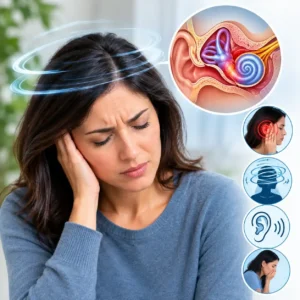
Common Symptoms of Ménière’s Disease
Symptoms may include:
- Recurrent vertigo
- Fluctuating hearing loss
- Tinnitus or ringing in the ear
- Ear fullness or pressure
- Nausea
- Balance problems
For definite Ménière’s disease, diagnostic criteria include at least two spontaneous vertigo episodes lasting 20 minutes to 12 hours, documented hearing loss in the relevant frequency range, fluctuating ear symptoms, and symptoms not better explained by another vestibular condition.
How Is Ménière’s Disease Diagnosed?
Diagnosis generally involves a detailed medical history and evaluation of hearing and balance symptoms.
A healthcare provider may recommend:
- Hearing testing or audiometry
- Review of vertigo episodes
- Assessment of tinnitus and ear fullness
- Evaluation for other vestibular conditions
- Additional testing or imaging when another condition needs to be ruled out
There is no single test that independently confirms Ménière’s disease in every patient.
Ménière’s Disease Treatment
There is currently no universal cure for Ménière’s disease, so treatment focuses on managing symptoms and reducing their impact.
Depending on the individual situation, treatment may include:
- Management of acute vertigo symptoms
- Dietary or lifestyle strategies
- Medication
- Vestibular rehabilitation for persistent balance problems
- Injections in selected cases
- Surgery for certain people with severe, treatment-resistant disease
Treatment decisions should be made with an appropriate healthcare professional.
BPPV vs Vestibular Migraine: What Is the Difference?
The biggest difference is often how the vertigo occurs.
BPPV
BPPV is characteristically associated with specific changes in head position. For example, a person may experience a short spinning sensation when rolling over in bed or looking upward.
Vestibular Migraine
Vestibular migraine involves recurrent vestibular symptoms associated with a migraine history and/or migraine features. Episodes may last substantially longer than typical BPPV episodes and do not necessarily require a specific positional trigger.
The Important Overlap
A person can have more than one vestibular condition, and symptoms do not always fit perfectly into one category. That is why a healthcare professional should evaluate persistent, recurrent, or unusual vertigo rather than relying solely on symptom checklists.
BPPV vs Ménière’s Disease: What Is the Difference?
The presence of hearing-related symptoms is an important distinction.
BPPV typically causes brief position-triggered vertigo without hearing loss. Ménière’s disease, in contrast, is associated with episodes of vertigo accompanied by hearing-related symptoms such as tinnitus, hearing loss, or aural fullness.
If you experience recurrent vertigo together with new or fluctuating hearing loss, tinnitus, or ear pressure, medical evaluation is particularly important.
Vestibular Migraine vs Ménière’s Disease: What Is the Difference?
These two conditions can sometimes be difficult to distinguish because both may cause recurrent episodes of vertigo.
Some useful clues include:
Vestibular migraine
- History of migraine is important.
- Episodes may occur with or without headache.
- Light and sound sensitivity may occur.
- Visual motion sensitivity may occur.
- Hearing loss is not a defining diagnostic feature.
Ménière’s disease
- Recurrent spontaneous vertigo is typical.
- Hearing loss is an important part of definite diagnostic criteria.
- Tinnitus may accompany attacks.
- Ear fullness or pressure may occur.
- Hearing evaluation is commonly part of the assessment.
These features are clues rather than a substitute for diagnosis.
How Long Does Vertigo Last in BPPV, Vestibular Migraine, and Ménière’s Disease?
Duration can be a useful clue, although it cannot establish a diagnosis by itself.
| Condition | Typical episode pattern |
|---|---|
| BPPV | Brief, position-triggered episodes, commonly lasting seconds |
| Vestibular migraine | Episodes can last from about 5 minutes to 72 hours under diagnostic criteria |
| Ménière’s disease | Definite cases involve spontaneous episodes lasting 20 minutes to 12 hours |
The duration ranges overlap in real-world experiences, so other symptoms and clinical findings must also be considered.
Can BPPV, Vestibular Migraine, and Ménière’s Disease Be Confused?
Yes.
Vertigo is a symptom rather than a diagnosis, and different vestibular and neurological conditions can produce similar sensations.
For example:
- BPPV can cause dizziness and imbalance.
- Vestibular migraine can cause vertigo and motion sensitivity.
- Ménière’s disease can cause vertigo with hearing-related symptoms.
- Other inner-ear, neurological, cardiovascular, medication-related, or systemic conditions can also cause dizziness.
Because of this overlap, persistent or unexplained vertigo deserves appropriate medical assessment.
Key Takeaways
The easiest way to remember the broad differences is:
- BPPV: Think position — brief vertigo triggered by specific head movements.
- Vestibular migraine: Think migraine-related vestibular symptoms — dizziness or vertigo may occur with migraine features and does not always include headache.
- Ménière’s disease: Think vertigo + hearing symptoms — recurrent vertigo associated with hearing loss, tinnitus, or ear fullness.
These are useful general patterns, not self-diagnostic rules. Similar symptoms can occur in other conditions, and more than one vestibular disorder may sometimes be present.
If recurring or unexplained dizziness is affecting your daily life, speak with a qualified healthcare professional for an appropriate evaluation.
Frequently Asked Questions
1. Which condition causes vertigo when turning over in bed?
Vertigo that repeatedly occurs when rolling over in bed or changing head position is characteristic of BPPV. However, a healthcare professional should confirm the diagnosis because other conditions can also cause dizziness.
2. Which condition is more likely to involve hearing loss?
Hearing loss is an important feature in the diagnosis of Ménière’s disease. It is not a defining feature of BPPV or vestibular migraine. New or sudden hearing changes should be medically evaluated.
3. Can vestibular migraine happen without a headache?
Yes. Vestibular migraine does not require a headache during every vestibular episode. A history of migraine and other migraine-associated features can help a healthcare professional evaluate the condition.
4. Do I need an MRI for dizziness or vertigo?
Not everyone with dizziness or vertigo needs an MRI. The need for imaging depends on the clinical assessment, symptoms, examination findings, and whether another condition needs to be ruled out. For typical BPPV, routine imaging is generally not recommended unless there is diagnostic uncertainty or another concerning finding.
5. Can I have more than one vestibular condition?
Yes. Vestibular disorders can overlap, and a person may have symptoms that do not fit neatly into one diagnosis. Persistent, recurrent, or changing symptoms should be discussed with a healthcare professional rather than self-diagnosed from an online comparison.
Medical Disclaimer
This article is provided for general educational and informational purposes only. It is not a substitute for professional medical advice, diagnosis, or treatment.
BPPV, vestibular migraine, Ménière’s disease, and other causes of dizziness can have overlapping symptoms. The information in this article should not be used to diagnose or treat a medical condition. A qualified healthcare professional should evaluate persistent, recurrent, severe, or unexplained vertigo.