

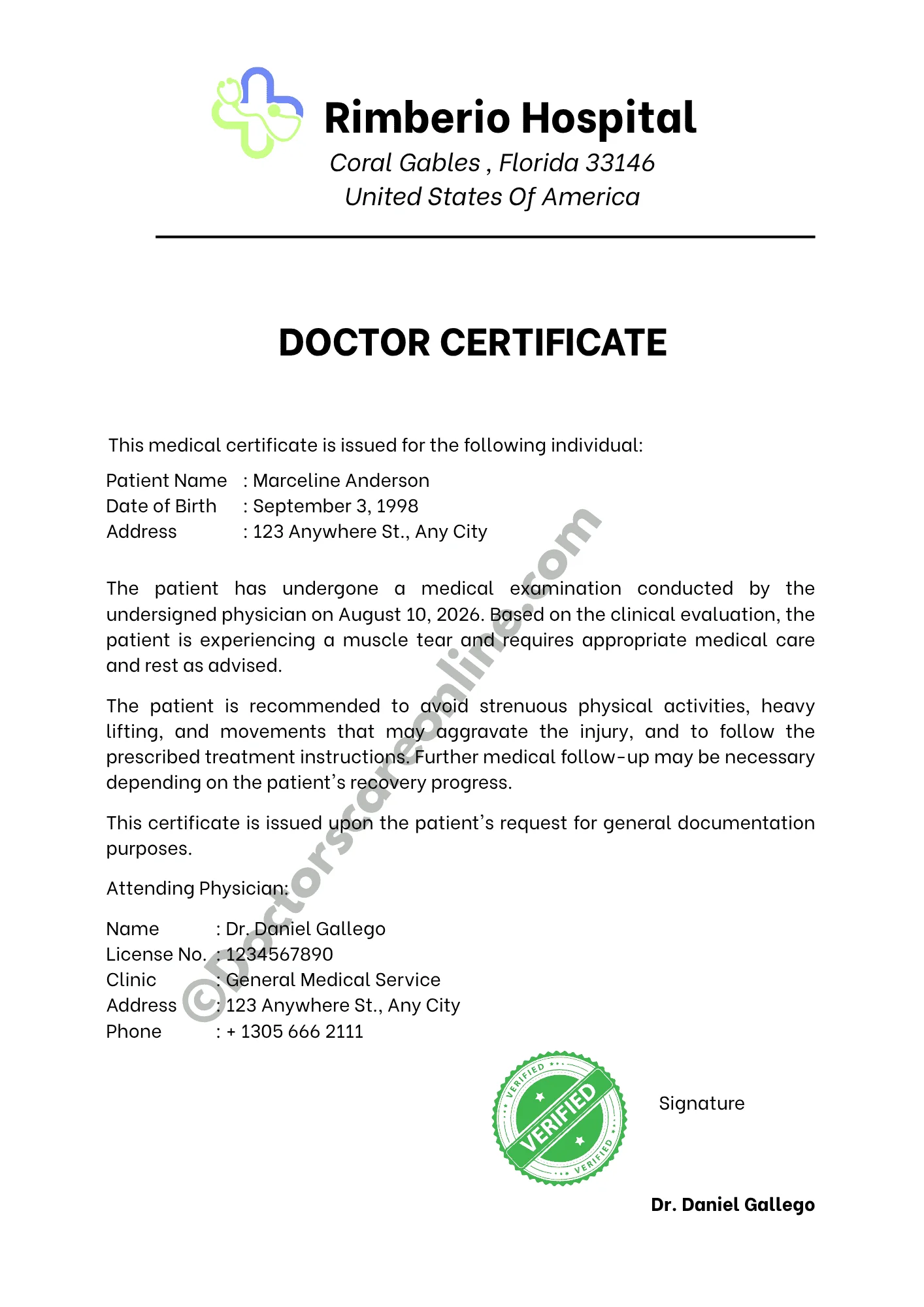
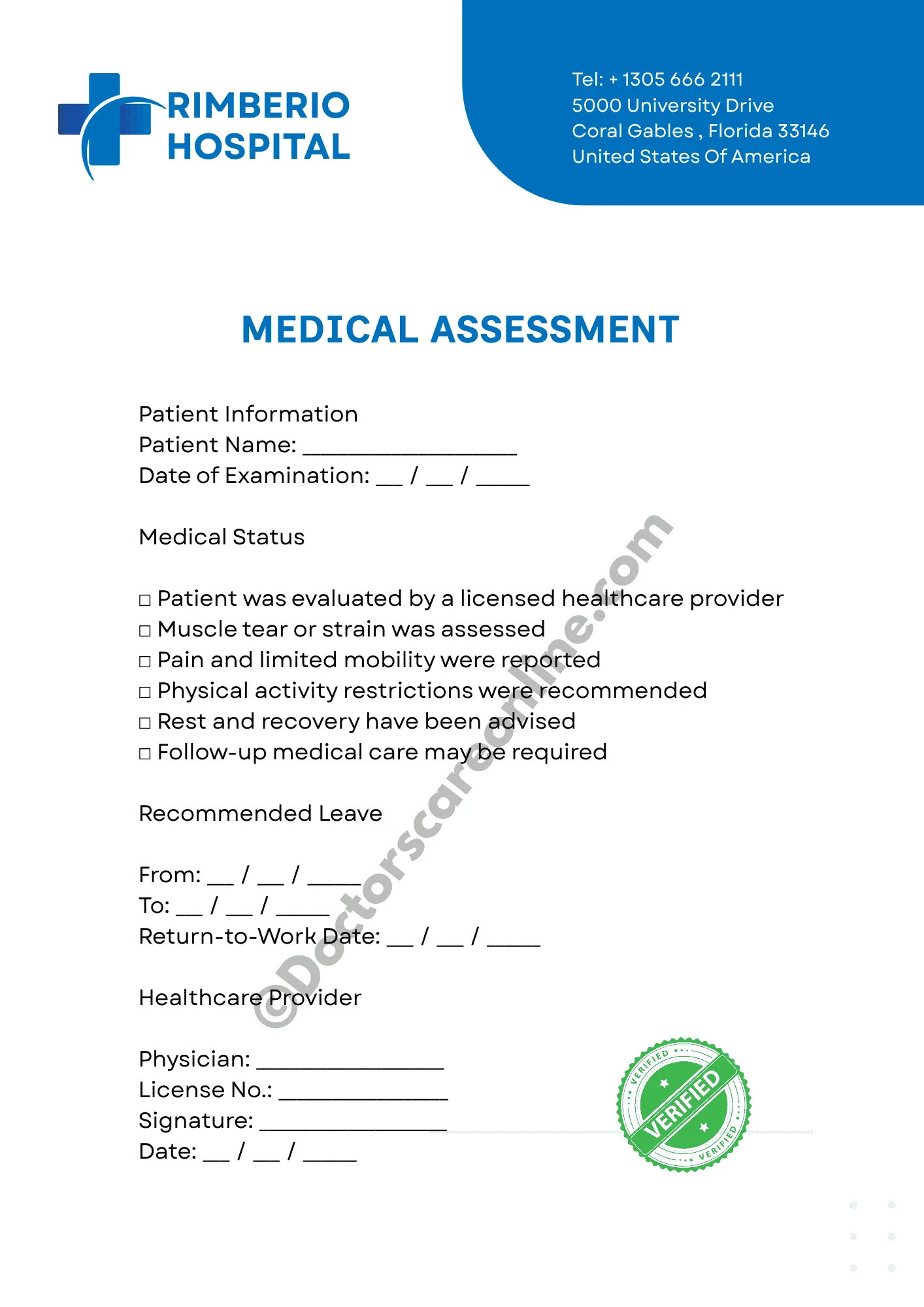
An Online Doctor’s Note for Muscle Tear can provide medical documentation after you complete an online doctor visit with a licensed healthcare professional. During the consultation, you can explain how the injury happened, describe your symptoms, and discuss how the condition is affecting your ability to perform your normal responsibilities.
If the healthcare provider determines that your condition requires time away from work or school, modified duties, activity restrictions, or another form of medical documentation, they may provide appropriate documentation based on their clinical assessment and applicable requirements.
A muscle tear is an injury in which muscle fibers are overstretched or damaged. Muscle injuries can range from a mild strain to a partial or complete tear involving the muscle or the tendon connected to it.
Muscle tears can occur during sports, exercise, lifting, sudden movements, falls, workplace activities, or repetitive physical tasks. Commonly affected areas include the hamstrings, calves, thighs, shoulders, arms, and lower back.
Related Doctor Note :——
You can also visit:
- Patient First Doctors Note for Work
- Doctor’s Note for Work From Home
- 3 Months of Unlimited Doctor’s Notes
Why You May Need Online Doctor’s Note for Muscle Tear
A muscle injury can make ordinary responsibilities difficult when your work or school activities require physical movement.
You may need medical documentation when:
- Your injury prevents you from safely performing your normal job duties.
- Your occupation requires lifting, carrying, bending, climbing, standing, or repetitive movement.
- You need temporary restrictions while the injured tissue recovers.
- Your school requires documentation for an absence related to an injury.
- You need modified duties instead of complete time away from work.
- You have an injury that affects participation in physical training or athletic activities.
- Your employer or educational institution has a medical documentation requirement.
The purpose of medical documentation is to communicate the healthcare provider’s recommendations clearly without requiring you to disclose unnecessary private medical information.
Common Causes of Muscle Tears
Muscle tears can develop from a single sudden event or from repeated stress placed on a muscle over time.
Common causes include:
- Sports and Athletic Activity: Running, jumping, sprinting, changing direction quickly, weightlifting, and contact sports can place substantial stress on muscles and tendons.
- Heavy Lifting: Lifting a heavy object without appropriate technique or suddenly increasing the amount of weight being handled can contribute to muscle injury.
- Sudden Movement: A rapid movement or unexpected change in direction can overstretch muscle fibers and cause an acute injury.
- Repetitive Physical Work: Jobs involving repeated lifting, pushing, pulling, bending, or other physical movements can contribute to overuse injuries.
- Falls and Accidents: A fall, collision, or other traumatic event can damage muscle tissue and surrounding structures.
- Inadequate Conditioning: Suddenly performing intense physical activity without adequate conditioning may increase the risk of muscle injury.
A previous injury to the same area may also affect the risk of another muscle strain or tear.
Symptoms of a Muscle Tear
Symptoms vary according to the location and severity of the injury.
Possible symptoms include:
- Sudden or localized muscle pain
- Tenderness around the injured area
- Swelling
- Bruising or skin discoloration
- Muscle weakness
- Reduced range of motion
- Muscle spasms
- Difficulty walking or using the affected body part
- Pain that increases when the muscle is used
- A popping or tearing sensation at the time of injury
Severe symptoms or difficulty using the injured muscle should be evaluated by a healthcare professional.
Can an Online Doctor Evaluate a Muscle Tear?
An online doctor visit may be appropriate for discussing certain muscle injuries, particularly when the provider can reasonably assess the symptoms and circumstances through telehealth.
During a virtual consultation, the healthcare professional may ask about:
- How the injury occurred
- The exact location of the pain
- When symptoms began
- Changes in movement or strength
- Swelling or bruising
- Whether you heard or felt a pop
- Previous injuries to the same area
- Treatments you have already tried
- Your work, school, or activity limitations
However, telehealth cannot replace an in-person examination when the provider believes that a physical assessment, diagnostic imaging, or urgent treatment is necessary. For some soft-tissue injuries, ultrasound or MRI may be used to evaluate the extent of the injury.
How to Book an Online Doctor Visit for a Muscle Tear
Booking an online consultation can be completed through the normal appointment process on our website.
Step 1: Choose an Available Doctor Visit
- Select an available online medical consultation that is appropriate for discussing your muscle injury.
Step 2: Register or Log In
- Create an account or sign in using the information requested by the website.
Step 3: Provide Your Medical Information
- Describe your symptoms, injury location, when the injury occurred, and how the muscle tear is affecting your normal activities.
Step 4: Select an Appointment Time
- Choose an available consultation time that works for you.
Step 5: Complete the Required Payment
- If payment is required for the selected consultation, complete the payment process using the available payment method.
Step 6: Attend Your Doctor Visit
- Join the online appointment at the scheduled time and communicate your symptoms and concerns directly to the healthcare professional.
Step 7: Follow the Provider’s Recommendation
- The healthcare provider may recommend home care, activity modification, additional evaluation, an in-person appointment, or other treatment depending on your condition.
If medical documentation is clinically appropriate, the provider may issue a doctor’s note according to applicable requirements.
What Should You Tell the Doctor During Your Appointment?
Providing complete and accurate information can help the healthcare professional understand the injury and its effect on your daily activities.
Before the appointment, consider noting:
- The date and time of the injury
- What you were doing when it happened
- The body part involved
- The intensity and type of pain
- Whether swelling or bruising developed
- Whether you noticed a pop or snap
- Whether you can move the affected area normally
- Any weakness, numbness, or tingling
- Previous injuries involving the same area
- Medications or treatments you have already used
- Your job or school responsibilities
- Any specific activity that you currently cannot perform
Being accurate is important because the healthcare provider uses the information you provide as part of the medical assessment.
What Can a Doctor’s Note for a Muscle Tear Include?
The exact content depends on the healthcare professional and the purpose of the documentation.
When medically appropriate, documentation may include:
- Patient identification
- Date of medical evaluation
- Confirmation that a medical assessment occurred
- Recommended period away from work or school
- Temporary activity limitations
- Modified-duty recommendations
- Expected return date when clinically appropriate
- Follow-up recommendations
- Healthcare provider information and signature
The amount of medical information included can vary depending on the documentation requirements and applicable privacy considerations.
Patients should never modify, alter, or add information to an issued medical document.
Muscle Tear Work Restrictions
Depending on the injury and the type of job you perform, a healthcare provider may recommend temporary changes to your usual duties.
Potential restrictions may involve:
- Avoiding heavy lifting
- Limiting repetitive movements
- Avoiding strenuous exercise
- Reducing prolonged standing
- Limiting climbing or walking
- Avoiding movements that increase pain
- Temporarily performing lighter duties
- Taking scheduled breaks
- Gradually returning to normal physical activities
The appropriate restrictions depend on the injured muscle, severity of symptoms, functional ability, occupation, and clinical assessment. There is no single work restriction that applies to every muscle tear.
How Long Does a Muscle Tear Take to Heal?
Recovery time varies significantly between injuries. A minor muscle injury may improve with conservative care, while a more significant partial or complete tear can require a longer rehabilitation period.
Recovery can depend on:
- Extent of tissue damage
- Location of the injury
- Overall health
- Physical demands of your daily activities
- Previous injuries
- Response to treatment
- Whether physical therapy is required
- Whether surgery or specialist care becomes necessary
Rather than relying on a fixed number of days, follow the recovery plan provided by your healthcare professional.
Treatment and Recovery for Muscle Tears
Treatment depends on the type and severity of the injury.
Healthcare professionals may recommend approaches such as:
- Protecting the injured area
- Rest or temporary activity modification
- Ice during the early period when appropriate
- Compression
- Elevation
- Pain management
- Physical therapy
- Progressive strengthening and mobility exercises
- Bracing or supportive equipment for selected injuries
- Specialist evaluation for significant injuries
More serious muscle or tendon injuries may require advanced treatment, and complete tears can sometimes require surgical management.
Do not begin strenuous exercise or return to demanding physical activity simply because the pain has temporarily decreased. Follow the treatment and rehabilitation instructions provided by your healthcare professional.
When a Muscle Injury Needs Urgent Medical Care
Some injuries require prompt in-person or emergency assessment rather than relying only on an online consultation.
Seek urgent medical care if you have severe symptoms, substantial loss of function, significant trauma, or symptoms suggesting a more serious injury.
If you are unable to safely use the injured body part, have severe worsening pain, develop significant weakness or numbness, or experience another concerning symptom after an injury, seek appropriate medical care promptly.
If you believe you have a medical emergency, call 911 or go to the nearest emergency department rather than waiting for an online appointment.
How Our Online Doctor Visit Can Help
Our service is designed to make the process of connecting with a healthcare professional more convenient when you need to discuss a muscle injury.
Instead of searching for an appointment in person, eligible users can use our online process to:
- Request a convenient doctor visit
- Explain their symptoms remotely
- Discuss how the injury affects work, school, or daily activities
- Receive professional medical guidance
- Ask questions about their symptoms and next steps
- Obtain appropriate medical documentation when the healthcare professional determines it is medically justified
The key benefit is convenience without removing the clinical decision-making process. A doctor determines what care or documentation is appropriate based on the information available during the consultation.
Why Patients Can Trust Our Process
We aim to make the online medical-visit process clear, convenient, and patient-focused.
Our website helps users understand what to expect before, during, and after an online consultation rather than simply providing a document without medical evaluation.
Patients can use the service to:
- Connect with a healthcare professional through an online appointment process
- Provide relevant information about their symptoms
- Receive medical guidance based on their individual situation
- Understand whether further in-person care may be necessary
- Request appropriate medical documentation when clinically justified
- Get assistance if they experience problems with their account or order
For telehealth services, privacy and security are important considerations when handling health information. U.S. Department of Health and Human Services guidance recommends appropriate privacy and security safeguards for telehealth and advises patients to use private settings and secure connections when sharing health information.
Important: Only make specific claims such as “HIPAA-compliant,” “HIPAA-covered,” “encrypted,” or “licensed in all 50 states” if those statements are accurate for your actual website, providers, technology, and operations.
Need Help With Registration, Login, Payment, or Your Order?
If you have a question or encounter a problem while using our website, you can contact our chatbox support for assistance.
You can use the chatbox if you need help with:
- Creating or accessing your account
- Registration or login problems
- Appointment-related questions
- Payment or checkout issues
- Order-related questions
- Understanding the next step in the online process
- General questions about using the website
Our support team can help with website and service-related questions. Medical questions and clinical decisions should be addressed with the healthcare professional during your appointment.
Protecting Your Privacy During an Online Doctor Visit
When discussing a muscle injury online, you may share personal health information with a healthcare provider. Choose a private location for your appointment and avoid discussing sensitive medical information over unsecured public networks when possible.
HHS recommends using privacy-conscious practices during telehealth visits, including having appointments in private locations and taking reasonable steps to protect health information.
Your healthcare information should be handled according to the privacy requirements applicable to the healthcare service and provider. Patients should also review the website’s privacy policy and understand how their information is collected, used, stored, and protected.
Who May Benefit From an Online Muscle Injury Consultation?
An online doctor visit may be useful for someone who wants to discuss a muscle injury that is affecting their normal routine and needs professional guidance about the next step.
This can include people experiencing:
- A sports-related muscle injury
- A pulled or torn muscle after exercise
- A workplace muscle injury
- A lifting-related injury
- A hamstring or calf injury
- A shoulder or arm muscle injury
- A thigh or hip muscle injury
- Lower-back muscle pain after physical activity
- A recurring muscle problem that needs medical assessment
Whether an online appointment is appropriate depends on the individual symptoms and the healthcare provider’s clinical judgment.
Frequently Asked Questions
1. Can a doctor determine whether I have a partial or complete muscle tear online?
An online consultation may help a healthcare professional assess your symptoms and determine whether further evaluation is needed, but a definitive assessment of the extent of some soft-tissue injuries may require an in-person examination or diagnostic imaging such as ultrasound or MRI.
2. Can a muscle tear affect my ability to work even if I can still walk?
Yes. The effect of an injury depends on your specific job duties. Someone with a physically demanding job may have difficulty performing essential tasks even when they can walk, while someone with sedentary work may have different limitations. Your healthcare provider can assess your functional limitations.
3. Can I ask my doctor about a return-to-work plan during the online visit?
Yes. Tell the healthcare professional what your normal job involves and which activities are difficult because of the injury. This gives the provider relevant information when discussing recovery and potential activity limitations.
4. What happens if the doctor thinks I need an in-person examination?
The healthcare provider may recommend an in-person evaluation or additional testing if your symptoms cannot be adequately assessed through telehealth. Follow that recommendation rather than relying solely on an online consultation.
5. Can I use a doctor’s note for a muscle tear for purposes other than work?
Potentially, depending on the documentation, its stated purpose, and the requirements of the organization receiving it. Schools, sports programs, employers, insurers, and other organizations may have different documentation requirements. Confirm the requirements with the organization before your appointment.
Medical Disclaimer: This content is provided for general educational and informational purposes and is not a substitute for professional medical advice, diagnosis, or treatment. A muscle tear can vary in severity, and symptoms that appear minor may sometimes require an in-person examination or additional testing.
An online consultation does not guarantee that a doctor’s note will be issued. Medical documentation should be provided only when a licensed healthcare professional determines that it is medically appropriate following an evaluation.





Reviews
There are no reviews yet.