
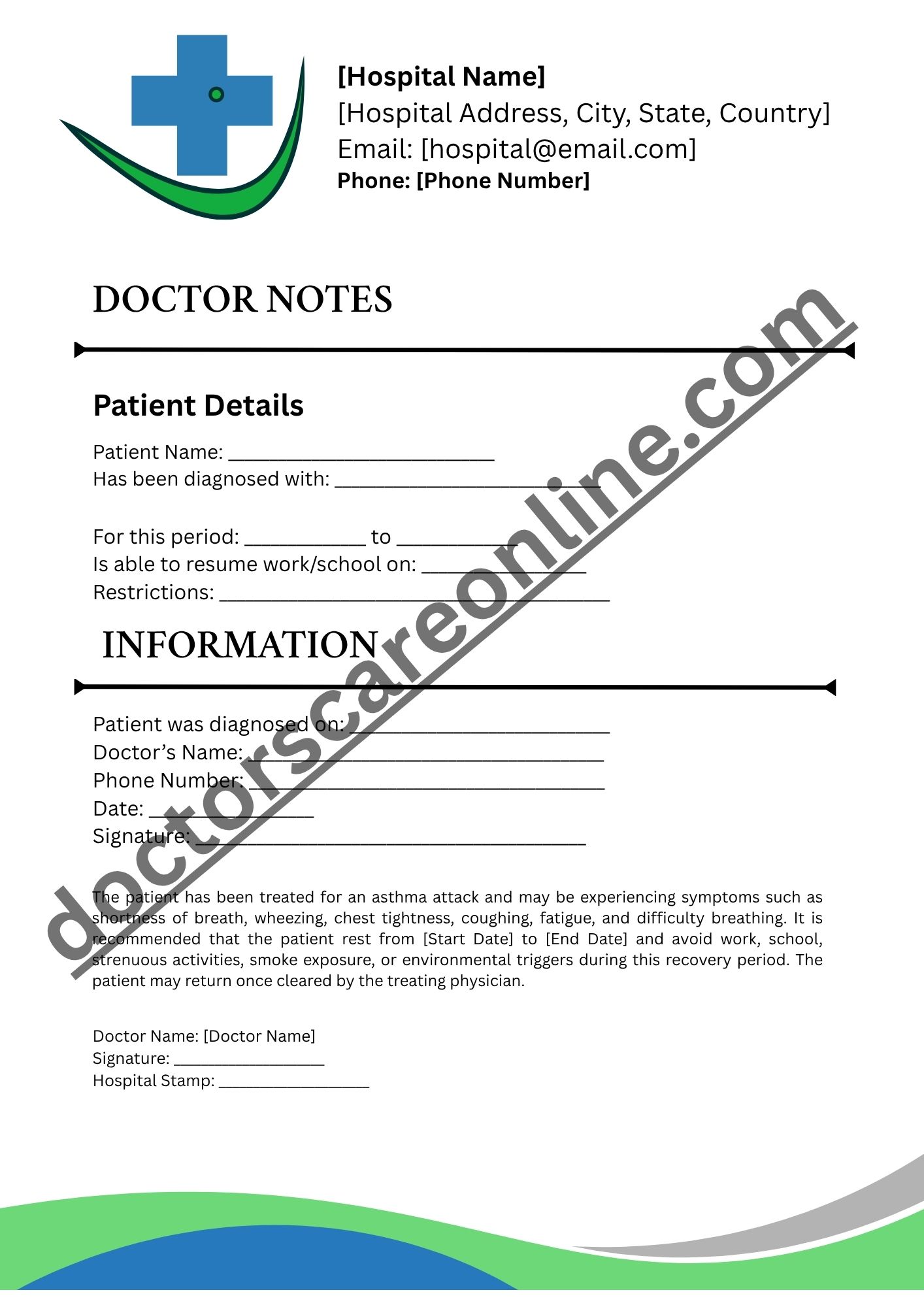
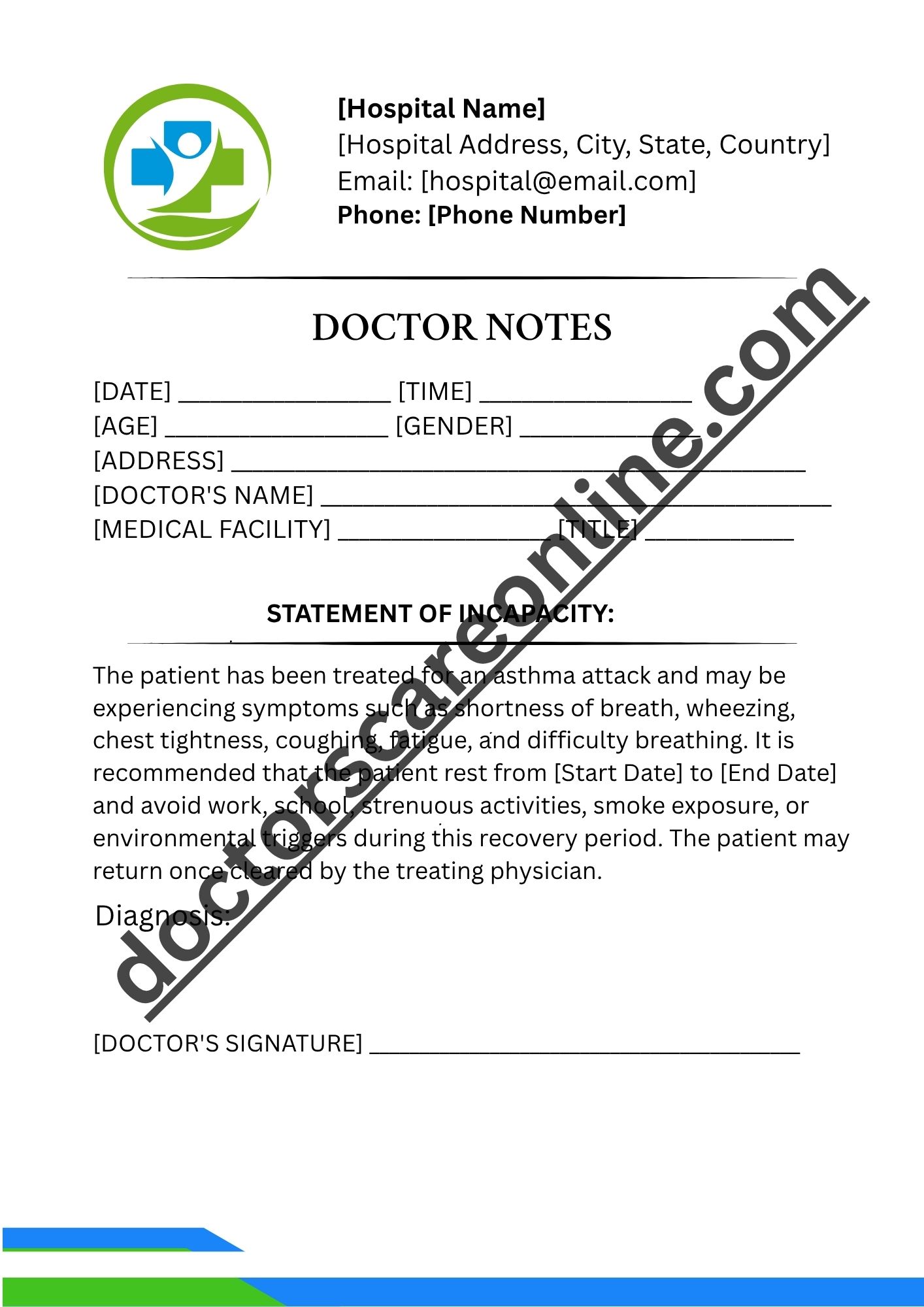
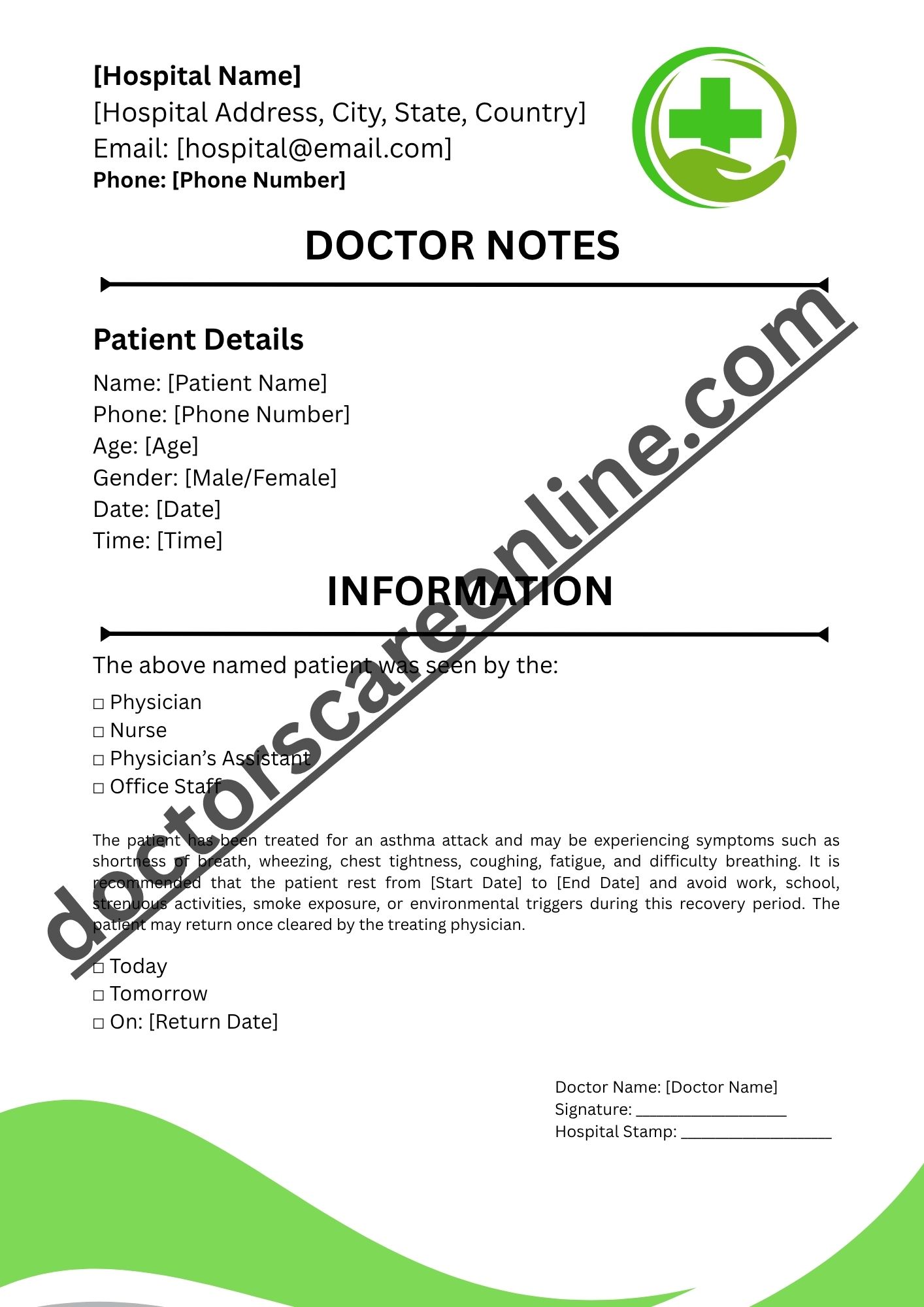
A Doctor’s Note for Asthma is a formal medical document issued by a licensed healthcare professional after evaluating a patient experiencing asthma-related symptoms or complications. It confirms that the individual received medical care and may need temporary leave from work, school, college, or other responsibilities while recovering.
The purpose of the note is not only to verify an absence but also to support the patient’s health by allowing adequate time to recover without risking further breathing problems or additional asthma attacks.
An asthma doctor’s note may be issued after:
- An acute asthma attack
- Severe wheezing or breathing difficulty
- Emergency room treatment
- Urgent care visits
- Follow-up appointments after hospitalization
- Medication adjustments
- Asthma symptoms triggered by allergies or infections
- Occupational asthma caused by workplace exposure
Unlike a general excuse letter, a doctor’s note is based on a medical examination and professional judgment. The healthcare provider determines whether the symptoms are significant enough to justify temporary leave or activity restrictions.
When Might You Need a Doctor’s Note for Asthma?
There are many situations where a doctor may recommend staying home to prevent worsening symptoms and allow proper recovery. Employers and educational institutions often request documentation when absences extend beyond their standard attendance policies.
- Severe Asthma Attack: An asthma attack can make breathing extremely difficult and may require immediate medical treatment. After receiving emergency care, a healthcare provider may recommend taking one or more days off to recover fully.
- Persistent Shortness of Breath: If breathing remains difficult even after using prescribed medication, your doctor may advise avoiding physically demanding activities until your symptoms improve.
- Emergency Room or Urgent Care Visit: Patients treated in an emergency department or urgent care clinic often receive documentation confirming the visit and any recommended recovery period.
- Hospital Admission: Individuals hospitalized due to severe asthma may need extended medical leave before returning to work or school.
- Respiratory Infection Triggering Asthma: Colds, influenza, COVID-19, bronchitis, and other respiratory infections can worsen asthma symptoms, making temporary leave medically appropriate.
- Medication Side Effects: Some asthma medications may temporarily cause fatigue, shakiness, dizziness, or difficulty concentrating, particularly after changes in treatment. A doctor may recommend short-term rest while monitoring the patient’s response.
- Follow-Up Medical Appointments: After a significant asthma episode, follow-up evaluations help ensure symptoms are improving and medications are working effectively. Documentation may be provided if the appointment affects attendance.
- Occupational Asthma: Some individuals develop asthma symptoms after exposure to chemicals, dust, smoke, or fumes in the workplace. A physician may recommend avoiding these triggers until the condition is under better control.
- School or College Attendance Requirements: Students experiencing moderate or severe asthma symptoms may require medical documentation for excused absences, missed examinations, laboratory sessions, or physical education exemptions.
Symptoms That May Lead to an Asthma Medical Excuse
Asthma symptoms vary from person to person and may change in severity over time. Some individuals experience occasional mild symptoms, while others develop sudden attacks that interfere with normal daily activities.
A healthcare provider may consider issuing a doctor’s note if symptoms significantly limit your ability to perform routine tasks safely.
Common symptoms include:
- Persistent wheezing during breathing
- Shortness of breath that limits normal activity
- Tightness or pressure in the chest
- Frequent coughing, especially at night or early morning
- Difficulty speaking because of breathlessness
- Rapid breathing
- Fatigue caused by reduced oxygen intake
- Increased mucus production
- Difficulty climbing stairs or walking short distances
- Reduced tolerance for physical activity
- Night-time asthma attacks disrupting sleep
- Chest discomfort associated with uncontrolled asthma
Symptoms become more concerning when they:
- Continue despite using a rescue inhaler
- Become more frequent than usual
- Wake you repeatedly during the night
- Require emergency medical treatment
- Interfere with work, school, or daily responsibilities
Only a qualified healthcare provider can determine whether these symptoms justify medical leave or additional treatment.
What Information Is Usually Included in an Asthma Doctor’s Note?
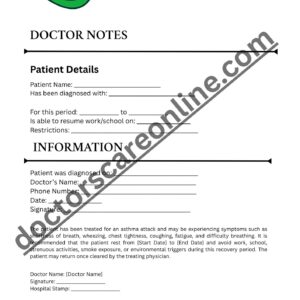
Although the exact format differs between healthcare providers, most legitimate asthma doctor’s notes contain several standard details needed for verification.
| Information Included | Purpose |
|---|---|
| Patient’s full name | Identifies the individual receiving medical care |
| Date of medical examination | Confirms when the evaluation took place |
| Healthcare provider’s name | Identifies the treating medical professional |
| Clinic or hospital information | Allows verification of the medical visit |
| Recommended absence period | Indicates how long the patient should remain away from work or school |
| Return-to-work or return-to-school date | States when normal activities may safely resume |
| Temporary activity restrictions | Lists limitations such as avoiding strenuous exercise or environmental triggers |
| Provider’s signature | Confirms the authenticity of the document |
| Contact information | Enables employers or schools to verify the documentation if necessary |
To protect patient privacy, doctor’s notes typically avoid sharing unnecessary medical details. Instead of describing every aspect of the diagnosis, they usually provide only the information required to support the recommended absence or accommodations.
How Doctors Evaluate Asthma Before Writing a Note
Before issuing a doctor’s note, a healthcare provider performs a medical evaluation to determine the severity of your asthma symptoms and whether time away from work or school is medically necessary.
The assessment helps ensure that treatment recommendations are appropriate and that any serious complications are identified promptly.
A typical asthma evaluation may include:
Review of Current Symptoms
Your doctor will ask about:
- Difficulty breathing
- Wheezing
- Chest tightness
- Persistent coughing
- Night-time symptoms
- Symptom frequency
- Recent asthma attacks
Medical History
The provider may review:
- Previous asthma diagnoses
- History of hospital admissions
- Emergency room visits
- Allergy history
- Current medications
- Known asthma triggers
Physical Examination
The examination often includes:
- Listening to the lungs with a stethoscope
- Measuring breathing effort
- Checking for wheezing
- Observing respiratory rate
- Looking for signs of respiratory distress
Oxygen Saturation Testing
A pulse oximeter may be used to measure oxygen levels in the blood. Low oxygen saturation can indicate that asthma symptoms are significantly affecting breathing.
Peak Flow Measurement
Some providers use a peak flow meter to measure how well air moves out of the lungs. Lower-than-normal readings may indicate worsening asthma control.
Spirometry (When Appropriate)
Spirometry is a breathing test that measures lung function and helps determine the severity of airway obstruction. It is commonly used during routine asthma evaluations or follow-up appointments rather than during every acute attack.
Identifying Possible Triggers
The doctor may discuss recent exposure to factors that commonly worsen asthma, such as:
- Dust
- Pollen
- Smoke
- Pet dander
- Cold air
- Respiratory infections
- Workplace chemicals
- Strong fragrances
Determining Recovery Recommendations
After reviewing all findings, the healthcare provider decides whether:
- Medical leave is necessary
- Temporary activity restrictions should be recommended
- Medications need adjustment
- Follow-up appointments are required
- Additional testing is needed before returning to normal activities
This evaluation forms the basis for any doctor’s note issued and helps ensure that the recommendations support both recovery and long-term asthma management.
How to Book an Online Appointment for an Asthma Doctor’s Note
If you’re experiencing asthma symptoms and need medical advice or documentation for work, school, or college, many healthcare providers now offer online appointment booking. The process is generally simple and can often be completed in just a few minutes.
Step 1: Choose a Trusted Healthcare Provider
Start by selecting a licensed healthcare provider that offers online appointments. You can book through:
- Your primary care doctor’s website
- A local hospital or medical clinic
- An urgent care center
- A telehealth platform that provides virtual consultations
- Your health insurance provider’s online directory (if applicable)
Make sure the provider is licensed and authorized to issue medical documentation if you require a doctor’s note.
Step 2: Create or Log In to Your Patient Account
Most healthcare providers require you to sign in before scheduling an appointment.
You may need to enter:
- Full name
- Date of birth
- Email address
- Mobile phone number
- Home address
- Health insurance details (if required)
If you’re an existing patient, simply log in using your registered account.
Step 3: Select the Type of Appointment
Choose the appointment option that best matches your situation.
Common options include:
- Asthma consultation
- Respiratory illness visit
- Primary care appointment
- Same-day sick visit
- Follow-up asthma appointment
- Telehealth/video consultation
- Urgent care visit
If your symptoms are severe or you’re having significant difficulty breathing, seek emergency medical care instead of scheduling a routine online appointment.
Step 4: Pick a Convenient Date and Time
Browse the available appointment slots and select one that works for your schedule.
Many providers offer:
- Same-day appointments
- Next-day availability
- Evening appointments
- Weekend appointments
- Virtual consultations
After choosing a time, confirm your selection before moving to the next step.
Step 5: Describe Your Symptoms
Most booking systems include a section where you can briefly explain why you’re requesting an appointment.
You might mention:
- Wheezing
- Shortness of breath
- Chest tightness
- Persistent coughing
- Recent asthma attack
- Difficulty completing work or school activities
- Need for a doctor’s note due to asthma-related absence
Providing accurate information helps the healthcare team prepare for your visit.
Step 6: Upload Medical Information (If Requested)
Some providers allow you to upload relevant documents before your appointment, such as:
- Previous asthma records
- Medication list
- Insurance information
- Referral documents
- Recent hospital discharge papers
- Peak flow readings (if available)
Uploading these documents in advance can help streamline your consultation.
Step 7: Confirm Your Appointment
Before submitting your request, review all the information you’ve entered, including:
- Appointment date
- Appointment time
- Provider’s name
- Visit type (in-person or virtual)
- Contact details
Once everything is correct, click “Confirm,” “Book Appointment,” or “Schedule Visit.”
Step 8: Check Your Confirmation
After booking, you’ll usually receive a confirmation by:
- SMS/text message
- Patient portal notification
The confirmation may include:
- Appointment details
- Video consultation link (for telehealth visits)
- Office address (for in-person appointments)
- Instructions for preparing for your visit
- Forms to complete before your appointment
Keep this confirmation until your appointment is complete.
Step 9: Attend Your Appointment
Join your virtual consultation a few minutes early or arrive at the clinic before your scheduled time.
During the visit, your healthcare provider may:
- Review your asthma symptoms
- Discuss recent asthma attacks or flare-ups
- Evaluate your breathing and medical history
- Adjust medications if needed
- Recommend treatment or follow-up care
- Determine whether a doctor’s note is medically appropriate based on your evaluation
Step 10: Receive Your Doctor’s Note (If Appropriate)
If your healthcare provider determines that your asthma symptoms justify medical leave, they may issue a doctor’s note. Depending on the provider’s process, it may be:
- Downloaded from your patient portal
- Sent by secure email
- Printed for in-person visits
- Shared with you through the clinic’s online system
The note typically includes your visit date, recommended absence period, return-to-work or school guidance (if applicable), and the healthcare provider’s verification. The exact format and information may vary by provider and local regulations.
How Long Is a Doctor’s Note for Asthma Valid?
There is no universal expiration period for an asthma doctor’s note. Its validity depends on the healthcare provider’s recommendations, the severity of your asthma symptoms, and the attendance or leave policies of your employer, school, or college.
In most cases, a doctor’s note is intended to cover a specific period of absence rather than remain valid indefinitely. Once that recommended recovery period ends, the note has generally served its purpose unless additional medical leave or updated documentation is required.
| Situation | Common Validity Period* |
|---|---|
| Mild asthma flare-up | 1–2 days |
| Moderate asthma symptoms | 2–5 days |
| Recovery after an emergency room visit | Several days, depending on the doctor’s advice |
| Hospitalization for severe asthma | May extend for one to several weeks |
| Follow-up medical review | Until the next scheduled evaluation if specified by the provider |
| Temporary work or sports restrictions | Valid for the period mentioned in the doctor’s instructions |
Does the Return Date Matter?
Yes. One of the most important parts of an asthma doctor’s note is the recommended return-to-work or return-to-school date.
Employers and educational institutions typically use this date to determine:
- When your excused absence ends.
- When you are expected to resume normal activities.
- Whether additional medical documentation is needed before returning.
- If temporary restrictions should continue after you return.
If your recovery takes longer than expected, it’s best to contact your healthcare provider for a reassessment rather than using the original note beyond the recommended period.
Common Reasons an Employer or School May Request an Asthma Note
A doctor’s note for asthma may be requested to verify that your absence or accommodation is supported by a licensed healthcare provider. Below are some of the most common reasons:
- Verify a Medical Absence – Confirms that you were unable to attend work, school, or college because of asthma-related symptoms or treatment.
- Support Extended Sick Leave – Required when your absence lasts longer than the number of self-certified sick days allowed by your employer or institution.
- Confirm Recovery After an Asthma Attack – Provides documentation after receiving treatment for a moderate or severe asthma flare-up.
- Return-to-Work or Return-to-School Clearance – Indicates that your healthcare provider considers you medically fit to resume normal activities.
- Request Exam or Assignment Extensions – Helps students obtain additional time for tests, coursework, or projects missed due to asthma.
- Excuse Missed Classes or Academic Activities – Verifies absences from lectures, laboratory sessions, clinical training, or other mandatory educational activities.
- Temporary Exemption From Physical Activities – Supports requests to avoid physical education classes, sports, or strenuous workplace tasks during recovery.
- Request Workplace Accommodations – Assists employees in requesting temporary adjustments, such as minimizing exposure to dust, smoke, strong odors, or chemical irritants that may trigger asthma symptoms.
- Maintain Attendance and Leave Records – Helps employers and educational institutions accurately document medically excused absences for attendance or payroll purposes.
- Comply With Organizational Attendance Policies – Many workplaces and schools require a doctor’s note once an absence exceeds a specified number of days or under certain attendance guidelines.
- Document Emergency or Hospital Treatment – Serves as evidence that you received emergency medical care or were hospitalized because of an asthma-related condition.
- Support Ongoing Medical Accommodation Requests – May be used to renew or continue approved accommodations for individuals managing chronic asthma.
Follow Your Prescribed Asthma Action Plan
An asthma action plan can explain:
- Your regular medications
- What to do when symptoms worsen
- How to recognize an asthma attack
- When to contact your healthcare provider
- When to seek emergency care
- Emergency contact information
Work with your healthcare professional to create and maintain an asthma action plan appropriate for your condition.
What an Asthma Doctor’s Note Does and Does Not Do
A doctor’s note may:
- Document that medical care was provided
- Support a medically recommended absence
- Document temporary activity restrictions
- Provide return-to-work or return-to-school guidance
- Support an accommodation request when appropriate
A doctor’s note does not:
- Replace asthma treatment
- Replace emergency medical care
- Guarantee approval of sick leave
- Guarantee workplace accommodations
- Guarantee an academic extension
- Automatically establish eligibility for benefits
- Permit a patient to alter medical restrictions
- Guarantee that an employer or school will accept the documentation
The organization receiving the note may have its own policies and legal requirements.
Treatment Options After an Asthma Attack
Recovering from an asthma attack often involves relieving airway inflammation, improving breathing, and preventing future flare-ups. Your healthcare provider will recommend treatment based on the severity of the attack and your overall asthma control.
- Use Prescribed Medications: Continue taking your rescue inhaler and any controller medications exactly as directed by your healthcare provider.
- Nebulizer Therapy: Some individuals may require nebulizer treatments to help open the airways and ease breathing after a moderate or severe asthma attack.
- Oral Corticosteroids: A short course of oral steroids may be prescribed to reduce airway inflammation and lower the risk of another flare-up.
- Monitor Your Symptoms: Keep track of wheezing, coughing, chest tightness, or shortness of breath. Seek medical advice if symptoms worsen or return.
- Avoid Asthma Triggers: Stay away from known triggers such as smoke, dust, pollen, strong fragrances, pet dander, or cold air while recovering.
- Attend a Follow-Up Appointment: Your healthcare provider may review your recovery, adjust your medications, and update your asthma action plan if needed.
- Get Emergency Care if Symptoms Return: Seek immediate medical attention if breathing becomes difficult again, your rescue inhaler doesn’t provide relief, or you experience severe chest tightness or blue lips or fingertips.
Workplace Rights and Asthma Attack Documentation
If an asthma attack prevents you from performing your job safely, you may be asked to provide medical documentation to support your absence or request temporary workplace adjustments. Your rights and employer requirements can vary depending on your country’s employment laws and your company’s attendance policies.
- Medical Leave Verification: A doctor’s note can help verify that your absence was due to an asthma attack and support sick leave requests.
- Reasonable Workplace Accommodations: If asthma affects your ability to work, you may be eligible to request temporary adjustments, such as improved ventilation, reduced exposure to dust or fumes, or modified duties, where applicable.
- Return-to-Work Clearance: Some employers may request medical clearance before you resume physically demanding or safety-sensitive job responsibilities.
- Medical Privacy: Employers generally require only the information necessary to process your leave or accommodations. Detailed medical information is often protected under applicable privacy laws.
- Follow Company Policies: Submit your doctor’s note within the timeframe required by your employer and notify your manager or HR department if additional recovery time is needed.
Tip: Review your organization’s sick leave and attendance policy so you understand the documentation requirements and deadlines for submitting an asthma-related doctor’s note.
FAQs
1. Can my employer ask for a doctor’s note after an asthma attack?
Yes. Many employers can request a doctor’s note if your asthma attack caused you to miss work or if your absence exceeds the company’s sick leave policy. The note helps verify that your leave was medically necessary.
2. Can I take sick leave because of an asthma attack?
Yes. If an asthma attack makes you unable to perform your job safely, you may be eligible to use sick leave according to your employer’s attendance policy and local employment laws.
3. Can I request workplace accommodations for asthma?
If asthma significantly affects your ability to work, you may be able to request reasonable workplace accommodations, where applicable. Examples include improved ventilation, limiting exposure to smoke or chemicals, modified duties, or temporary remote work if appropriate.
4. Does my doctor’s note need to mention that I have asthma?
Not always. In many cases, a doctor’s note only needs to confirm that you were medically evaluated and are unable to work for a specified period. The amount of medical information included depends on your healthcare provider and applicable privacy laws.
5. What if I need more time off after my asthma attack?
If your symptoms continue or recovery takes longer than expected, schedule a follow-up appointment with your healthcare provider. They can reassess your condition and provide updated medical documentation if additional leave is medically necessary.
6. Can You Request a Doctor’s Note After an Emergency Asthma Attack?
Yes. If you receive emergency treatment for a severe asthma attack, you can request a doctor’s note from the hospital, emergency department, or urgent care provider. This document confirms that you were medically evaluated and may recommend time away from work, school, or college for recovery.
A doctor’s note may help you:
- Verify your medical absence from work or school.
- Support sick leave or medical leave requests.
- Explain missed classes, exams, or assignments.
- Obtain return-to-work or return-to-school guidance after recovery.
- Request temporary activity restrictions if your doctor advises avoiding strenuous tasks or asthma triggers.
Tip: If your recovery takes longer than expected, schedule a follow-up appointment. Your healthcare provider can reassess your condition and issue updated medical documentation if additional leave is medically necessary.
Related Post-



Reviews
There are no reviews yet.