
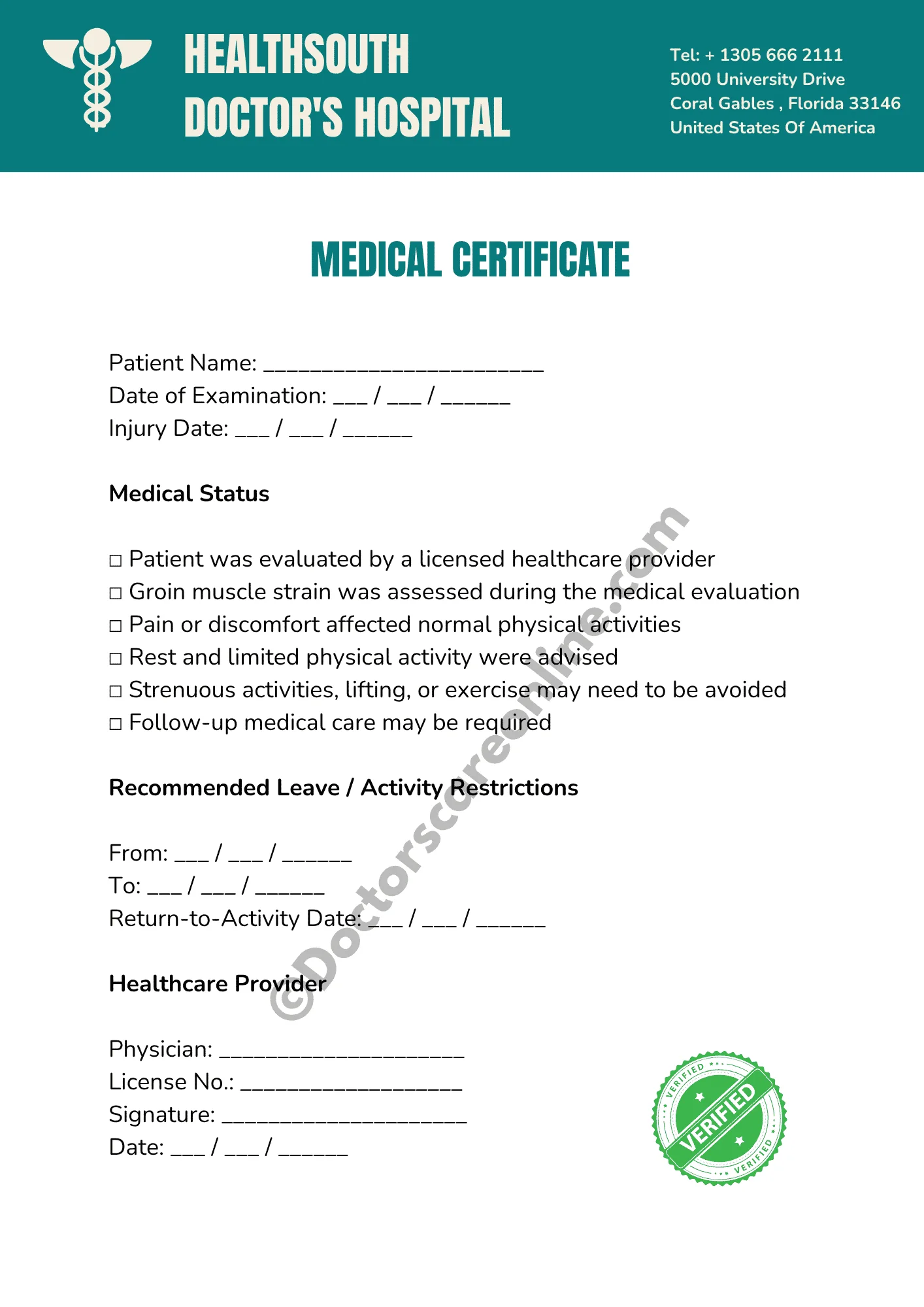
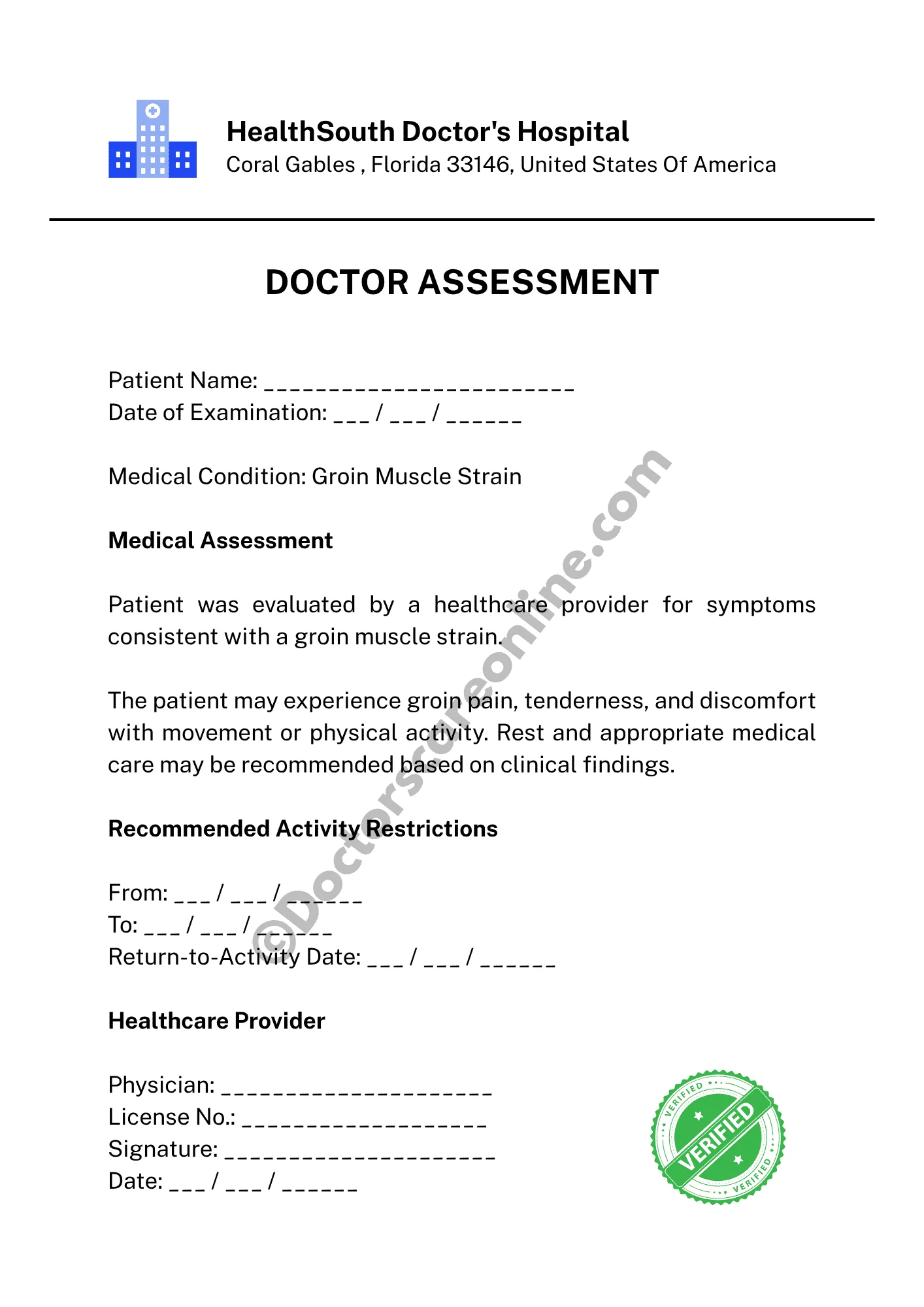
A doctor’s note for groin muscle strain is medical documentation that a healthcare provider may provide after evaluating your symptoms and determining that your injury affects your ability to work, attend school, exercise, or perform normal activities. A groin muscle strain can involve the muscles and tendons around the inner thigh, hip, and groin and may occur after sudden movements, sports, lifting, overstretching, or repetitive physical activity.
If groin pain is interfering with your normal responsibilities, an online medical visit may be a convenient starting point when telehealth is appropriate for your symptoms. During the consultation, you can explain when the injury occurred, what movements cause pain, and how the symptoms affect your daily activities. The healthcare provider can then determine whether your condition can be appropriately assessed remotely and whether medical documentation is appropriate.
Related Doctor Note :——
You can also visit:
What Is a Groin Muscle Strain?
A groin muscle strain is an injury involving one or more muscles or tendons in the groin or inner-thigh region. The adductor muscles are commonly involved, although other muscles around the hip and groin can also be affected.
A strain can range from a mild overstretching injury to a more significant muscle or tendon tear. Healthcare providers may classify muscle strains according to severity, with more serious injuries involving greater tissue damage and functional limitations.
Information Needed for a Doctor’s Note for Groin Muscle Strain
Preparing relevant information before an online visit can make the consultation more useful.
Consider having these details available:
- Date and approximate time of the injury
- Activity being performed when symptoms began
- Exact location of the pain
- Whether the pain is on the right or left side
- Pain severity and whether it is improving or worsening
- Any swelling or bruising
- Difficulty walking or moving the hip
- Any previous groin or hip injuries
- Current medications and treatments
- Your normal work responsibilities
- Physical tasks you are currently unable to perform
- Any documentation requirements provided by your employer or school
Common Symptoms of a Groin Muscle Strain
Symptoms vary depending on the location and severity of the injury. A person may notice symptoms immediately after an activity or develop discomfort gradually.
Common symptoms include:
- Pain or tenderness in the groin
- Pain along the inner thigh
- Discomfort when moving the hip or leg
- Muscle weakness
- Swelling
- Bruising or discoloration
- Muscle spasms
- Reduced range of motion
- Difficulty walking
- Pain that increases with certain movements
Some people describe a sudden pulling, sharp, or tearing sensation when the injury occurs. The symptoms and severity can differ considerably between individuals.
How a Healthcare Provider Evaluates a Groin Strain
A healthcare provider will generally begin by asking about the injury and your symptoms. You may be asked what you were doing when the pain started, whether you felt a pop or tearing sensation, and which movements make the discomfort worse.
A physical examination may assess:
- The location of tenderness
- Swelling or bruising
- Hip and leg movement
- Muscle strength
- Range of motion
- Ability to walk or bear weight
- The circumstances surrounding the injury
Depending on the symptoms and examination findings, additional testing may be considered. Ultrasound or MRI can help evaluate soft-tissue injuries, while an X-ray may be useful when a bone injury is suspected.
Because groin pain can have causes other than a muscle strain, an appropriate medical assessment is important rather than relying solely on self-diagnosis.
When an Online Visit May Be Appropriate
An online appointment can be useful when you want to discuss a non-emergency groin injury with a healthcare provider without initially traveling to a clinic.
During a telehealth appointment, you may be able to discuss:
- How the injury happened
- The location and severity of your pain
- Changes in mobility
- Work or school limitations
- Sports and exercise restrictions
- Previous injuries
- Current treatments
- Whether an in-person examination may be necessary
Telehealth is not appropriate for every groin injury. If your symptoms suggest a serious injury or another urgent medical condition, the provider may recommend immediate in-person or emergency evaluation instead.
How to Book a Groin Strain Online Visit
Booking an online medical consultation can usually be completed through the website’s appointment process.
1. Select an Available Appointment
- Choose an available online consultation that fits your schedule and follow the booking instructions provided on the website.
2. Create or Access Your Account
- If registration is required, enter the requested information to create an account. Returning users can log in using their existing credentials.
3. Provide Your Symptom Information
- Describe your groin injury accurately. Include when it started, what caused it, where you feel pain, and whether walking or moving your leg is difficult.
4. Complete the Consultation
- Attend the scheduled online visit and answer the healthcare provider’s questions honestly. The provider will determine whether your symptoms can be appropriately assessed through telehealth.
5. Follow the Provider’s Recommendation
- Depending on the evaluation, the provider may recommend home care, activity modification, additional evaluation, or another appropriate next step.
6. Receive Medical Documentation When Appropriate
- If the provider determines that a doctor’s note is medically justified, documentation may be provided according to applicable requirements and the provider’s clinical judgment.
When a Doctor’s Note May Be Useful
A medical note may be relevant when a groin injury temporarily interferes with responsibilities that require physical activity or prolonged movement.
Examples include:
- A physically demanding job
- Heavy lifting
- Repeated bending or squatting
- Frequent walking or climbing
- Standing for extended periods
- Athletic training
- School physical activities
- Sports participation
- Recovery following a more significant injury
Depending on the assessment, a provider may recommend temporary activity limitations rather than complete absence from work or school. The appropriate recommendation depends on the individual’s condition and functional limitations.
Possible Work Restrictions for a Groin Strain
If your job involves physical activity, a healthcare provider may determine that temporary modifications are appropriate.
Possible restrictions may involve:
- Avoiding heavy lifting
- Limiting running or jumping
- Reducing repetitive leg movements
- Avoiding movements that increase pain
- Limiting prolonged standing or walking
- Taking appropriate rest breaks
- Temporarily performing lighter duties
The exact restrictions, if any, should be determined by the healthcare provider based on the individual’s symptoms and job requirements.
A medical note does not guarantee that an employer must provide a particular accommodation. Workplace policies, applicable employment laws, and the specific circumstances can affect how medical documentation is handled.
Recovery and Treatment Considerations
Treatment for a groin strain depends on its severity. Many muscle strains are managed conservatively, while significant tears may require additional medical treatment.
A healthcare provider may recommend:
- Temporarily stopping activities that aggravate the injury
- Gradual return to movement as tolerated
- Ice or other measures during the early phase when appropriate
- Compression when recommended
- Pain-relief medication when appropriate for the individual
- Physical therapy
- Strengthening and flexibility exercises during rehabilitation
- Further evaluation for a suspected significant tear
Do not begin strenuous exercise or return to sports simply because the pain has improved. Your healthcare provider can advise when it is appropriate to increase activity.
Returning to Work, Exercise, or Sports
Returning to normal activities should depend on your symptoms, functional ability, and healthcare provider’s recommendations rather than a fixed number of days.
Before resuming strenuous activity, consider whether you can:
- Walk comfortably
- Move your hip without significant pain
- Perform required work movements safely
- Follow recommended restrictions
- Complete rehabilitation exercises as instructed
- Avoid movements that reproduce significant symptoms
Returning to intense exercise too quickly can increase the risk of aggravating an existing muscle injury. Cleveland Clinic recommends allowing the injured muscles time to heal and avoiding intense exercise while recovering.
How Long Can a Groin Muscle Strain Affect Work?
There is no universal number of days that applies to every groin injury. Recovery depends on factors such as the severity of the strain, the affected muscle, the individual’s symptoms, physical demands at work, and response to treatment.
Mild and moderate injuries can take weeks to recover fully, while more severe injuries may require substantially longer rehabilitation.
For this reason, a healthcare provider should determine whether you need time away from work, modified duties, or a gradual return based on your individual evaluation.
How Our Online Service Can Help
Our online service is designed to make the process of seeking medical evaluation and documentation more convenient for users dealing with non-emergency concerns.
You can use the service to:
- Request an online medical consultation
- Explain your symptoms and functional limitations
- Discuss how your injury affects work, school, or normal activities
- Connect with a healthcare provider through the available online appointment process
- Receive medical guidance appropriate to your situation
- Obtain medical documentation when a provider determines that it is appropriate
The goal is to provide a structured process rather than simply supplying a document without medical assessment. A healthcare provider makes the clinical decision about whether documentation is appropriate.
Why Users Can Rely on a Structured Medical Evaluation
A trustworthy medical-documentation process should prioritize evaluation, clear communication, and appropriate clinical decision-making.
Our service is designed around an online consultation process rather than allowing users to simply create or alter medical documentation themselves. Users can describe their symptoms, discuss their concerns with a healthcare provider, and receive documentation only when the provider determines it is medically appropriate.
Users should always provide truthful information during the consultation. Accurate information helps the provider understand the situation and determine the appropriate next step.
The exact availability of telehealth services, documentation, and provider options can vary by state and individual circumstances.
Need Help With Registration, Login, Payment, or Your Order?
If you experience a problem while using the website, you do not have to figure it out alone.
For questions or issues related to:
- Registration
- Login or account access
- Appointment booking
- Payment
- Order status
- Website navigation
- General service questions
- Other technical or account-related concerns
you can contact our website chatbox for assistance.
The chatbox provides a convenient way to ask questions and get help with the service process. For medical concerns, the appropriate healthcare provider should be contacted rather than relying on customer-support assistance for medical advice.
When Groin Pain Needs Urgent Medical Attention
Not every case of groin pain is a simple muscle strain. Groin discomfort can also occur with conditions such as hernias, fractures, urinary problems, hip injuries, or certain reproductive or testicular emergencies.
Seek urgent or emergency medical care if you experience symptoms such as:
- Sudden severe groin pain
- Inability to move the leg or hip
- Significant or worsening swelling
- Numbness or tingling
- A cold or unusually discolored leg
- Major trauma
- Severe testicular pain or swelling
- A new painful groin or abdominal lump
- Groin pain accompanied by fever, nausea, or vomiting
- Other rapidly worsening symptoms
Cleveland Clinic specifically advises emergency evaluation for severe symptoms, inability to move the leg or hip, persistent/worsening swelling, changes in skin color, or numbness and tingling.
If you are experiencing a potential emergency, do not wait for an online appointment.
Privacy and Medical Information
Medical information can be sensitive. During an online consultation, provide only accurate information requested for your care and documentation.
A medical note generally focuses on information relevant to the purpose of the documentation, such as confirmation of evaluation, recommended restrictions, or an appropriate period away from certain activities. The exact information included depends on the healthcare provider and applicable requirements.
Before using any online healthcare service, review its privacy policy and understand how your personal and medical information is handled.
Frequently Asked Questions
1. Can a groin strain cause pain when walking?
Yes. A groin strain can cause pain or difficulty when moving the hip or leg, and some people may have difficulty walking depending on the severity of the injury.
2. Can groin pain be caused by something other than a muscle strain?
Yes. Groin pain can have several causes, including hernias, fractures, hip conditions, urinary problems, and other medical conditions. This is why an appropriate evaluation is important rather than assuming every case is a pulled muscle.
3. Can a groin muscle strain affect athletic performance?
Yes. Pain, weakness, reduced movement, and discomfort during activity can interfere with running, jumping, changing direction, and other sports-related movements. A gradual return to activity should follow appropriate medical guidance.
4. Does every groin strain require an MRI?
No. Many groin strains can be evaluated through medical history and physical examination. Imaging may be considered when the provider needs additional information about the soft tissues, bone, or severity of the injury.
5. Can groin pain come back after it improves?
Yes. Reinjury can occur, particularly if the affected muscles have not adequately recovered or strenuous activity is resumed too quickly. A healthcare provider or physical therapist can guide an appropriate rehabilitation and return-to-activity plan.
Medical Disclaimer: This content is provided for general educational and informational purposes only and is not a substitute for professional medical advice, diagnosis, or treatment. A doctor’s note for groin muscle strain should only be issued by a qualified healthcare provider after an appropriate evaluation.
Online visits may not be appropriate for every injury or medical condition. Healthcare providers may recommend an in-person examination, diagnostic testing, urgent care, or emergency treatment when clinically necessary.




Reviews
There are no reviews yet.