

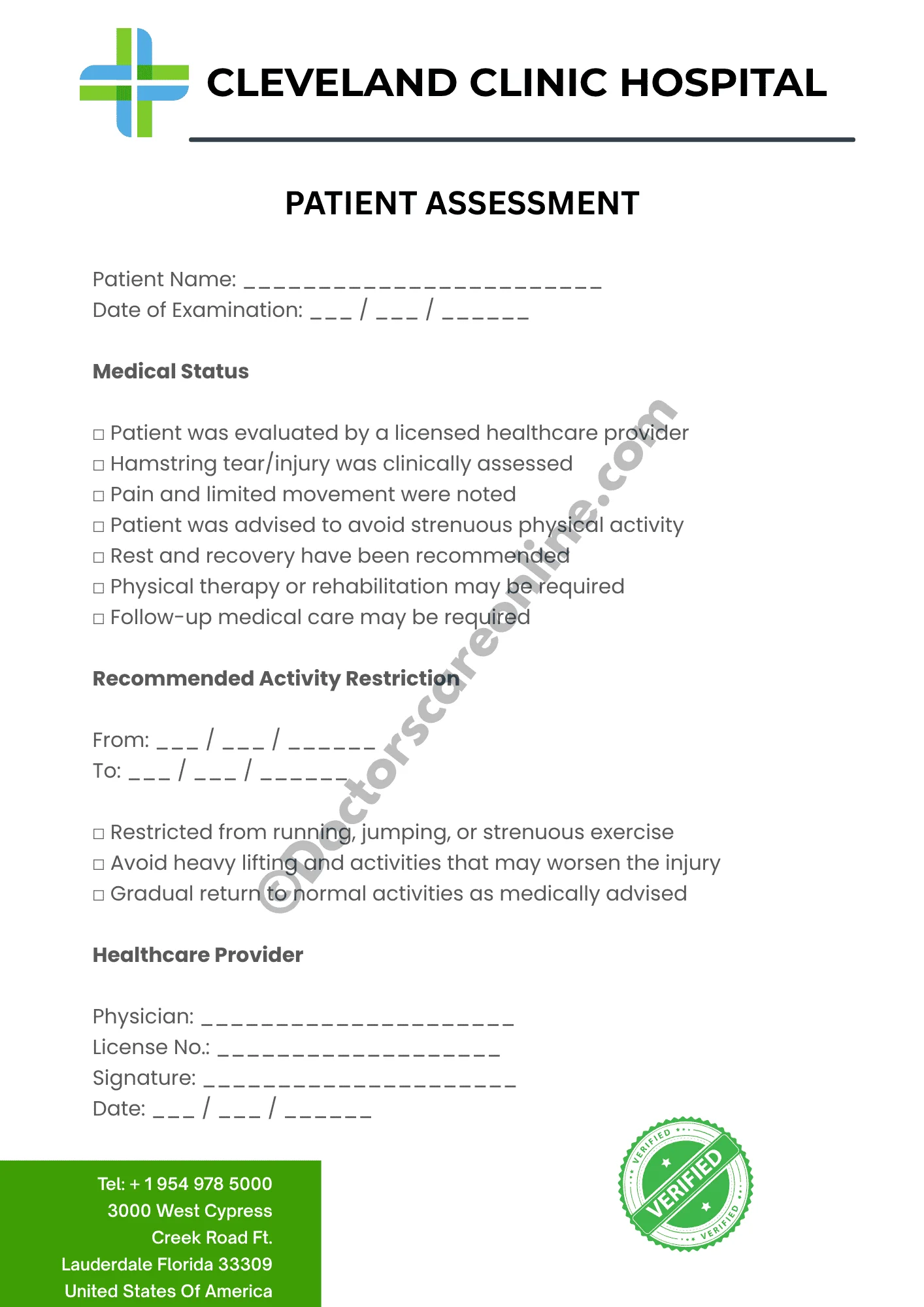
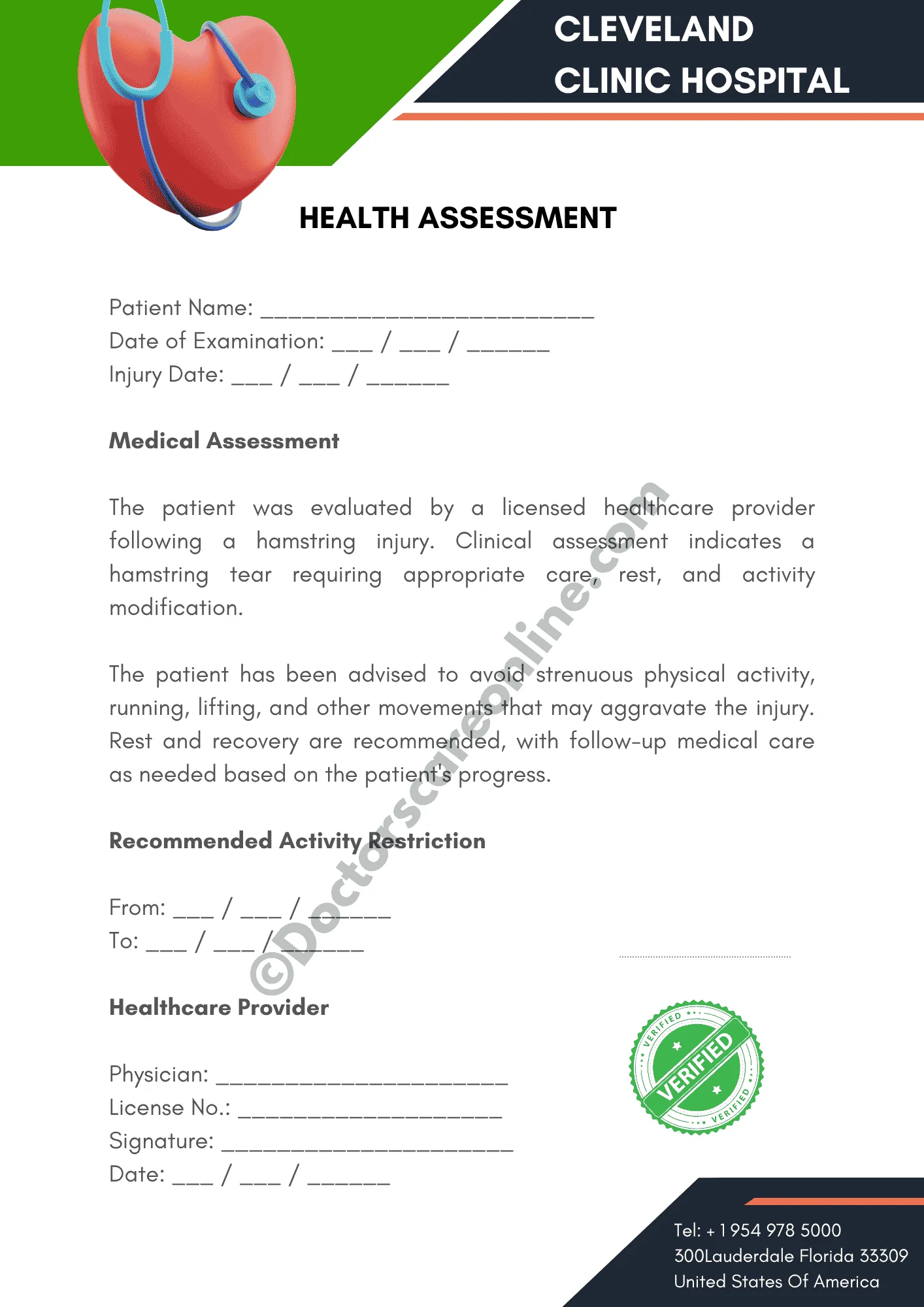
A Doctor’s Note for Hamstring Tear can provide formal medical documentation when a hamstring injury affects your ability to work, attend school, participate in sports, or perform normal physical activities. A hamstring injury can range from a mild muscle strain to a partial or complete tear, and the appropriate recovery plan depends on the severity and location of the injury.
Our online service helps U.S. users connect with healthcare providers through an online medical consultation. During the consultation, you can explain your symptoms, injury, physical limitations, and documentation needs. If the healthcare provider determines that medical documentation is appropriate after evaluating your situation, they may issue a medical note in accordance with applicable requirements and their clinical judgment.
Related Doctor Note : —–
- Doctor’s Note for 3 Days Off Work
- Doctor’s Note for Torn Muscle
- Doctor’s Note for Muscle Strain
- Doctor’s Note for Pulled Muscle
- Doctor’s Note for Missing Work
What Can a Doctor’s Note for Hamstring Tear Include?
The content of medical documentation varies according to the healthcare provider, the patient’s circumstances, and the requirements of the organization receiving it.
When medically appropriate, documentation may include:
- Patient identification
- Date of medical evaluation
- Confirmation that the patient was evaluated
- Recommended period away from work or school, when applicable
- Temporary activity restrictions
- Modified-duty recommendations
- Expected return date, when clinically appropriate
- Follow-up recommendations
- Healthcare provider identification and signature
- Relevant clinic or practice information
A healthcare provider determines what information should be included. Patients should not alter, edit, or add information to a medical document after it has been issued.
What Is a Hamstring Tear?
A hamstring tear is an injury involving one or more of the muscles or tendons at the back of the thigh. Hamstring injuries can occur when the muscle is suddenly stretched beyond its normal capacity, particularly during sprinting, jumping, running, sports, or other activities involving rapid movement.
Healthcare professionals commonly describe hamstring strains according to their severity:
- Grade 1: A mild strain involving relatively minor muscle damage.
- Grade 2: A partial muscle tear with more significant pain and functional limitation.
- Grade 3: A complete muscle or tendon tear that can cause substantial loss of function and may sometimes require surgical treatment.
Recovery varies according to the severity of the injury. A mild injury may improve relatively quickly, while a more serious tear can require substantially longer rehabilitation.
For this reason, a healthcare provider should determine the appropriate activity level, treatment plan, and need for medical documentation rather than relying only on the patient’s description of the injury.
Common Symptoms of a Hamstring Tear
A hamstring injury may cause symptoms that interfere with walking, sitting, standing, exercising, or performing physically demanding work.
Common symptoms can include:
- Pain or tenderness at the back of the thigh
- Sudden pain during physical activity
- Swelling around the injured area
- Bruising or skin discoloration
- Muscle weakness
- Difficulty walking normally
- Pain when stretching or contracting the hamstring
- Reduced range of motion
- Difficulty running or performing athletic movements
- A sensation of pulling, snapping, or tearing at the time of injury
The severity of symptoms can vary considerably. Significant bruising, difficulty bearing weight, or substantial loss of movement may warrant medical evaluation.
How Hamstring Injuries Happen
Hamstring tears can occur during sports and exercise, but physical activity is not the only possible cause. Sudden or excessive loading of the muscle can result in a strain or tear.
Potential situations include:
- Sprinting or sudden acceleration
- Jumping or landing
- Soccer, football, basketball, or other sports
- Running
- Weight training
- Sudden changes in direction
- Stretching beyond normal flexibility
- Slips or falls
- Physically demanding work
- Repetitive strenuous activity
- Inadequate warm-up before intense activity
A strain occurs when a muscle or tendon is stretched excessively and becomes damaged.
When a Hamstring Injury May Affect Work or School
The impact of a hamstring injury depends heavily on what you normally need to do during the day.
For example, someone whose job involves sitting at a desk may have different functional limitations from someone who regularly lifts, climbs, walks, drives, or performs physical labor.
A healthcare provider may consider whether your symptoms affect your ability to:
- Walk safely
- Stand for extended periods
- Climb stairs
- Drive
- Lift or carry objects
- Squat or bend
- Operate equipment
- Perform repetitive physical movements
- Participate in sports or physical education
- Complete normal workplace duties
Students may also have difficulty attending classes, walking around campus, participating in physical education, or completing other required activities.
If your injury creates temporary functional limitations, medical documentation may help communicate those restrictions to an employer, school, athletic program, or other organization, subject to its policies.
What a Doctor Evaluates Before Providing Medical Documentation
A healthcare provider does more than simply record that you have pain. The provider may review the circumstances surrounding the injury and assess how the symptoms affect your function.
An evaluation may consider:
- How and when the injury occurred
- The location of the pain
- Severity and progression of symptoms
- Bruising or swelling
- Ability to walk and bear weight
- Muscle strength
- Range of motion
- Previous hamstring injuries
- Current treatment
- Occupational or school responsibilities
- Whether symptoms suggest a more significant injury
Depending on the presentation, further assessment or an in-person examination may be recommended.
If the injury cannot be adequately evaluated through telehealth, the provider may recommend an urgent care visit, primary care appointment, sports medicine evaluation, orthopedic assessment, or other appropriate in-person care.
How Hamstring Tears Are Diagnosed
Diagnosis generally begins with the patient’s history and a physical examination. The healthcare provider may assess tenderness, strength, movement, and the location and severity of symptoms.
Additional testing is not necessarily required for every hamstring injury. However, depending on the suspected severity or circumstances, a healthcare professional may consider imaging or specialist evaluation.
For example, a more significant injury involving the tendon near the buttock may require orthopedic or sports-medicine assessment. Some severe injuries can involve tendon retraction and may require surgical consideration.
The appropriate diagnostic approach depends on the individual presentation and should be determined by a qualified healthcare professional.
Treatment and Recovery for a Hamstring Tear
Treatment depends on the severity of the injury. Initial management may include reducing activities that aggravate the injury, protecting the affected area, and using measures recommended by a healthcare professional.
Depending on the injury, treatment may involve:
- Activity modification
- Rest from painful activities
- Ice during the early stage when recommended
- Compression
- Elevation
- Pain management
- Physical therapy
- Gradual mobility exercises
- Strengthening exercises
- Progressive return to activity
- Specialist treatment for more serious injuries
MedlinePlus notes that hamstring injuries can range from mild strains to complete tears, with recovery time depending on the injury’s grade. Returning to activity too quickly can increase the risk of reinjury.
A healthcare provider should determine when it is appropriate to increase activity and return to work, exercise, or sports.
How Long Does a Hamstring Tear Take to Heal?
There is no single recovery period that applies to every hamstring tear.
A minor injury may improve within days, whereas a more significant partial or complete tear may take weeks or longer. Severe injuries, particularly those involving tendon detachment or retraction, may require specialist treatment and potentially surgery.
Recovery can be influenced by:
- Injury severity
- Location of the tear
- Whether a tendon is involved
- Physical demands of your job
- Treatment plan
- Previous hamstring injuries
- Individual healing progress
- Adherence to rehabilitation recommendations
Therefore, a doctor’s note should reflect the healthcare provider’s assessment rather than a predetermined number of days.
When You May Need Temporary Activity Restrictions
A healthcare provider may recommend temporary restrictions when particular activities could interfere with recovery or are difficult to perform safely.
Depending on the person’s condition and job requirements, restrictions may involve:
- Avoiding heavy lifting
- Limiting running
- Avoiding jumping
- Reducing prolonged walking
- Limiting climbing
- Avoiding strenuous exercise
- Limiting repetitive lower-body movements
- Taking appropriate breaks
- Performing modified duties
- Temporarily avoiding sports activities
The exact restrictions and their duration should be determined by the healthcare provider.
For employers, the relevant documentation may focus on functional limitations and recommended restrictions rather than unnecessary details about the patient’s medical history.
Can a Hamstring Tear Doctor’s Note Support Time Off Work?
It may, depending on the healthcare provider’s assessment and the requirements of the employer.
If your injury prevents you from safely performing essential job duties, a provider may recommend temporary leave or modified work activities.
For example, someone working in construction, warehouse operations, landscaping, delivery, fitness, or another physically demanding occupation may have restrictions that differ from those of an office employee.
The medical recommendation should be based on the individual’s symptoms, functional ability, occupation, and clinical assessment.
Employer policies may determine what documentation is required and how leave or workplace restrictions are handled.
How to Get a Doctor’s Note for Hamstring Tear Online
If your situation is appropriate for telehealth, obtaining medical documentation may begin with an online healthcare consultation.
Step 1: Create or Access Your Account
- Register for an account or log in if you already have one. Enter the requested information accurately so the healthcare provider has the necessary details for your consultation.
Step 2: Select an Online Medical Appointment
- Choose an available appointment that suits your schedule and select the appropriate medical service.
Step 3: Explain Your Hamstring Injury
During the consultation, describe:
- When the injury occurred
- What activity caused it
- Where the pain is located
- Your current symptoms
- Any swelling or bruising
- Difficulty walking or performing normal activities
- Your work or school requirements
- Any treatment you have already received
Step 4: Complete the Medical Evaluation
- The healthcare provider will determine whether your symptoms can be appropriately assessed through telehealth. If an in-person examination is necessary, you may be advised to seek additional care.
Step 5: Follow the Provider’s Recommendation
- The provider may recommend treatment, activity modification, follow-up care, or an in-person evaluation.
If medical documentation is clinically appropriate, the provider may issue a doctor’s note according to applicable requirements and professional judgment.
Why Our Online Medical Note Service Can Be Useful
Our service is designed to make the process of connecting with healthcare providers more convenient for users who may have difficulty visiting a clinic immediately.
For someone dealing with a hamstring injury, online access can be useful for discussing symptoms, understanding whether telehealth is appropriate, and determining whether medical documentation may be medically justified.
- Convenient Online Access: You can begin the process online rather than spending time searching for an available appointment at a physical location.
- Healthcare-Provider Evaluation: Medical documentation is connected to a healthcare evaluation rather than being presented as a document that can simply be purchased without assessment.
- Clear Documentation Process: Users can explain their symptoms and documentation needs during the consultation and receive guidance about the appropriate next step.
- Privacy-Conscious Approach: Medical information is personal. Users should provide accurate information through the appropriate secure channels and share documentation only with organizations that legitimately require it.
- U.S.-Focused Service: Our online process is designed for users in the United States, while availability and documentation requirements may vary based on location, provider, and individual circumstances.
A medical note is ultimately subject to the healthcare provider’s clinical judgment and applicable requirements.
Need Help With Registration, Login, Payment, or Your Order?
If you experience an issue while using our website, you do not have to figure it out alone.
If you have questions or problems related to:
- Registration
- Login or account access
- Appointment booking
- Payment
- Order status
- Medical-note requests
- Website navigation
- General service questions
you can contact our website chatbox for assistance.
Our chat support gives users a convenient way to ask questions when they encounter difficulties during the online process. If your question involves a medical decision, diagnosis, treatment, or whether documentation is clinically appropriate, that decision must be addressed by the qualified healthcare provider rather than customer support.
How to Prepare for Your Online Consultation
Having relevant information ready can make your appointment more efficient.
Before your consultation, consider preparing:
- The date of your injury
- How the injury happened
- The location of the pain
- Whether you heard or felt a pop
- Bruising or swelling
- Difficulty walking
- Current medications
- Previous hamstring injuries
- Previous treatment
- Your normal work responsibilities
- Any physical restrictions you are currently experiencing
Be honest and specific when describing your symptoms. Accurate information helps the healthcare provider make an appropriate clinical assessment.
When a Hamstring Injury Needs Prompt Medical Attention
Some symptoms can indicate a more serious injury and should not be managed solely through an online documentation request.
Seek prompt medical evaluation if you experience:
- Severe or rapidly increasing pain
- Significant swelling
- Extensive bruising
- Inability to walk or bear weight
- Major weakness in the affected leg
- Sudden numbness or tingling
- A significant loss of movement
- A suspected complete muscle or tendon tear
- An injury associated with major trauma
MedlinePlus advises contacting a healthcare provider for concerning changes such as sudden numbness or tingling, increased pain or swelling, or an injury that is not healing as expected.
For a serious injury or medical emergency, seek appropriate emergency medical care rather than relying on an online doctor’s-note service.
Returning to Work, School, or Sports After a Hamstring Injury
Returning to normal activity should be based on recovery and medical guidance rather than simply reaching a particular number of days.
A gradual return may be appropriate when symptoms have improved and the healthcare provider believes activity can safely increase.
Depending on the injury, returning to normal activities may involve:
- Gradually increasing movement
- Following prescribed rehabilitation
- Continuing recommended physical therapy
- Avoiding activities that reproduce significant pain
- Following temporary workplace restrictions
- Increasing physical demands progressively
- Attending follow-up appointments when recommended
Returning too quickly can increase the risk of reinjury. MedlinePlus recommends discussing return to work or physical activity with a healthcare provider and increasing activity gradually as symptoms improve.
Frequently Asked Questions
1. Can a hamstring tear qualify for short-term disability?
A hamstring tear may affect eligibility for short-term disability depending on the severity of the injury, functional limitations, employer or insurance requirements, and applicable policy terms. A healthcare provider may document medical restrictions or inability to work when clinically appropriate.
2. Can I use a hamstring injury doctor’s note for a sports team?
A healthcare provider may document restrictions from sports or physical activity when medically appropriate. However, athletic programs may have their own participation, clearance, and return-to-play requirements, so you should check the rules of your specific team or organization.
3. Does a hamstring tear require an MRI?
Not every hamstring injury requires an MRI. The need for imaging depends on the suspected severity, symptoms, physical examination, and clinical circumstances. A healthcare provider can determine whether additional testing or specialist evaluation is appropriate.
4. Can a previous hamstring injury affect my current medical evaluation?
Yes. A history of previous hamstring injuries can be relevant because recurring injuries may affect symptoms, recovery, and the provider’s assessment. Tell the healthcare provider about previous injuries and treatments during your consultation.
5. Can I request updated documentation if my hamstring injury has not healed?
If your symptoms continue or your functional limitations change, you can contact a healthcare provider for reassessment. The provider can determine whether updated medical documentation or different restrictions are medically appropriate.
Medical Disclaimer: This content is provided for general educational and informational purposes and is not a substitute for professional medical advice, diagnosis, or treatment. A doctor’s note should only be issued by a licensed healthcare provider after an appropriate medical evaluation. Telehealth availability, medical documentation requirements, workplace policies, and applicable regulations can vary by state, provider, employer, school, and individual circumstances.





Reviews
There are no reviews yet.