

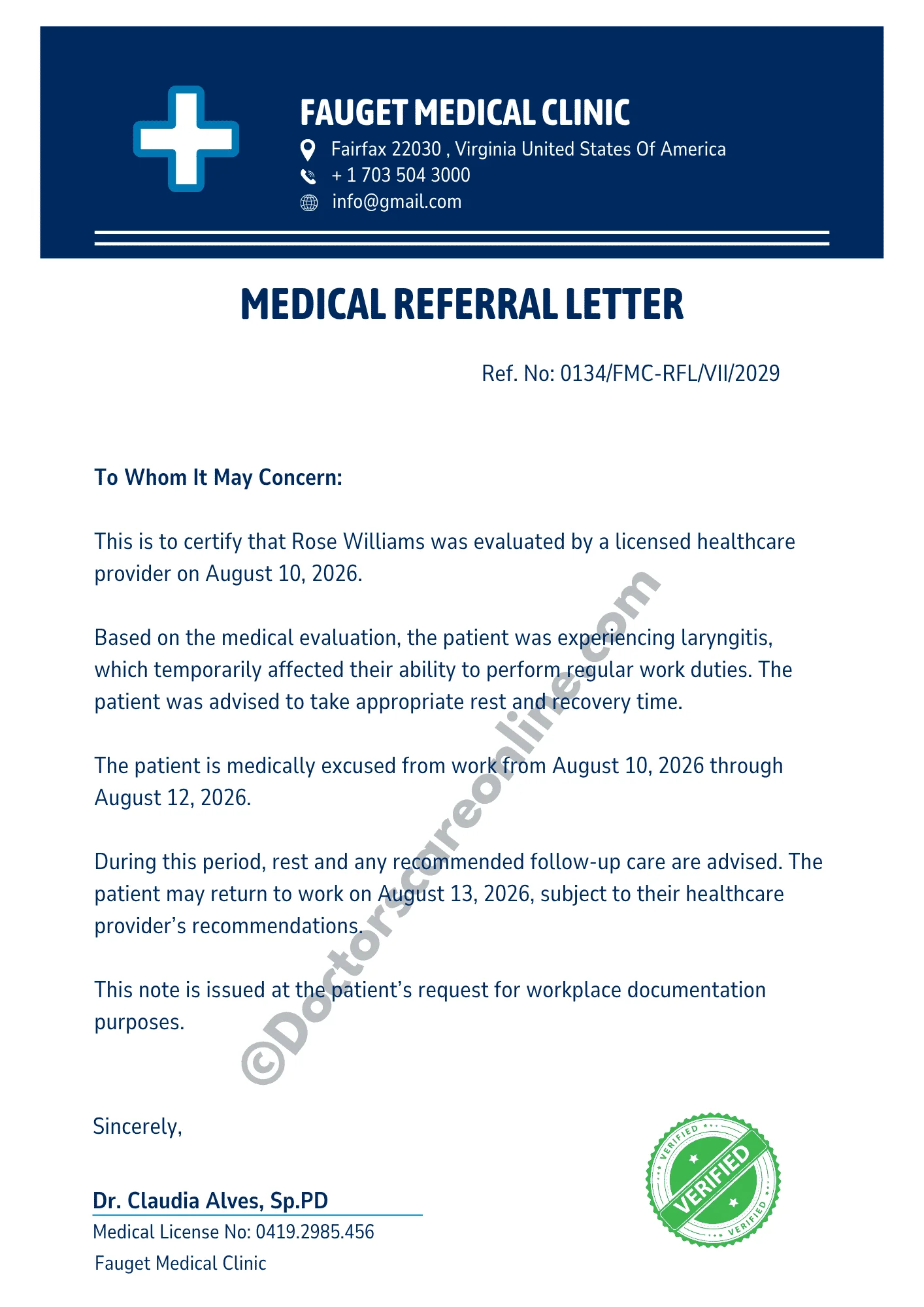
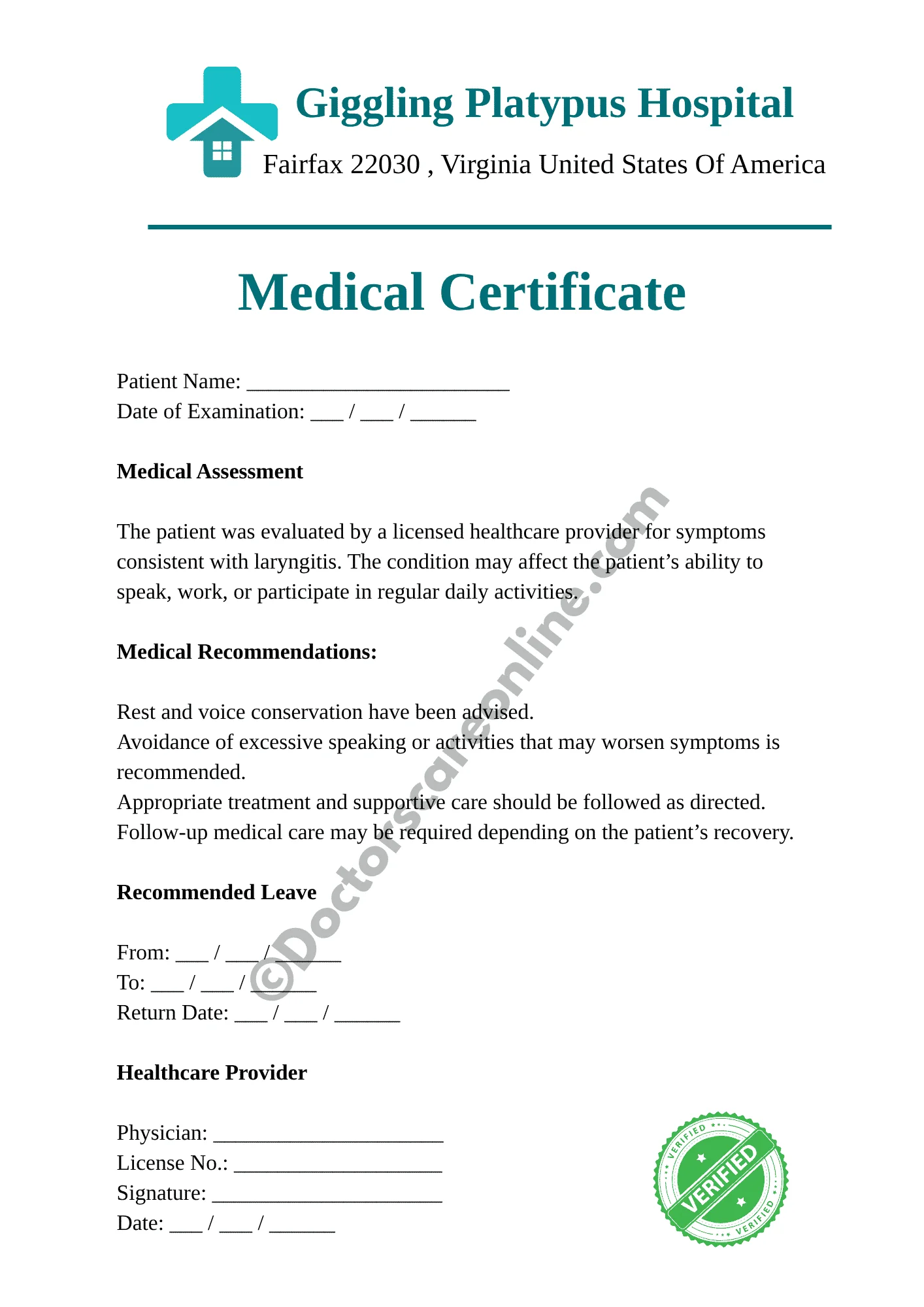
Doctor’s Note for Laryngitis is a medical document issued by a licensed healthcare professional to confirm that an individual is suffering from inflammation of the voice box (larynx), often caused by viral infections, overuse of the voice, or irritation. This condition can make speaking difficult and may require voice rest and limited communication. The note is commonly used for work or school absence or to request temporary adjustments. It typically includes the diagnosis, recommended rest period, and advice such as avoiding strain on the voice and staying hydrated.
Related Doctor Note :——
You can also visit:
- Online Doctor’s Note for Sore Throat
- Doctors Note for Strep Throat
- Doctor’s Note for Inner Ear Vertigo
- 3 Months of Unlimited Doctor’s Notes
Laryngitis involves inflammation or irritation of the larynx, also called the voice box. It can occur because of a viral respiratory infection, vocal overuse, irritation, allergies, smoking, acid reflux, or other causes. Acute laryngitis is often temporary, while persistent voice changes may require further medical assessment.
An online medical consultation can provide an opportunity to discuss your symptoms with a licensed healthcare provider. If the provider determines that your condition can be appropriately assessed through telehealth and that medical documentation is justified, they may provide a doctor’s note in accordance with applicable requirements and their clinical judgment.
When You May Need a Doctor’s Note for Laryngitis
Laryngitis can make communication and daily responsibilities difficult, particularly for people whose work or education depends heavily on speaking. A healthcare provider may recommend temporary leave, modified duties, or other restrictions when symptoms interfere with normal activities.
A doctor’s note may be relevant when you:
- Need documentation for a work absence caused by laryngitis.
- Are unable to perform a job that requires frequent speaking.
- Work in customer service, teaching, sales, healthcare, call centers, or other voice-dependent roles.
- Need temporary restrictions on prolonged speaking or vocal strain.
- Need documentation for a school or college absence.
- Require additional time to recover before returning to normal duties.
- Need medical documentation following an online or in-person healthcare evaluation.
- Need to communicate medically recommended restrictions to an employer or educational institution.
The appropriate recommendation depends on your symptoms, occupation, overall health, and healthcare provider’s assessment.
Laryngitis Symptoms That Can Affect Work or School
Laryngitis primarily affects the voice, but symptoms can vary depending on the underlying cause. Common symptoms include:
- Hoarse or raspy voice
- Weak voice
- Temporary loss of voice
- Dry or irritated throat
- Sore throat
- Dry cough
- Throat tickling or rawness
- Frequent need to clear the throat
- Discomfort when speaking
People who rely on their voice professionally may find even moderate hoarseness disruptive. Teachers, presenters, singers, call-center employees, receptionists, sales professionals, healthcare workers, and customer-service employees may have particular difficulty completing normal duties while experiencing significant voice symptoms.
What Causes Laryngitis?
Laryngitis can have several possible causes, so a healthcare provider may consider your recent illness, voice use, environmental exposure, and other symptoms when evaluating the condition.
Common causes and contributing factors include:
- Viral respiratory infections: Colds and flu-like illnesses are common causes of acute laryngitis.
- Vocal strain: Frequent shouting, singing, prolonged speaking, or speaking loudly can irritate the vocal cords.
- Smoke and chemical irritants: Cigarette smoke, secondhand smoke, fumes, and other airborne irritants may affect the larynx.
- Acid reflux: Stomach acid reaching the throat can contribute to irritation and ongoing voice symptoms.
- Allergies: Exposure to allergens may contribute to throat irritation and voice changes.
- Persistent coughing or throat clearing: Repeated irritation can place additional stress on the voice box.
The cause matters because persistent or recurring hoarseness may require evaluation for an underlying condition rather than being assumed to be simple acute laryngitis.
Acute vs. Chronic Laryngitis
- Acute laryngitis is generally short-term and often develops alongside a respiratory infection or after significant vocal strain. Many cases improve as the underlying irritation or infection resolves.
- Chronic laryngitis lasts longer and may be associated with ongoing irritation, reflux, smoking, allergies, or other underlying problems. Persistent hoarseness should be assessed by a healthcare professional rather than continuously self-treated.
The duration and severity of symptoms do not automatically determine whether someone qualifies for medical leave. A healthcare provider should make that decision after considering the individual’s condition and functional limitations.
How Laryngitis May Affect Your Job
The effect of laryngitis can depend heavily on the type of work you perform.
Someone with a desk-based role involving minimal speaking may be able to continue working, while a teacher, call-center employee, salesperson, performer, or customer-service representative may have substantial difficulty communicating.
Depending on the circumstances, a healthcare provider may consider recommendations such as:
- Temporary absence from work
- Reduced speaking requirements
- Avoiding prolonged voice use
- Temporary modified duties
- Reduced workload where appropriate
- Additional recovery time
- A gradual return to normal responsibilities
Any restrictions should reflect the individual’s medical condition and job requirements rather than being automatically assigned based only on a diagnosis.
Laryngitis and School or College Absence
Students may experience difficulty attending classes, participating in presentations, completing oral examinations, or communicating with teachers when their voice is significantly affected.
If laryngitis interferes with attendance or academic responsibilities, a healthcare provider may determine whether medical documentation is appropriate. Schools and colleges may have their own requirements regarding acceptable documentation, absence reporting, examinations, and accommodations.
Before submitting a doctor’s note, check your institution’s current policy so you understand what information is required.
What a Healthcare Provider May Evaluate
During an appointment, the healthcare provider may ask about the beginning and progression of your symptoms, recent respiratory infections, voice use, smoking or environmental exposure, allergies, reflux symptoms, and other relevant medical history.
Depending on the situation, the evaluation may involve:
- Reviewing your symptoms and medical history
- Listening to changes in your voice
- Assessing throat-related symptoms
- Considering possible causes
- Determining whether further evaluation is necessary
- Recommending appropriate treatment or self-care
- Deciding whether work or school restrictions are medically appropriate
For persistent voice problems, a healthcare professional may recommend additional assessment or referral to an ear, nose and throat (ENT) specialist. Laryngoscopy can be used to examine the larynx and vocal cords when clinically indicated.
What Information May Be Needed During an Online Consultation?
Providing accurate information can help a healthcare provider understand how your symptoms affect you.
Before your appointment, consider having the following information available:
- When your voice symptoms began
- Whether you have recently had a cold or flu
- Whether you have completely or partially lost your voice
- Whether you have throat pain or difficulty swallowing
- Whether you have a cough or fever
- How frequently you need to speak for work or school
- Whether you recently shouted, sang, or used your voice extensively
- Exposure to smoke, fumes, dust, or other irritants
- Any history of acid reflux or allergies
- Current medications or treatments
- Previous episodes of prolonged hoarseness
- Any employer or school documentation requirements
Being honest and specific during a consultation helps the healthcare provider make an appropriate clinical assessment.
How to Request a Doctor’s Note for Laryngitis Online
If your symptoms are affecting your ability to work or attend school, an online healthcare appointment may be a convenient way to discuss your condition where telehealth is available.
Step 1: Choose an Available Healthcare Provider
- Select an appropriate licensed healthcare professional offering online consultations in your location.
Step 2: Register or Log In
- Create an account or sign in using the information requested by the website.
Step 3: Book Your Appointment
- Choose an available consultation time and provide the requested appointment details.
Step 4: Explain Your Symptoms
- Describe your voice changes, throat symptoms, when they started, possible triggers, and how they affect your normal responsibilities.
Step 5: Complete the Medical Evaluation
- The provider will determine whether your symptoms can be appropriately evaluated through telehealth or whether an in-person assessment is necessary.
Step 6: Follow the Provider’s Recommendation
- The healthcare professional may recommend voice rest, fluids, symptom management, further evaluation, or other appropriate care depending on the suspected cause.
Step 7: Receive Medical Documentation When Appropriate
- If the provider determines that a doctor’s note is medically justified, documentation may be provided according to applicable requirements and professional judgment.
A medical note is not automatically guaranteed simply because it is requested. Documentation should be based on an appropriate healthcare evaluation.
What May Be Included in a Laryngitis Doctor’s Note?
The exact content of medical documentation varies according to the healthcare provider and the requirements of the organization receiving it.
When appropriate, documentation may include:
- Patient identification
- Date of medical evaluation
- Confirmation that the patient was evaluated
- Recommended absence period, if medically necessary
- Relevant activity or work restrictions
- Recommended return date, when applicable
- Follow-up recommendations
- Healthcare provider information
- Provider signature or electronic authentication
A medical note does not necessarily need to disclose every detail of a patient’s medical history. The information included should be appropriate for the purpose of the documentation and consistent with applicable privacy and documentation requirements.
How Long Should You Stay Away From Work With Laryngitis?
There is no universal number of days that applies to everyone with laryngitis.
The appropriate recovery or absence period depends on factors such as:
- Severity of symptoms
- Underlying cause
- Ability to speak normally
- Type of work performed
- Whether the job requires continuous speaking
- Presence of other symptoms
- Response to treatment
- Healthcare provider’s clinical assessment
Many cases of acute laryngitis improve within approximately one to two weeks, although individual recovery varies. Persistent symptoms may require further assessment.
Your healthcare provider should determine whether you need time away from work or school rather than relying on a fixed number of days.
Voice Care During Laryngitis Recovery
Protecting your voice can be an important part of recovery from acute laryngitis.
Helpful measures may include:
- Resting your voice as much as reasonably possible
- Drinking sufficient fluids
- Keeping indoor air comfortably humid
- Avoiding smoking and secondhand smoke
- Limiting exposure to dust and chemical fumes
- Avoiding prolonged shouting or singing
- Avoiding whispering, which can also strain the voice
- Following treatment recommendations from your healthcare provider
Mayo Clinic and the NHS both recommend voice rest and adequate hydration as part of supportive care for laryngitis.
Medication should be used according to professional advice and the individual’s medical circumstances.
When Laryngitis Needs Medical Attention
Most uncomplicated acute laryngitis is temporary, but persistent or severe symptoms should not simply be ignored.
Arrange medical evaluation if:
- Hoarseness continues longer than expected.
- Voice changes repeatedly return.
- Symptoms are becoming worse instead of improving.
- You have persistent difficulty swallowing.
- You develop ongoing or significant throat pain.
- You have unexplained weight loss.
- You cough up blood.
- You have a persistent fever.
- You have other concerning symptoms accompanying the voice change.
Persistent hoarseness can have causes other than ordinary acute laryngitis, which is why ongoing voice changes deserve professional assessment.
When Laryngitis May Be an Emergency
Certain symptoms require urgent medical attention rather than waiting for a routine online appointment.
Seek emergency care if you experience:
- Difficulty breathing
- Significant difficulty swallowing
- Rapidly worsening symptoms affecting your airway
- Coughing up blood with concerning symptoms
- Severe symptoms after a serious injury or other urgent medical situation
Breathing difficulty is particularly important because swelling involving the upper airway can become serious.
If you are having trouble breathing, seek emergency medical care immediately instead of relying on an online doctor’s-note service.
Why Our Online Medical Note Service Can Be Useful
Our service is designed to make the process of connecting with healthcare support and understanding medical-documentation requirements more convenient.
For users dealing with laryngitis, the platform can provide a structured online experience where you can:
- Request an online healthcare consultation where available.
- Explain your symptoms before or during the appointment.
- Discuss how your condition affects work, school, or other responsibilities.
- Receive professional medical guidance based on your individual situation.
- Obtain medical documentation only when a licensed healthcare provider determines that it is appropriate.
- Access the process online without unnecessarily navigating multiple steps.
Our goal is to make the experience clear, convenient, and user-focused while keeping the medical evaluation and documentation decision with the healthcare professional.
We do not encourage users to obtain documentation without an appropriate medical evaluation. A legitimate doctor’s note should reflect a healthcare provider’s assessment and professional judgment.
Why You Can Trust the Medical Documentation Process
Trust is especially important when a website provides access to healthcare-related services.
Our approach is centered on:
- Professional evaluation: Medical documentation is connected to a healthcare evaluation rather than being presented as something that can simply be purchased without assessment.
- Clear process: Users can understand the general steps involved in registration, appointment booking, consultation, and documentation.
- Patient-focused information: We explain what users may need to provide and what they can expect from the consultation process.
- Privacy awareness: Medical information is sensitive, so users should review the site’s applicable privacy and security policies before submitting personal or health information.
- No guaranteed outcome: A consultation does not automatically guarantee a doctor’s note. The healthcare provider decides whether documentation is medically appropriate.
- Responsible medical information: Educational content should not replace an individualized diagnosis or treatment plan from a qualified healthcare professional.
Having Trouble With Registration, Login, Payment, or Your Order?
If you are experiencing a technical or account-related issue while using our website, you do not have to figure it out alone.
If you have questions or problems involving:
- Registration
- Login or account access
- Appointment booking
- Payment
- Order status
- Website navigation
- Understanding the service
- Other questions about the process
you can contact our chatbox support for assistance.
Our chatbox gives users a convenient way to ask questions and report issues while using the website. If your question is about your medical condition itself, however, it should be discussed with the licensed healthcare provider during your consultation rather than relying on customer support for medical advice.
What Happens After Your Medical Consultation?
After the consultation, follow the healthcare provider’s recommendations carefully.
Depending on your situation, you may receive:
- Medical advice for managing your symptoms
- Recommendations for voice rest or activity modification
- Instructions for follow-up care
- A recommendation for an in-person evaluation
- Work or school documentation when medically appropriate
- Temporary restrictions when clinically justified
If your symptoms change significantly or do not improve as expected, contact an appropriate healthcare professional for further evaluation.
Returning to Work or School After Laryngitis
Returning to normal responsibilities depends on your symptoms and the recommendations provided by your healthcare professional.
Consider whether you can:
- Speak comfortably enough for your responsibilities.
- Complete essential duties without worsening your symptoms.
- Follow any recommended activity restrictions.
- Maintain appropriate hydration and voice care.
- Communicate effectively if your role requires frequent speaking.
If your job depends heavily on your voice, returning too quickly to prolonged speaking may make recovery more difficult. Your healthcare provider can advise whether temporary modifications or additional recovery time are appropriate.
Frequently Asked Questions
1. Can laryngitis cause you to lose your voice completely?
Yes. Laryngitis can cause significant hoarseness or temporary loss of voice because inflammation of the vocal cords can interfere with normal vibration.
2. Is laryngitis contagious?
Laryngitis itself can have different causes. When it results from a contagious respiratory infection such as a viral cold or flu, the underlying infection can spread to other people. Laryngitis caused by vocal overuse, reflux, or irritation is not necessarily contagious.
3. Can talking a lot make laryngitis worse?
Yes. Prolonged, loud, or strenuous voice use can further irritate the vocal cords. Voice rest is commonly recommended while recovering from acute laryngitis.
4. Can laryngitis keep coming back?
Recurring laryngitis or repeated voice problems can have different underlying causes, including repeated vocal strain, reflux, allergies, smoking, or other conditions. Recurrent symptoms should be discussed with a healthcare professional rather than repeatedly self-treating the problem.
5. Should I see an ENT specialist for laryngitis?
Not everyone with short-term laryngitis needs an ENT specialist. However, persistent, recurring, or unexplained voice problems may require additional evaluation, and a primary healthcare professional may refer you to an ENT specialist when appropriate.
Important Medical Disclaimer: This content is provided for general educational and informational purposes only. It does not replace professional medical advice, diagnosis, or treatment.
A doctor’s note should only be issued by a licensed healthcare provider following an appropriate medical evaluation. Availability of telehealth services, medical documentation, work restrictions, school requirements, and other healthcare services may vary by location and individual circumstances.




Reviews
There are no reviews yet.