
A Doctor’s Note for Modified Duties is medical documentation that may explain temporary changes to an employee’s normal job responsibilities when a healthcare provider determines that certain activities could interfere with recovery or safe work performance. Depending on the individual situation, modified duties may include avoiding heavy lifting, limiting repetitive movements, reducing prolonged standing or sitting, or performing lighter tasks for a specific period.
For people who need convenient access to medical care, an online doctor visit may provide an option to discuss symptoms and work-related limitations with a licensed healthcare provider. If the provider determines that an online evaluation is clinically appropriate and modified duties are medically justified, they may provide appropriate medical documentation in accordance with applicable requirements.
You can also visit:
- Doctor’s Note for Family Leave of Absence
- Doctors Note for Limited Work
- 6 Months of Unlimited Doctor’s Notes
- Unlimited Doctor’s Notes for 1 Year
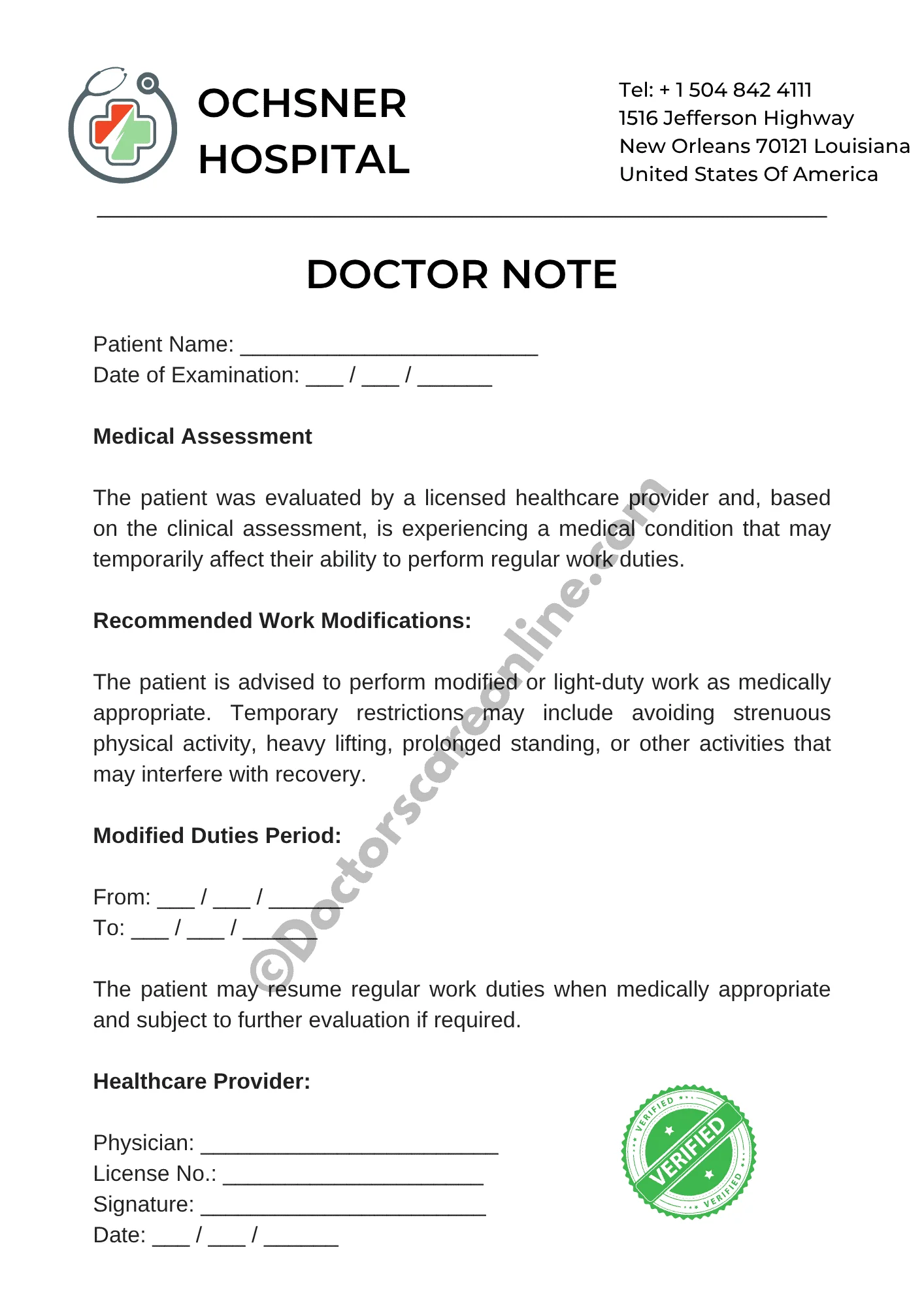
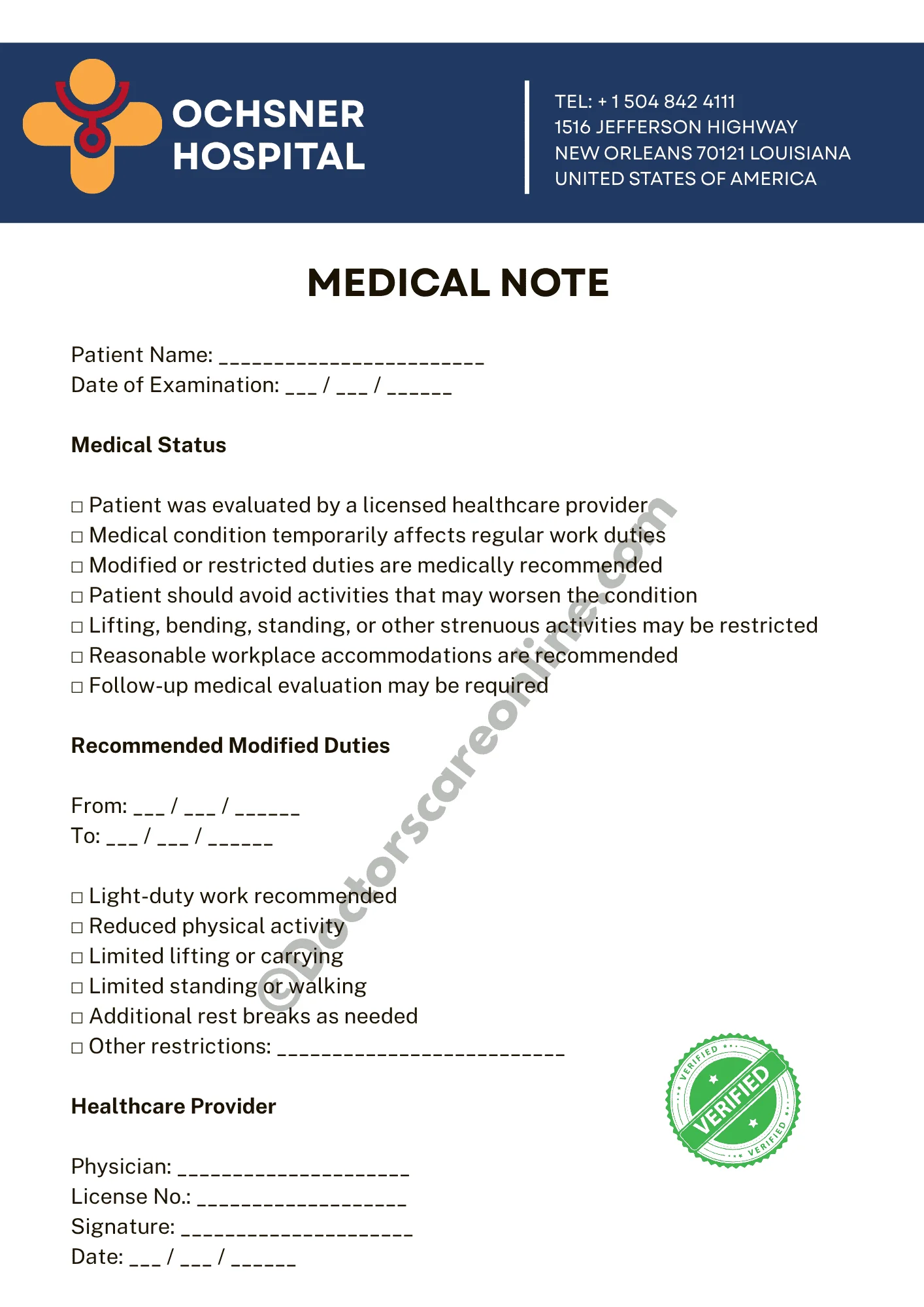
Printable Doctor’s Note for Modified Duties Template
A doctor’s note for modified duties is a medical document that communicates work-related limitations recommended by a healthcare provider after evaluating a patient’s condition.
Rather than simply stating that an employee is sick, the documentation may explain the types of activities the employee should temporarily avoid or modify.
Depending on the medical assessment, modified duties may involve:
- Avoiding heavy lifting or carrying.
- Limiting repetitive bending, twisting, or reaching.
- Reducing prolonged standing or walking.
- Limiting prolonged sitting.
- Taking periodic rest or movement breaks.
- Avoiding strenuous physical activity.
- Performing lighter or less physically demanding tasks.
- Temporarily changing work responsibilities.
- Working reduced hours when medically appropriate.
- Following a temporary restriction until a specified follow-up date.
The healthcare provider determines which restrictions are medically appropriate. The employer then reviews the documentation according to its workplace policies and applicable requirements.
When Might You Need Modified Work Duties?
Temporary work restrictions may be considered when a medical condition affects your ability to safely perform one or more essential job activities.
Situations may include:
- Back or neck pain: Symptoms may make lifting, bending, standing, or prolonged sitting difficult.
- Muscle or joint injuries: Temporary limitations may be needed while an injury heals.
- Post-surgical recovery: Certain procedures may require restrictions on physical activity.
- Sprains or strains: Reduced physical demands may support recovery.
- Pregnancy-related limitations: A healthcare provider may recommend changes when medically appropriate.
- Migraine or other recurring conditions: Certain work environments or schedules may worsen symptoms.
- Respiratory conditions: Temporary adjustments may be appropriate when exertion affects symptoms.
- Work-related injuries: A provider may recommend restrictions based on functional limitations.
- Physical therapy recovery: Modified activities may be recommended while completing rehabilitation.
- Chronic-condition flare-ups: Temporary changes may help an employee continue working safely.
A medical provider does not automatically recommend modified duties simply because a patient requests them. The restrictions should be based on the provider’s clinical assessment and the individual’s circumstances.
Examples of Modified Duties at Work
Modified duties can vary significantly depending on the employee’s medical condition and occupation.
| Regular Job Activity | Possible Temporary Modification |
|---|---|
| Heavy lifting | No lifting above the provider’s recommended limit |
| Repetitive bending | Reduce or avoid repetitive bending |
| Prolonged standing | Allow sitting or additional breaks |
| Prolonged sitting | Allow periodic movement breaks |
| Frequent walking | Reduce walking requirements temporarily |
| Physical labor | Assign lighter tasks |
| Repetitive movements | Limit the specific movement involved |
| Long work shifts | Reduced hours if medically recommended |
| Driving or operating equipment | Restriction when medically necessary |
| Strenuous activity | Temporary avoidance of strenuous tasks |
These examples are for general understanding only. A healthcare provider should determine the actual restrictions based on the patient’s medical condition and job requirements.
Who Can Provide a Doctor’s Note for Modified Duties?
A doctor’s note should come from an appropriately licensed healthcare professional who evaluates the patient and determines whether medical documentation is warranted.
Depending on the situation and availability, this may include:
- Primary care physicians.
- Family medicine providers.
- Internal medicine providers.
- Certain specialist physicians.
- Other qualified healthcare professionals who are legally authorized to provide the relevant medical documentation.
The exact requirements for medical documentation vary by state, employer, occupation, and individual circumstances.
A legitimate medical note should be based on an actual healthcare evaluation rather than simply being purchased or issued without appropriate clinical assessment.
What Can an Online Doctor Visit Help With?
An online doctor visit can allow patients to discuss symptoms, medical history, functional limitations, and concerns with a healthcare provider remotely when telehealth is appropriate.
During an online appointment, you may be asked about:
- Your current symptoms.
- When the symptoms began.
- Activities that make the condition better or worse.
- Your ability to perform normal work activities.
- Previous injuries or medical conditions.
- Current medications and allergies.
- Your occupation and physical job requirements.
- Any treatment you have already received.
The provider may determine whether your condition can reasonably be evaluated through telehealth or whether an in-person examination is necessary. HHS guidance similarly recommends that patients understand what telehealth can and cannot address and that providers explain when in-person care may be needed.
If the provider determines that modified duties are medically appropriate, documentation may be provided when permitted and clinically justified.
How to Book an Online Doctor Visit for Modified Duties
Booking an online medical appointment can be straightforward when telehealth is available for your situation.
Follow These Steps
- Choose an online medical service: Select a platform that connects patients with appropriately licensed healthcare professionals.
- Create or access your account: Register or log in using the information requested by the platform.
- Select an appointment: Choose an available date and time that works for you.
- Provide your medical information: Describe your symptoms, limitations, medical history, and relevant concerns accurately.
- Explain your work requirements: Tell the provider what your job involves, such as lifting, standing, driving, sitting, walking, or repetitive movements.
- Complete the online consultation: Discuss your condition directly with the healthcare provider.
- Follow the provider’s recommendations: The provider may recommend treatment, restrictions, additional evaluation, or in-person care.
- Receive documentation when medically appropriate: If the provider determines that modified duties are justified, they may issue appropriate documentation subject to applicable rules.
HHS recommends preparing relevant medications, allergies, questions, and other health information before a telehealth visit and testing your device and internet connection beforehand.
What Information Should You Prepare for Your Appointment?
Preparing accurate information can help the healthcare provider understand how your condition affects your ability to work.
Before your appointment, consider having:
- The date your symptoms started.
- Your current symptoms and their severity.
- Any pain, weakness, numbness, dizziness, fatigue, or other relevant symptoms.
- Information about previous injuries or medical conditions.
- Current medications and known allergies.
- Previous treatment, therapy, or medical evaluations.
- Your normal work responsibilities.
- The specific job activities you are currently unable to perform comfortably or safely.
- Any workplace documentation requirements you have been given.
Be honest and specific when describing your limitations. The provider needs accurate information to make an appropriate medical assessment.
What May Be Included in a Modified-Duty Doctor’s Note?
The contents of medical documentation depend on the provider’s assessment and the requirements of the organization requesting it.
A note may include:
- Patient identification information.
- Date of medical evaluation.
- Confirmation that the patient was evaluated.
- General functional limitations, when appropriate.
- Recommended work restrictions.
- Suggested duration of restrictions.
- Follow-up recommendations.
- Possible return-to-work or reassessment date.
- Healthcare provider information and signature, where applicable.
The documentation does not necessarily need to disclose every detail of a patient’s medical history. The appropriate amount of information depends on the situation and applicable requirements.
For workplace accommodations, medical documentation may sometimes be used to support or confirm a functional limitation and the need for an accommodation.
How Long Can Modified Duties Last?
There is no universal duration for modified work duties.
The appropriate period can depend on:
- The underlying medical condition.
- Severity of symptoms.
- Physical or mental functional limitations.
- Type of occupation.
- Treatment and recovery progress.
- Response to treatment.
- Whether additional evaluation is required.
- The healthcare provider’s clinical judgment.
A provider may recommend restrictions for a defined period and request a follow-up evaluation before returning to unrestricted duties.
If your symptoms change or the restrictions are no longer appropriate, contact your healthcare provider for reassessment rather than changing the medical restrictions yourself.
Doctor’s Note for Modified Duties vs. Time Off Work
Modified duties and medical leave serve different purposes.
| Modified Duties | Time Off Work |
|---|---|
| Employee may continue working with restrictions | Employee temporarily does not work |
| Certain tasks may be limited | Normal work activities are paused |
| May allow lighter responsibilities | May involve a complete absence |
| Restrictions may have a specific end date | Leave may have a specified recovery period |
| Employee follows provider-recommended limitations | Employee follows provider-recommended recovery plan |
The appropriate option depends on the person’s medical condition, job requirements, and healthcare provider’s assessment.
How Our Online Doctor Visit Can Help You
Our online medical service is designed to make it easier for users to access a healthcare consultation without unnecessarily complicating the appointment process.
Convenient Access to Medical Care
Instead of arranging an immediate in-person appointment for every situation, eligible users may be able to discuss their concerns through an online doctor visit when telehealth is appropriate.
Medical Evaluation Comes First
Our process is centered on connecting users with a healthcare provider for an actual medical evaluation. A modified-duty doctor’s note is not automatically guaranteed simply because someone requests one.
If the provider determines that documentation is medically appropriate, they can decide what information and restrictions should be included based on their professional judgment.
Clear and Practical Process
Users can generally:
- Register or log in.
- Select an available appointment.
- Provide relevant medical information.
- Attend the online doctor visit.
- Discuss symptoms and work limitations.
- Follow the provider’s medical recommendations.
- Receive appropriate documentation when medically justified and permitted.
Support When You Need Help
If you experience an issue while registering, logging in, booking an appointment, completing payment, or navigating the website, you can contact our support team through the website chatbox.
You can also use the chatbox to ask questions about the website process or get help when you are unsure what to do next.
This gives users a convenient way to seek assistance instead of having to figure out every technical or account-related issue on their own.
Why Users Can Choose Our Online Medical Service
Choosing an online healthcare service involves more than convenience. Users should feel comfortable understanding how the service works, what to expect from the consultation, and how their information is handled.
Our service is designed to support users by providing:
- Access to online medical consultations: Users can seek care remotely when telehealth is appropriate for their situation.
- Healthcare-provider evaluation: Medical documentation is based on the provider’s assessment rather than a simple purchase request.
- Transparent appointment process: Users can review the appointment process and provide relevant information before speaking with the provider.
- Customer support: Website chat support is available for registration, login, payment, appointment, and general platform questions.
- Privacy-conscious telehealth experience: Patients should use a private location and secure internet connection during online medical visits. HHS recommends protecting personal health information during telehealth and avoiding public Wi-Fi when sharing sensitive health information.
- Patient-focused communication: Users can explain their symptoms, concerns, and work limitations directly during their consultation.
- Appropriate medical documentation: If a provider determines that documentation is medically justified, the provider decides what is appropriate to issue.
Important: Do not add claims such as “100% HIPAA compliant,” “guaranteed doctor’s note,” “guaranteed approval,” or “always accepted by employers” unless your business has verified documentation supporting those claims.
How to Make Your Online Doctor Visit Easier
A little preparation can reduce common problems during a virtual appointment.
Before the Appointment
- Check your appointment date and time.
- Make sure your phone, tablet, or computer is charged.
- Test your internet connection.
- Keep your medical information available.
- Prepare a list of medications and allergies.
- Find a quiet and private location.
- Keep your work-related questions ready.
During the Appointment
- Explain your symptoms accurately.
- Tell the provider how your condition affects your work.
- Answer medical questions honestly.
- Ask questions if you do not understand a recommendation.
- Follow the provider’s instructions.
HHS recommends using a private location, checking technology before the visit, and asking questions when something about the telehealth process is unclear.
Protecting Your Privacy During an Online Doctor Visit
Medical information is sensitive, so users should take reasonable steps to protect their privacy when using telehealth.
Helpful Privacy Practices
- Attend your appointment from a private location.
- Avoid public Wi-Fi when discussing or transmitting sensitive health information.
- Use a password-protected personal device when possible.
- Keep your login credentials private.
- Avoid sharing appointment links with unauthorized people.
- Use the healthcare platform’s secure communication features when available.
HHS advises patients to use private spaces and take reasonable precautions to protect health information during telehealth visits.
What If Your Employer Does Not Accept the Recommended Restrictions?
Employers may have their own procedures for reviewing medical documentation and arranging modified duties.
If your employer has questions about the documentation:
- Review the employer’s medical documentation or accommodation policy.
- Ask what information is required.
- Provide the medical documentation through the employer’s approved process.
- Contact your healthcare provider if additional medical information is legitimately required.
- Do not alter the doctor’s note yourself.
Workplace requirements can differ, so employees should follow the policies that apply to their specific employment situation.
When an Online Doctor Visit May Not Be Enough
Telehealth is not appropriate for every medical situation.
You may need an in-person evaluation when:
- A physical examination is necessary.
- Your symptoms are severe or rapidly worsening.
- An injury requires imaging or other testing.
- The provider cannot safely evaluate the condition remotely.
- You have symptoms requiring urgent or emergency medical attention.
An online appointment should not delay emergency care when serious symptoms are present.
Frequently Asked Questions
1. Can a modified-duty note help with a workplace accommodation request?
It may help document medically supported functional limitations, but whether an accommodation is approved depends on the circumstances, employer process, applicable law, and the specific job.
2. Can my doctor change my work restrictions later?
Yes. If your condition changes, a healthcare provider may reassess your situation and update medical recommendations when clinically appropriate.
3. Do I need to tell my doctor exactly what my job requires?
Providing accurate information about your actual job duties can help the provider understand how your condition affects your ability to perform those duties safely.
4. Can I ask my healthcare provider questions during an online appointment?
Yes. Patients should feel comfortable asking questions and requesting clarification about their medical recommendations, treatment, restrictions, or follow-up care. HHS specifically encourages patients to ask questions when something about a telehealth visit is unclear.
5. What should I do if I cannot connect to my online appointment?
Check your internet connection, device, microphone, camera, and appointment link first. If the problem continues, use the available support or chatbox to ask for assistance with the technical issue or appointment process.
Medical Disclaimer: This content is provided for general educational and informational purposes only. It is not a substitute for professional medical advice, diagnosis, or treatment.
A doctor’s note for modified duties should only be issued by an appropriately licensed healthcare provider after an appropriate medical evaluation. A consultation does not guarantee that a doctor’s note, work restriction, accommodation, or specific duration of modified duties will be provided.
Telehealth availability, medical-documentation requirements, employer policies, and applicable laws may vary by state and individual circumstances.



Reviews
There are no reviews yet.