
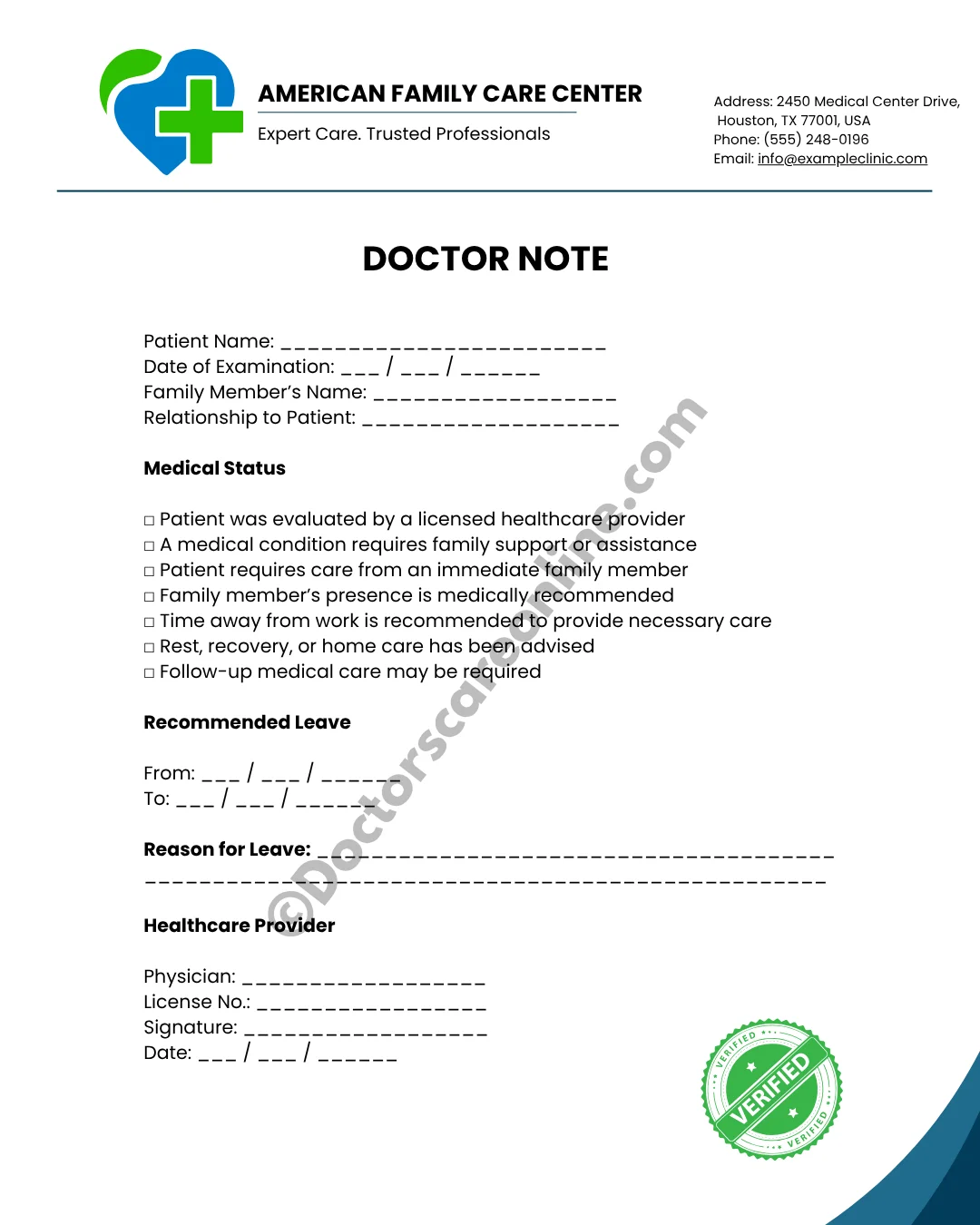
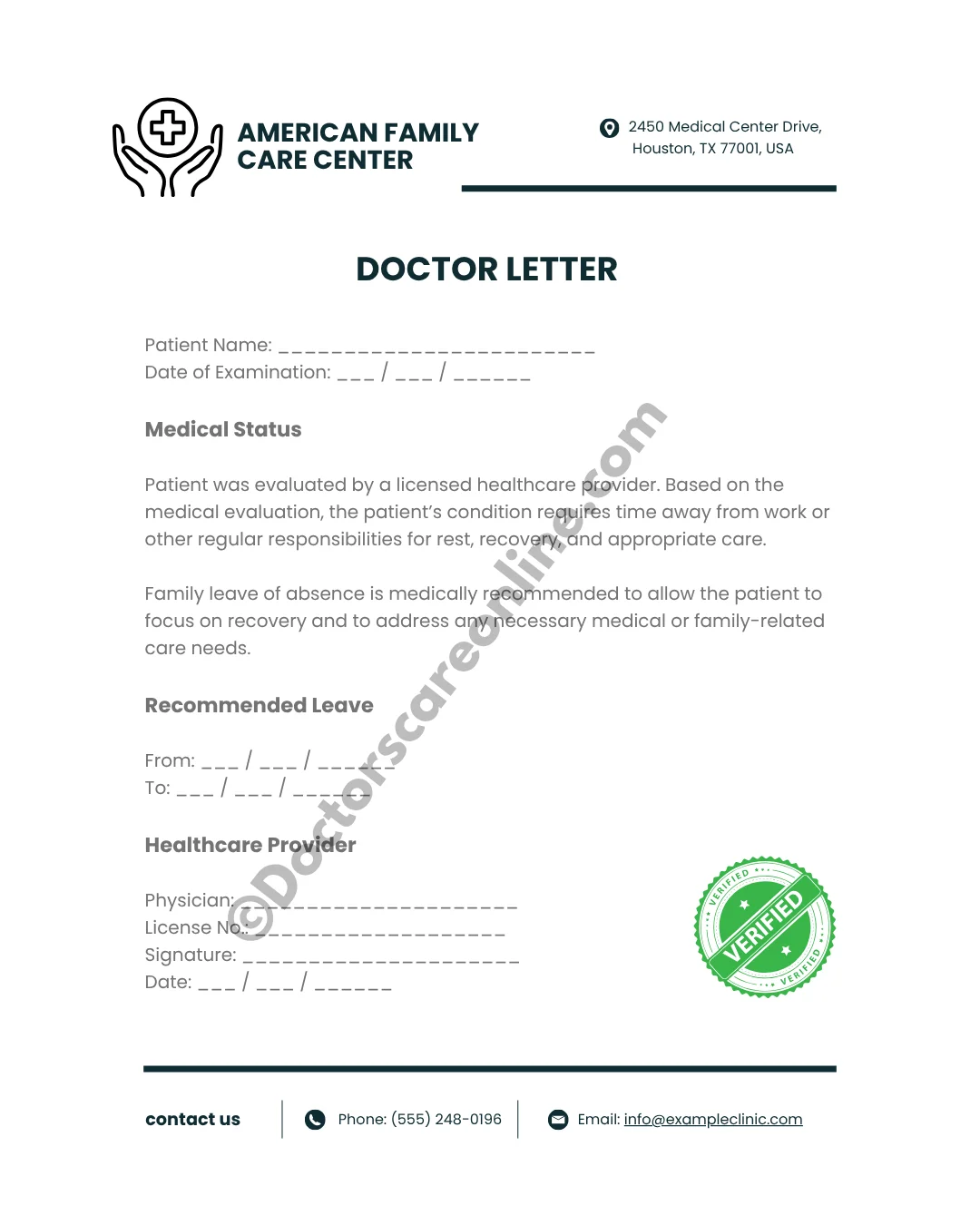
A doctor’s note for family leave of absence is medical documentation provided by a qualified healthcare professional when an employee needs time away from work to care for a family member with a medical condition. Depending on the circumstances, an employer may request medical certification or other documentation supporting the need for family medical leave.
A legitimate family leave medical note should be based on a real healthcare evaluation. The healthcare provider must determine what documentation is medically appropriate based on the circumstances.
What Is a Doctor’s Note for Family Leave of Absence?
A family leave doctor’s note is medical documentation that may support an employee’s need to take time away from work because a family member requires medical care or assistance.
The documentation may be used to support situations involving:
- Care for a seriously ill family member
- A family member receiving medical treatment
- Hospitalization or recovery
- A family member requiring assistance during recovery
- Ongoing medical appointments or treatment
- Intermittent time away from work for caregiving
- A reduced work schedule when medically necessary
The exact documentation required depends on the employer, applicable workplace policies, the reason for leave, and the laws that apply to the employee.
For eligible employees covered by the U.S. Family and Medical Leave Act (FMLA), an employer may request medical certification when leave is being taken to care for a covered family member with a serious health condition.
When Might You Need a Family Leave Doctor’s Note?
Employees may need medical documentation for family leave when a family member’s health condition requires the employee to provide care or assistance.
Common situations include:
- Caring for a Sick Spouse: You may need time away from work to assist a spouse who is experiencing a serious health condition, undergoing treatment, recovering from surgery, or attending necessary medical appointments.
- Caring for a Sick Child: Parents or eligible caregivers may need leave to care for a child who requires medical treatment, supervision, or assistance because of a serious health condition.
- Caring for a Parent: An employee may need family medical leave to help a parent who is seriously ill, hospitalized, receiving treatment, or recovering from a medical procedure.
- Supporting a Family Member After Surgery: A family member may temporarily require assistance with transportation, daily activities, medication management, or recovery following surgery.
- Hospitalization or Serious Medical Treatment: Extended medical treatment or hospitalization may create a need for an employee to provide ongoing care or assistance.
- Intermittent Family Leave: Some medical situations may require an employee to take leave in separate blocks of time rather than being absent continuously. Under the FMLA, intermittent or reduced-schedule leave may be available when medically necessary and the employee is otherwise eligible.
Family Leave vs. FMLA: What’s the Difference?
A family leave of absence is a broad term for time away from work to care for or support a family member.
FMLA leave is a specific type of job-protected leave available to eligible employees and covered employers under U.S. federal law.
FMLA can include leave to care for a covered spouse, child, or parent with a serious health condition. Eligible employees may generally receive up to 12 workweeks of FMLA leave in the applicable 12-month period, subject to the law’s eligibility and coverage requirements. Certain military caregiver situations have different provisions.
Not every family-related absence qualifies for FMLA, and an employer may have additional leave policies or benefits.
Important: A doctor’s note does not automatically make an employee eligible for FMLA leave. Eligibility and whether a specific absence qualifies are determined under the applicable law and employer procedures.
Can You Get a Family Leave Doctor’s Note Online?
In many situations, you can book an online medical appointment for family leave documentation with a licensed healthcare professional when telehealth is appropriate and available in your location.
During the consultation, the healthcare provider may ask about:
- The family member’s health condition
- When the condition began
- Current treatment or medical care
- Whether the family member requires assistance
- The type of care the employee needs to provide
- The expected duration of caregiving
- Whether leave will be continuous or intermittent
- The employee’s work schedule
- Employer documentation requirements
The provider will determine whether the available information and the type of consultation are sufficient to support medical documentation.
If an in-person examination or additional medical information is necessary, the healthcare professional may recommend an in-person appointment.
How to Get a Doctor’s Note for Family Leave Online
Getting started with an online medical evaluation can be straightforward.
1. Check Your Employer’s Leave Requirements
Before scheduling an appointment, review your company’s leave policy or contact HR. Determine whether your employer requires a general doctor’s note, FMLA certification, a specific company form, or other documentation.
2. Choose a Licensed Healthcare Provider
Select a legitimate healthcare provider offering online consultations in your location. Verify that the provider is appropriately licensed and that telehealth services are available for your situation.
3. Schedule an Online Appointment
Choose an available appointment time and provide the information requested during the booking process.
4. Explain the Family Member’s Medical Situation
Provide accurate information about the family member’s condition, treatment, medical appointments, recovery needs, and the type of assistance you are expected to provide.
5. Explain Your Leave Requirements
Tell the healthcare provider whether you need:
- Continuous leave
- Specific days away from work
- Intermittent leave
- A reduced work schedule
- Time for medical appointments
- Temporary caregiving leave
6. Complete the Medical Evaluation
The healthcare professional will assess the information available and determine whether medical certification or other documentation is clinically appropriate.
7. Receive Documentation When Appropriate
If the provider determines that documentation is medically justified, they may complete an appropriate medical note or certification consistent with applicable requirements.
8. Submit the Documentation to Your Employer
Provide the completed documentation to your employer, HR department, or leave administrator according to your company’s procedures.
A medical note should never be altered, edited, or created without an appropriate healthcare evaluation.
What Information May Be Included in a Family Leave Medical Note?
The information depends on the type of documentation requested and the applicable requirements.
A medical certification may include:
- Healthcare provider’s name and contact information
- Type of medical practice or specialty
- Date the medical condition began
- Expected duration of the condition
- Relevant medical facts
- Whether the family member requires care
- Estimated frequency and duration of required care
- Whether intermittent or reduced-schedule leave is medically necessary
For FMLA certification involving care for a family member, the U.S. Department of Labor states that certification can include information about when the serious health condition began, how long it is expected to last, appropriate medical facts, the need for care, and an estimate of the amount of time care is needed.
Does a Family Leave Doctor’s Note Need to Include a Diagnosis?
Not always.
For FMLA medical certification, a diagnosis is not required. The certification must contain sufficient medical facts to establish the need for qualifying leave.
The healthcare provider determines what medically relevant information should be included. Employees should check their employer’s requirements before requesting unnecessary medical details.
How Long Can Family Medical Leave Last?
There is no single leave duration that applies to every family situation.
The appropriate amount of time may depend on:
- The family member’s medical condition
- The type of care required
- Expected recovery period
- Treatment schedule
- Whether leave is continuous or intermittent
- Employer policies
- Applicable federal or state laws
- Employee eligibility
Under the FMLA, eligible employees may generally take up to 12 workweeks of qualifying leave during the applicable 12-month period, while military caregiver leave can provide up to 26 workweeks in qualifying circumstances.
What Is Intermittent Family Leave?
Intermittent family leave allows an eligible employee to take leave in separate blocks of time instead of taking one continuous period away from work.
This may be useful when a family member needs:
- Recurring medical appointments
- Periodic treatment
- Ongoing assistance
- Transportation to healthcare visits
- Care during occasional symptom flare-ups
Under the FMLA, intermittent or reduced-schedule leave may be available when medically necessary for a qualifying serious health condition.
The healthcare provider may need to estimate the expected frequency and duration of the employee’s absences when completing applicable medical certification.
What Should You Prepare Before an Online Family Leave Appointment?
Having the right information ready can make your consultation more efficient.
Prepare:
- Family member’s relationship to you
- General description of the medical condition
- Date the condition began
- Current treatment or medical care
- Upcoming appointments
- Hospitalization or procedure information, if applicable
- Type of caregiving assistance required
- Expected duration of care, if known
- Expected dates of absence
- Whether you need intermittent leave
- Your work schedule
- Employer’s leave requirements
- Any employer-provided certification form
Provide truthful and accurate information. The healthcare provider—not the patient or employer—determines what medical information and documentation are clinically appropriate.
What If My Employer Has Its Own Family Leave Form?
Some employers use their own medical certification or leave forms.
Before your appointment, ask HR or your leave administrator whether a specific form must be completed.
For FMLA purposes, the U.S. Department of Labor explains that employers may use their own forms as long as the required information is consistent with applicable FMLA requirements. A complete and sufficient certification can also be provided in another appropriate format, such as healthcare-provider letterhead.
Providing the correct form or documentation requirements to your healthcare provider can help prevent unnecessary delays.
Can My Employer See My Family Member’s Entire Medical History?
Generally, an employer should only receive medical information necessary for the applicable leave or certification process.
For FMLA certification, the U.S. Department of Labor states that the employer may require information relevant to the serious health condition supporting the leave, rather than unrelated medical history.
Medical information covered by applicable confidentiality rules should be handled separately from ordinary personnel records. The EEOC also explains that employee medical information generally must be kept confidential and maintained separately from regular personnel files.
Common Reasons a Family Leave Request May Need Medical Documentation
Medical documentation may be relevant when an employee needs leave because a family member:
- Has a serious health condition
- Is undergoing treatment
- Is recovering from surgery
- Has been hospitalized
- Needs ongoing medical care
- Requires assistance with daily activities
- Has recurring medical appointments
- Requires the employee’s caregiving support
- Needs transportation or assistance related to medical treatment
- Requires intermittent care
Not every family-related leave request requires a medical certification. For example, under the FMLA, an employer may not require medical certification for leave to bond with a newborn or a child placed for adoption or foster care, although other documentation may apply.
How Our Online Family Leave Medical Evaluation Works
If you are looking for a doctor’s note for family leave online, the most important factor is obtaining legitimate medical evaluation rather than simply purchasing documentation.
A responsible online healthcare process should involve:
Licensed Provider → Medical Consultation → Clinical Assessment → Appropriate Documentation
During the consultation, the healthcare professional reviews the information relevant to the leave request and determines whether medical certification or another form of documentation is appropriate.
If documentation is medically justified, the provider can complete the appropriate information based on their professional judgment.
This approach helps ensure that the documentation reflects a genuine healthcare evaluation and gives employees a clearer understanding of what their employer may require.
Why Choose a Legitimate Online Medical Evaluation?
When choosing an online service for family leave documentation, look for transparency and legitimate healthcare practices.
A trustworthy service should clearly explain:
- Who provides the medical evaluation
- Whether healthcare professionals are appropriately licensed
- How appointments are conducted
- What information you need to provide
- When documentation may be issued
- Whether documentation is guaranteed or subject to medical judgment
- How medical information is handled
- What happens if an in-person evaluation is necessary
- What fees apply before you book
Be cautious of services promising guaranteed medical notes without an evaluation. A legitimate healthcare provider should make documentation decisions based on clinical assessment rather than payment alone.
Benefits of an Online Medical Appointment for Family Leave
When telehealth is appropriate, an online appointment can offer several practical advantages:
- Convenient appointment scheduling
- Access to healthcare from home
- Reduced travel time
- Easier communication with a healthcare professional
- Convenient discussion of caregiving needs
- Digital documentation when medically appropriate
- Helpful option for employees balancing work and family responsibilities
Telehealth is not appropriate for every medical situation. If the provider determines that an in-person assessment is necessary, follow that recommendation.
Family Leave Doctor’s Note vs. Personal Leave Request
A personal leave request is an employee’s request to their employer for time away from work.
A family leave doctor’s note or medical certification provides healthcare-related documentation when medical circumstances support the leave.
They serve different purposes:
| Personal Leave Request | Medical Documentation |
|---|---|
| Submitted by the employee | Completed or issued by a healthcare provider |
| Requests time away from work | Supports medically related leave when appropriate |
| May explain the general reason for leave | Provides relevant medical information |
| Follows employer leave procedures | Based on healthcare evaluation |
| Does not replace medical certification when required | May be required for qualifying medical leave |
Your employer may require both an employee leave request and supporting medical documentation.
Common Mistakes to Avoid
Avoid these mistakes when requesting family medical leave documentation:
- Waiting until the last minute to check employer requirements
- Assuming every family leave request requires a doctor’s note
- Assuming a doctor’s note automatically qualifies you for FMLA
- Using a provider who is not appropriately licensed
- Providing inaccurate information during a consultation
- Failing to tell the provider about intermittent leave needs
- Submitting an incomplete employer form
- Altering medical documentation
- Assuming an online consultation is suitable for every situation
- Sharing unnecessary medical information with people who do not need it
- Ignoring your employer’s submission deadlines
Trust & Transparency: What You Should Know
Your health and privacy should come before obtaining paperwork.
A legitimate medical documentation service should not promise approval, guarantee a specific leave period, or encourage users to provide false information.
Instead, the process should be based on:
- A real healthcare consultation
- Accurate patient information
- Professional clinical judgment
- Appropriate documentation
- Applicable laws and regulations
- Clear communication about limitations
- Respect for medical privacy
The U.S. Department of Labor states that FMLA certification should contain information relevant to the qualifying serious health condition and that employees generally do not have to provide their employer with a diagnosis simply because certification is required.
Key Takeaways
A doctor’s note for family leave of absence may help document an employee’s need to care for a family member with a serious health condition when medical certification is appropriate.
Remember:
- Not every family leave request requires a doctor’s note.
- FMLA has specific eligibility and certification requirements.
- A medical certification should come from an appropriate healthcare provider.
- An online appointment may be suitable for some situations.
- Documentation is not guaranteed simply because it is requested.
- The provider determines what information is medically appropriate.
- Employers may have their own forms and procedures.
- Medical information should be handled confidentially under applicable requirements.
- Never alter or falsify medical documentation.
If you need family leave documentation, review your employer’s requirements and schedule an appropriate healthcare evaluation.
Frequently Asked Questions
1. Can I get a doctor’s note for family leave online?
Yes, an online healthcare appointment may be available when telehealth is appropriate in your location. A licensed healthcare professional can evaluate the situation and determine whether medical documentation is appropriate. A note or certification is not guaranteed simply by requesting one.
2. Can a Doctor’s Note Protect Your Job During Family Leave?
A doctor’s note itself does not automatically provide job protection.
If you are seeking FMLA leave, eligibility and qualifying requirements must be met under the applicable law. Other federal, state, or employer-provided leave programs may have separate requirements.
For this reason, employees should not assume that simply obtaining a family leave medical note automatically guarantees protected leave.
If you believe your absence may qualify for FMLA, speak with your employer or HR department about the applicable leave process.
3. Does a doctor’s note automatically qualify me for FMLA leave?
No. A doctor’s note or medical certification does not automatically establish FMLA eligibility. Eligibility depends on the employee, employer, leave reason, and other requirements under the FMLA.
4. Can I use a doctor’s note to care for my sick parent, spouse, or child?
Potentially, depending on the circumstances. Under the FMLA, eligible employees may take qualifying leave to care for a covered spouse, child, or parent with a serious health condition. Other family relationships and leave programs may have different rules.
5. Do I have to provide my family member’s diagnosis to my employer?
Not necessarily. For FMLA medical certification, a diagnosis itself is not required, although sufficient medical facts must establish the need for qualifying leave. Employer and applicable legal requirements can vary, so review your specific leave policy and certification requirements.
Medical Disclaimer: This content is provided for general informational and educational purposes and is not a substitute for professional medical, legal, employment, or benefits advice.
A doctor’s note or medical certification for family leave should only be issued by an appropriately qualified healthcare professional following an appropriate evaluation. Documentation is not guaranteed, and the healthcare provider determines whether it is medically appropriate.
Family leave, FMLA eligibility, employer documentation requirements, state and local leave laws, telehealth rules, and privacy requirements can vary. Information on this page should not be interpreted as a guarantee that a particular leave request will be approved.
Related Post :—-

Reviews
There are no reviews yet.