

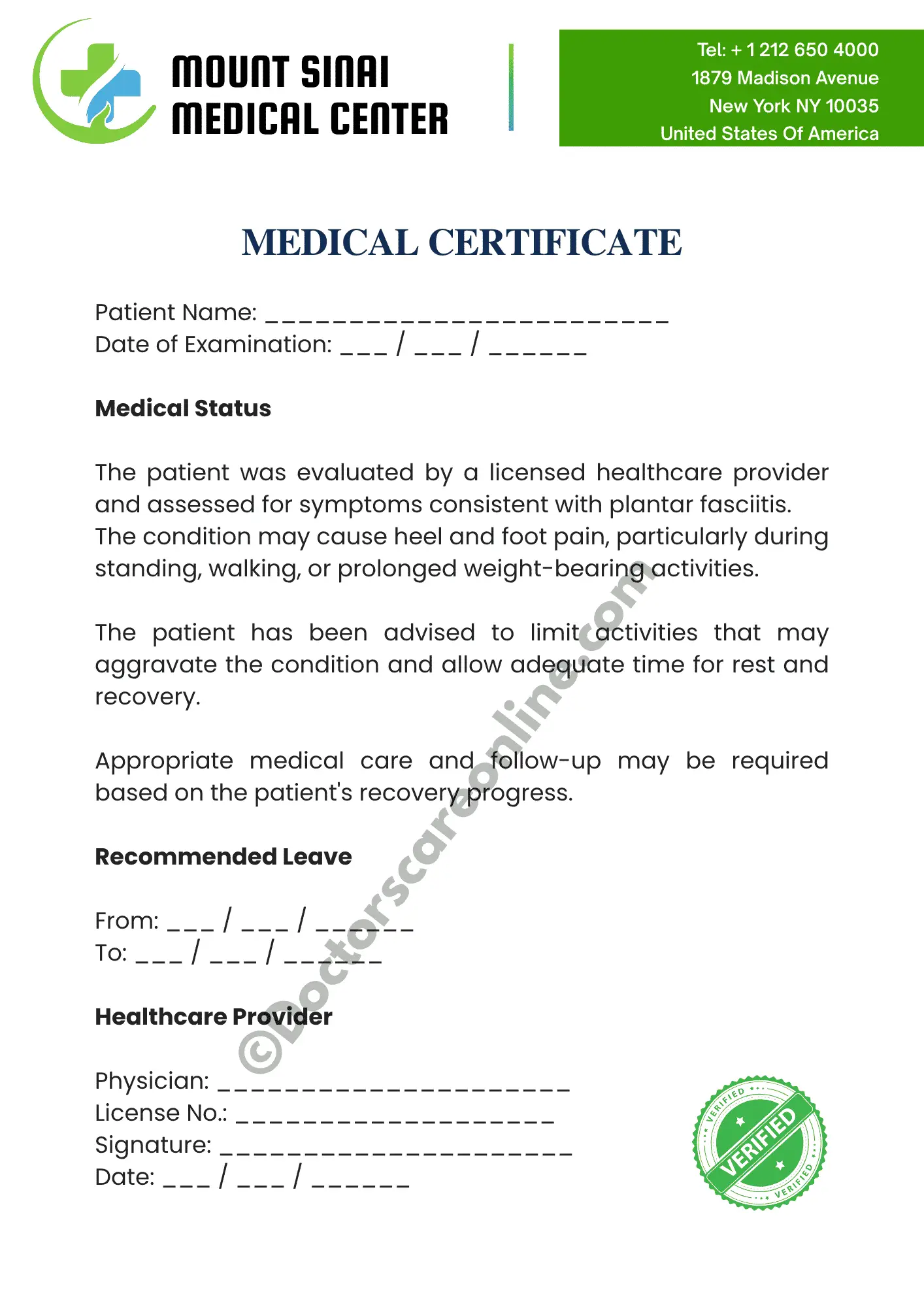
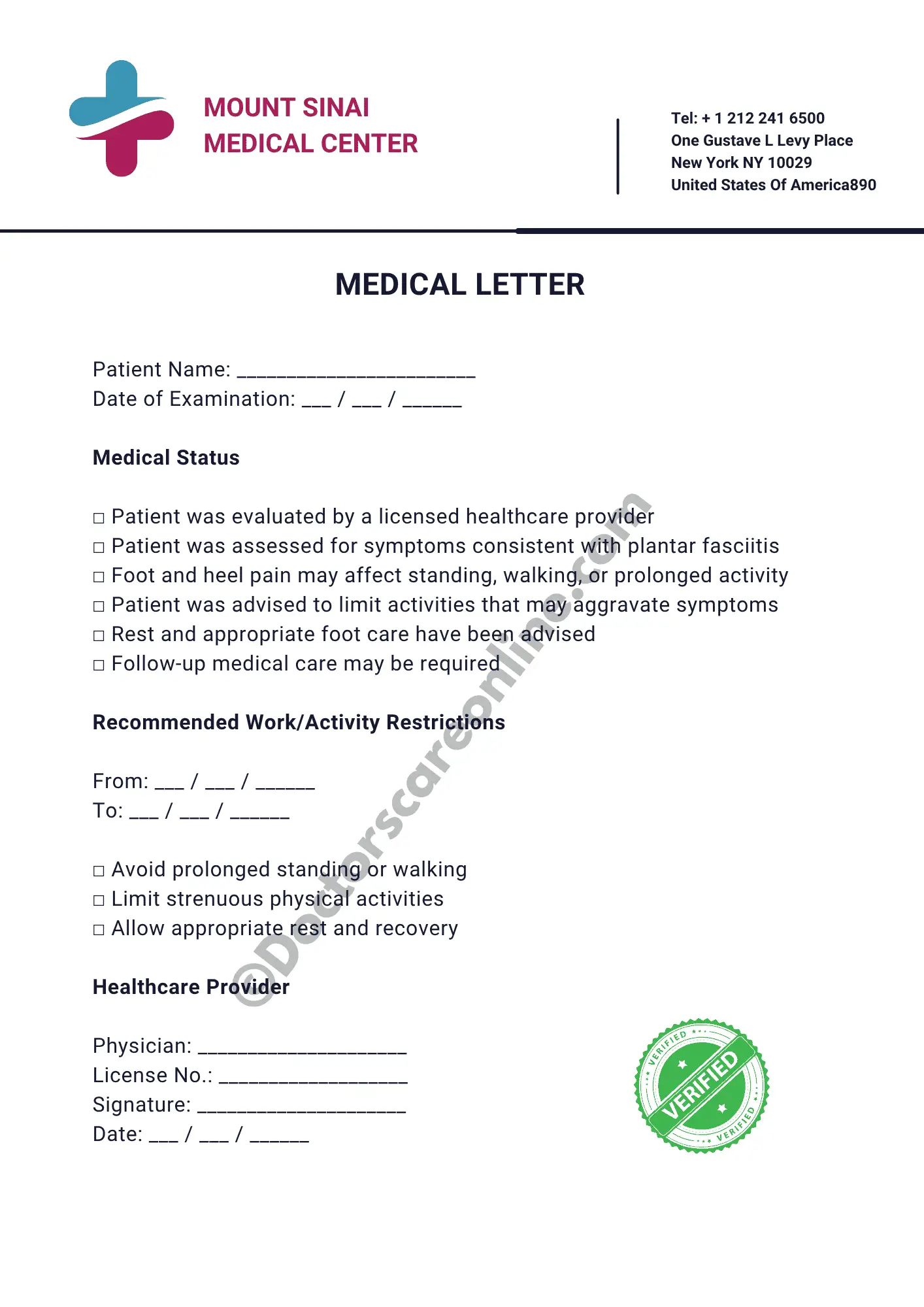
Doctors Note for Plantar Fasciitis – Plantar fasciitis can cause persistent heel and foot pain that makes walking, standing, exercising, or completing physically demanding work uncomfortable. When these symptoms interfere with your normal responsibilities, a online doctor’s note for plantar fasciitis may provide medical documentation of an evaluation and any work, school, or activity restrictions considered appropriate by a licensed healthcare provider.
Our online healthcare service makes it easier to connect with a licensed healthcare provider from home when telehealth is appropriate for your situation. During an online consultation, you can describe your symptoms, explain how plantar fasciitis is affecting your daily activities, and discuss whether you need time away from work or school, modified duties, or other medical recommendations.
Related Doctor Note :——
You can also visit:
- Doctors Note for Limited Work
- Doctors Note for Foot Injury
- Doctors Note for Sprained Ankle
- Doctor’s Note for Injury
- Unlimited Doctor’s Notes for 1 Year
What Is Plantar Fasciitis?
Plantar fasciitis is a common cause of pain around the bottom of the heel. It involves irritation or injury of the plantar fascia, a strong band of tissue extending along the bottom of the foot and helping support the arch.
Pain is often most noticeable with the first steps after waking up or after sitting for a period of time. It may also become more noticeable after prolonged standing, walking, running, or other activities that place repeated stress on the foot.
When Might You Need a Doctor’s Note for Plantar Fasciitis?
A medical note may be useful when foot or heel pain affects your ability to safely perform required activities and your employer, school, or another organization requires supporting documentation.
Situations may include:
- Your job requires prolonged standing or walking.
- Your work involves lifting, climbing, or physically demanding activities.
- Heel pain makes it difficult to commute or move around the workplace.
- You need temporary modified duties while recovering.
- You need to avoid activities that aggravate your symptoms.
- You need documentation for a work absence.
- Your school or college requires medical documentation for an absence.
- You need a healthcare provider to document functional limitations.
- You are returning to work after a period of medically recommended activity modification.
Whether a note is appropriate depends on the provider’s evaluation and the documentation requirements of the organization requesting it.
How Plantar Fasciitis Can Affect Work and Daily Activities
The impact of plantar fasciitis depends on your symptoms and the physical demands of your routine. Someone working at a desk may experience different limitations from someone whose job requires walking, standing, lifting, or operating equipment.
For example, heel pain may make it difficult to:
- Stand for extended periods.
- Walk across a large workplace.
- Repeatedly climb stairs.
- Perform warehouse or retail duties.
- Complete jobs requiring constant movement.
- Participate in sports or physical training.
- Wear certain work shoes comfortably.
- Travel to and from work.
- Maintain normal activity levels throughout a shift.
A healthcare provider can assess your symptoms and determine whether temporary restrictions or other recommendations are appropriate.
Common Symptoms of Plantar Fasciitis
Typical symptoms can include:
- Sharp or stabbing pain near the heel.
- Pain along the bottom of the foot.
- Significant discomfort with the first steps after waking.
- Pain after getting up following prolonged sitting.
- Increased discomfort after extended standing or walking.
- Tenderness around the heel or arch.
- Pain that interferes with exercise or normal movement.
Symptoms can vary from person to person, and heel pain does not automatically mean that plantar fasciitis is the cause. Other conditions can produce similar symptoms, which is why an appropriate medical assessment is important.
What Can Cause or Contribute to Plantar Fasciitis?
Plantar fasciitis can develop when the plantar fascia is repeatedly placed under stress. Certain activities, footwear choices, and individual foot mechanics may increase the load placed on the tissue.
Potential contributing factors include:
- Increased walking or running.
- Prolonged standing on hard surfaces.
- Sudden increases in physical activity.
- Repetitive high-impact exercise.
- Limited flexibility in the calf or ankle.
- Certain foot-structure or gait characteristics.
- Wearing footwear that provides inadequate support.
- Spending substantial time barefoot on hard surfaces.
- Increased body weight placing additional stress on the feet.
Mayo Clinic notes that prolonged walking or standing, running, changes in exercise routines, footwear, and certain biomechanical factors can contribute to plantar fasciopathy.
How Is Plantar Fasciitis Diagnosed?
A healthcare provider generally begins by discussing your symptoms, medical history, activities, and factors that may have contributed to your heel pain. A physical examination can help identify tenderness and determine whether the symptoms are consistent with plantar fasciitis.
Depending on your symptoms, the evaluation may consider:
- Location and pattern of your pain.
- When symptoms started.
- Activities that increase or reduce discomfort.
- Previous foot or ankle problems.
- Your work and exercise routine.
- Walking and standing limitations.
- Tenderness around the heel or plantar fascia.
- Range of motion and other relevant physical findings.
Most people do not require imaging solely to identify plantar fasciitis. However, a healthcare provider may recommend an X-ray, MRI, or another test when another condition, such as a stress fracture, needs to be considered.
What Information Should You Provide During an Online Consultation?
Providing clear information can help the healthcare provider understand how your symptoms affect your daily life.
Before your appointment, consider preparing:
- When your heel or foot pain began.
- Whether the pain affects one or both feet.
- Where the discomfort is located.
- Whether mornings are particularly painful.
- Activities that make the symptoms worse.
- Whether you have recently changed your exercise routine.
- The type of shoes you normally wear.
- How much time you spend standing or walking.
- Your occupation and physical job requirements.
- Previous foot injuries or conditions.
- Current medications and treatments.
- Any previous diagnosis or medical evaluation.
You should also explain if your symptoms are preventing you from performing specific work or school activities.
How to Get a Doctor’s Note for Plantar Fasciitis Online
If telehealth is appropriate in your location, the process can be completed online without unnecessarily delaying an evaluation.
1. Start Your Online Appointment
- Choose an available consultation option and provide the information requested during registration.
2. Complete Your Account Information
- Enter the required personal and contact details accurately. This allows the healthcare service to process your appointment and communicate with you.
3. Describe Your Heel Pain
- Explain your symptoms, how long they have been present, and how they affect walking, standing, working, exercising, or other activities.
4. Meet With the Healthcare Provider
- Attend your scheduled online consultation. The provider will review your symptoms and determine whether your condition can be appropriately evaluated through telehealth.
5. Follow the Provider’s Recommendation
- The healthcare provider may recommend self-care, further evaluation, an in-person examination, treatment, activity modification, or another appropriate next step.
6. Receive Documentation When Medically Appropriate
- If the provider determines that medical documentation is justified, a doctor’s note may be issued according to the provider’s clinical judgment and applicable requirements.
A note should never be altered or obtained without an appropriate medical evaluation.
How Our Online Service Helps You
Finding time for an in-person appointment can be difficult when you are already dealing with painful walking or standing. Our online service is designed to make the process more convenient by allowing eligible users to request a healthcare consultation from a location where the service is legally available.
You can use the service to:
- Request an online medical consultation.
- Explain your plantar fasciitis symptoms remotely.
- Discuss how your condition affects work or school.
- Receive professional medical guidance when telehealth is appropriate.
- Ask whether medical documentation may be appropriate for your situation.
- Access the service without unnecessarily traveling for an initial consultation.
The service does not replace emergency care or guarantee that a provider will issue a doctor’s note. The healthcare provider makes the final clinical decision after reviewing your individual circumstances.
Why Users Can Trust Our Online Service
Trust is especially important when using an online healthcare service. Our goal is to provide a straightforward process that helps users connect with healthcare professionals while keeping the medical decision in the hands of a licensed provider.
Our service focuses on:
- Provider-led evaluation: Medical documentation is based on the healthcare provider’s assessment rather than an automatic approval.
- Clear process: Users can understand the appointment, consultation, and documentation process before proceeding.
- Convenient access: Online consultations can reduce unnecessary travel when a condition is suitable for telehealth.
- Privacy-conscious communication: Users should provide only the information necessary for their healthcare consultation and documentation needs.
- User support: Questions about the website process can be directed to our customer support team.
- No guaranteed outcome: A doctor’s note is provided only when the healthcare provider determines that it is medically appropriate.
Healthcare providers remain responsible for clinical decisions, including whether an in-person examination or additional evaluation is necessary.
Having Trouble With Registration, Login, or Payment?
If you are trying to schedule an appointment and encounter a problem, you do not need to figure it out alone.
You can use the chatbox on our website to ask questions about:
- Registration problems.
- Login difficulties.
- Appointment-related questions.
- Payment issues.
- Problems completing checkout.
- General questions about using the website.
- Questions about the online consultation process.
Our support team can help with website and service-related questions. However, medical questions and clinical decisions must be addressed by the appropriate healthcare provider.
Please note: Customer support cannot guarantee that a doctor will issue medical documentation. That decision belongs to the licensed healthcare provider following the medical evaluation.
Treatment and Recovery for Plantar Fasciitis
Treatment depends on the individual’s symptoms and clinical assessment. Many people improve with conservative approaches rather than surgery. Common options can include activity modification, stretching, supportive footwear, physical therapy, orthotics, night splints, and pain-relief measures when appropriate.
A healthcare provider may recommend:
- Temporarily reducing activities that worsen pain.
- Calf and plantar fascia stretching.
- Foot and lower-leg strengthening.
- Supportive shoes.
- Heel cups or arch supports.
- Physical therapy.
- Night splints.
- Ice or other symptom-management measures.
- Appropriate medication based on individual circumstances.
Persistent symptoms may require further evaluation or additional treatment options. Surgery is generally reserved for selected cases that do not improve with conservative management.
Work Restrictions That May Be Considered
When plantar fasciitis substantially affects physical activity, a healthcare provider may consider whether temporary workplace modifications are appropriate.
Depending on the person’s job and clinical situation, recommendations could involve:
- Reducing prolonged standing.
- Limiting extended walking.
- Temporarily avoiding high-impact activities.
- Allowing appropriate rest periods.
- Modifying physically demanding tasks.
- Temporarily reducing activities that aggravate symptoms.
The specific restrictions, duration, and return-to-work recommendations should come from the healthcare provider based on the individual’s condition and job requirements.
When Heel Pain May Need Prompt Medical Evaluation
Not every case of heel pain is plantar fasciitis. Seek prompt medical attention when symptoms are severe, follow a significant injury, or are accompanied by concerning changes.
Examples include:
- Inability to bear weight on the foot.
- Significant swelling after an injury.
- An open wound or drainage.
- Fever or signs of infection.
- New numbness or significant weakness.
- Severe pain that develops suddenly after trauma.
- Symptoms that continue or worsen despite appropriate self-care.
Mayo Clinic recommends medical evaluation for severe foot pain or swelling after injury, inability to put weight on the foot, signs of infection, and certain persistent or neurological symptoms.
What Happens After Your Consultation?
Your next steps depend on the healthcare provider’s assessment. You may receive recommendations for home care, treatment, activity modification, additional evaluation, or follow-up.
If medical documentation is appropriate, the provider may specify relevant information such as:
- Date of medical evaluation.
- Recommended time away from certain activities.
- Temporary functional restrictions.
- Recommended return-to-work or school date, when appropriate.
- Follow-up requirements.
The exact information included depends on the provider and the requirements applicable to your situation.
Frequently Asked Questions
Q: Can a podiatrist provide a doctor’s note for plantar fasciitis?
Yes. A podiatrist may provide medical documentation when they evaluate your condition and determine that a note or activity restriction is medically appropriate. Other qualified healthcare professionals may also provide documentation depending on the situation and applicable rules.
Q: Can plantar fasciitis qualify for workplace accommodations?
It can, depending on the severity of the condition, the person’s functional limitations, the job requirements, and applicable workplace rules. A healthcare provider can document medically appropriate restrictions, while the employer determines what accommodations can be provided under applicable policies and laws.
Q: Does plantar fasciitis usually require an X-ray?
Not necessarily. Plantar fasciitis is often diagnosed through medical history and physical examination. Imaging may be considered when a healthcare provider needs to investigate another possible cause of heel pain.
Q: Can plantar fasciitis affect both feet?
Yes. Although symptoms may occur in only one foot, plantar fasciitis can affect both feet. The pattern and severity can differ between individuals.
Q: What if my heel pain is not plantar fasciitis?
Heel pain can have several causes, including other tendon, bone, nerve, joint, or soft-tissue conditions. If your symptoms do not match typical plantar fasciitis or are not improving, a healthcare provider can evaluate you and determine whether additional testing or an alternative diagnosis should be considered.
Medical Disclaimer: This content is provided for general educational and informational purposes and is not a substitute for professional medical advice, diagnosis, or treatment. Plantar fasciitis and other causes of heel pain can have similar symptoms, so a qualified healthcare provider should evaluate persistent, severe, or concerning symptoms.
A doctor’s note for plantar fasciitis is not guaranteed. Medical documentation should be issued only when a licensed healthcare provider determines that it is medically appropriate following an evaluation. Telehealth availability, provider licensing, treatment options, documentation requirements, and workplace or school policies can vary by state and individual circumstances.





Reviews
There are no reviews yet.