
A Doctor’s Note for Pulled Muscle can provide medical documentation when a muscle strain affects your ability to work, attend school, exercise, or perform normal activities. A pulled muscle, medically known as a muscle strain, occurs when a muscle or tendon is stretched beyond its normal capacity and may involve damaged or torn tissue. Strains can range from mild injuries to more serious tears.
If your symptoms are interfering with your normal responsibilities, an online doctor visit may provide a convenient way to discuss the injury with a licensed healthcare provider. Depending on the symptoms and whether the condition can be appropriately assessed remotely, the provider may recommend treatment, activity restrictions, an in-person evaluation, or medical documentation when clinically appropriate.
Related Doctor Note : —–
- Doctor’s Note for 3 Days Off Work
- Doctor’s Note for Torn Muscle
- Doctor’s Note for Injury
- Doctor’s Note for Missing Work
When Might a Doctor’s Note for a Pulled Muscle Be Appropriate?
A doctor’s note may be relevant when a medically evaluated muscle strain temporarily affects your ability to perform normal responsibilities.
Situations may include:
- Your job requires heavy lifting.
- Your work involves repetitive physical movements.
- You have difficulty standing or walking.
- Your injury limits reaching, carrying, pushing, or pulling.
- Your symptoms interfere with school attendance.
- Your healthcare provider recommends temporary activity modification.
- You need documentation for a medically necessary absence.
- Your provider recommends modified or light-duty work.
The healthcare provider determines what restrictions or leave recommendations are medically appropriate.
What Is a Pulled Muscle?
A pulled muscle is another common term for a muscle strain. It can occur when muscle fibers or a tendon are overstretched or torn.
Common characteristics of a muscle strain
- Localized muscle pain or tenderness
- Swelling around the affected area
- Bruising or skin discoloration
- Reduced range of motion
- Muscle spasms
- Weakness in the affected muscle
- Difficulty using the injured body part normally
Muscle strains can develop suddenly during activities such as lifting, sprinting, jumping, or changing direction. They can also develop gradually because of repeated movements or overuse.
When a Pulled Muscle May Affect Work or School
The effect of a muscle strain depends on where the injury occurred and what activities your daily responsibilities require.
For example:
| Situation | Possible Functional Difficulty |
|---|---|
| Leg or hamstring strain | Walking, climbing stairs, standing, or running |
| Back muscle strain | Bending, lifting, sitting, or prolonged standing |
| Shoulder strain | Reaching, lifting, carrying, or repetitive arm movements |
| Arm muscle strain | Carrying, gripping, pushing, or pulling |
| Groin strain | Walking, running, changing direction, or exercising |
| Neck muscle strain | Turning the head or maintaining certain positions |
A healthcare provider can evaluate how symptoms affect your functional abilities and determine whether temporary activity limitations or medical documentation are appropriate.
Common Causes of a Pulled Muscle
A muscle strain can result from a sudden injury or repeated stress placed on a muscle or tendon.
Common causes include:
- Lifting a heavy object
- Sudden twisting or turning
- Sprinting or jumping
- Sports-related activity
- Weightlifting
- Repetitive physical work
- Overuse of a muscle
- Exercising without adequate conditioning
- Falls or accidental injuries
- Sudden movements during everyday activities
Previous muscle injuries, inadequate conditioning, and repetitive physical demands may also contribute to the risk of another strain.
Symptoms of a Pulled Muscle
Symptoms vary according to the severity and location of the injury.
You may experience:
- Pain or tenderness at the injury site
- Swelling
- Bruising
- Muscle tightness
- Muscle spasms
- Reduced flexibility
- Difficulty moving the affected area
- Muscle weakness
- Pain that increases when the muscle is used
A healthcare professional can help determine whether the symptoms are consistent with a muscle strain or whether another injury needs to be considered.
When Should You Seek Medical Evaluation?
Some muscle strains improve with appropriate home care, while others require professional assessment. Consider contacting a healthcare provider when:
- Pain is severe or continues to worsen.
- You have significant swelling.
- You cannot use or move the affected body part normally.
- You develop persistent numbness or tingling.
- You experience substantial weakness.
- The injury occurred during a significant accident.
- Symptoms are not improving as expected.
- You are unsure whether the injury is a strain or another type of injury.
Mayo Clinic notes that worsening symptoms, serious or persistent pain, numbness or tingling, and difficulty using the injured muscle are reasons to seek professional evaluation.
Pulled Muscle vs. Other Injuries
Not every muscle-related injury is the same. A strain affects a muscle or tendon, whereas a sprain involves a ligament.
Simple distinction
- Muscle strain: Involves a stretched or torn muscle or tendon.
- Sprain: Involves a stretched or torn ligament.
- Tendon injury: May involve irritation, partial tearing, or more significant tendon damage.
- Fracture: Involves a broken bone and requires a different type of evaluation.
Because different injuries can cause similar symptoms, a healthcare provider should determine the appropriate diagnosis rather than relying solely on symptoms or self-diagnosis.
How Is a Pulled Muscle Evaluated?
A healthcare provider generally begins by asking about the injury and examining the affected area.
The evaluation may include:
- Medical history: When the injury happened and what activity caused it.
- Symptom review: Pain level, swelling, weakness, bruising, and movement limitations.
- Physical examination: Checking tenderness, movement, strength, and the affected tissue.
- Functional assessment: Determining how the injury affects walking, lifting, reaching, or other activities.
- Imaging when appropriate: Ultrasound or other imaging may sometimes be considered to assess soft-tissue injury severity.
The appropriate evaluation depends on the symptoms and suspected injury.
Treatment and Recovery for a Pulled Muscle
Treatment depends on the severity and location of the strain. For many strains, initial care focuses on protecting the injured area and avoiding activities that make symptoms worse.
Depending on the injury, care may involve:
- Rest or activity modification
- Ice during the early period after an injury
- Compression when appropriate
- Elevation for an injured limb
- Gradual return to movement
- Pain-relief medication when appropriate
- Physical therapy
- Strengthening and rehabilitation exercises
- Bracing or other support for certain injuries
Mayo Clinic describes protection, rest, ice, compression, and elevation as initial measures for many muscle strains. Rehabilitation may later include strengthening and stability exercises.
Do not push through significant pain or resume strenuous activity before your healthcare provider recommends that it is appropriate.
How Long Does a Pulled Muscle Take to Heal?
There is no single recovery period that applies to every muscle strain.
Recovery can depend on:
- Severity of the injury
- Location of the strain
- Whether the muscle or tendon is partially or completely torn
- Your activity level
- Type of work or sport involved
- Previous injuries
- Response to treatment
- Whether rehabilitation is needed
A mild strain may improve with conservative care, while a more serious injury can require professional treatment and a longer rehabilitation period.
For this reason, a healthcare provider should determine whether you need time away from work, modified duties, or a follow-up evaluation rather than relying on a predetermined number of days.
What Can a Doctor’s Note for a Pulled Muscle Include?
The exact information varies depending on the provider, patient’s situation, and documentation requirements.
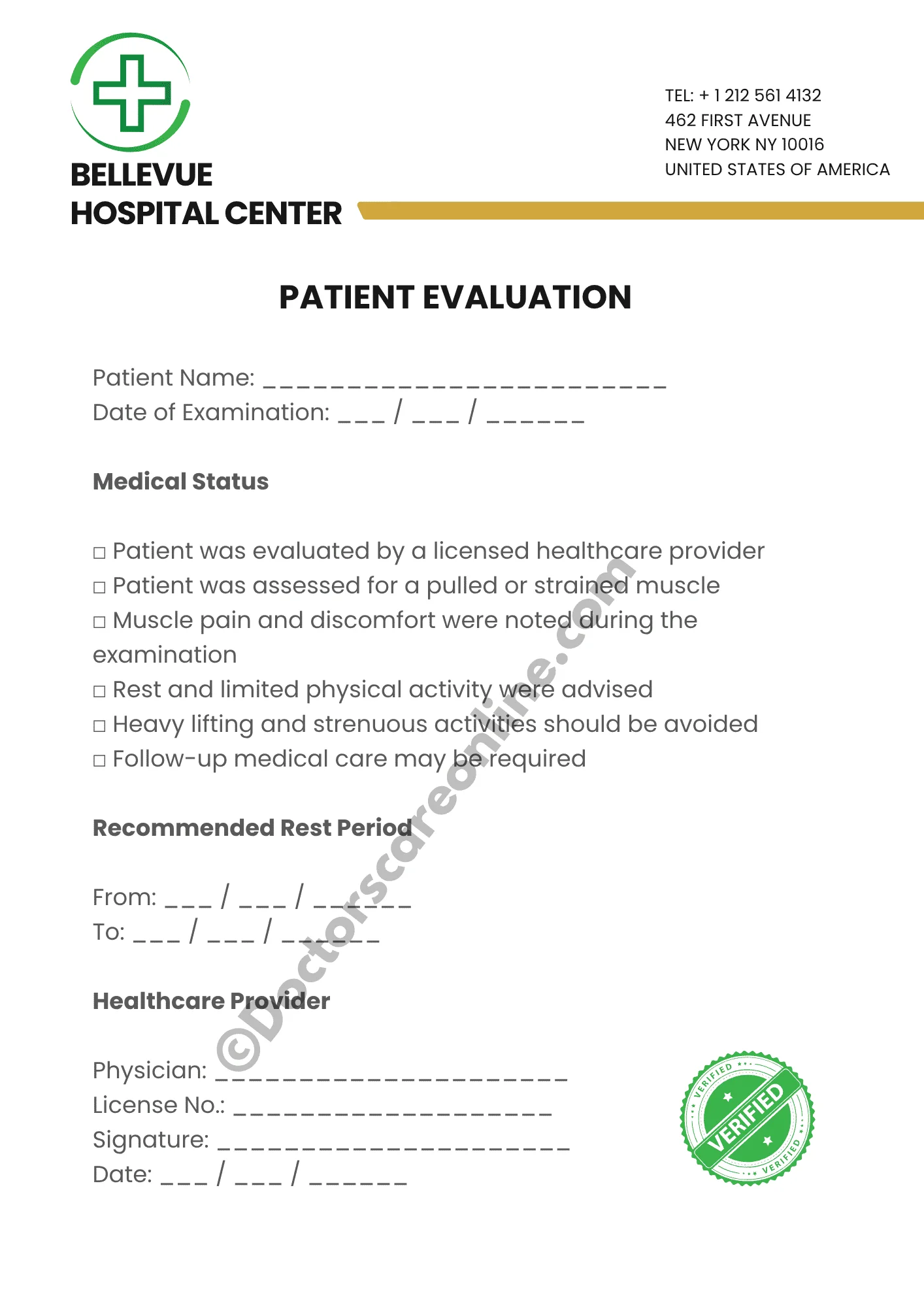
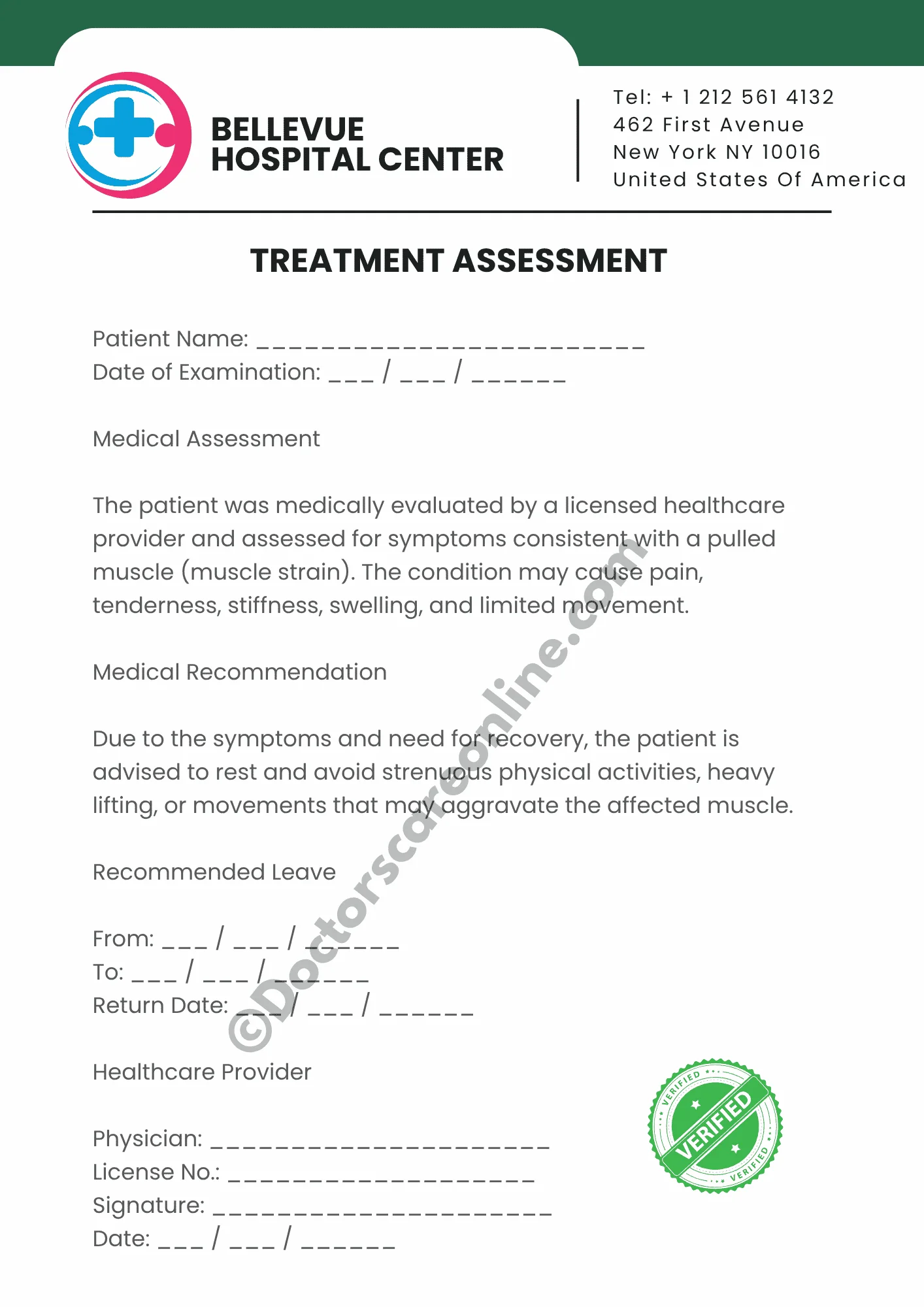
A medical note may include:
- Patient’s name
- Date of medical evaluation
- Confirmation that the patient was evaluated
- Recommended period away from work or school, when medically appropriate
- Temporary activity or work restrictions
- Recommended return-to-work or return-to-school date, when applicable
- Follow-up instructions
- Healthcare provider’s name and professional information
- Provider signature or other authentication
A note does not necessarily need to disclose every detail of a patient’s medical condition. The information included should be determined by the healthcare provider and applicable requirements.
Work Restrictions for a Pulled Muscle
Some jobs place considerably more physical demand on an injured muscle than others. A healthcare provider may consider the patient’s symptoms and job duties when determining whether temporary restrictions are appropriate.
Possible restrictions may involve:
- No heavy lifting
- Reduced lifting limits
- Avoiding repetitive bending
- Avoiding pushing or pulling
- Limiting prolonged standing
- Limiting strenuous exercise
- Taking appropriate breaks
- Temporary light-duty responsibilities
These restrictions are not automatically appropriate for every patient. They should be based on the individual’s medical evaluation and functional limitations.
Can You Get a Doctor’s Note for a Pulled Muscle Online?
An online doctor visit may be an option for discussing a suspected muscle strain when the condition can be appropriately evaluated through telehealth.
During an online appointment, you may be asked about:
- How and when the injury happened
- The affected muscle or body area
- Your symptoms
- Pain severity
- Swelling or bruising
- Movement limitations
- Your occupation or daily activities
- Treatments you have already tried
- Previous injuries
- Any concerning symptoms
Telehealth can provide access to healthcare professionals through video or other remote communication methods, but some conditions require an in-person examination or additional testing.
If the provider determines that an online evaluation is appropriate and medical documentation is justified, documentation may be provided according to the provider’s clinical judgment and applicable requirements.
How to Book an Online Doctor Visit for a Pulled Muscle
Booking an online medical appointment can be convenient when you want to discuss a muscle strain without immediately visiting a physical clinic.
Follow these steps:
- Visit our website: Open the online doctor visit service from your device.
- Register or log in: Create an account or access your existing account.
- Select an appointment: Choose an available healthcare provider and appointment time.
- Provide your information: Enter the requested personal and medical details.
- Describe the injury: Explain when the pulled muscle occurred, where it hurts, and how it affects your activities.
- Complete payment: If payment is required, follow the available checkout instructions.
- Attend the online visit: Connect with the healthcare provider at your scheduled time.
- Follow the provider’s recommendations: The provider may recommend treatment, restrictions, additional evaluation, or follow-up care.
- Receive documentation if medically appropriate: If the provider determines that a doctor’s note is warranted, the documentation may be provided according to applicable requirements.
Why Use Our Online Doctor Visit Service?
Our service is designed to make the process of accessing an online medical evaluation more convenient for people dealing with everyday health concerns such as a suspected pulled muscle.
How we can be useful to patients
- Convenient online access: Start the appointment process from a computer or mobile device.
- Simple appointment process: Submit the required information and select an available visit.
- Healthcare-provider evaluation: Your symptoms can be reviewed by a healthcare professional through the appropriate online consultation process.
- Documentation when medically appropriate: A doctor’s note is provided only when the healthcare provider determines that it is clinically appropriate.
- Clear next steps: The provider can explain whether you may need rest, activity modification, additional evaluation, or follow-up care.
- Support during the process: If you have questions about using the website, our support options can help you navigate the process.
The purpose of an online doctor visit is to connect patients with appropriate healthcare evaluation—not to guarantee a particular diagnosis, treatment, prescription, or doctor’s note.
Having Trouble With Registration, Login, or Payment?
If you experience a problem while using our website, you do not have to figure it out alone.
You can contact us through our chatbox for questions about:
- Creating or accessing your account
- Registration problems
- Login difficulties
- Appointment-booking questions
- Payment or checkout issues
- Website navigation
- General questions about the online visit process
- Questions about what information you need to provide
Our chatbox gives users a convenient way to ask questions when they encounter a technical or process-related issue.
For medical questions about your symptoms, treatment, or whether a doctor’s note is clinically appropriate, the healthcare provider conducting your medical evaluation should be consulted.
What Makes an Online Medical Service Trustworthy?
Choosing an online healthcare service involves more than simply finding a convenient appointment. Patients should understand how the service works and what they can reasonably expect.
Look for these trust signals:
- Licensed healthcare professionals where required
- A genuine medical evaluation before documentation is issued
- Clear information about the online appointment process
- Transparent pricing and payment information
- Accessible customer support
- Clear privacy and data-handling information
- Honest communication about what telehealth can and cannot evaluate
- No guarantee of a medical document regardless of clinical circumstances
- Appropriate referral to in-person or emergency care when remote evaluation is insufficient
Our service is intended to make access to an online doctor visit straightforward while keeping the medical decision with the healthcare provider. A trustworthy process should prioritize appropriate evaluation rather than promising documentation to every person who requests it.
What to Do After Your Online Doctor Visit
After your consultation, carefully follow the healthcare provider’s recommendations.
Your next steps may include:
- Following activity or work restrictions.
- Using recommended home-care measures.
- Taking medications only as directed or as otherwise advised by a healthcare professional.
- Attending recommended follow-up appointments.
- Seeking an in-person evaluation if your provider recommends one.
- Monitoring your symptoms for improvement or worsening.
- Asking your healthcare provider questions if you are unsure about the instructions.
Telehealth guidance may include follow-up recommendations or additional care when needed.
When a Pulled Muscle Needs Urgent Attention
A suspected muscle strain should not automatically be treated as a minor injury. Seek prompt medical attention if you have significant swelling, cannot move the affected area, develop substantial weakness or numbness, or have severe or worsening symptoms.
Seek emergency care when appropriate for:
- Inability to move an affected body part after an injury
- Severe or rapidly worsening symptoms
- Significant trauma accompanied by serious symptoms
- Major bleeding associated with the injury
- Severe weakness or other concerning neurological symptoms
If you believe you are experiencing a medical emergency, use emergency medical services rather than relying on an online doctor’s visit.
Preventing Future Muscle Strains
Reducing the risk of another strain involves preparing the body for physical activity and avoiding sudden increases in workload.
Helpful habits include:
- Warm up before strenuous exercise.
- Build strength gradually.
- Improve flexibility appropriately.
- Increase workout intensity gradually.
- Use proper technique when lifting.
- Avoid suddenly overloading an unconditioned muscle.
- Allow adequate recovery between demanding activities.
- Follow rehabilitation recommendations after an injury.
Regular conditioning and strengthening can help support muscles and reduce the risk of future strains.
Frequently Asked Questions
1. Can I get a doctor’s note for a pulled muscle without going to a clinic?
You may be able to discuss a suspected muscle strain through an online doctor visit when telehealth is appropriate in your location. A healthcare provider must evaluate your situation and determine whether medical documentation is justified; a note is not automatically provided simply because it is requested.
2. Can a pulled muscle qualify for a work excuse?
It can, depending on how the injury affects your ability to perform your job and what the healthcare provider determines during the medical evaluation. Physically demanding work may require temporary restrictions when certain movements could interfere with recovery.
3. Can a doctor’s note for a pulled muscle be used for school?
If your healthcare provider determines that your injury warrants an absence or activity restriction, they may provide appropriate medical documentation. The school or educational institution may have its own requirements for accepting medical documentation.
4. What happens if an online doctor cannot properly evaluate my pulled muscle?
The provider may recommend an in-person appointment, urgent care, diagnostic testing, or another appropriate form of medical assessment. Telehealth is not a substitute for in-person care when the condition cannot be safely evaluated remotely.
5. Can I ask for help if I have a problem with my account or checkout?
Yes. If you have trouble registering, logging in, completing payment, booking an appointment, or navigating the website, you can use our chatbox to ask about the issue and receive assistance with the website process.
Medical Disclaimer: This content is provided for general educational and informational purposes and does not replace professional medical advice, diagnosis, or treatment. A Doctor’s Note for Pulled Muscle should only be issued by a licensed healthcare provider after an appropriate medical evaluation. The availability of telehealth, medical documentation, work restrictions, and other services may vary based on your location, healthcare provider, employer, school, and applicable requirements.




Reviews
There are no reviews yet.