

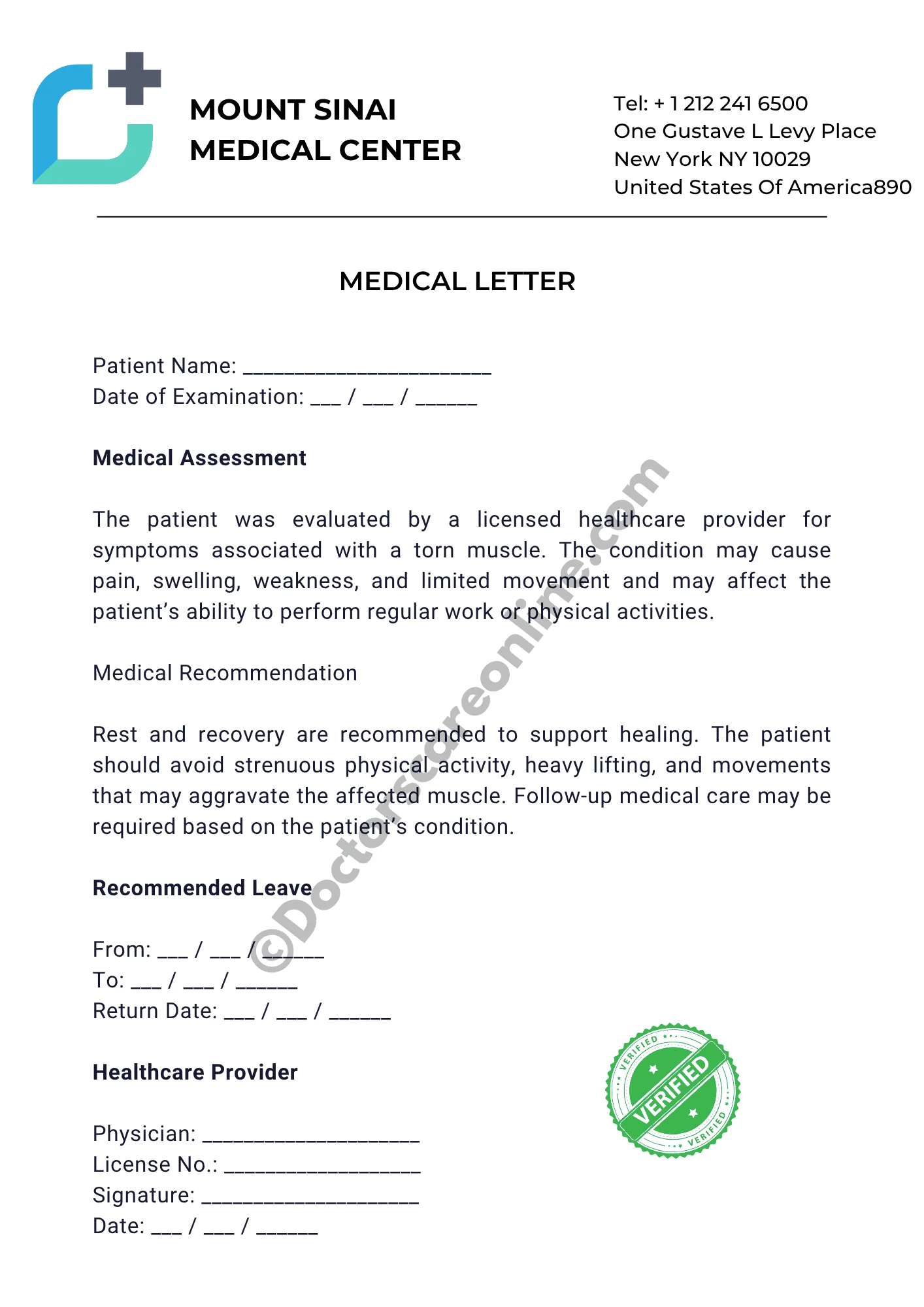
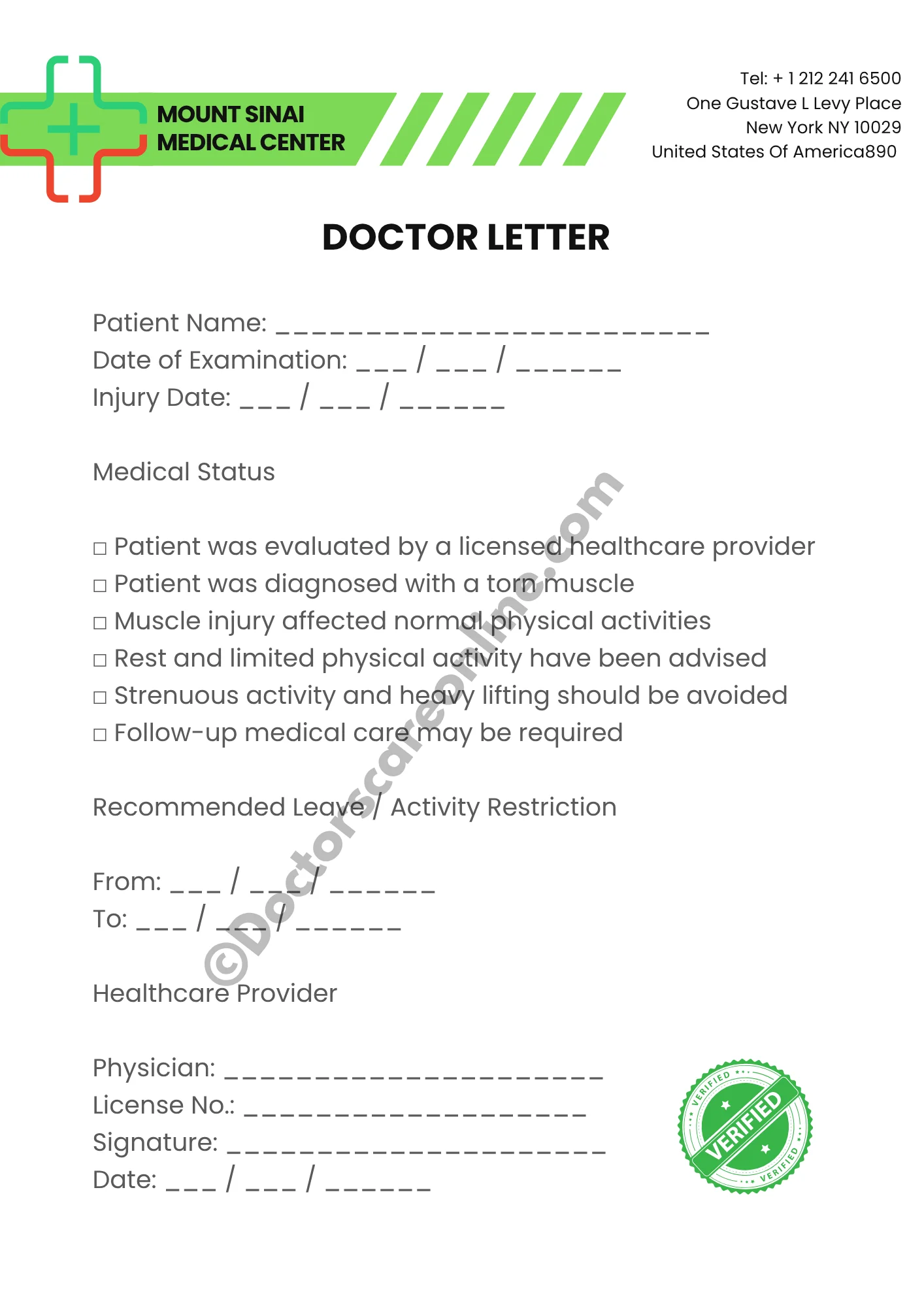
A doctor’s note for a torn muscle is medical documentation that a licensed healthcare provider may provide after evaluating a muscle injury. Depending on the severity of the injury and your ability to perform normal activities, the provider may recommend time away from work or school, temporary activity restrictions, modified duties, or a follow-up evaluation.
A torn muscle is generally considered a type of muscle strain, which can occur when a muscle or tendon is stretched beyond its normal capacity and becomes injured. Symptoms can include pain, swelling, bruising, muscle spasms, and difficulty moving the affected area.
If your injury is affecting your ability to work, attend school, exercise, or perform routine activities, an online medical appointment may provide a convenient way to discuss your symptoms with a healthcare provider. However, a doctor’s note is not automatically issued simply because it is requested. The healthcare provider determines whether medical documentation is appropriate after an evaluation.
Related Doctor Note : —–
Printable Doctor’s Note for a Torn Muscle Template
A doctor’s note for a torn muscle is written medical documentation that may confirm that you were evaluated by a healthcare professional and may describe medically appropriate restrictions or a recommended period away from normal activities.
Depending on your circumstances, the documentation may address:
- Date of medical evaluation
- Recommended time away from work or school
- Temporary physical restrictions
- Modified or light-duty work recommendations
- Restrictions on lifting, pushing, pulling, bending, or strenuous activity
- Recommended return-to-work or return-to-school date
- Follow-up recommendations
- Healthcare provider and clinic information
The information included depends on the provider’s clinical judgment and the requirements of the organization requesting the documentation.
What Does a Torn Muscle Feel Like?
A torn or significantly strained muscle may produce symptoms that interfere with normal movement and physical activity.
Common symptoms can include:
- Sudden or localized muscle pain
- Tenderness around the injured area
- Swelling
- Bruising or discoloration
- Muscle spasms
- Reduced strength
- Difficulty moving the affected muscle
- Pain that becomes worse when using the injured muscle
Symptoms vary according to the location and severity of the injury. A healthcare provider can determine whether further evaluation is necessary.
Common Causes of a Torn Muscle
Muscle injuries can happen during everyday activities, exercise, sports, or physically demanding work.
Common causes include:
- Heavy lifting: Sudden or excessive force can strain muscles.
- Sports injuries: Sprinting, jumping, changing direction, or contact sports can cause muscle injuries.
- Weight training: Lifting weights beyond the muscle’s current capacity may contribute to injury.
- Sudden movements: Rapid twisting or pulling can overstretch muscle tissue.
- Falls: A fall can cause muscles to stretch or contract suddenly.
- Overuse: Repetitive activity without adequate recovery can contribute to muscle strain.
- Poor warm-up: Starting intense physical activity without appropriate preparation may increase injury risk.
Muscle strains can develop suddenly or over time, and back and hamstring strains are among the commonly recognized types.
When Might You Need a Doctor’s Note for a Torn Muscle?
A medical note may be useful when your injury affects your ability to safely meet work, school, or other physical responsibilities.
You may need documentation if:
- Your job requires heavy lifting.
- You cannot stand or walk comfortably.
- Your work requires repetitive physical movements.
- You need temporary light-duty responsibilities.
- You need time away from work to recover.
- Your school requires documentation for an absence.
- Your injury prevents participation in physical education or sports.
- You need temporary restrictions after a medically evaluated injury.
- Your employer requests medical documentation.
The provider should determine whether leave or restrictions are medically appropriate rather than documentation being based solely on the patient’s request.
Torn Muscle Injuries That May Affect Work
The effect of a muscle injury often depends on both the injury and the physical demands of your job.
| Job Activity | Possible Functional Difficulty |
|---|---|
| Heavy lifting | Pain or reduced strength while lifting |
| Repetitive bending | Increased discomfort with repeated movement |
| Prolonged standing | Difficulty remaining upright for extended periods |
| Walking-intensive work | Increased pain with continued movement |
| Manual labor | Difficulty performing physically demanding tasks |
| Warehouse work | Problems with lifting, carrying, pushing, or pulling |
| Office work | Discomfort from prolonged sitting depending on injury location |
| Driving | Difficulty maintaining a comfortable position or controlling pedals, depending on the injury |
A healthcare provider can assess your individual limitations and determine whether temporary restrictions are appropriate.
Can a Doctor Recommend Work Restrictions for a Torn Muscle?
Yes. When clinically appropriate, a healthcare provider may recommend temporary restrictions based on your symptoms, physical limitations, occupation, and recovery needs.
Possible restrictions may include:
- Avoiding heavy lifting
- Limiting repetitive movements
- Avoiding strenuous exercise
- Reducing pushing or pulling activities
- Limiting prolonged standing
- Limiting activities that aggravate the injured muscle
- Temporary light-duty assignments
- Gradual return to normal physical activity
The exact restrictions and their duration should come from the healthcare provider’s assessment.
How Is a Torn Muscle Evaluated?
A healthcare provider may begin by asking about how the injury happened, when symptoms started, and how the injury affects movement.
The evaluation may include:
- Medical history: Discussing the injury mechanism and previous injuries.
- Symptom review: Identifying pain, swelling, bruising, weakness, and movement problems.
- Physical examination: Checking the affected area and functional movement.
- Strength assessment: Evaluating muscle function where appropriate.
- Range-of-motion assessment: Determining whether movement is limited.
- Additional testing: Imaging or other evaluation may be recommended when clinically necessary.
Not every muscle injury requires imaging. The appropriate evaluation depends on the individual’s symptoms and clinical circumstances.
Torn Muscle vs. Muscle Strain: What Is the Difference?
The terms torn muscle, pulled muscle, and muscle strain are often used to describe related injuries involving muscle or tendon tissue.
A strain occurs when a muscle or tendon is stretched or torn. The severity can vary considerably, from relatively minor tissue injury to a more significant tear.
Because symptoms alone cannot always establish the severity of an injury, a healthcare provider should evaluate significant pain, weakness, swelling, bruising, or movement limitations.
What Should You Tell the Online Doctor?
Before your online appointment, prepare information that can help the healthcare provider understand your injury.
Be ready to explain:
- Where the injury occurred
- When the injury happened
- What you were doing when it occurred
- Whether you heard or felt a pop
- How severe the pain is
- Whether swelling or bruising developed
- Whether you can move the affected area normally
- Whether you have weakness
- Whether the symptoms are improving or getting worse
- What treatment you have already tried
- Whether the injury affects your job or school responsibilities
- What type of medical documentation you need
Providing accurate information helps the provider determine whether your symptoms can be appropriately evaluated through telehealth.
How to Book an Online Doctor Appointment for a Torn Muscle
If online medical appointments are available for your location and condition, the process can generally be completed in several steps.
- Access the appointment page: Select the online medical consultation option.
- Create an account or log in: Enter the requested account information.
- Choose an available appointment: Select a suitable date and time.
- Complete the intake information: Provide relevant personal and medical details.
- Describe your muscle injury: Explain the injury, symptoms, timing, and functional limitations.
- Complete payment: Follow the available payment instructions if a consultation fee applies.
- Attend the appointment: Join the consultation at the scheduled time.
- Follow the provider’s recommendations: The provider may recommend treatment, additional evaluation, activity modification, or in-person care.
- Receive documentation if medically appropriate: If the provider determines that a doctor’s note is warranted, documentation may be provided according to applicable requirements.
Telehealth availability and requirements can vary by location and clinical situation.
What Makes Our Online Doctor Appointment Service Useful?
For users looking for medical evaluation without unnecessarily complicated steps, our online appointment service is designed to provide a convenient way to connect with a healthcare provider.
- Convenient Online Access: You can start the appointment process online instead of arranging an in-person visit solely to discuss a potentially straightforward concern.
- Medical Evaluation Comes First: The purpose of the appointment is to allow a healthcare provider to evaluate your reported symptoms and determine an appropriate course of action. A doctor’s note is provided only when the provider considers it medically appropriate.
- Clear Appointment Process: The online process allows you to provide relevant information about your injury before speaking with the healthcare provider, helping make the consultation more organized.
- Support When You Need It: If you experience an issue with registration, login, payment, appointment steps, or another website-related question, you can use the chatbox on our website to ask for assistance.
Our support team can help with website and process-related questions, while medical questions and clinical decisions should be addressed with the healthcare provider.
Why Users Can Feel More Confident Using Our Service
Choosing an online healthcare service involves more than simply finding an appointment. Users should understand who provides the medical evaluation, what the service includes, and what happens after the consultation.
Our approach focuses on:
- Connecting users with healthcare professionals for medical evaluation
- Clearly separating customer support from clinical decision-making
- Providing an appointment process that is easy to understand
- Allowing users to explain their symptoms and functional limitations
- Making documentation dependent on the provider’s medical assessment
- Giving users access to support for registration, login, payment, and technical questions
- Encouraging users to seek in-person or emergency care when online evaluation is not appropriate
For telehealth generally, U.S. Department of Health and Human Services guidance emphasizes privacy and security when health information is exchanged online. Users should also review the specific privacy practices and terms of the service they choose.
How Long Can You Be Excused From Work for a Torn Muscle?
There is no universal number of days that applies to every muscle injury.
The appropriate recovery or work-restriction period may depend on:
- Location of the injury
- Severity of the muscle injury
- Pain and swelling
- Muscle strength and movement
- Type of work performed
- Physical demands of the job
- Response to treatment
- Follow-up findings
- Healthcare provider’s clinical judgment
A healthcare provider may recommend a specific period of leave or restrictions when medically justified and may reassess the patient if symptoms continue.
How to Care for a Muscle Strain During Recovery
Treatment depends on the nature and severity of the injury. For many strains, initial care can include resting the affected muscle and using ice appropriately. As symptoms improve, gradual movement and rehabilitation may be recommended.
General recovery measures may include:
- Resting the injured muscle from activities that increase pain
- Applying ice appropriately during the early period after an injury
- Gradually returning to movement as symptoms improve
- Following the healthcare provider’s treatment instructions
- Using medication only as directed or recommended
- Completing physical therapy when prescribed
- Avoiding a premature return to strenuous activity
Do not use general recovery advice as a substitute for an individualized medical evaluation.
When Should a Torn Muscle Receive Urgent Medical Attention?
Some muscle injuries require prompt medical assessment rather than routine online care.
Seek urgent medical attention if you experience:
- Inability to move the affected limb or muscle
- Severe or rapidly increasing swelling
- Significant weakness
- Severe pain following major trauma
- A serious wound or bleeding
- Rapidly worsening symptoms
- Symptoms suggesting another serious injury or medical condition
MedlinePlus advises seeking medical help for substantial swelling, worsening swelling, or inability to move the affected area.
If you believe you have a medical emergency, call 911 or go to the nearest emergency department rather than waiting for an online appointment.
What Happens After Your Online Appointment?
After your consultation, the healthcare provider may recommend different next steps depending on the assessment.
You may be advised to:
- Continue home care
- Modify physical activity
- Avoid specific movements
- Use prescribed or recommended treatment
- Schedule follow-up care
- Visit an in-person healthcare facility
- Obtain additional testing
- Return to work with appropriate restrictions
- Remain away from work or school for a medically determined period
If your symptoms change significantly after the consultation, contact a healthcare professional for further evaluation.
Medical Documentation for Work or School
Employers, schools, colleges, sports programs, and other organizations may have different requirements for medical documentation.
Before submitting a doctor’s note, check whether the organization specifies:
- Required documentation format
- Dates that must be included
- Return-to-work or return-to-school requirements
- Work restrictions or activity limitations
- Whether electronic documentation is accepted
- Whether additional verification is required
A healthcare provider determines what medical information is appropriate to include. Do not modify a medical document after it has been issued.
Protecting Your Privacy During an Online Appointment
When discussing a muscle injury through telehealth, choose a private environment where other people cannot overhear your medical information.
Helpful privacy practices include:
- Use a private room whenever possible.
- Avoid discussing sensitive health information over public Wi-Fi.
- Use a secure device.
- Keep your account credentials private.
- Review the platform’s privacy policies.
- Confirm that you are communicating with the intended healthcare provider.
HHS guidance recommends taking reasonable steps to protect health information during telehealth, including using a private location and secure technology.
Frequently Asked Questions
1. Can I get a doctor’s note for a torn muscle without an in-person visit?
Depending on your location and symptoms, a healthcare provider may be able to evaluate certain muscle injuries through telehealth. The provider decides whether an online assessment is sufficient and whether medical documentation is appropriate.
2. Can a torn muscle qualify for short-term disability?
It can depend on the severity of the injury, how long it affects your ability to work, your occupation, your insurance or benefits plan, and the applicable requirements. A healthcare provider can document medically supported functional limitations when appropriate.
3. Can I get a doctor’s note for a torn muscle after a sports injury?
A healthcare provider can evaluate symptoms following a sports injury and determine whether treatment, activity restrictions, time away from activities, or medical documentation is appropriate.
4. Can a torn muscle keep me from working?
Yes, depending on the location and severity of the injury and the physical demands of your job. A healthcare provider can assess your functional limitations and determine whether temporary leave or modified duties are medically appropriate.
5. Can I use a doctor’s note for a torn muscle to cancel a gym membership?
Whether medical documentation can be used to cancel, freeze, or modify a gym membership depends on the gym’s contract and policies. A healthcare provider may provide appropriate medical documentation when clinically justified, but the gym determines whether that documentation satisfies its membership requirements.
Medical Disclaimer: This content is provided for general educational and informational purposes only. It does not replace professional medical advice, diagnosis, or treatment. A torn muscle or other muscle injury should be evaluated by a qualified healthcare professional when symptoms are significant, persistent, worsening, or affecting normal function.




Reviews
There are no reviews yet.