
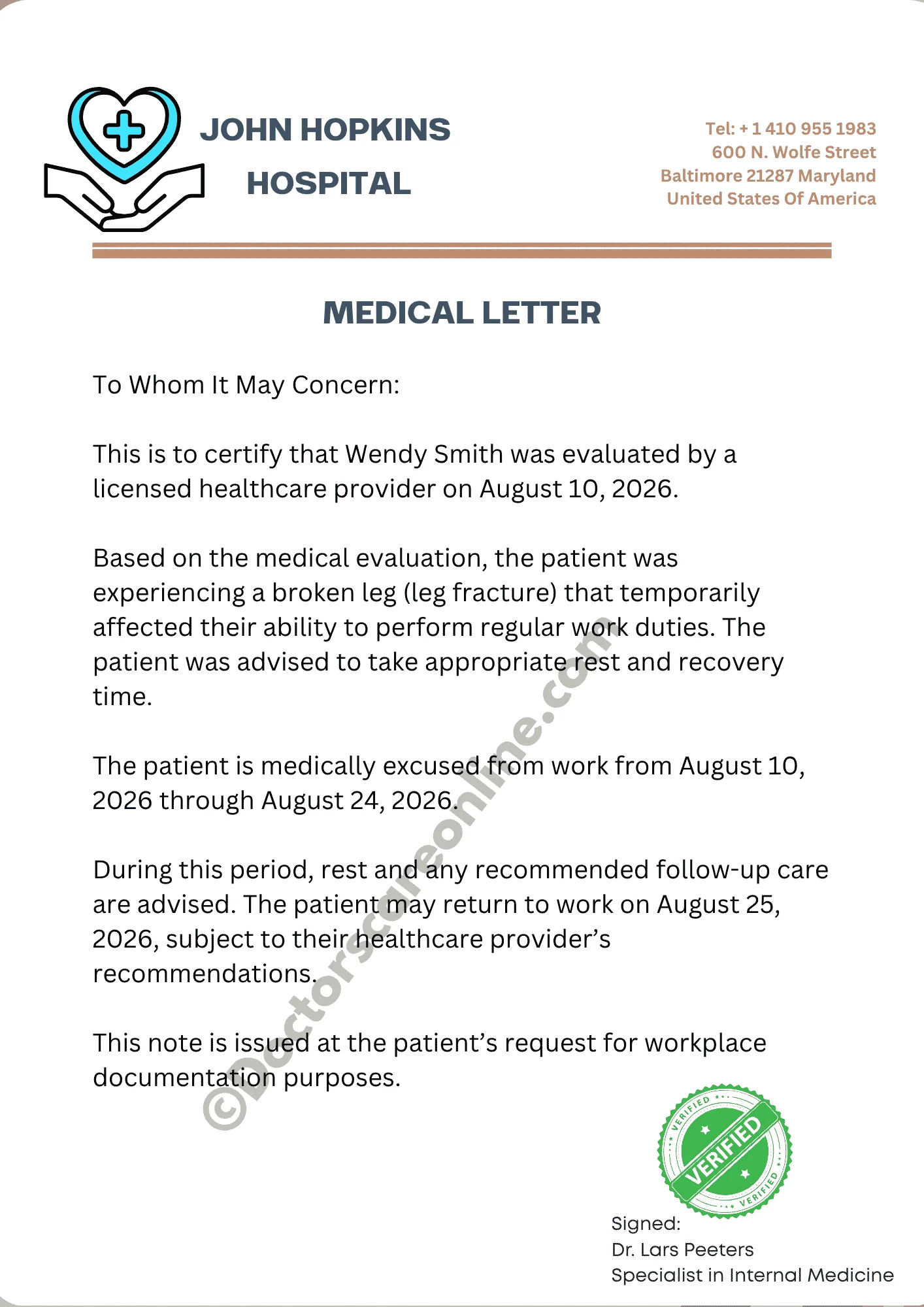
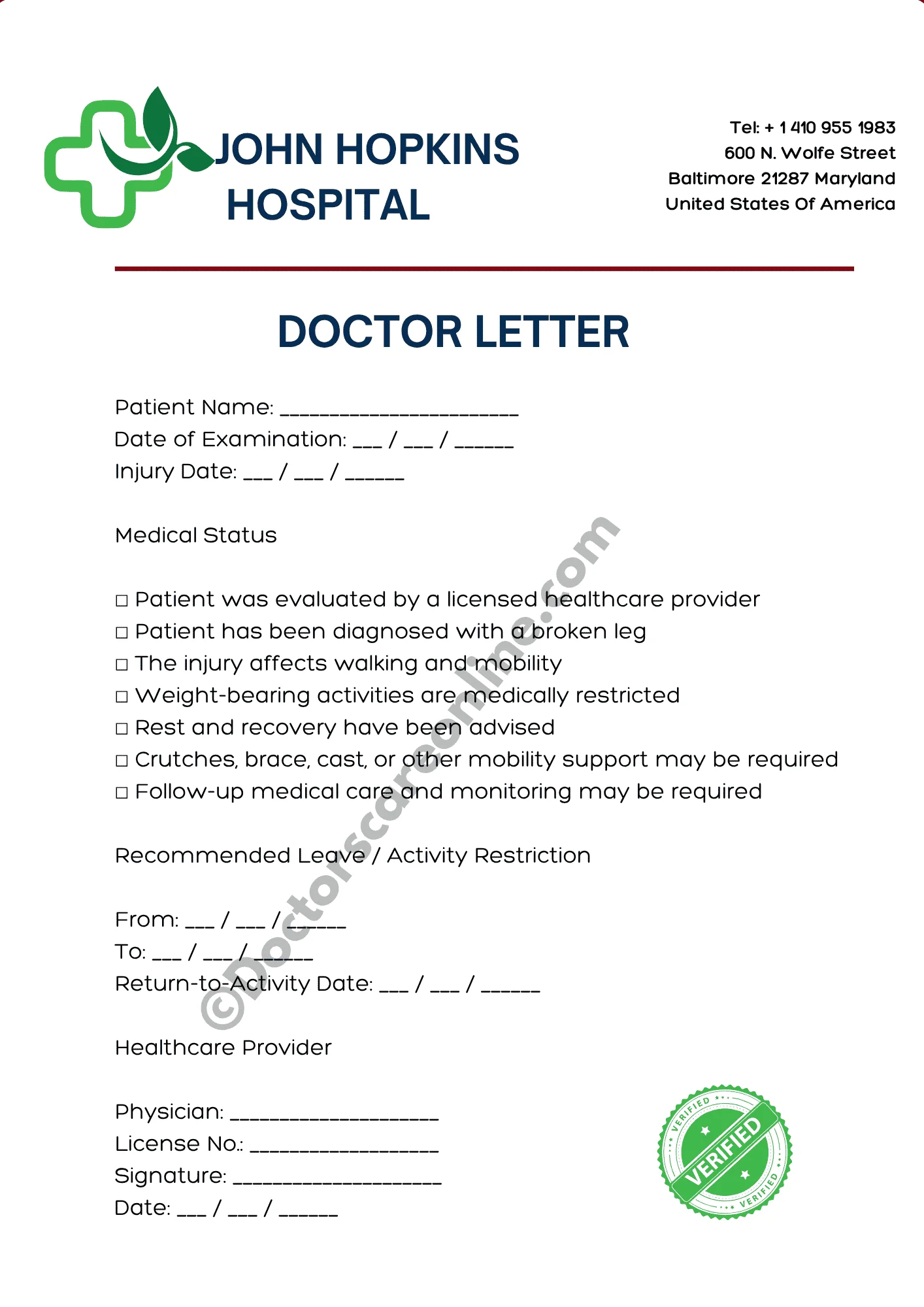
A doctor’s note for a broken leg is medical documentation issued by a licensed healthcare provider after evaluating an injury. It may confirm that the patient was medically assessed and may recommend time away from work or school, temporary activity restrictions, modified duties, or a specific follow-up period.
A broken leg can significantly affect mobility, balance, standing, walking, driving, lifting, and other everyday activities. Depending on the location and severity of the fracture, recovery may involve immobilization, crutches, a walking boot, physical therapy, or additional orthopedic care.
Related Doctor Note :—
You can also visit:
- Doctors Note for Kidney Stones
- Doctors Note for Medication on Flight
- Doctor’s Note for Work From Home
- Unlimited Doctor’s Notes for 1 Year
When You May Need a Doctor’s Note for a Broken Leg
A broken leg can make normal responsibilities difficult or unsafe, particularly when your work or education requires physical activity. Medical documentation may be appropriate when you need to explain an absence or communicate temporary restrictions.
Common situations include:
- Taking time away from work after a leg fracture
- Missing school or college because of limited mobility
- Requesting temporary modified or light-duty work
- Avoiding prolonged standing or walking
- Restricting climbing, lifting, bending, or other physical tasks
- Recovering after fracture treatment or surgery
- Attending follow-up orthopedic appointments
- Requesting reasonable workplace accommodations when applicable
- Documenting medically recommended restrictions for an employer or educational institution
The specific documentation you need depends on the organization requesting it and the healthcare provider’s assessment.
Common Types of Broken Leg Injuries
“Broken leg” can refer to several different fractures. The affected bone, fracture pattern, severity, and treatment can influence mobility and recovery.
Tibia Fracture
A tibia fracture involves the shinbone, which is one of the major weight-bearing bones in the lower leg. Depending on the injury, walking may be restricted during recovery.
Fibula Fracture
The fibula is the smaller bone running alongside the tibia. Some fibula fractures can be treated without surgery, while more complicated injuries may require additional orthopedic care.
Femur Fracture
A femur fracture affects the thighbone and is generally a serious injury requiring prompt medical assessment. Treatment and rehabilitation depend on the location and severity of the fracture.
Ankle Fracture
An ankle fracture can affect mobility and may make standing or walking difficult. Treatment can range from immobilization to surgical repair depending on the injury.
Stress Fracture
A stress fracture is a small crack in a bone that can develop through repetitive stress or overuse. Continued activity can worsen the injury, so medical assessment is important.
Symptoms That Can Occur With a Leg Fracture
Possible symptoms of a broken leg include:
- Significant pain after an injury
- Swelling around the affected area
- Bruising or discoloration
- Difficulty putting weight on the leg
- Difficulty walking
- Tenderness around the injured bone
- Reduced range of motion
- Visible deformity
- A shortened or unusual appearance of the limb
- Pain that increases with movement
Not every fracture produces the same symptoms. Some fractures may be difficult to identify without appropriate medical evaluation and imaging.
How a Broken Leg Is Diagnosed
A healthcare provider may assess the injury by reviewing how it happened, examining the affected leg, checking movement and circulation, and evaluating pain and swelling.
Depending on the circumstances, diagnostic imaging may include:
- X-ray
- CT scan
- MRI in selected cases
The provider may also assess whether there is damage to surrounding tissue, nerves, or blood vessels.
A suspected fracture should not be self-diagnosed based solely on symptoms.
Treatment for a Broken Leg
Treatment depends on the type, location, alignment, and severity of the fracture.
Possible treatment approaches include:
- Immobilization with a cast or splint
- Walking boot
- Crutches or another mobility aid
- Activity modification
- Pain management as recommended by a healthcare professional
- Physical therapy during rehabilitation
- Follow-up imaging
- Orthopedic treatment
- Surgical repair when medically necessary
Your healthcare provider determines the appropriate treatment based on your individual injury.
How a Broken Leg Can Affect Work
The effect of a leg fracture depends heavily on your occupation.
Someone with a desk-based job may have different restrictions from someone whose work involves construction, warehouse duties, healthcare, delivery driving, retail, or prolonged standing.
Possible temporary limitations may include:
- No prolonged standing
- Limited walking
- No climbing stairs or ladders
- No heavy lifting
- No operating certain equipment
- Use of crutches or other mobility aids
- Modified work duties
- Reduced physical activity
- Temporary remote work when appropriate and available
A healthcare provider should determine restrictions based on the patient’s condition and functional abilities.
For eligible employees covered by the U.S. Family and Medical Leave Act, an employer may request medical certification supporting the need for qualifying leave. FMLA certification can address information such as the condition’s duration, relevant medical facts, and whether the employee is unable to perform essential job functions.
Broken Leg and School or College Absence
Students recovering from a leg fracture may have difficulty attending classes, navigating campus, participating in physical activities, or completing certain academic requirements.
Depending on the circumstances, medical documentation may support requests for:
- Excused absence
- Temporary academic accommodations
- Additional time for certain activities
- Modified physical education requirements
- Assistance with mobility
- Adjustments related to attendance
Schools and colleges establish their own documentation requirements, so students should check the institution’s policy.
What a Doctor’s Note for a Broken Leg May Include
The content depends on the healthcare provider and the purpose of the documentation.
A medical note may include:
- Patient identification
- Date of medical evaluation
- Healthcare provider information
- Confirmation of medical evaluation
- Recommended absence period, when medically appropriate
- Functional or activity restrictions
- Expected return-to-work or return-to-school date, when appropriate
- Follow-up recommendations
- Healthcare provider’s signature or authentication
The information included should be medically appropriate and consistent with the provider’s professional assessment.
For FMLA purposes, the U.S. Department of Labor states that an employer may require sufficient medical certification but does not generally require an employee to provide their entire medical record.
How Long Can You Be Excused From Work for a Broken Leg?
There is no universal number of days that applies to every broken leg.
The appropriate period depends on factors such as:
- Type and location of the fracture
- Severity of the injury
- Treatment received
- Ability to walk or bear weight
- Type of job performed
- Progress during recovery
- Need for surgery or rehabilitation
- Healthcare provider’s clinical assessment
A provider may recommend a specific period of leave and reassess the patient’s ability to resume normal or modified duties during follow-up care.
Returning to Work After a Broken Leg
Returning to work should be based on your recovery and the recommendations of your healthcare provider.
Depending on your job, you may initially need modified duties before returning to your normal responsibilities.
Before resuming work, consider whether you can safely:
- Walk or stand as required
- Travel to and from work
- Use stairs if necessary
- Perform required physical tasks
- Operate workplace equipment
- Lift objects within your permitted limits
- Maintain safe mobility throughout your shift
If your duties exceed your current abilities, discuss possible temporary modifications with your healthcare provider and employer.
When a Broken Leg Requires Urgent Medical Care
A suspected or confirmed fracture may require urgent evaluation, particularly after significant trauma.
Seek immediate medical attention if you experience:
- A leg that appears severely deformed
- Bone visible through the skin
- Severe or rapidly increasing pain
- Significant swelling after an injury
- Numbness or loss of sensation
- A cold, pale, or blue foot
- Inability to move the affected limb
- Heavy bleeding
- Severe injury following a major accident
These symptoms can indicate complications requiring prompt medical treatment.
How to Prepare for an Online Broken Leg Consultation
If you are considering a telehealth appointment, prepare relevant information before speaking with a healthcare provider.
Have the following details available:
- When and how the injury happened
- Where the pain is located
- Whether you can put weight on the leg
- Current swelling or bruising
- Any imaging or previous medical records you have
- Treatment already received
- Medications currently being used
- Your work or school responsibilities
- Any restrictions already provided by another healthcare professional
- The type of documentation your employer or school has requested
A healthcare provider will determine whether your injury can be appropriately assessed through telehealth or whether an in-person examination or additional testing is necessary.
How to Book an Online Appointment for a Broken Leg
If online medical appointments are available in your location, the process generally involves:
- Select an available provider: Choose an appropriate licensed healthcare professional.
- Create or access your account: Enter the information required by the healthcare platform.
- Choose an appointment: Select an available date and time.
- Explain the injury: Provide accurate information about the fracture or suspected fracture.
- Complete the consultation: Discuss your symptoms, treatment history, and functional limitations.
- Follow the provider’s recommendations: The provider may recommend additional care or an in-person evaluation.
- Receive documentation if medically appropriate: If the provider determines that a medical note is justified, documentation may be issued according to applicable requirements.
A doctor’s note is not guaranteed simply because it is requested. Medical documentation should be based on an appropriate healthcare evaluation.
Why Choose Our Online Medical Service?
Our service is designed to make the process of connecting with healthcare support more convenient when an online consultation is appropriate.
Convenient Online Access
You can request an appointment online without needing to coordinate an in-person visit solely to begin the consultation process.
Licensed Healthcare Evaluation
Medical documentation should come from an appropriately licensed healthcare professional following an evaluation. The provider—not the website—determines whether a doctor’s note or restrictions are medically appropriate.
Clear Documentation Process
We help users understand the appointment and documentation process so they know what information may be required and what to expect.
Privacy-Conscious Experience
Health information is sensitive. U.S. HIPAA-covered healthcare providers and related entities have obligations concerning protected health information, including safeguards for privacy and security. Users should also review the specific privacy practices of the service they use.
Support When You Need It
If you have a question about registration, login, payment, appointment scheduling, documentation, or another website-related issue, you can contact our chatbox support for assistance. Our support team can help with account and service questions and guide you through the available process.
Important: Customer support can help with website, account, and service-related questions, but medical decisions—including whether documentation should be issued—are made by the healthcare provider.
What Makes Medical Documentation Trustworthy?
A legitimate medical document should accurately reflect an evaluation performed by an appropriately licensed healthcare professional.
Users should look for documentation that:
- Identifies the healthcare provider
- Includes relevant dates
- Clearly states medically appropriate recommendations
- Contains provider authentication or signature where applicable
- Does not contain altered or fabricated information
- Matches the patient’s actual medical evaluation
Patients should never alter, fabricate, or misrepresent medical documentation.
For covered healthcare providers, HIPAA provides privacy protections and gives individuals certain rights regarding their health information and medical records.
Broken Leg Doctor’s Note: Important Things to Know
Before submitting medical documentation, check the requirements of the organization requesting it.
Your employer, school, insurer, or another organization may have its own procedures concerning:
- Acceptable documentation formats
- Submission deadlines
- Required provider information
- Leave or accommodation procedures
- Return-to-work requirements
- Additional certification forms
For example, FMLA-covered situations can involve specific certification requirements, and employers may have procedures for obtaining and submitting that documentation.
Always follow the applicable policy rather than assuming that every organization uses the same requirements.
5 Frequently Asked Questions
1. Can a broken leg qualify for FMLA leave?
A broken leg may qualify for FMLA protection when the applicable eligibility, employer-coverage, and serious-health-condition requirements are met. FMLA eligibility is not automatic for every injury or employee.
2. Can I use a doctor’s note to request workplace accommodations?
Medical documentation may support a request for workplace accommodations, but whether an accommodation is available depends on the circumstances, applicable law, the employer, and the employee’s situation.
3. Can I use an urgent care visit as medical documentation?
An urgent care provider may provide documentation after evaluating your injury, if medically appropriate. The document should accurately reflect the care provided and any recommendations made by the healthcare professional.
4. Can I drive with a broken leg?
Whether you can safely drive depends on the injured leg, vehicle type, mobility limitations, medications, and healthcare provider’s advice. Do not drive if you cannot safely control the vehicle.
5. Can I get medical documentation if my broken leg was treated at another facility?
You may be able to obtain documentation from another healthcare provider after an appropriate evaluation, but the provider decides what documentation they can ethically and medically issue based on the information available to them.
Medical Disclaimer
This information is provided for general educational purposes and is not a substitute for professional medical advice, diagnosis, or treatment. A doctor’s note should only be issued by an appropriately licensed healthcare professional following an appropriate medical evaluation. Availability of telehealth services, medical documentation, workplace leave, accommodations, and other requirements can vary by state, employer, school, insurance plan, and individual circumstances.
If you have a suspected broken leg, severe pain, significant deformity, heavy bleeding, numbness, loss of circulation, or another serious symptom, seek appropriate urgent or emergency medical care rather than relying on an online information page.


Reviews
There are no reviews yet.