

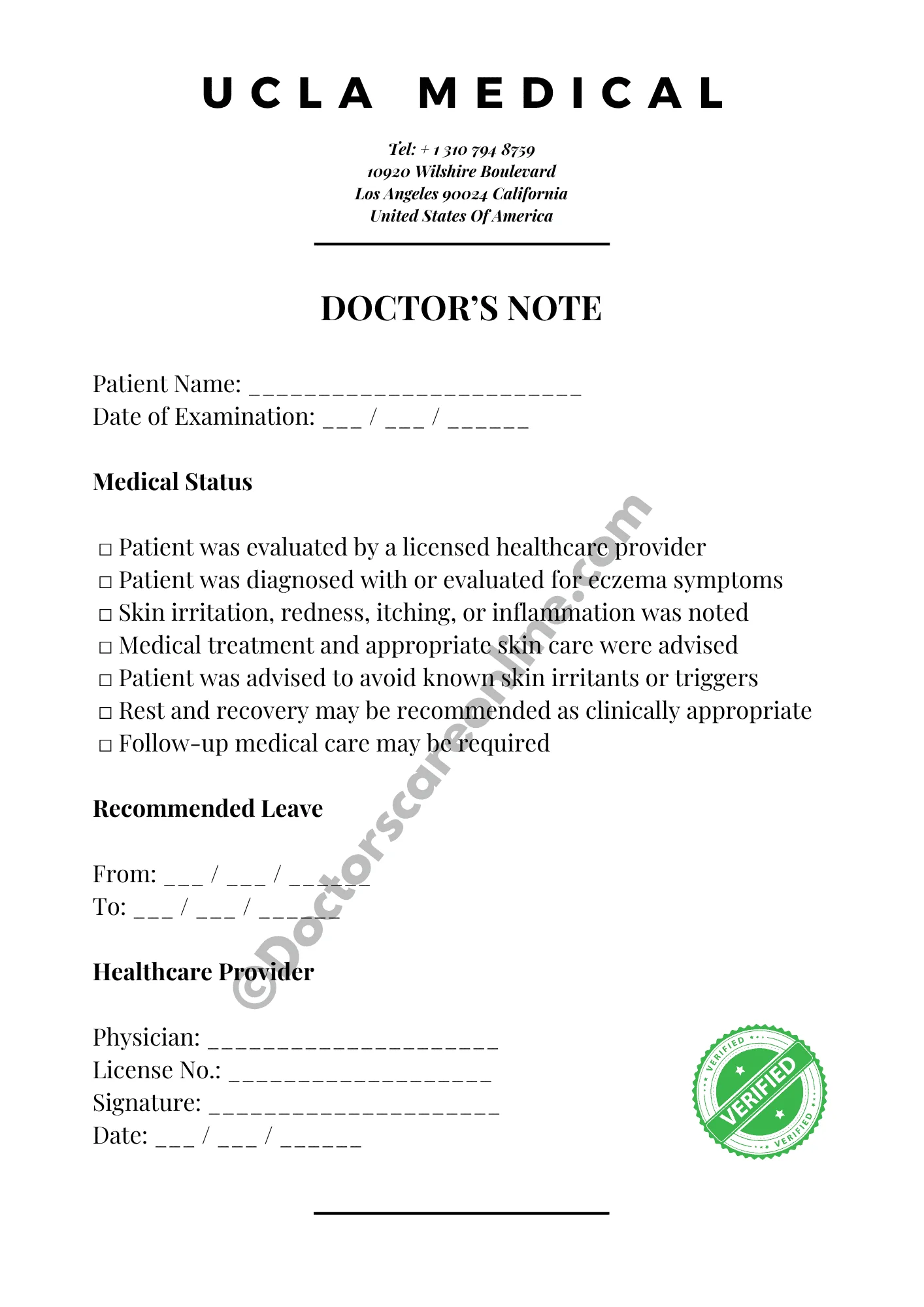
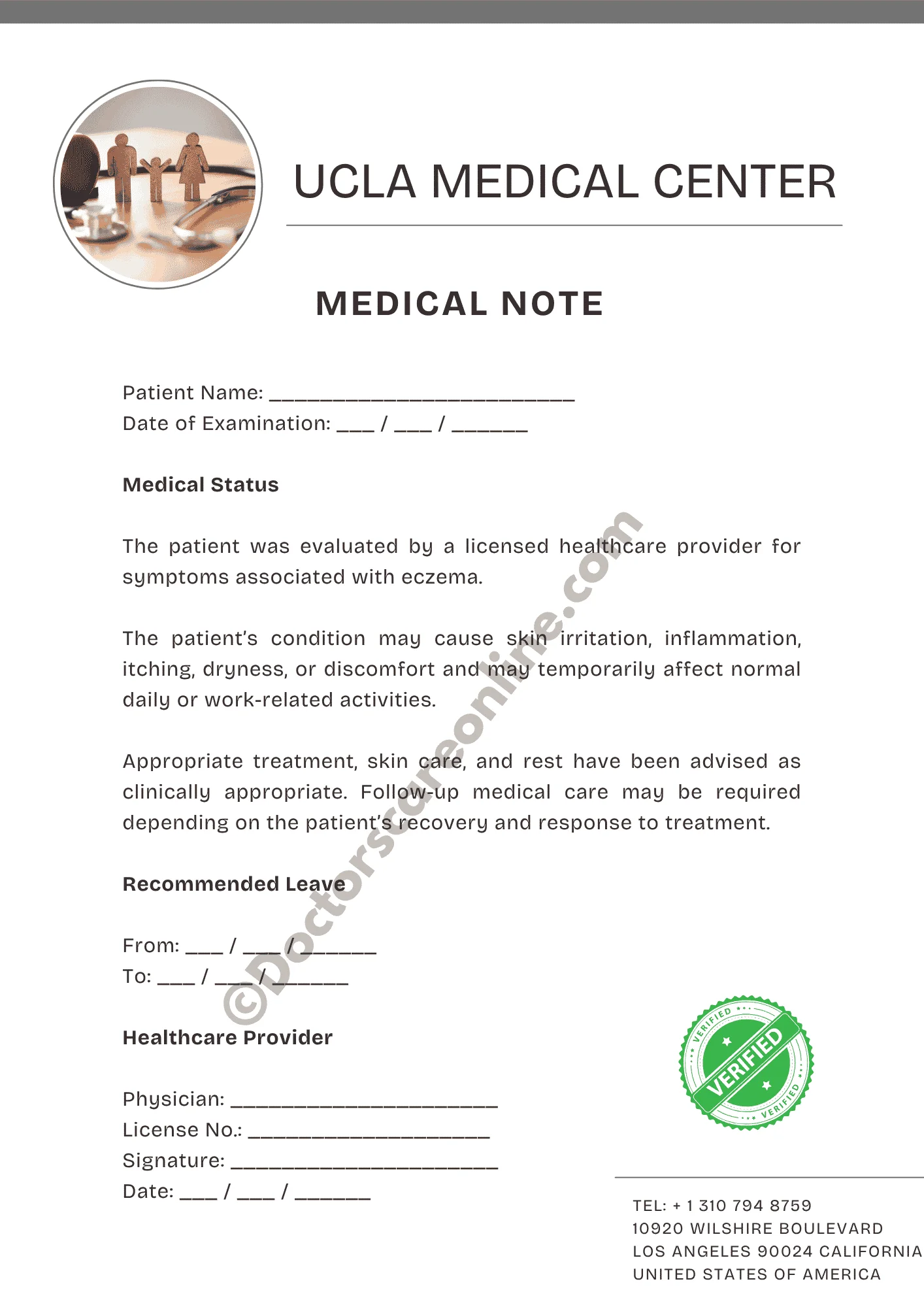
A doctor’s note for eczema is medical documentation that may be provided by a licensed healthcare professional after an appropriate evaluation. Depending on the individual situation, the documentation may confirm that the patient was medically evaluated and may recommend time away from work or school, temporary activity limitations, or other medically appropriate accommodations.
Our online doctor appointment service provides a convenient way to connect with a healthcare professional remotely where telehealth is available and appropriate. During an appointment, you can describe your symptoms, discuss how eczema is affecting your daily activities, and ask whether medical documentation may be appropriate for your circumstances.
Related Doctor Note :——
You can also visit:
- Doctors Note for Allergies
- Doctors Note for Limited Work
- Doctor’s Note for Work From Home
- Unlimited Doctor’s Notes for 1 Year
Situations Where an Doctor’s Note for Eczema May Be Requested
A person may seek medical documentation for different practical reasons, including:
- Work absence
- Severe symptoms may temporarily interfere with normal job responsibilities.
- School or college absence
- A significant flare-up may make attending classes or completing coursework difficult.
- Workplace accommodations
- Certain jobs may expose the skin to irritants, water, heat, chemicals, gloves, or repeated friction.
- Temporary duty modifications
- A healthcare professional may recommend limiting activities that aggravate symptoms.
- Follow-up care
- Ongoing eczema may require continued medical management and reassessment.
- Documentation of medical evaluation
- An employer, school, or other organization may request confirmation that a healthcare professional evaluated the condition.
Understanding Eczema and Atopic Dermatitis
Eczema describes a group of conditions that can cause itchy, dry, irritated, or inflamed skin. Atopic dermatitis is the most common type of eczema. Other forms include contact dermatitis, dyshidrotic eczema, nummular eczema, hand eczema, neurodermatitis, and stasis dermatitis.
Common symptoms may include:
- Intense itching
- Dry or scaly skin
- Irritated or inflamed areas
- Skin discoloration
- Rough or thickened skin
- Cracking
- Scratching-related irritation
- Oozing or crusting in some cases
- Recurrent flare-ups
Symptoms can vary considerably from person to person and may appear on different parts of the body.
When Eczema May Interfere With Work or School
Eczema does not affect everyone in the same way. A mild flare may be manageable while continuing normal activities, whereas more significant symptoms may make work, school, or other responsibilities difficult.
Medical documentation may become relevant when symptoms affect your ability to:
- Concentrate because of persistent itching or discomfort
- Sleep adequately before work or school
- Wear required uniforms or protective equipment
- Perform duties involving frequent handwashing or chemical exposure
- Work in environments that aggravate skin symptoms
- Attend classes or complete academic responsibilities
- Perform physically demanding activities
- Maintain normal daily activities during a significant flare
Whether time off or modified activities are medically appropriate should be determined by a healthcare professional after evaluating the individual’s condition.
Common Eczema Triggers That May Affect Daily Activities
Eczema triggers are not identical for everyone. Identifying personal triggers can be useful when discussing symptoms with a healthcare professional.
Potential triggers or aggravating factors can include:
- Fragrances and perfumes
- Harsh soaps or cleansers
- Certain skin-care ingredients
- Detergents
- Wool or irritating fabrics
- Hot weather
- Cold or dry weather
- Sweating
- Stress
- Repeated exposure to water
- Workplace irritants
The American Academy of Dermatology recommends individualized trigger management because different people can have different factors that worsen atopic dermatitis.
How an Online Doctor Appointment for Eczema Works
Telehealth can allow patients to discuss skin concerns with a healthcare professional without traveling to a clinic when remote evaluation is appropriate. Dermatology telemedicine may involve video consultation, telephone communication, or securely sharing photographs and descriptions of the affected skin.
Step-by-Step Online Appointment Process
- Choose an available appointment
- Select a suitable date and time through the online booking system.
- Create or access your account
- Enter the required information to register or sign in.
- Provide your basic information
- Complete the requested patient and contact details.
- Describe your eczema symptoms
- Explain when the symptoms started, where they appear, and how they affect you.
- Provide relevant medical information
- Mention previous diagnoses, treatments, medications, allergies, and known triggers when applicable.
- Attend the consultation
- Speak with the healthcare professional through the available telehealth method.
- Discuss your documentation needs
- If you need documentation for work, school, or another legitimate purpose, explain the requirement during the consultation.
- Follow the provider’s decision
- If the healthcare professional determines that documentation is medically appropriate, they may provide it according to applicable requirements and professional judgment.
An online appointment does not guarantee that a doctor’s note will be issued. The healthcare professional must determine whether documentation is appropriate after evaluating the patient’s circumstances.
What to Prepare Before Your Online Eczema Appointment
Having relevant information available can make your consultation more productive.
Prepare These Details
- When your current flare started
- Areas of the body affected
- How severe the itching or irritation is
- Whether symptoms are improving or worsening
- Previous eczema or skin-condition diagnoses
- Current and recently used medications
- Skin-care products you use
- Known allergies or sensitivities
- Possible triggers
- Previous treatments and their results
- Whether symptoms are interfering with work or school
- Any workplace or school documentation requirements
Consider Taking Clear Photos
If the healthcare professional requests photographs, take clear images in good lighting and show the affected areas from useful angles. Photos can provide additional information during remote consultations, although they do not replace an in-person examination when one is necessary.
Can Eczema Be Evaluated Through Telehealth?
Some eczema concerns can be evaluated through telehealth, particularly when the affected skin can be adequately described or viewed through an appropriate remote-care method. However, telehealth is not suitable for every skin problem or every patient.
A healthcare professional may recommend an in-person visit when:
- The diagnosis is uncertain
- The appearance of the rash requires closer examination
- A skin infection is suspected
- Additional testing may be necessary
- The symptoms are severe or rapidly changing
- The condition cannot be adequately assessed remotely
The American Academy of Dermatology recognizes telemedicine as an option for certain skin concerns while emphasizing appropriate evaluation and preparation.
What Information May Be Included in an Eczema Doctor’s Note?
The contents depend on the medical assessment and the purpose of the documentation.
| Possible Information | Purpose |
|---|---|
| Patient name | Identifies the individual |
| Date of evaluation | Documents when medical care occurred |
| Provider information | Identifies the healthcare professional or practice |
| Medical confirmation | Confirms that an evaluation took place |
| Recommended absence | Documents medically recommended time away, when applicable |
| Activity restrictions | Identifies temporary limitations, if medically necessary |
| Return date | Provides a recommended return date when appropriate |
| Follow-up recommendation | Indicates whether additional evaluation may be needed |
A healthcare provider may not need to disclose every detail of a patient’s medical condition. The appropriate content can depend on the documentation requirements and applicable privacy rules.
Eczema and Workplace Restrictions
Certain work environments can make eczema symptoms more difficult to manage. For example, repeated handwashing, frequent contact with cleaning products, prolonged glove use, heat, sweating, or exposure to irritants may aggravate symptoms in some individuals.
Depending on the medical assessment and job requirements, a healthcare professional may consider recommendations such as:
- Temporarily reducing exposure to identified irritants
- Using appropriate protective measures
- Modifying tasks involving repeated skin exposure
- Allowing appropriate skin-care breaks
- Temporarily changing certain duties
- Taking medically recommended time away from work
Any restriction should be individualized rather than assumed to apply to every person with eczema.
How Eczema May Affect Quality of Life
Eczema can affect more than the appearance of the skin. Persistent itching and discomfort may interfere with sleep, concentration, daily routines, and work or school responsibilities.
Severe atopic dermatitis can also have a meaningful impact on quality of life, including difficulty sleeping and maintaining normal activities.
If eczema symptoms are repeatedly interfering with your normal routine, discussing the problem with a healthcare professional can help identify appropriate next steps.
Eczema Skin Care While Waiting for Medical Care
General skin-care measures may help support the skin barrier, although they should not replace individualized medical advice.
Dermatologists commonly recommend:
- Moisturizing regularly
- Choosing fragrance-free creams or ointments
- Using gentle skin-care products
- Avoiding known personal triggers
- Taking short, comfortable baths or showers
- Avoiding excessive heat
- Wearing fabrics that do not irritate your skin
- Following your prescribed treatment plan
The American Academy of Dermatology specifically recommends regular moisturization and fragrance-free products as part of eczema-friendly skin care.
When Eczema May Need Prompt Medical Evaluation
Eczema can sometimes become complicated by infection or another skin condition. Seek prompt medical attention if you notice concerning changes such as:
- Rapidly worsening symptoms
- Significant swelling
- Increasing pain or tenderness
- Pus or extensive drainage
- Fever with worsening skin symptoms
- Rapidly spreading redness
- Extensive blistering
- Significant skin breakdown
- Symptoms involving the eyes or causing vision concerns
A healthcare professional can determine whether the symptoms represent an eczema flare, infection, allergic reaction, or another condition requiring different treatment.
How Our Online Doctor Appointment Service Can Help
Finding appropriate medical care can be difficult when you are dealing with an uncomfortable skin flare and also need documentation for work or school.
Our online appointment service is designed to make the process more convenient by allowing eligible users to seek a healthcare evaluation remotely.
Why Our Website Can Be Useful
- Convenient access: You can request an online appointment without needing to travel to a physical clinic when telehealth is appropriate.
- Simple appointment process: Online scheduling helps you select an available appointment according to the options provided.
- Clear communication: You can explain your symptoms and documentation needs directly during the consultation.
- Healthcare-provider evaluation: Documentation is based on the provider’s medical assessment rather than simply purchasing a document.
- User-focused experience: The website is designed to make appointment-related steps easier to understand.
- Transparent process: Users can review the available appointment and payment information before completing the process.
- Support when you need it: If you have a question about registration, login, payment, booking, or another website-related issue, you can contact our support team through the website chatbox.
Important Note About Medical Documentation
Our service does not guarantee that every user will receive a doctor’s note. A licensed healthcare professional must determine whether medical documentation is appropriate after evaluating the patient’s situation.
This approach helps keep the process centered on legitimate medical evaluation and appropriate documentation.
Having Trouble With Registration, Login, Payment, or Your Appointment?
If you experience a technical or account-related problem while using our website, you do not have to figure it out alone.
You can use our website chatbox to ask about:
- Registration problems
- Login issues
- Appointment-booking questions
- Payment-related concerns
- Difficulty navigating the website
- General service questions
- Questions about the next step in the appointment process
For privacy and security, avoid sharing unnecessary sensitive medical or payment information in a public or unsecured message. Use the secure options provided by the website when submitting personal information.
What Makes Our Service Trustworthy for Users?
Trust is especially important when a website deals with healthcare-related appointments and documentation.
Our service is designed around several user-focused principles:
- Medical evaluation comes first
- A doctor’s note should be based on an appropriate healthcare evaluation rather than simply being supplied on request.
- Clear expectations
- Receiving a doctor’s note is not guaranteed. The healthcare provider determines whether documentation is medically appropriate.
- Convenient access
- Online appointments can provide an alternative to traveling to a clinic when telehealth is suitable.
- Support is available
- Users can use the website chatbox when they encounter registration, login, payment, appointment, or general service questions.
- Privacy-conscious communication
- Users should provide only the information necessary for their healthcare appointment and use secure channels for sensitive information.
- Patient-centered process
- The goal is to connect users with appropriate medical evaluation while making the appointment process straightforward and understandable.
What Happens If an Online Provider Cannot Fully Evaluate Your Eczema?
An online consultation may not always be sufficient to determine the cause of a skin problem.
If the healthcare professional believes an in-person examination, testing, or another type of medical evaluation is necessary, they may recommend that you seek appropriate in-person care.
This is an important part of responsible telehealth: the purpose of an online appointment is not to replace in-person care when remote evaluation is insufficient.
Eczema Documentation for Work, School, or Other Organizations
Before requesting documentation, check the requirements of the organization that will receive it.
Requirements may differ regarding:
- Whether a doctor’s note is required
- What information must be included
- Whether electronic documentation is accepted
- Whether a specific form must be completed
- Whether a return-to-work or return-to-school date is required
- Whether additional documentation is necessary
Your healthcare provider can determine what medical information is appropriate to document, while the employer, school, or organization determines its own administrative requirements.
Frequently Asked Questions
1. Can eczema cause you to miss work?
Eczema can sometimes interfere with work when symptoms are severe enough to affect concentration, sleep, movement, hand function, or exposure to workplace irritants. Whether time away from work is medically appropriate depends on the individual’s condition and healthcare provider’s assessment.
2. Can a dermatologist write an eczema note for work?
A dermatologist or another appropriately licensed healthcare professional may provide medical documentation when, after an evaluation, they determine that documentation is medically appropriate. The content and duration depend on the individual’s circumstances.
3. Can eczema be a reason for workplace accommodations?
Potentially. If eczema substantially affects an individual’s ability to perform certain job activities, medical documentation may help communicate medically appropriate restrictions or limitations. Specific accommodation requirements depend on the circumstances and applicable workplace rules.
4. Can I show pictures of my eczema during an online appointment?
Yes, a healthcare professional may ask for photographs of affected areas during a telehealth consultation. Clear, well-lit images can provide useful information, although the provider may still determine that an in-person examination is necessary.
5. What if my eczema keeps coming back even after treatment?
Recurring eczema may require reassessment because triggers, severity, treatment response, and even the underlying diagnosis can vary. A healthcare professional can review your history and determine whether your current management plan should be changed or whether another condition needs to be considered.
Medical Disclaimer: This content is provided for general educational and informational purposes only and does not replace professional medical advice, diagnosis, or treatment. Eczema can have different causes and may resemble other skin conditions, so an appropriate healthcare professional should evaluate persistent, severe, unusual, or worsening symptoms.
A doctor’s note should only be issued by an appropriately licensed healthcare professional after an appropriate medical evaluation. Availability of telehealth services and medical documentation may vary by location, provider, applicable laws, and individual circumstances.



Reviews
There are no reviews yet.