

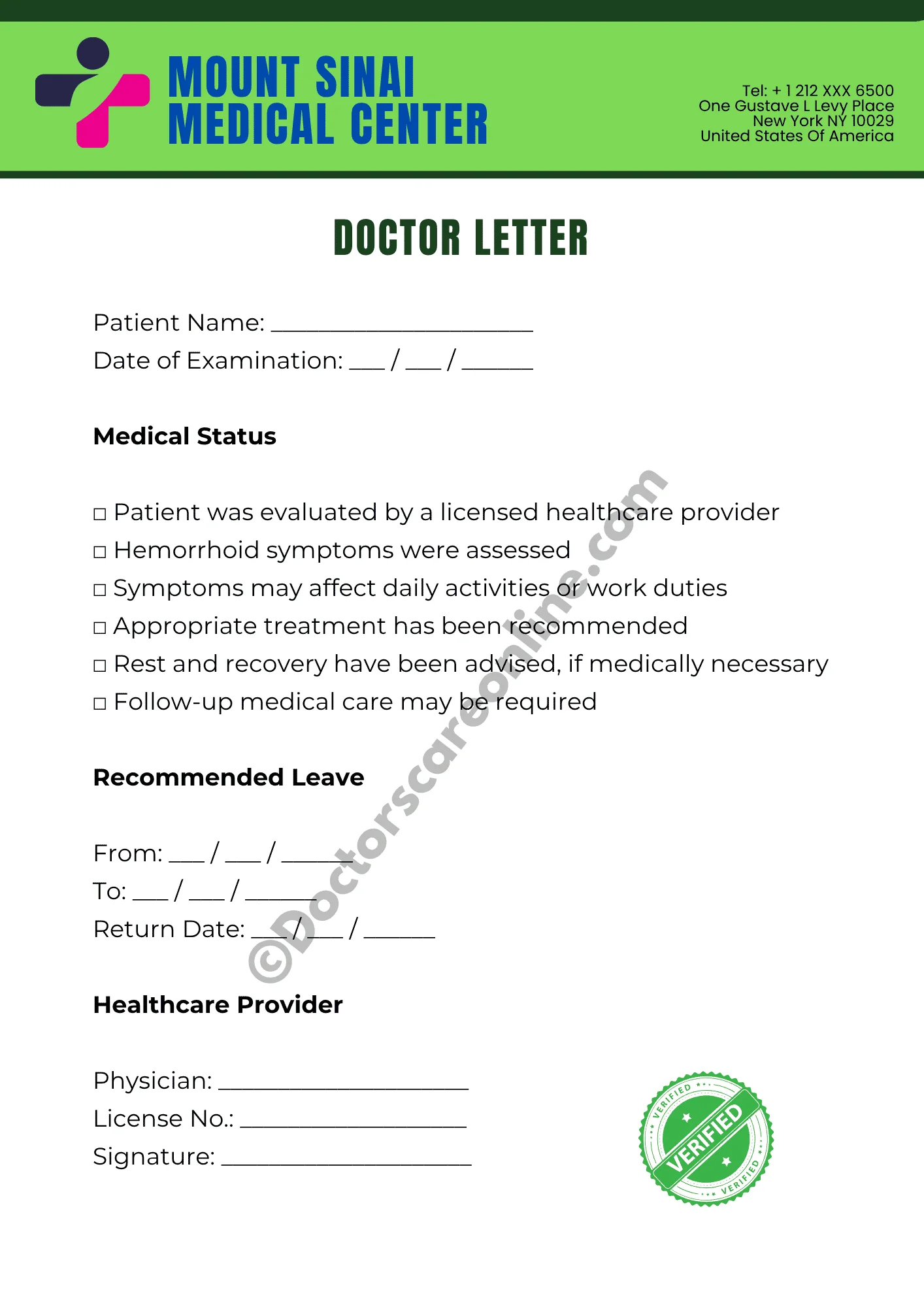
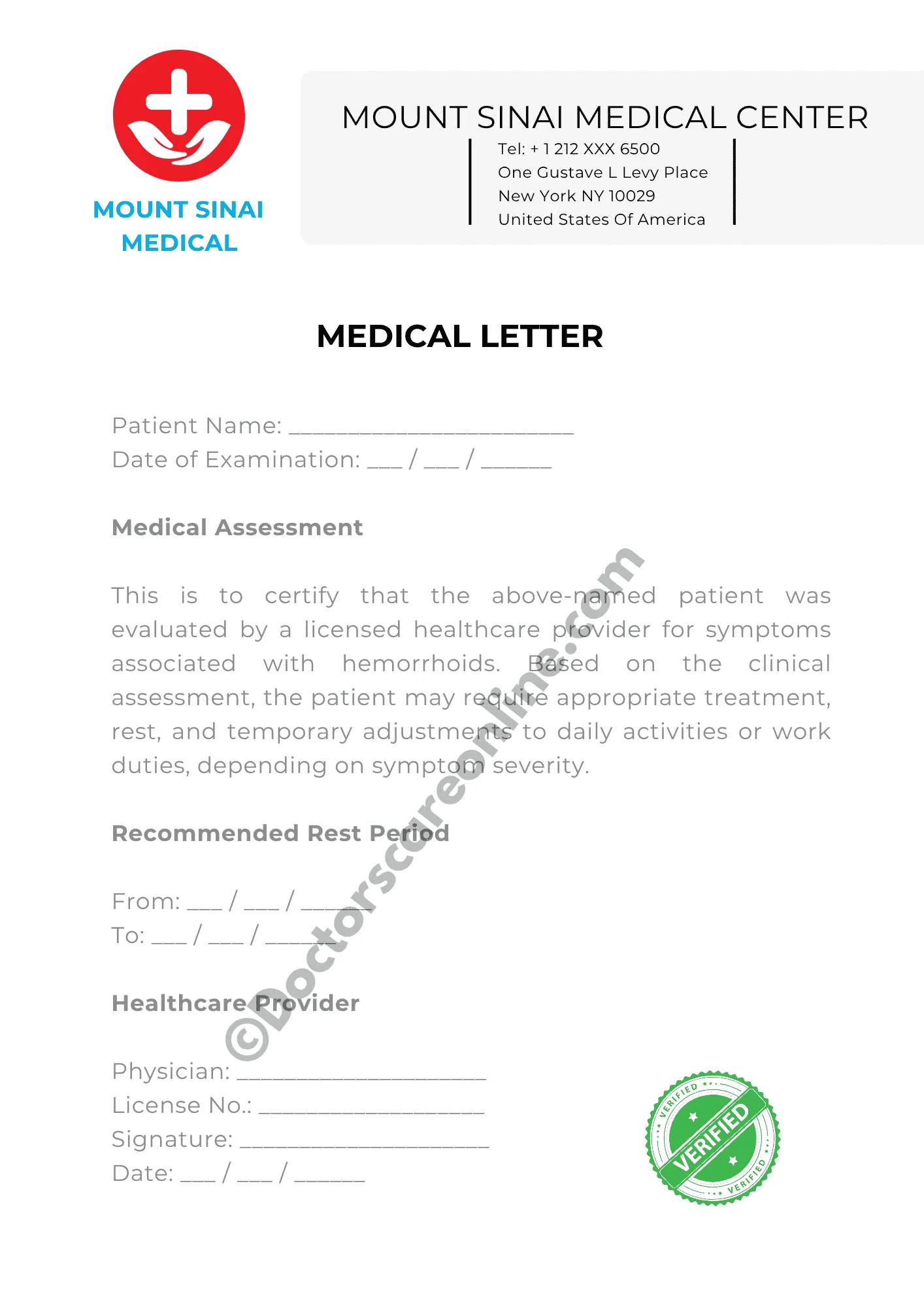
A Doctor’s Note for Hemorrhoids is medical documentation provided by a licensed healthcare professional after an appropriate evaluation. Depending on the individual’s situation, the documentation may confirm the medical evaluation, recommend a period of absence, describe temporary restrictions, or provide a recommended return-to-work or school date.
Hemorrhoids, commonly called piles, are swollen veins in and around the anus or lower rectum. They can cause symptoms such as anal itching, discomfort, swelling, pain, or rectal bleeding and may sometimes make sitting, walking, working, or completing everyday activities uncomfortable.
Important: A doctor’s note should never be obtained by simply purchasing or requesting a predetermined excuse. A licensed healthcare provider must determine whether documentation is medically appropriate based on the patient’s symptoms and clinical circumstances.
Related Doctor Note :——
You can also visit:
- Online Doctor’s Note for Sore Throat
- Doctors Note for Strep Throat
- Doctor’s Note for Work From Home
- Unlimited Doctor’s Notes for 1 Year
Printable Doctor’s Note for Hemorrhoids
A doctor’s note for hemorrhoids is a formal medical document that may be provided after a healthcare professional evaluates symptoms associated with hemorrhoids.
Depending on the circumstances, it may document:
- The date of the medical evaluation
- Confirmation that the patient was assessed
- A recommended period away from work or school, when medically necessary
- Temporary activity or workplace restrictions
- A recommended return date, when appropriate
- Follow-up instructions
- Healthcare provider and clinic information
- Provider signature or other required authentication
The amount of medical information included can vary. A healthcare provider generally determines what information is appropriate to disclose while considering applicable privacy requirements and the documentation needs of the recipient.
When Might You Need a Doctor’s Note for Hemorrhoids?
Hemorrhoid symptoms can range from mild irritation to significant discomfort. A medical evaluation may be particularly useful when symptoms interfere with normal responsibilities.
A doctor’s note may be relevant when:
- You cannot comfortably perform your normal job duties
- Sitting for prolonged periods increases discomfort.
- Physical activity or lifting aggravates symptoms.
- Pain makes concentration or productivity difficult.
- You need time away from work
- Symptoms temporarily prevent normal work activities.
- Your healthcare provider recommends rest or activity modification.
- You need temporary workplace accommodations
- You may need more frequent breaks.
- Prolonged sitting may need to be limited.
- Certain physical activities may need temporary modification.
- You are unable to attend school or college
- Symptoms make sitting through classes difficult.
- Pain or treatment interferes with attendance.
- A school requires medical documentation for an absence.
- Your employer or institution requires medical documentation
- Some organizations have their own rules regarding medical leave or absences.
- The required documentation may vary by workplace or educational institution.
Common Hemorrhoid Symptoms That May Affect Daily Activities
Hemorrhoids can produce different symptoms depending on whether they are internal, external, or complicated by problems such as thrombosis or prolapse.
| Symptom | How It May Affect Daily Life |
|---|---|
| Anal itching | Can cause persistent irritation and distraction |
| Anal pain or discomfort | May make sitting or walking uncomfortable |
| Swelling | Can make movement or sitting difficult |
| Bright-red rectal bleeding | May require medical evaluation rather than self-diagnosis |
| Tender lump near the anus | Can cause pain, especially when sitting |
| Prolapsed hemorrhoid | May cause irritation, discomfort, or difficulty with normal activities |
| Severe pain from a thrombosed hemorrhoid | May significantly interfere with work or daily activities |
Not every instance of rectal bleeding is caused by hemorrhoids. Other gastrointestinal or colorectal conditions can also cause bleeding, so unexplained or persistent bleeding should be evaluated by a healthcare professional.
Internal vs. External Hemorrhoids
Understanding the difference can help users describe their symptoms during a medical consultation.
| Type | General Description | Possible Symptoms |
|---|---|---|
| Internal hemorrhoids | Develop inside the lower rectum | Bright-red bleeding, prolapse, discomfort in some cases |
| External hemorrhoids | Develop under the skin around the anus | Itching, swelling, pain, tenderness, or a lump |
| Thrombosed external hemorrhoids | An external hemorrhoid containing a blood clot | Sudden or severe pain, swelling, and a firm or discolored lump |
A healthcare professional can determine whether symptoms are consistent with hemorrhoids and whether another condition needs to be considered.
What Can Cause or Contribute to Hemorrhoids?
Several factors can increase pressure on the veins around the anus and lower rectum.
Common contributing factors include:
- Straining during bowel movements
- Chronic constipation
- Long-lasting diarrhea
- Spending prolonged periods sitting on the toilet
- A diet low in fiber
- Pregnancy
- Aging-related weakening of supporting tissues
- Frequent heavy lifting
- Increased pressure in the lower rectal area
These factors do not necessarily mean that every person with hemorrhoids has the same underlying cause. A healthcare provider can assess the individual’s symptoms and medical history.
How Are Hemorrhoids Diagnosed?
A healthcare provider may diagnose hemorrhoids using a combination of medical history, symptom discussion, and physical examination. Depending on the symptoms, additional examination may be necessary.
The evaluation may include:
- Medical history
- When symptoms began
- Bowel habits
- Constipation or diarrhea
- Previous hemorrhoid problems
- Current medications and health conditions
- Symptom assessment
- Pain
- Itching
- Swelling
- Bleeding
- Prolapse
- Changes in bowel habits
- Physical examination
- Examination of the area around the anus
- Assessment for swelling, lumps, irritation, or other abnormalities
- Additional evaluation when needed
- A digital rectal examination
- Anoscopy or other examination of the lower rectum
- Additional testing when symptoms suggest another condition
The specific evaluation depends on the individual’s symptoms and clinical history. NIDDK
Can You Get a Doctor’s Note for Hemorrhoids Online?
In some circumstances, a telehealth appointment may be appropriate for discussing hemorrhoid symptoms. However, whether an online consultation is suitable depends on the symptoms, medical history, location, and healthcare provider’s clinical judgment.
During an online consultation, you may be asked about:
- Your symptoms and when they started
- Pain or discomfort
- Rectal bleeding
- Bowel movements
- Constipation or diarrhea
- Previous hemorrhoid episodes
- Current medications
- Existing medical conditions
- How symptoms affect work or school
If the provider determines that the condition can be appropriately evaluated through telehealth and that medical documentation is justified, the provider may issue a doctor’s note where permitted.
An online doctor’s note is not guaranteed simply because a patient requests one.
How to Book an Online Hemorrhoid Consultation
If your symptoms are appropriate for telehealth, the process can generally be completed in a few steps:
- Choose an online healthcare service
- Select a service that connects patients with appropriately licensed healthcare professionals.
- Create or access your account
- Register with the required information or log in to your existing account.
- Select an appointment
- Choose an available consultation time that works for you.
- Describe your symptoms
- Provide accurate information about your hemorrhoid symptoms and how they affect your daily activities.
- Complete the medical consultation
- Discuss your symptoms and medical history with the healthcare provider.
- Follow the provider’s recommendation
- The provider may recommend home care, medication, an in-person examination, additional testing, or other treatment.
- Receive documentation if medically appropriate
- If the provider determines that a doctor’s note is justified, appropriate medical documentation may be provided in accordance with applicable requirements.
What Information Should You Have Ready for Your Appointment?
Preparing relevant information can make your consultation more useful.
Keep the following details available:
- Date symptoms started
- Location and severity of discomfort
- Presence of rectal bleeding
- Constipation or diarrhea
- Bowel movement changes
- Previous hemorrhoid diagnosis
- Current medications
- Relevant medical conditions
- Previous treatments
- Work or school responsibilities
- Any documentation requirements from your employer or institution
Tip: Be accurate and honest about your symptoms. This helps the healthcare provider make an appropriate clinical assessment.
What May Be Included in a Hemorrhoid Doctor’s Note?
The exact contents depend on the provider and the purpose of the documentation.
A note may include:
| Information | Possible Purpose |
|---|---|
| Patient name | Identifies the patient |
| Examination date | Confirms when the evaluation occurred |
| Medical confirmation | Documents that an evaluation took place |
| Leave period | States recommended absence when medically appropriate |
| Activity restrictions | Describes temporary limitations |
| Return date | Indicates when normal activities may resume, if determined |
| Follow-up instructions | Provides next-step medical guidance |
| Provider information | Identifies the healthcare professional or practice |
| Signature/authentication | Helps verify the document |
The note does not necessarily need to disclose every detail of the patient’s medical condition.
Can Hemorrhoids Affect Work Performance?
Yes. Depending on severity, hemorrhoid symptoms can interfere with certain work activities.
Examples include:
- Sitting at a desk for extended periods
- Driving for long periods
- Standing for prolonged periods
- Performing physically demanding work
- Repeated lifting
- Bending or strenuous movement
- Concentrating while experiencing significant discomfort
A healthcare provider can assess whether symptoms are affecting functional ability and whether temporary restrictions or time away from work are medically appropriate.
Temporary Work Restrictions for Hemorrhoids
Depending on the individual’s condition and occupation, a healthcare provider may recommend temporary modifications.
Possible restrictions could include:
- Limiting prolonged sitting
- Taking appropriate movement breaks
- Temporarily avoiding strenuous activity
- Limiting heavy lifting when clinically appropriate
- Modifying physically demanding tasks
- Adjusting work duties during recovery
Restrictions should be based on the healthcare provider’s clinical assessment rather than a predetermined request.
Hemorrhoid Treatment and Recovery
Treatment depends on the severity and type of hemorrhoids. Many people with mild symptoms improve with conservative measures, while persistent, severe, prolapsed, or bleeding hemorrhoids may require medical treatment.
Healthcare professionals may recommend:
- Increasing dietary fiber
- Drinking adequate fluids according to individual needs
- Avoiding straining during bowel movements
- Avoiding prolonged toilet sitting
- Warm sitz baths
- Appropriate over-the-counter treatments
- Stool-softening or fiber products when appropriate
- Prescription treatment when needed
- Office-based procedures for certain hemorrhoids
- Surgical treatment in selected cases
Do not start or stop medication solely based on online information. Ask a healthcare professional or pharmacist about appropriate treatment for your circumstances.
Self-Care Measures That May Help
For mild hemorrhoid symptoms, healthcare professionals may recommend measures that reduce irritation and make bowel movements easier.
Helpful habits can include:
- Eating more fiber-rich foods
- Drinking adequate fluids
- Avoiding excessive straining
- Keeping toilet visits reasonably brief
- Following recommended treatment instructions
- Maintaining appropriate physical activity when comfortable
- Using warm water soaks when recommended
Increasing fiber can soften stools and may help reduce straining.
When Should You See a Healthcare Provider?
Medical evaluation is particularly important when:
- Rectal bleeding occurs
- Symptoms persist despite home care
- Pain becomes significant
- Symptoms repeatedly return
- A lump becomes unusually painful
- There are changes in bowel habits
- You are uncertain whether symptoms are actually hemorrhoids
Rectal bleeding should not automatically be attributed to hemorrhoids because other gastrointestinal conditions can also cause bleeding.
When Are Hemorrhoid Symptoms an Emergency?
Seek urgent medical attention for heavy or continuous rectal bleeding, particularly when accompanied by dizziness, fainting, severe abdominal pain, or other signs of significant blood loss. Severe anal pain accompanied by bleeding, fever, or abdominal symptoms also warrants prompt medical care.
Do not rely on an online doctor’s-note service for emergency symptoms.
If you are experiencing a medical emergency, contact 911 or seek emergency medical care immediately.
How Our Online Service Can Help
Our website is designed to make the process of connecting with healthcare services more convenient for users seeking an online medical consultation.
Users can:
- Review the online appointment process
- Provide information about their symptoms
- Connect with an appropriate healthcare professional where services are available
- Discuss how their symptoms are affecting work, school, or daily activities
- Receive medical guidance based on the provider’s assessment
- Request appropriate documentation when medically justified
Our role is to make the consultation process more accessible and convenient. The healthcare provider—not the website—makes the clinical decision about diagnosis, treatment, restrictions, or whether a doctor’s note should be issued.
Why Users Can Trust Our Website
Choosing an online healthcare service involves more than simply finding a convenient appointment. Users should know what to expect from the service and how their concerns will be handled.
Our service is designed around:
- Professional medical evaluation: Documentation is connected to an appropriate healthcare consultation rather than being automatically issued.
- Convenient online access: Users can arrange a consultation without necessarily needing to visit a physical office for every concern.
- Clear process: The appointment and documentation process is explained before users proceed.
- Patient-focused communication: Users can describe their symptoms and concerns to the healthcare provider.
- Responsible documentation: A doctor’s note is provided only when the healthcare professional determines it is medically appropriate.
- Support when questions arise: Users can contact our support team through the website’s chatbox if they have questions about registration, login, payment, appointments, or using the website.
Always review the specific healthcare provider’s credentials, licensing information, privacy practices, and applicable terms before receiving medical services.
Need Help With Registration, Login, Payment, or Your Order?
If you experience a problem while using our website, you do not have to figure it out alone.
You can use our website chatbox to ask questions about:
- Registration
- Problems creating an account
- Questions about required information
- Login
- Trouble accessing your account
- Login-related questions
- Payment
- Payment errors
- Questions about the checkout process
- Problems completing a transaction
- Appointments
- Questions about the booking process
- General appointment-related assistance
- Website or order issues
- Technical problems
- Questions about using the service
- Other service-related concerns
Our support team can help with website and service questions. Medical questions should be addressed by a qualified healthcare professional rather than customer support.
Doctor’s Note for Hemorrhoids: What to Expect
The process should focus on obtaining appropriate medical care first and documentation second.
A typical journey may look like this:
Book consultation → Describe symptoms → Medical evaluation → Provider recommendation → Documentation if medically appropriate → Follow workplace/school requirements
This approach helps ensure that the documentation reflects an actual healthcare evaluation rather than functioning as a generic excuse.
Frequently Asked Questions
1. Can hemorrhoids be serious enough to require time off work?
They can sometimes cause enough pain, bleeding, or discomfort to interfere with normal activities. Whether time away from work is appropriate depends on the healthcare provider’s assessment and the person’s specific job duties.
2. Can I ask a doctor for a hemorrhoid work restriction instead of full leave?
Yes. You can discuss your job responsibilities and symptoms with the healthcare provider. If medically appropriate, the provider may recommend temporary restrictions rather than complete absence from work.
3. Can rectal bleeding always be treated as a hemorrhoid symptom?
No. Although hemorrhoids can cause rectal bleeding, other conditions can also cause it. New, persistent, unexplained, or significant bleeding should be evaluated by a healthcare professional.
4. What happens if my hemorrhoid symptoms do not improve after home treatment?
Contact a healthcare professional for further evaluation. Persistent symptoms may require a different treatment approach or an examination to determine whether another condition is contributing to the symptoms.
5. Can I use an online consultation if I am unsure whether I have hemorrhoids?
You may be able to discuss your symptoms through telehealth where available. The healthcare provider will determine whether your symptoms can be appropriately assessed remotely or whether an in-person examination is necessary.
Medical Disclaimer: This content is provided for general educational and informational purposes only and does not replace professional medical advice, diagnosis, or treatment. Hemorrhoid symptoms can overlap with other medical conditions, and rectal bleeding should not automatically be assumed to be caused by hemorrhoids.
A doctor’s note should be issued only by an appropriately licensed healthcare professional after an appropriate medical evaluation. The availability of telehealth, medical documentation, work restrictions, leave recommendations, and other services may vary based on the patient’s location, healthcare provider, employer, school, and applicable laws or policies.
If you have heavy or continuous rectal bleeding, severe pain with bleeding, dizziness, fainting, severe abdominal symptoms, fever with significant anal pain, or another emergency warning sign, seek urgent medical care or call 911 rather than relying on an online doctor’s-note service.





Reviews
There are no reviews yet.