

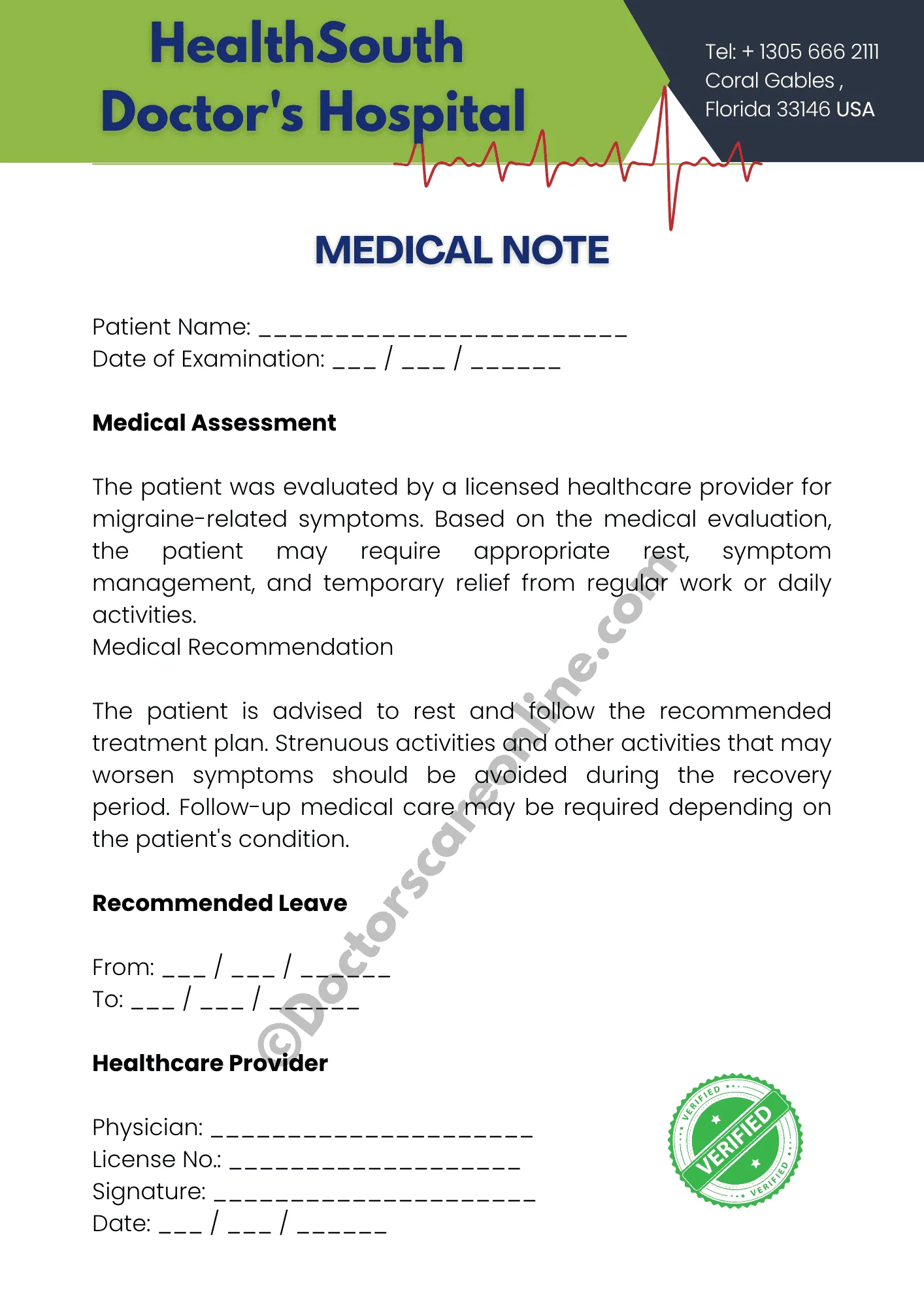
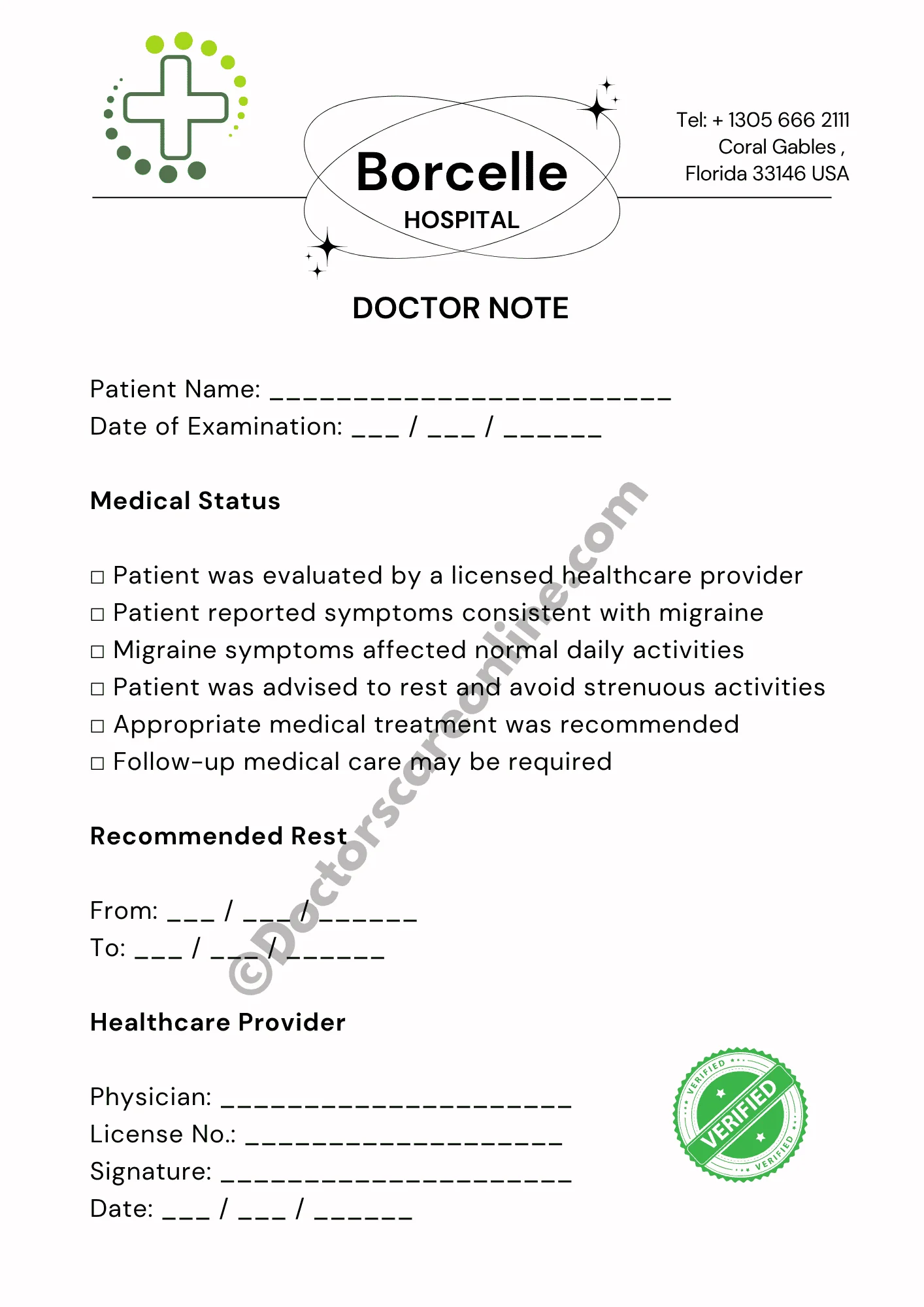
A doctor’s note for migraine is medical documentation issued after an appropriate evaluation. It may confirm that you were assessed and provide relevant information about recommended absence, restrictions, or a return date without unnecessarily disclosing private medical details.
Migraine is more than an ordinary headache. It is a neurological condition that can cause moderate to severe head pain along with symptoms such as nausea, sensitivity to light or sound, dizziness, visual changes, and difficulty concentrating. For some people, a migraine attack can interfere with work, school, driving, or normal daily activities.
Related Doctor Note :——
You can also visit:
- Doctor’s Note for Vertigo Work Restrictions
- Doctor’s Note for Inner Ear Vertigo
- Doctor’s Note for Work From Home
- Unlimited Doctor’s Notes for 1 Year
When Might You Need a Migraine Doctor’s Note?
Migraine symptoms can vary considerably from one person to another. A healthcare provider may determine that medical documentation is appropriate when symptoms significantly interfere with normal responsibilities.
Common situations include:
- Missing work because of a migraine
- Severe headache pain, nausea, light sensitivity, or other symptoms may make normal work difficult.
- Missing school or college
- A migraine attack may interfere with classes, assignments, examinations, or attendance.
- Temporary workplace limitations
- Some people may need reduced exposure to bright lights, prolonged screen use, or other factors depending on their symptoms and job.
- Recovery after a severe migraine episode
- A provider may recommend temporary rest or activity modification when medically appropriate.
- Recurring migraine symptoms
- Frequent or changing headaches may require professional evaluation and an updated treatment plan.
- Documentation requested by an organization
- An employer, school, college, or other organization may have its own medical documentation requirements.
Common Migraine Symptoms That Can Affect Daily Activities
Migraine symptoms are not limited to head pain. Different people can experience different combinations of symptoms.
Common Symptoms
- Moderate to severe headache pain
- Throbbing or pulsating pain
- Nausea or vomiting
- Sensitivity to light
- Sensitivity to sound
- Dizziness
- Difficulty concentrating
- Fatigue
- Visual disturbances
- Temporary changes in normal activity tolerance
Some people experience migraine with aura, which can involve visual, sensory, or speech-related symptoms before or during an attack. New or unusual neurological symptoms should be medically evaluated rather than automatically assumed to be migraine.
Migraine With Aura vs. Migraine Without Aura
Migraine presentations differ between individuals. Aura refers to temporary neurological symptoms that can occur before or during some migraine attacks.
| Feature | Migraine With Aura | Migraine Without Aura |
|---|---|---|
| Aura symptoms | May occur | Usually absent |
| Visual changes | May occur | May occur as a migraine symptom but not necessarily as aura |
| Sensory changes | Can occur | Less characteristic |
| Speech-related symptoms | Can occur | Less characteristic |
| Headache | May follow or accompany aura | Common feature |
| Medical evaluation | Important when symptoms are new or unusual | Important when headache patterns change |
A new neurological symptom, sudden severe headache, or major change from a person’s usual migraine pattern warrants medical attention.
Common Migraine Triggers
Migraine triggers vary between individuals, and identifying personal patterns can be useful when discussing recurring symptoms with a healthcare provider.
Potential triggers may include:
- Irregular sleep
- Stress
- Dehydration
- Skipping meals
- Certain foods or beverages
- Hormonal changes
- Bright or flashing lights
- Strong smells
- Changes in routine
- Excessive or insufficient caffeine
- Environmental changes
Keeping a migraine diary can help record when symptoms begin, what happened beforehand, how long the attack lasted, and what helped or worsened symptoms. This information can be useful during a medical consultation.
How Migraine Can Affect Work and School
A migraine attack can interfere with activities that require concentration, visual attention, communication, physical activity, or exposure to light and noise.
At Work
Depending on the person’s symptoms and occupation, migraine may make it difficult to:
- Concentrate on detailed tasks.
- Work with computer screens.
- Work in bright environments.
- Participate in lengthy meetings.
- Drive or operate equipment safely.
- Maintain normal productivity.
- Complete physically demanding duties.
At School or College
Migraine symptoms may interfere with:
- Attending classes.
- Completing assignments.
- Taking examinations.
- Reading or using digital screens.
- Participating in classroom activities.
- Maintaining normal attendance.
Whether time away or an accommodation is medically appropriate should be determined through an individual healthcare assessment.
How to Prepare for an Online Migraine Appointment
Providing clear information can help a healthcare provider understand your symptoms and determine whether an online evaluation is appropriate.
Before your appointment, consider preparing:
- Headache history: When your headaches began and how frequently they occur.
- Duration: How long individual attacks usually last.
- Location: Where the pain occurs.
- Intensity: How severe the pain becomes.
- Associated symptoms: Nausea, vomiting, light sensitivity, sound sensitivity, dizziness, or visual changes.
- Aura information: Describe any visual, sensory, or speech-related changes.
- Possible triggers: Note food, sleep, stress, environmental, or other patterns.
- Current medications: Include prescription, over-the-counter, and other medicines you take.
- Previous treatment: Mention treatments you have already tried and whether they helped.
- Medical history: Include relevant health conditions and previous headache diagnoses.
- Family history: Tell the provider if migraine or other headache disorders run in your family.
- Work or school impact: Explain how the symptoms affect your ability to perform normal responsibilities.
Healthcare providers commonly use symptom history and medical history when evaluating migraine; additional testing may be considered when another condition needs to be ruled out.
How an Online Doctor Appointment for Migraine Works
An online medical appointment can provide a convenient way to discuss migraine symptoms with a healthcare professional when telehealth is appropriate.
Step-by-Step Process
- Choose an available appointment
- Select an appointment time that works for you.
- Create or access your account
- Provide the information requested by the platform.
- Describe your migraine symptoms
- Include the onset, frequency, severity, associated symptoms, and impact on daily activities.
- Complete the medical consultation
- Discuss your symptoms and relevant medical history with the healthcare provider.
- Follow the provider’s recommendations
- The provider may recommend treatment, monitoring, follow-up care, or an in-person evaluation.
- Request medical documentation when appropriate
- If the provider determines that a doctor’s note is medically justified, appropriate documentation may be issued according to applicable requirements.
An online appointment does not guarantee a doctor’s note. The healthcare provider must determine whether documentation is appropriate based on the medical evaluation.
How Our Online Doctor Appointment Service Can Help
Our platform is designed to make the process of seeking an online medical evaluation more convenient for people who may have difficulty arranging an in-person appointment.
Designed Around User Convenience
Users can:
- Request an online medical appointment.
- Provide information about their symptoms before or during the consultation.
- Communicate with a healthcare provider through the available online process.
- Receive guidance based on their individual medical situation.
- Request medical documentation when it is appropriate.
Why This Can Be Useful
Online healthcare can be particularly convenient when traveling to a clinic is difficult, when symptoms make leaving home uncomfortable, or when someone needs to discuss a non-emergency health concern from a convenient location.
However, telehealth is not appropriate for every medical situation. A healthcare provider may recommend an in-person examination or urgent care when symptoms cannot be safely assessed remotely.
Why Users Can Rely on Our Platform
Choosing an online medical service involves more than convenience. Users should understand how the service works, what information is required, and what support is available throughout the process.
Our platform is designed to provide a straightforward experience by:
- Clearly presenting the online appointment process.
- Allowing users to provide relevant information about their health concern.
- Connecting users with the appropriate online medical consultation process.
- Explaining that medical documentation depends on healthcare-provider assessment.
- Avoiding the promise of a doctor’s note without a medical evaluation.
- Providing customer support for account and payment-related questions.
Support for Registration, Login, Payment, and Other Questions
If you experience an issue while using our website, you can use the website chatbox to ask about:
- Registration problems
- Login difficulties
- Payment-related questions
- Appointment-related questions
- Website navigation
- Order or service questions
- Other general queries about using the platform
Our support team can help guide you through website-related issues and explain the next steps available through the platform.
Medical decisions, diagnoses, treatment recommendations, and whether documentation should be issued remain the responsibility of the appropriate healthcare professional.
What Information May Be Included in a Migraine Doctor’s Note?
The exact contents depend on the healthcare provider and the purpose of the documentation.
A note may include:
| Information | Possible Purpose |
|---|---|
| Patient name | Identifies the individual |
| Date of evaluation | Documents when the assessment occurred |
| Medical confirmation | Confirms that an evaluation took place |
| Recommended absence | Documents an advised period away from work or school |
| Activity restrictions | Describes temporary limitations when appropriate |
| Return date | Indicates when normal activities may resume, if determined |
| Follow-up recommendation | Identifies whether further evaluation is advised |
| Provider information | Identifies the healthcare professional or practice |
| Signature or authentication | Verifies the medical documentation |
The provider determines what information is appropriate to include. A patient should not modify a medical document after it has been issued.
Does a Migraine Doctor’s Note Include the Diagnosis?
Not necessarily.
Medical documentation may focus on the fact that an individual was evaluated and whether a temporary absence, restriction, or accommodation is medically appropriate.
Depending on the circumstances, a note may include:
- Date of medical evaluation
- Recommended time away
- Functional restrictions
- Return-to-work or school information
- Follow-up recommendations
- Provider identification
The amount of health information disclosed can depend on the documentation requirements, applicable privacy rules, and the healthcare provider’s judgment.
Users should check what their employer, school, or other organization specifically requires before requesting documentation.
How Long Can You Be Excused From Work for Migraine?
There is no universal number of days that applies to every migraine patient.
The appropriate period may depend on:
- Severity of the migraine episode
- Frequency of attacks
- Associated symptoms
- Ability to perform essential job duties
- Treatment response
- Whether symptoms are improving
- Occupational safety requirements
- Healthcare provider’s clinical assessment
A provider may recommend a short absence, temporary restrictions, or follow-up evaluation depending on the individual situation.
A doctor’s note should not be treated as an automatic entitlement to a specific number of days away from work.
Temporary Work Accommodations for Migraine
Some people may be able to continue working with appropriate temporary modifications rather than taking complete time away.
Depending on the job and medical assessment, possible accommodations may include:
- Reduced exposure to bright light
- Temporary screen breaks
- A quieter workspace
- Modified work hours
- Temporary reduction in strenuous activities
- Additional rest breaks
- Remote work when feasible
- Temporary adjustment of certain duties
The appropriate accommodation depends on the person’s medical needs, job responsibilities, and applicable workplace policies.
Migraine Diagnosis: What Does a Healthcare Provider Evaluate?
Migraine is generally diagnosed based on the person’s symptoms, medical history, and physical or neurological evaluation rather than a single test that proves migraine.
During an evaluation, a provider may consider:
- Headache characteristics
- Frequency and duration
- Associated symptoms
- Previous headache history
- Family history
- Medication use
- Neurological symptoms
- Changes in the usual headache pattern
- Potential alternative causes
Imaging such as CT or MRI may be considered when a provider identifies symptoms or circumstances that warrant further investigation.
Migraine Treatment and Management
Treatment depends on the individual’s symptoms, medical history, frequency of attacks, and healthcare provider’s recommendations.
Management may involve:
- Prescription medication
- Over-the-counter medication when appropriate
- Preventive treatment for people with frequent attacks
- Hydration
- Regular sleep
- Stress-management strategies
- Identifying personal triggers
- Maintaining regular meals
- Following an individualized treatment plan
A healthcare provider can help determine which treatment approach is appropriate. There is no single treatment that works for everyone with migraine.
Self-Care During a Migraine Attack
For a migraine that is consistent with a person’s usual symptoms and does not include emergency warning signs, supportive measures may include:
- Resting in a quiet, dark room.
- Drinking fluids, particularly if vomiting has occurred.
- Using a cool cloth or cold pack.
- Following an existing migraine treatment plan.
- Avoiding known personal triggers.
- Getting adequate sleep when possible.
Medications should be used according to the label or healthcare provider’s instructions. People who frequently use pain medicines should discuss their medication use with a healthcare professional.
When Migraine Symptoms Require Urgent Medical Attention
Not every severe headache should automatically be assumed to be migraine.
Seek immediate medical attention for warning signs such as:
- A sudden, explosive, or unusually severe headache.
- The worst headache you have experienced.
- New weakness or numbness.
- New difficulty speaking.
- Significant or new vision changes.
- Loss of balance or coordination.
- Confusion or altered awareness.
- Severe headache accompanied by fever or stiff neck.
- A severe headache following a head injury.
- A major or unexplained change from your usual headache pattern.
These symptoms can indicate conditions requiring urgent evaluation. If you believe you are experiencing a medical emergency in the United States, call 911 or go to the nearest emergency department.
When to Schedule a Follow-Up for Migraine
A follow-up appointment may be appropriate when:
- Your headache pattern changes.
- Migraine attacks become more frequent.
- Your usual treatment stops working.
- Your symptoms become more difficult to manage.
- Medication causes unwanted side effects.
- You develop new symptoms.
- Migraine begins interfering more often with work, school, or daily life.
Keeping track of your symptoms can help your healthcare provider identify changes over time.
What to Do After Receiving a Migraine Doctor’s Note
Once you receive medical documentation, review it carefully before submitting it to your employer, school, or another organization.
Check the Document For
- Correct name
- Correct evaluation date
- Recommended absence dates, if applicable
- Work or school restrictions
- Return date, if provided
- Healthcare provider information
- Required signature or authentication
Submit It According to the Organization’s Policy
Different employers and educational institutions may have different procedures for submitting medical documentation. Follow the applicable policy and retain a copy for your records.
Do not alter the medical document. If something appears incorrect, contact the healthcare provider or appropriate support team for clarification.
Doctor’s Note for Migraine: Online vs. In-Person Evaluation
| Online Consultation | In-Person Evaluation |
|---|---|
| Convenient from home | Allows direct physical examination |
| Useful for appropriate non-emergency concerns | Useful when physical examination is needed |
| Symptoms can be discussed remotely | Additional testing can be arranged when necessary |
| May reduce travel time | May be preferable for new or concerning symptoms |
| Provider determines whether telehealth is suitable | Appropriate for situations requiring immediate hands-on care |
The choice depends on the symptoms and clinical situation. A healthcare provider may recommend in-person care when an online assessment is insufficient.
Medical Documentation for Work or School: What Users Should Know
Before requesting a migraine doctor’s note, check the requirements of the organization requesting it.
Consider confirming:
- Whether a doctor’s note is required.
- Whether a specific form must be completed.
- Whether digital documentation is accepted.
- Whether the diagnosis must be included.
- Whether a return-to-work or return-to-school date is required.
- Whether additional documentation is needed for extended absences.
These requirements can vary, so the healthcare provider’s documentation should be based on the actual medical evaluation and the applicable requirements.
Frequently Asked Questions
1. Can a migraine qualify for a work absence?
Yes, migraine symptoms can sometimes interfere substantially with a person’s ability to perform normal work duties. Whether a work absence is medically appropriate depends on an individual evaluation and the healthcare provider’s clinical judgment.
2. Can migraine cause temporary difficulty concentrating?
Yes. Some people with migraine experience symptoms such as brain fog or difficulty concentrating. The extent and duration vary between individuals.
3. Can I use a migraine doctor’s note for a college exam?
A medical note may support an absence or request for an academic accommodation when medically appropriate, but the college or university determines whether its requirements for excused examinations have been met.
4. Can a doctor determine whether my headache is actually migraine?
A healthcare provider can evaluate your symptoms, medical history, and examination findings to determine whether they are consistent with migraine and whether another condition needs to be considered.
5. What if my migraine symptoms are different from my usual attacks?
A significant change in headache pattern or the appearance of new neurological symptoms should be medically evaluated rather than automatically treated as a typical migraine. Sudden severe headache or symptoms such as weakness, speech difficulty, major vision changes, or confusion require urgent medical attention.
Medical Disclaimer: This content is provided for general educational and informational purposes only and does not replace professional medical advice, diagnosis, or treatment.
A doctor’s note should only be issued by an appropriately qualified healthcare provider after an appropriate medical evaluation. A request for documentation does not guarantee that a healthcare provider will issue a note. The provider determines whether medical documentation, work restrictions, school accommodations, or time away from normal activities are medically appropriate.




Reviews
There are no reviews yet.