
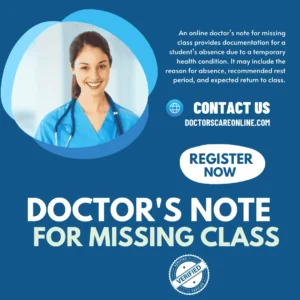
Missing class because of an illness, injury, medical appointment, or other health-related concern can sometimes require official documentation. A Doctor’s Note for Missing Class can provide written confirmation that a student was evaluated by a licensed healthcare provider and, when medically appropriate, may support a school absence or temporary academic accommodation.
Schools, colleges, and universities may have different requirements for excused absences and medical documentation. Before submitting a doctor’s note, students should check their institution’s attendance policy to understand what information is required.
With an online doctor appointment, eligible patients may be able to discuss their symptoms with a licensed healthcare provider through telehealth without visiting a traditional clinic. Telehealth can be delivered through video, telephone, or other communication technologies, although some conditions require an in-person evaluation.
Related Doctor Note :——
You can also visit:
- Doctors Note for Child School Absence
- Doctor’s Note for Family Leave of Absence
- Doctors Note for Missing An Exam
- Doctor’s Note for Work From Home
- Unlimited Doctor’s Notes for 1 Year
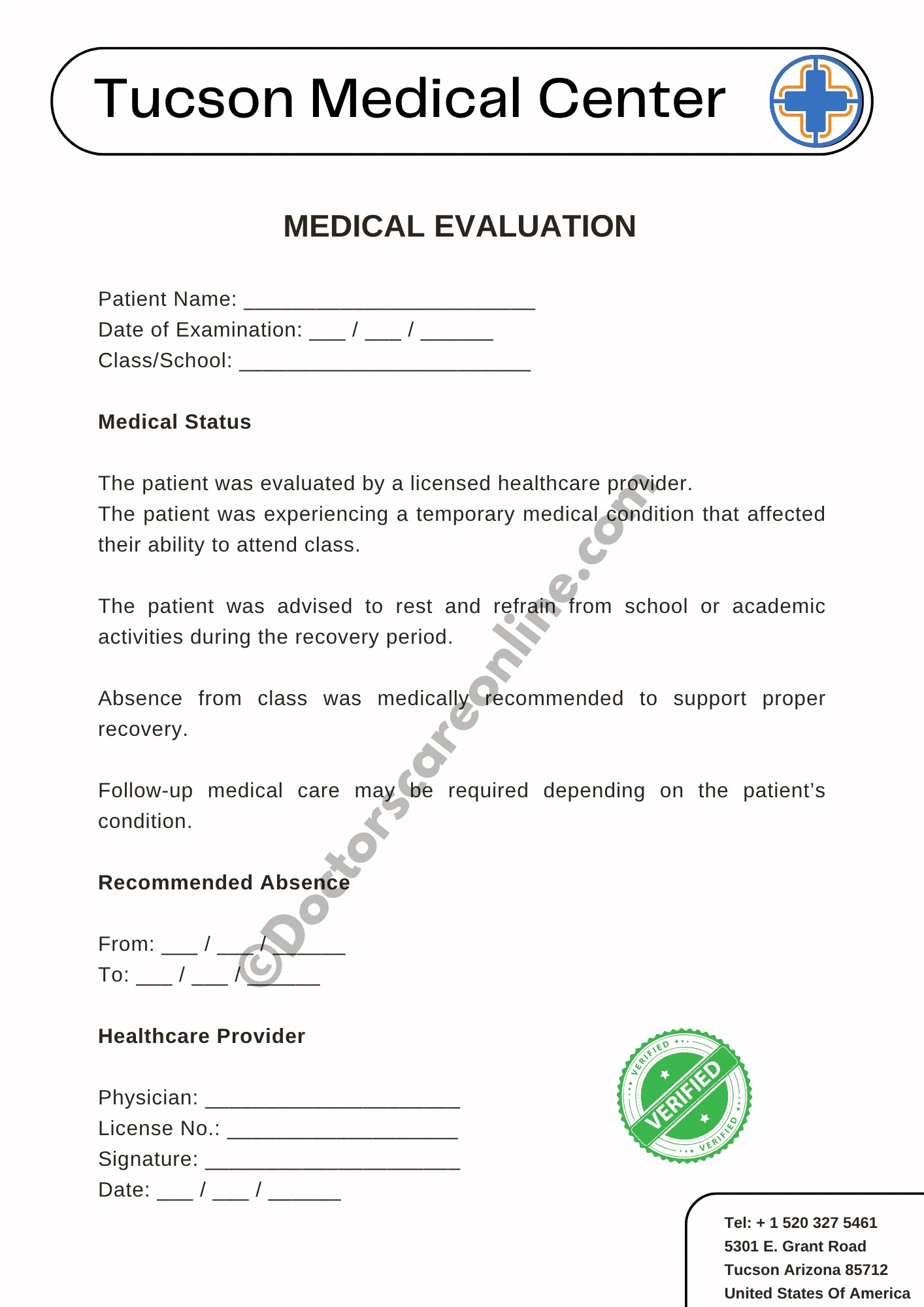
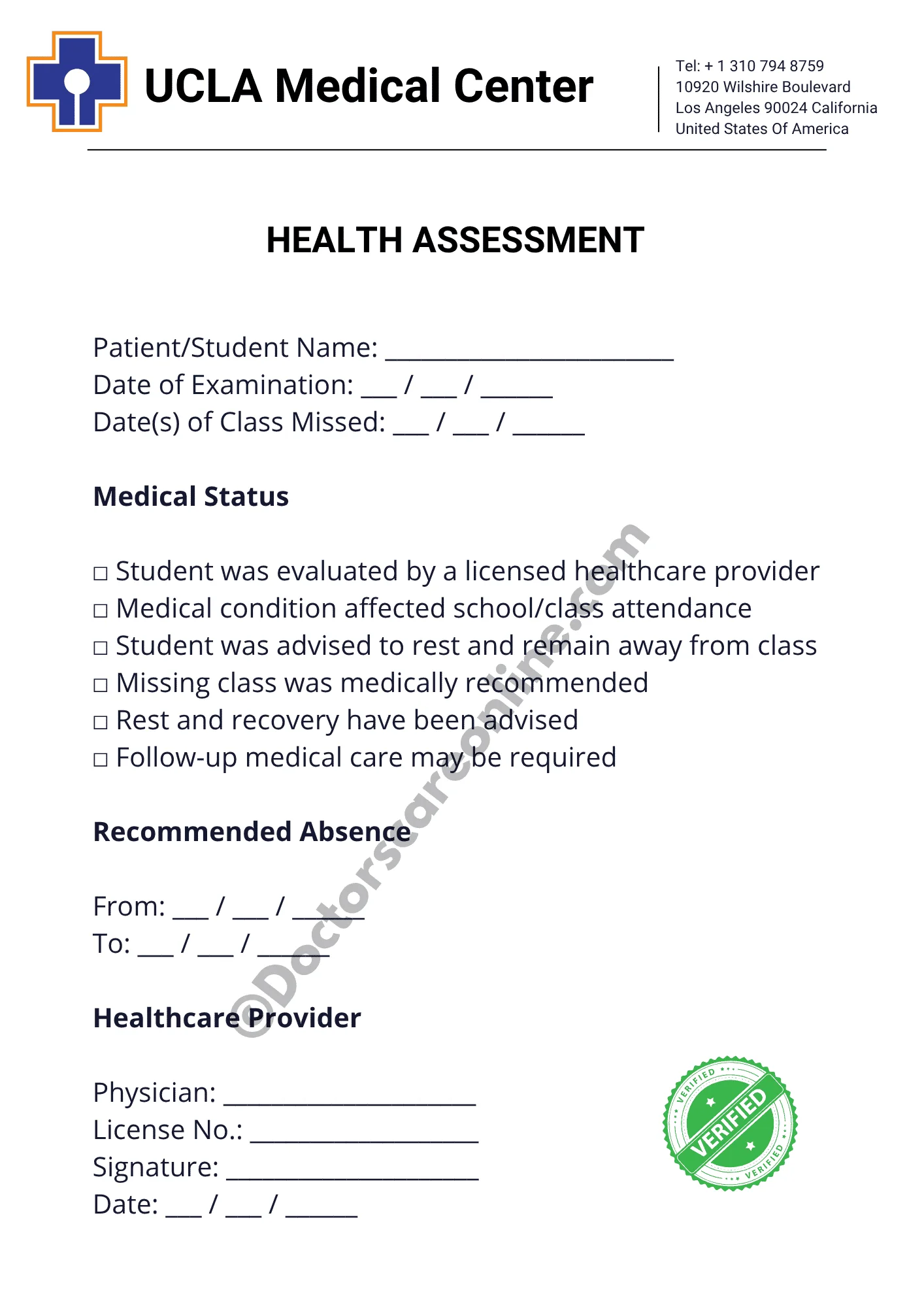
Printable Doctor’s Note for Missing Class Template
A doctor’s note for missing class is medical documentation issued by a licensed healthcare provider after an appropriate evaluation. Depending on the student’s circumstances, the documentation may confirm that the student was medically evaluated and may recommend a period of absence, activity restrictions, or a return date.
A medical excuse note may be relevant when a student:
- Is too ill to attend class safely.
- Has an injury that affects mobility or participation.
- Needs time to recover from an illness or medical procedure.
- Has a medical appointment or follow-up care.
- Requires temporary academic accommodations because of a health condition.
- Needs documentation requested by a school, college, or university.
A healthcare provider determines whether medical documentation is appropriate. A doctor’s note should reflect the provider’s actual clinical assessment rather than simply documenting a requested absence.
When Might a Student Need a Doctor’s Note?
The need for medical documentation depends on the institution’s attendance and academic policies. Some schools may accept a student’s explanation for certain absences, while others may request documentation for specific circumstances.
Common situations include:
- Acute illness – Fever, flu-like symptoms, stomach illness, respiratory infections, or other conditions may temporarily prevent class attendance.
- Injury – An injury may make walking, sitting, standing, or participating in class activities difficult.
- Medical treatment – A student may need time away from class for a medical procedure, treatment, or follow-up appointment.
- Recovery period – Some illnesses or injuries require temporary rest or activity modification.
- Recurring health conditions – A flare-up of an existing condition may interfere with attendance or academic responsibilities.
- Mental health concerns – Certain mental health conditions may affect a student’s ability to attend or participate in classes and may require professional evaluation.
- Academic accommodations – A healthcare provider may recommend reasonable temporary adjustments when medically appropriate.
Students should review their school’s requirements before requesting or submitting documentation.
What Can a Doctor’s Note for Missing Class Include?
The exact content varies according to the healthcare provider, student’s circumstances, and institutional requirements.
A medical absence note may include:
- Student or patient name.
- Date of medical evaluation.
- Confirmation that the patient was evaluated.
- Recommended dates of absence, when medically appropriate.
- Activity or participation restrictions.
- Recommended return date, if applicable.
- Follow-up recommendations.
- Healthcare provider’s name and professional information.
- Clinic or practice information.
- Provider signature or authorized electronic authentication, where applicable.
A medical note does not necessarily need to disclose a detailed diagnosis. The appropriate amount of medical information depends on the circumstances and applicable requirements.
Common Reasons for Missing Class Because of a Health Issue
Students can miss class for many legitimate medical reasons. A healthcare provider evaluates the individual situation before recommending absence or restrictions.
Examples include:
| Health situation | Possible effect on attendance |
|---|---|
| Fever or viral illness | May make attending class difficult or unsafe |
| Flu-like symptoms | May require recovery time and reduced activity |
| Stomach illness | Symptoms may interfere with attending class |
| Migraine | Severe headache or light sensitivity may affect participation |
| Back pain | Sitting, walking, or traveling to class may be difficult |
| Sprain or injury | Mobility or physical activity may be limited |
| Respiratory symptoms | Symptoms may interfere with normal activities |
| Recovery after a procedure | Temporary rest may be recommended |
| Mental health condition | Symptoms may affect attendance or concentration |
| Chronic condition flare-up | Temporary limitations may occur |
The appropriate recommendation depends on the student’s symptoms, medical history, functional limitations, and healthcare provider’s clinical judgment.
Doctor’s Note for College or University Absence
College and university students may encounter attendance requirements that differ from those used in elementary or secondary schools. Individual instructors, departments, academic programs, and student-services offices may also have separate procedures.
A college medical excuse note may be requested when a student:
- Misses an examination.
- Cannot attend a required lecture or laboratory.
- Misses clinical or practical training.
- Needs temporary academic accommodations.
- Requires an absence to be documented.
- Needs to explain a medically related interruption in attendance.
Before submitting documentation, students should determine whether the note should be provided directly to a professor, academic department, attendance office, dean of students, disability services office, or another designated department.
Doctor’s Note for High School or School Absence
For younger students, school policies may involve parents or guardians as well as the student. Requirements can vary considerably between school districts and individual schools.
A school may request information such as:
- Student’s name.
- Date of absence.
- Date of medical evaluation.
- Recommended period away from school.
- Return-to-school recommendation, when applicable.
- Temporary activity restrictions.
- Healthcare provider information.
Parents or guardians should review the school’s attendance policy before submitting medical documentation.
How an Online Doctor Appointment Can Help
An online doctor appointment can provide a convenient way to discuss certain health concerns with a licensed healthcare provider. Telehealth may be appropriate for some conditions, but it is not suitable for every medical situation. HHS guidance notes that some care requires an in-person visit.
A typical online consultation may involve:
- Booking an appointment
Select an available appointment time and provide the information requested during registration. - Sharing your health information
Explain your symptoms, when they started, how they affect your activities, and any relevant medical history. - Speaking with the healthcare provider
The provider reviews your information and determines whether your condition can be appropriately assessed through telehealth. - Following medical recommendations
The provider may recommend treatment, monitoring, an in-person examination, testing, or follow-up care. - Receiving documentation when medically appropriate
If the healthcare provider determines that documentation is justified, they may issue appropriate medical documentation subject to applicable requirements.
Telehealth workflows commonly include scheduling, check-in, billing, consent, clinical assessment, and documentation.
What to Prepare Before Your Online Doctor Appointment
Being prepared can help you communicate your health concerns clearly during the consultation.
Before the appointment, consider having:
- A description of your symptoms.
- The date your symptoms started.
- Information about any recent injury or illness.
- Current medications and supplements.
- Known allergies.
- Relevant medical history.
- Previous diagnoses or treatments.
- Your temperature or other available measurements, when relevant.
- Your school’s documentation requirements.
- The dates or classes you expect to miss.
- Questions you want to ask the healthcare provider.
HHS telehealth guidance recommends preparing relevant medical information and questions before a virtual visit.
How to Book an Online Doctor Appointment for a Class Absence
Follow these steps to arrange an online medical consultation:
- Choose an appropriate online healthcare service.
- Create an account or log in using the required information.
- Select an available appointment.
- Enter your basic health and contact information.
- Describe why you are seeking medical care.
- Explain how your symptoms affect your ability to attend class.
- Complete the required payment or insurance process, if applicable.
- Attend the scheduled consultation.
- Follow the healthcare provider’s recommendations.
- If documentation is medically appropriate, review the information provided and submit it according to your school’s requirements.
Patients should use a private location for telehealth whenever possible. HHS recommends protecting privacy during virtual healthcare visits and avoiding situations where other people can overhear sensitive health information.
How Our Online Doctor Appointment Service Can Help
Our platform is designed to make the process of connecting with an online healthcare provider more convenient for users who need medical attention without unnecessarily adding an in-person visit to their schedule.
The service can be useful when you need:
- A convenient way to request an online medical consultation.
- Access to a healthcare provider through telehealth, where available.
- A simple online appointment-booking process.
- A way to explain your symptoms and medical concerns remotely.
- Medical documentation when a provider determines it is appropriate.
- Clear information about the appointment process.
- Assistance if you experience problems while using the website.
Our role is to facilitate access to an appropriate healthcare consultation. We do not guarantee that every patient will receive a doctor’s note. Documentation is provided only when a licensed healthcare provider determines that it is medically appropriate and permitted under applicable requirements.
This approach helps keep the service focused on legitimate medical evaluation rather than simply supplying documentation on request.
Why Users Can Rely on Our Platform
A trustworthy online healthcare experience should make the medical process clear rather than promising a guaranteed outcome.
Our platform is designed around several user-focused principles:
- Licensed healthcare evaluation: Medical documentation should come from an appropriate licensed healthcare professional after evaluation.
- Clear process: Users can understand the steps involved in booking and attending an appointment.
- Convenience: Online appointments can help eligible patients access care remotely.
- Transparent expectations: Receiving a doctor’s note depends on the provider’s medical assessment.
- User support: Customers can ask questions if they encounter problems with registration, login, payment, appointment booking, or other website-related issues.
- Privacy awareness: Patients should be given appropriate information about protecting their health information during online healthcare interactions.
- Accessible communication: Users can contact support when they need assistance navigating the service.
Telehealth privacy and security are important considerations in the United States. HHS advises patients to use private locations, protect their devices and connections, and be cautious when sharing health information online.
Need Help With Registration, Login, Payment, or Your Appointment?
If you experience a problem while using our website, you do not have to figure it out alone.
You can use our chatbox to ask questions or request assistance with issues such as:
- Creating or registering an account.
- Logging into your account.
- Password or account-access problems.
- Appointment-booking questions.
- Payment-related issues.
- Questions about the checkout process.
- Problems completing an online form.
- General questions about using the website.
- Technical issues during the booking process.
- Questions about what to do before an appointment.
Our support team can help guide you through website-related questions and explain the next steps available through the platform.
For medical questions, symptoms, diagnosis, treatment, or whether a doctor’s note is clinically appropriate, the healthcare provider is the appropriate person to advise you.
How to Submit a Doctor’s Note to Your School
After receiving legitimate medical documentation, follow your school’s established submission process.
You may need to:
- Review the attendance policy.
- Confirm where medical documentation should be submitted.
- Check whether there is a submission deadline.
- Provide only the information requested by the institution.
- Keep a copy of the submitted documentation for your records.
- Contact the appropriate school office if you are unsure about the process.
Do not modify, edit, or falsify medical documentation. If the information on a note is incorrect, contact the healthcare provider or issuing office for clarification or correction.
What If Your School Does Not Accept an Online Doctor’s Note?
Schools and universities establish their own attendance and documentation policies. A school may have specific requirements concerning the type of healthcare provider, information included in documentation, submission method, or acceptable dates.
If your school does not accept a particular form of documentation:
- Ask the school which documentation it requires.
- Review the student handbook or attendance policy.
- Contact the appropriate academic or student-services office.
- Ask whether additional documentation is needed.
- Contact the healthcare provider if clarification or corrected documentation is required.
Do not assume that every institution follows the same rules.
Can a Doctor’s Note Be Used for an Excused Absence?
A doctor’s note can provide medical documentation supporting an absence, but the final decision about whether an absence is considered excused generally depends on the school’s applicable attendance policy.
A medical note may document:
- That a student received medical evaluation.
- The date of the evaluation.
- A medically recommended period away from school, when applicable.
- Temporary activity limitations.
- A recommended return date, when appropriate.
Students should follow the requirements established by their individual school, college, or university.
Privacy and Online Medical Appointments
Privacy is an important part of any healthcare interaction. During a telehealth appointment, patients should choose a private location where conversations cannot easily be overheard.
HHS recommends using a private setting, avoiding public Wi-Fi when sharing sensitive health information, keeping devices secure, and using appropriate secure communication methods.
Healthcare privacy requirements can vary depending on the organizations and services involved. Covered healthcare providers and their business associates may have obligations under HIPAA, while educational records can be subject to FERPA in applicable circumstances.
For this reason, users should review the platform’s privacy policy and understand how their information is collected, used, and protected.
When an Online Appointment May Not Be Enough
Telehealth is convenient for many healthcare concerns, but it cannot replace in-person care in every situation.
An online healthcare provider may recommend an in-person examination, testing, urgent care, or emergency treatment when symptoms cannot be safely evaluated remotely.
Seek appropriate urgent or emergency medical care when you experience a serious or rapidly worsening medical problem rather than relying solely on an online appointment.
Examples can include:
- Severe difficulty breathing.
- Loss of consciousness.
- Severe chest pain.
- Serious injury or trauma.
- Severe bleeding.
- Sudden neurological symptoms.
- Other symptoms that appear to require immediate medical attention.
If you are unsure whether a symptom is an emergency, seek appropriate medical advice or emergency care based on the severity of the situation.
After Your Online Doctor Appointment
After a telehealth appointment, carefully follow the healthcare provider’s instructions.
Depending on your situation, the provider may recommend:
- Rest or activity modification.
- Medication or other treatment.
- An in-person examination.
- Diagnostic testing.
- Follow-up care.
- A referral to another healthcare professional.
- Monitoring for changes in symptoms.
Keep any medical documentation provided to you and follow your school’s submission instructions. HHS notes that providers may make documents available after a telehealth appointment through a patient portal or other method.
Doctor’s Note for Missing Class: Important Things to Remember
Before requesting or submitting medical documentation, remember these key points:
- A doctor’s note should be based on a genuine medical evaluation.
- A healthcare provider determines whether documentation is medically appropriate.
- Telehealth is suitable for some medical concerns but not every condition.
- School attendance requirements vary by institution.
- Medical documentation should not be altered or falsified.
- Check your school’s policy before submitting a note.
- Protect your personal and medical information during online appointments.
- Contact website support through the chatbox if you have registration, login, payment, booking, or technical questions.
- Contact a healthcare professional for medical questions rather than relying on customer support.
Frequently Asked Questions
1. Can a professor verify a doctor’s note?
A school or college may have procedures for verifying medical documentation. If there is a concern about the authenticity or accuracy of a note, the institution may follow its applicable policies and legal requirements for verification.
2. What happens if I miss class because my appointment runs late?
Notify your instructor or the appropriate school office as soon as practical and follow the institution’s attendance procedure. If documentation is needed, ask your healthcare provider what documentation can appropriately confirm the appointment.
3. Can a parent request a doctor’s note for a college student?
Whether a parent can arrange care or access medical information for an adult college student depends on the student’s age, consent, applicable privacy requirements, and the healthcare provider’s policies. Adult students generally control access to their own medical information unless an appropriate authorization or legal exception applies.
4. Can I request a doctor’s note for a class I already missed?
You should explain the actual circumstances to the healthcare provider. A provider can determine whether a retrospective medical assessment or documentation is clinically appropriate. A note should not falsely state that an evaluation occurred on a date when it did not.
5. Can I use the same doctor’s note for multiple classes?
That depends on the information contained in the documentation and the requirements of your school or institution. Check whether your school accepts one document for multiple missed classes or requires separate documentation for different courses or dates.
Medical Disclaimer: This content is provided for general educational and informational purposes only and does not replace professional medical advice, diagnosis, or treatment. A doctor’s note should be issued only by an appropriately licensed healthcare provider after an appropriate medical evaluation. Availability of telehealth, medical documentation, treatment, and academic accommodations may vary by state, healthcare provider, school, college, university, and individual circumstances.
Reviews
There are no reviews yet.