

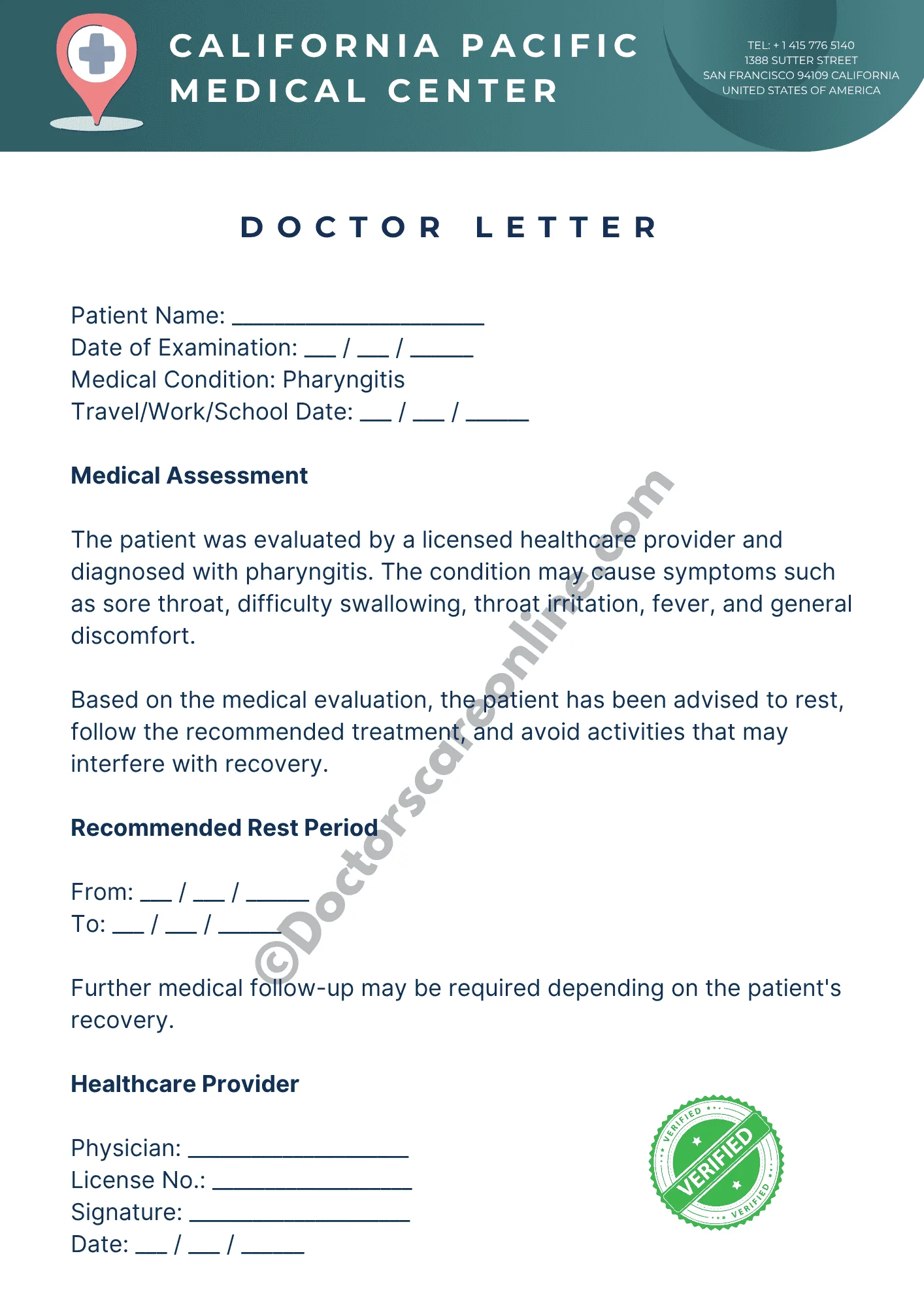
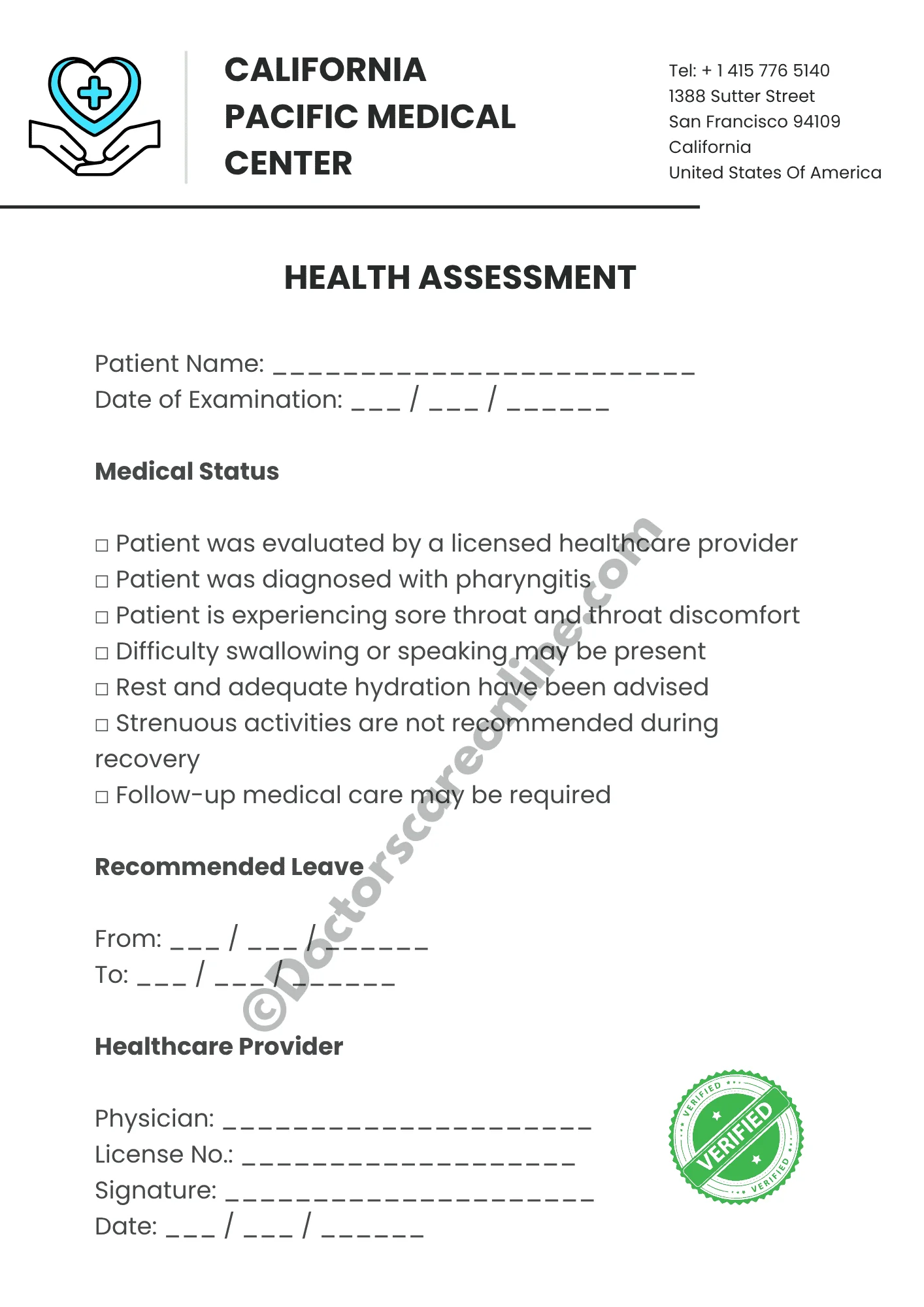
A doctor’s note for pharyngitis is medical documentation provided by a healthcare professional after evaluating a patient’s symptoms and condition. Depending on the situation, it may confirm that the patient was medically evaluated and may recommend time away from work or school, temporary activity restrictions, or a return date.
A medical note may be useful when:
- An employer requests documentation for a health-related absence.
- A school, college, or university requires an excuse for an absence.
- Throat symptoms make normal work responsibilities difficult.
- A patient needs temporary restrictions while recovering.
- A healthcare provider recommends staying home because of illness.
- Follow-up documentation is needed after an initial evaluation.
The exact information included depends on the provider’s clinical judgment and the requirements of the organization requesting the documentation.
If your symptoms are affecting your ability to work or attend school, an online doctor visit may provide a convenient way to discuss your condition with a licensed healthcare provider where telehealth is appropriate. After evaluating your symptoms and medical history, the provider can determine whether treatment, testing, activity restrictions, or medical documentation is appropriate.
You can also visit:
- Doctors Note for Child School Absence
- Doctor’s Note for Family Leave of Absence
- 6 Months of Unlimited Doctor’s Notes
- Unlimited Doctor’s Notes for 1 Year
When Might You Need a Doctor’s Note for Pharyngitis?
A medical note may be useful when throat symptoms interfere with responsibilities that require attendance, communication, physical activity, or close contact with others.
You may consider seeking medical documentation if:
- You cannot safely perform your normal job duties because of illness, weakness, fever, or significant throat symptoms.
- Your employer requires medical documentation for a sick absence.
- You need an excused school absence because of your illness.
- Your symptoms affect speaking or communication, particularly if your occupation requires frequent talking.
- A healthcare provider recommends temporary activity limitations while you recover.
- You need documentation for a return-to-work or return-to-school process, if required by the organization.
Whether a note is medically appropriate is determined by the healthcare provider after evaluation.
Common Causes of Pharyngitis
Pharyngitis refers to inflammation of the pharynx, commonly experienced as a sore or irritated throat. It may occur as part of a viral respiratory illness or from a bacterial infection such as group A strep. Pharyngitis can have several causes, and identifying the likely cause is important when deciding whether testing or specific treatment is necessary.
Viral Pharyngitis
Viruses are the most common cause of sore throat. Viral pharyngitis may occur with:
- Common cold symptoms
- Influenza-like illness
- Cough
- Runny nose
- Hoarseness
- Fatigue
- Fever
Antibiotics do not treat viral infections.
Bacterial Pharyngitis
Group A Streptococcus can cause bacterial pharyngitis, commonly known as strep throat. Symptoms may include:
- Sudden sore throat
- Fever
- Painful swallowing
- Red and swollen tonsils
- Swollen lymph nodes in the front of the neck
- White patches or streaks on the tonsils
- Small red spots on the roof of the mouth
A healthcare provider may use a rapid strep test or throat culture when group A strep is suspected.
Other Possible Triggers
Throat inflammation or soreness may also be associated with:
- Allergies
- Smoke exposure
- Irritants
- Dry air
- Other upper respiratory conditions
A healthcare professional can help determine whether symptoms are consistent with an infection or another cause.
Doctor’s Note for Pharyngitis for Work
A pharyngitis doctor’s note may be requested when an employee needs documentation for a medically related absence or temporary workplace restriction.
Depending on the medical assessment, documentation may address:
- Date of medical evaluation
- Recommended absence period, when medically appropriate
- Expected return date, if known
- Temporary activity restrictions
- Follow-up recommendations
- Healthcare provider information
Employers may have their own documentation requirements. Before submitting a note, employees should review their workplace’s sick-leave or attendance policy.
Doctor’s Note for Pharyngitis for School or College
Students may need medical documentation when pharyngitis symptoms prevent them from attending classes, completing examinations, participating in activities, or meeting attendance requirements.
A healthcare provider may document:
- That the student was evaluated
- The relevant date of the medical visit
- Recommended absence or activity limitations, when appropriate
- A possible return date when clinically appropriate
- Follow-up recommendations
School and college policies vary, so students should confirm what documentation their institution accepts.
Can Pharyngitis Be Evaluated During an Online Doctor Visit?
Some cases of sore throat or suspected pharyngitis may be suitable for an online medical consultation. During a telehealth appointment, a healthcare provider can ask about symptoms, medical history, exposure, duration, severity, medications, and other relevant factors.
The provider may discuss:
- When the throat symptoms started
- Whether the illness is getting better or worse
- Presence of fever
- Difficulty swallowing
- Cough or nasal symptoms
- Tonsil or throat changes
- Exposure to someone with strep throat
- Previous episodes of throat infection
- Current medications and allergies
However, an online consultation cannot replace an in-person examination or throat testing when those are clinically necessary. Suspected group A strep may require a rapid antigen test or throat culture for confirmation.
How to Book an Online Doctor Visit for Pharyngitis
Booking an online doctor visit can be a convenient first step when your symptoms may be appropriate for telehealth.
Step 1: Choose an Online Medical Service
- Select a healthcare platform that offers online consultations with licensed healthcare professionals where telehealth services are available.
Step 2: Create or Access Your Account
- Register for an account or log in if you already have one.
Step 3: Select an Available Appointment
- Choose an available date and time that fits your schedule.
Step 4: Provide Your Medical Information
- Enter the requested information about your symptoms, medical history, medications, allergies, and other relevant details.
Step 5: Describe Your Pharyngitis Symptoms
Be specific about:
- Throat pain
- Fever
- Difficulty swallowing
- Cough
- Runny nose
- Hoarseness
- Tonsil symptoms
- How long you have been sick
- Whether symptoms are improving or worsening
Step 6: Complete the Online Visit
- Attend the appointment and answer the healthcare provider’s questions honestly and completely.
Step 7: Follow the Provider’s Recommendations
- The provider may recommend home care, testing, an in-person visit, prescription treatment when appropriate, or additional evaluation.
Step 8: Receive Medical Documentation When Appropriate
- If the healthcare provider determines that a doctor’s note is medically appropriate, documentation may be provided in accordance with applicable requirements and professional standards.
A doctor’s note is not automatically issued simply because it is requested; the provider must determine that documentation is appropriate following the medical evaluation.
What Information Should You Have Ready for Your Online Appointment?
Preparing relevant information can make your consultation more efficient.
Have the following available:
- Date your symptoms began
- Current symptoms and their severity
- Temperature or recent fever history
- Current medications
- Known medication allergies
- Existing medical conditions
- Recent exposure to someone with a sore throat or strep throat
- Previous throat infections
- Any recent testing
- Employer or school documentation requirements, if applicable
Accurate information helps the healthcare provider make an informed clinical assessment.
How Is Pharyngitis Diagnosed?
Diagnosis depends on the symptoms, medical history, physical findings, and suspected cause.
A healthcare provider may consider:
- Medical history: When symptoms began and how they have progressed.
- Symptom assessment: Presence of fever, cough, swollen glands, difficulty swallowing, and other symptoms.
- Physical examination: Examination of the throat, tonsils, and surrounding areas when an in-person assessment is performed.
- Strep testing: A rapid antigen detection test or throat culture may be used when group A strep is suspected.
- Additional evaluation: Further testing may be recommended when symptoms suggest another condition.
CDC guidance states that clinical symptoms alone cannot reliably distinguish group A strep from viral pharyngitis when clear viral symptoms are absent, which is why appropriate testing may be necessary.
Pharyngitis Treatment Options
Treatment depends on the underlying cause.
For Viral Pharyngitis
When a virus is responsible, treatment generally focuses on symptom relief and recovery. Depending on individual circumstances, a healthcare professional may recommend:
- Adequate fluids
- Rest
- Warm beverages
- Salt-water gargling
- Throat lozenges when age-appropriate
- Humidified air
- Appropriate over-the-counter symptom relief
Most uncomplicated viral sore throats improve without antibiotics.
For Confirmed or Suspected Bacterial Pharyngitis
When group A strep is confirmed, a healthcare provider may prescribe antibiotics according to current clinical guidance. Antibiotics should be taken only when prescribed and exactly as directed.
Antibiotics should not be used simply because someone has a sore throat. They do not treat viral infections and unnecessary antibiotic use can cause side effects and contribute to antimicrobial resistance.
When Should You Seek Medical Attention for Pharyngitis?
Contact a healthcare provider when throat symptoms are concerning, persistent, worsening, or interfering substantially with normal activities.
Prompt medical evaluation may be appropriate for:
- Difficulty swallowing
- Difficulty breathing
- Dehydration
- Blood in saliva or phlegm
- Significant or persistent fever
- Severe throat pain
- Rash accompanying a sore throat
- Symptoms that continue without improvement
- Symptoms that become progressively worse
- Recurrent episodes of sore throat
CDC guidance specifically identifies difficulty breathing, difficulty swallowing, dehydration, blood in saliva or phlegm, rash, and worsening or persistent symptoms as reasons to seek medical care.
Seek Emergency Care for Severe Symptoms
Emergency medical care may be necessary if you are experiencing severe difficulty breathing, an inability to swallow fluids, significant dehydration, rapidly worsening symptoms, or another potentially serious medical problem.
Do not rely solely on an online appointment when emergency evaluation is needed.
Returning to Work or School After Pharyngitis
The appropriate return date depends on the underlying illness, symptoms, treatment, and healthcare provider’s advice.
If group A strep is diagnosed, CDC guidance recommends staying home until the person is without fever and has received appropriate antibiotic treatment for at least 12–24 hours. Individual circumstances and workplace or school policies may vary.
When returning:
- Follow the healthcare provider’s recommendations.
- Complete prescribed treatment as directed.
- Follow your employer’s or school’s attendance requirements.
- Avoid close contact with others when advised.
- Monitor symptoms for worsening or recurrence.
How Our Online Doctor Visit Service Can Help
Dealing with a sore throat while trying to arrange healthcare or obtain appropriate medical documentation can be stressful. Our online doctor visit service is designed to provide a convenient way to connect with healthcare professionals where telehealth is available and appropriate.
- Convenient Access: You can start the process online without necessarily needing to travel to a clinic for the initial consultation.
- Medical Evaluation Comes First: Our service is designed around a healthcare evaluation rather than simply supplying documentation on request. A licensed healthcare provider reviews the information you provide and determines what medical advice or documentation is appropriate.
- Clear Documentation Process: When a provider determines that a doctor’s note is medically appropriate, the documentation can reflect the provider’s recommendations and applicable requirements.
- User-Focused Support: We aim to make the online process straightforward by providing guidance through the appointment and documentation process.
Help With Registration, Login, Payment, or Other Questions
If you have a problem while using the website, you do not have to figure everything out on your own.
You can use our chatbox to ask questions or request help with issues such as:
- Creating an account
- Registering for the service
- Logging into your account
- Difficulty accessing your appointment
- Payment-related questions
- Problems completing checkout
- Questions about the online appointment process
- General website or service-related queries
Our support team can help guide you through the relevant process and explain the next steps.
Why Users Can Trust Our Online Doctor Visit Process
Trust is especially important when dealing with medical information and healthcare documentation.
Our service focuses on:
- Healthcare evaluation: Medical documentation should follow an appropriate evaluation by a healthcare professional.
- Clear communication: Users provide information about their symptoms and needs so the provider can make an informed assessment.
- Responsible documentation: A doctor’s note is provided only when the healthcare provider determines that it is medically appropriate.
- Convenient online access: Users can begin the consultation process online when telehealth is suitable.
- Customer support: Users can contact the website’s chatbox when they have registration, login, payment, appointment, or general service questions.
- Privacy-conscious communication: Users should provide only the information requested through the appropriate healthcare and website channels.
The goal is to make accessing appropriate healthcare evaluation and related documentation more convenient while maintaining a responsible medical process.
What a Doctor’s Note for Pharyngitis May Include
The contents of a medical note vary according to the provider and the reason documentation is required.
It may include:
| Information | Purpose |
|---|---|
| Patient name | Identifies the individual evaluated |
| Date of evaluation | Records when medical assessment occurred |
| Medical confirmation | Confirms that an evaluation took place |
| Recommended absence | Documents medically appropriate time away, if applicable |
| Activity restrictions | Identifies temporary limitations, if applicable |
| Return date | Provides a recommended return date when appropriate |
| Follow-up recommendation | Indicates whether further medical evaluation is needed |
| Provider information | Identifies the healthcare professional or practice |
A doctor’s note does not necessarily need to disclose a detailed diagnosis. The amount of medical information included depends on the provider, applicable requirements, and the purpose of the documentation.
How Long Is a Pharyngitis Doctor’s Note Valid?
There is no single nationwide validity period for every doctor’s note.
The relevant period may depend on:
- The dates written by the healthcare provider
- The patient’s medical condition
- The recommended recovery period
- The employer’s documentation policy
- The school’s attendance policy
- Whether additional evaluation is required
If symptoms continue beyond the period covered by the documentation, a healthcare provider may recommend reassessment rather than automatically extending the original note.
Can a Doctor’s Note Be Used for Work Restrictions?
When medically appropriate, a healthcare provider may recommend temporary restrictions based on a patient’s symptoms and job requirements.
Possible restrictions could involve:
- Limiting strenuous activity
- Avoiding tasks that worsen symptoms
- Taking appropriate rest breaks
- Temporarily modifying physically demanding responsibilities
- Following a gradual return to normal duties
The provider determines whether restrictions are appropriate and what limitations should be documented.
Protecting Your Health While Recovering
While recovering from pharyngitis, follow the recommendations provided by your healthcare professional.
General supportive measures may include:
- Drink adequate fluids.
- Get sufficient rest.
- Avoid smoking and secondhand smoke.
- Use a humidifier if dry air aggravates symptoms.
- Choose soothing beverages or foods that are comfortable to swallow.
- Follow medication instructions carefully.
- Avoid taking antibiotics that were not prescribed for your current illness.
- Monitor your symptoms and seek medical care if they worsen.
CDC recommends measures such as fluids, warm beverages, salt-water gargling, humidified air, and appropriate symptom-relief medicines for sore throat symptoms.
What to Avoid When You Have Pharyngitis
Some actions can delay appropriate care or create unnecessary health risks.
Avoid:
- Taking leftover antibiotics.
- Using someone else’s prescription medication.
- Stopping prescribed antibiotics without discussing concerns with your healthcare provider.
- Assuming every sore throat is strep throat.
- Ignoring severe or worsening symptoms.
- Altering a medical note after it has been issued.
- Providing inaccurate information during a medical consultation.
Antibiotics should be used only when medically indicated because they do not treat viral infections and unnecessary use can cause harm.
Medical Documentation and Your Privacy
A doctor’s note generally focuses on the information necessary for its intended purpose. Depending on the situation, it may confirm that a patient was evaluated and describe recommended leave, restrictions, or a return date without providing unnecessary clinical details.
The exact information that can or should be included depends on the healthcare provider, applicable law, and the requirements of the organization requesting documentation.
Users should always review the information on their medical documentation before submitting it and contact the issuing provider if they believe something is inaccurate.
Frequently Asked Questions
1. Is pharyngitis the same as strep throat?
No. Pharyngitis describes inflammation of the throat and can have several causes. Strep throat is a specific bacterial infection caused by group A Streptococcus. A healthcare provider may recommend testing when strep is suspected.
2. Can pharyngitis cause you to lose your voice?
It can. Throat inflammation may occur alongside conditions that affect the voice, particularly when the illness also causes hoarseness or irritation of the upper airway. Persistent or significant voice changes should be discussed with a healthcare professional.
3. Can pharyngitis spread to other people?
Some causes of pharyngitis are contagious. Viral respiratory infections and group A strep can spread through close contact. The appropriate precautions depend on the underlying cause and medical advice.
4. Do I need a strep test if I have a sore throat?
Not everyone with a sore throat needs strep testing. When clear viral symptoms are present, testing for group A strep may not be necessary. When those viral symptoms are absent and strep is suspected, a healthcare provider may recommend a rapid strep test or throat culture.
5. Can pharyngitis come back after treatment?
Yes. A person can experience another episode of throat inflammation because different infections and noninfectious causes can produce similar symptoms. Recurrent or persistent sore throats should be discussed with a healthcare provider to determine whether additional evaluation is needed.
Important Medical Disclaimer
This content is provided for general educational and informational purposes only. It is not a substitute for professional medical advice, diagnosis, or treatment.
A doctor’s note for pharyngitis should be issued only by an appropriately licensed healthcare provider after an appropriate medical evaluation. An online doctor visit may not be suitable for every throat condition, and some patients may require an in-person examination, throat swab, laboratory testing, or urgent medical care.
Treatment decisions, including whether antibiotics are appropriate, should be made by a healthcare professional based on the patient’s individual condition. Do not use antibiotics without medical advice.





Reviews
There are no reviews yet.