
An online doctor’s note for viral fever is medical documentation that may be provided by a licensed healthcare professional after an appropriate consultation and evaluation. If viral fever symptoms affect your ability to work, attend school, travel, or complete normal daily activities, a healthcare provider may recommend rest, temporary activity restrictions, or time away from work or school when medically appropriate.
Our online healthcare service helps make it easier to connect with a licensed healthcare provider from the convenience of home. During your consultation, you can explain your symptoms, discuss how they are affecting your daily activities, and receive professional medical guidance. If the provider determines that medical documentation is appropriate, they may issue a doctor’s note in accordance with applicable regulations and their clinical judgment.
A doctor’s note is not automatically provided simply because it is requested. It should be based on a genuine medical consultation and the healthcare provider’s assessment.
Related Doctor Note : ——-
When Might You Need a Doctor’s Note for Viral Fever?
Viral fever can cause symptoms such as elevated temperature, fatigue, body aches, chills, headache, weakness, and other flu-like symptoms. When these symptoms interfere with normal responsibilities, medical documentation may be requested.
You may need a doctor’s note when:
- Your employer requires medical documentation for sick leave.
- Your school or college requires proof of a medical absence.
- Fever and associated symptoms prevent you from safely performing your job.
- You have been advised to rest during recovery.
- You need temporary work or activity restrictions.
- You need documentation following an online medical consultation.
- Your workplace requires a return-to-work or fitness-for-duty document.
- You need to explain a medically necessary absence according to applicable organizational policies.
Requirements vary between employers, educational institutions, insurers, and jurisdictions, so it is important to check the specific documentation requirements that apply to you.
Common Symptoms Associated With Viral Fever
Viral infections can produce different symptoms depending on the underlying illness. Common symptoms may include:
- Fever or elevated body temperature
- Chills
- Headache
- Body aches
- Muscle pain
- Fatigue or weakness
- Sore throat
- Cough
- Runny or stuffy nose
- Reduced appetite
- Nausea
- Mild vomiting or diarrhea
- Sweating
Not every fever is caused by a viral infection. A healthcare professional can evaluate your symptoms and determine whether further assessment or testing is appropriate.
How an Online Doctor’s Appointment for Viral Fever Works
An online consultation can provide a convenient way to discuss fever and related symptoms with a licensed healthcare professional when telehealth is appropriate.
Step 1: Choose an Online Healthcare Service
Select a legitimate telehealth service that connects patients with licensed healthcare professionals.
Step 2: Register or Log In
Create an account using the information requested by the healthcare service. Existing users can log in to their account to continue.
Step 3: Book Your Appointment
Choose an available appointment time that works for your schedule.
Step 4: Describe Your Symptoms
Provide accurate information about your fever and other symptoms, including when they started, how severe they are, and whether they are improving or getting worse.
Step 5: Complete Your Medical Consultation
Speak with the healthcare provider through the available online consultation method. The provider may ask about your symptoms, medical history, medications, recent illnesses, and other relevant information.
Step 6: Follow the Provider’s Recommendations
The healthcare professional may recommend home care, further testing, an in-person examination, treatment, rest, or other medical follow-up depending on your condition.
Step 7: Receive Documentation When Medically Appropriate
If the provider determines that medical documentation is justified, they may issue a doctor’s note according to their professional judgment and applicable requirements.
What Information May Be Included in an Online Doctor’s Note?
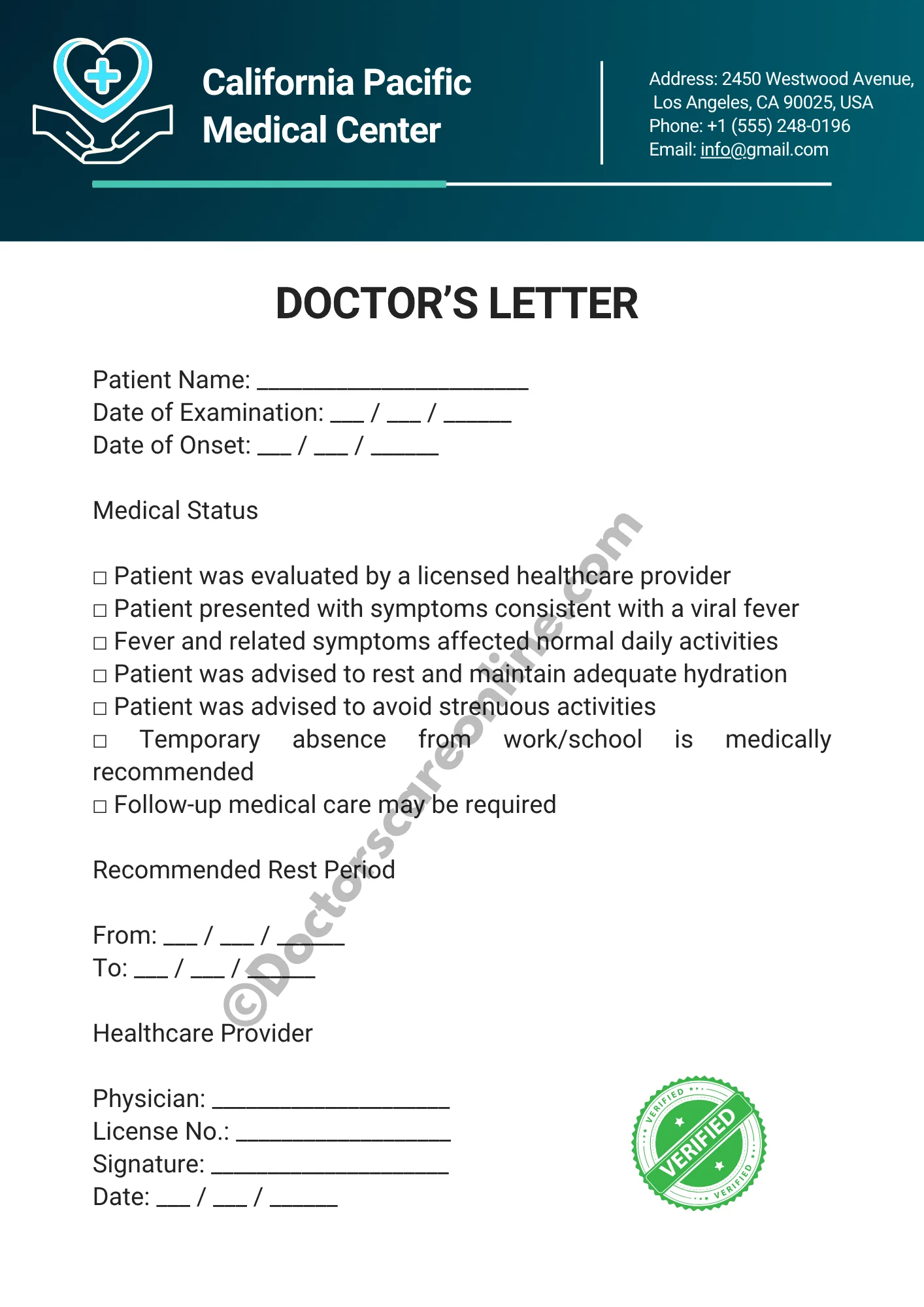
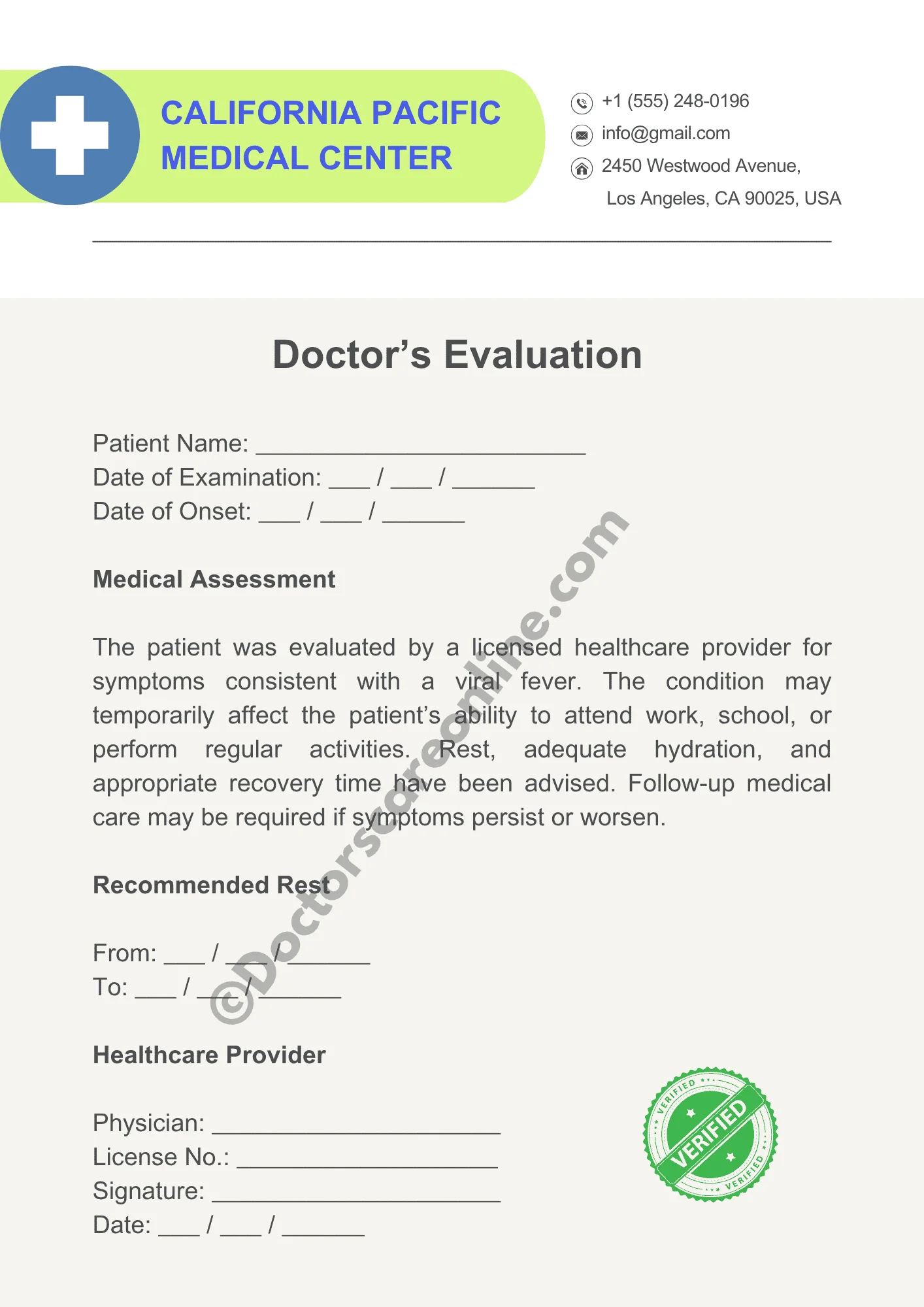
The contents of a medical note vary depending on the provider and the purpose of the documentation. It may include:
- Patient’s name
- Date of medical consultation
- Confirmation that the patient was evaluated
- Recommended period of absence, when medically appropriate
- Activity or work restrictions, if necessary
- Recommended return-to-work or return-to-school date
- Follow-up recommendations
- Healthcare provider’s name and credentials
- Clinic or healthcare service information
- Provider’s signature or other applicable authentication
A doctor’s note does not necessarily need to disclose a detailed diagnosis. The healthcare provider determines what information is appropriate to include while considering applicable privacy requirements.
Can You Get an Online Doctor’s Note for Viral Fever?
In many locations, you may be able to consult a licensed healthcare provider online for fever and related symptoms. Whether a doctor can issue documentation remotely depends on the provider’s clinical assessment, the nature of the illness, telehealth requirements, and applicable local regulations.
During the consultation, the provider determines whether your symptoms can be appropriately evaluated through telehealth. If an in-person examination or testing is necessary, you may be advised to visit a clinic or other appropriate healthcare facility.
If medical leave or other documentation is clinically justified, the provider may issue a doctor’s note where permitted.
How Our Online Service Helps You
Getting medical documentation should be part of a legitimate healthcare process, not simply a document-purchasing transaction. Our service is designed to make the consultation process more convenient while keeping the healthcare provider’s medical judgment at the center of the process.
- Convenient Online Access: You can connect with a healthcare provider online without necessarily needing to travel to a clinic for an initial consultation, where telehealth is appropriate.
- Licensed Healthcare Professionals: Your symptoms are reviewed by a healthcare professional rather than relying on a self-created or altered document.
- Convenient Scheduling: Online appointment options can make it easier to find a consultation time that fits your schedule.
- Clear Medical Process: You can explain your symptoms, receive professional guidance, and understand whether medical documentation is appropriate for your situation.
- Documentation When Appropriate: A doctor’s note is issued only when the healthcare provider determines that it is medically justified and permitted.
- Privacy-Conscious Documentation: Medical documentation generally focuses on information relevant to the absence, restrictions, or return date rather than unnecessarily disclosing private medical details.
Having Trouble With Registration, Login, Payment, or Your Order?
If you are experiencing an issue while using our website, you do not have to figure it out on your own.
You can contact our website chatbox if you have questions or problems related to:
- Creating an account
- Registering on the website
- Logging into your account
- Booking an online consultation
- Payment or checkout
- Understanding the order or appointment process
- Technical issues on the website
- Questions about using our online service
- General order or service-related queries
Our support team can help you understand the next steps and troubleshoot website-related issues.
Important: The chatbox is intended for website, account, payment, booking, and service-support questions. Medical advice should be obtained directly from a licensed healthcare professional during an appropriate consultation.
How Long Can a Doctor Excuse You for Viral Fever?
There is no universal number of days that a healthcare provider must excuse someone from work or school for viral fever.
The recommended recovery period may depend on:
- Severity of the symptoms
- Underlying illness
- Fever duration
- Overall health
- Response to treatment or supportive care
- Type of work or school activities
- Whether the person is able to safely perform normal activities
- Healthcare provider’s clinical assessment
Some illnesses may resolve within a few days, while others can take longer. Your healthcare provider should determine whether you need medical leave and how long it should last.
Do not assume that a specific number of days is automatically appropriate for every case of viral fever.
Viral Fever and Work: When Might Time Off Be Appropriate?
Fever and associated symptoms can affect concentration, energy, mobility, and the ability to perform physical or mentally demanding work.
A healthcare provider may recommend staying home when symptoms significantly interfere with your ability to work safely or when recovery requires rest.
Temporary work restrictions may be considered depending on the person’s condition and job duties.
For example, a healthcare provider may recommend temporarily:
- Avoiding physically demanding activities
- Limiting strenuous exercise
- Reducing certain work duties
- Taking time to rest and recover
- Returning to work after a specified recovery period
Your employer may have its own sick-leave and medical-documentation policies, so check those requirements as well.
Viral Fever and School or College Absence
Students experiencing significant fever or viral symptoms may be unable to attend classes, complete examinations, or participate in normal academic activities.
Depending on the student’s condition, a healthcare provider may recommend temporary absence or other medically appropriate restrictions.
A medical note may be requested by a school, college, or university to document the reason for an absence. Students should check their institution’s policies regarding:
- Medical absence documentation
- Exam rescheduling
- Attendance requirements
- Submission deadlines
- Return-to-class requirements
What Should You Tell the Doctor During an Online Consultation?
Accurate information helps the healthcare provider understand your condition and determine whether online evaluation is appropriate.
Be prepared to explain:
- When your fever started
- Your highest measured temperature, if known
- How you measured your temperature
- Other symptoms you are experiencing
- Whether symptoms are improving or worsening
- Recent contact with someone who was ill
- Recent travel, if medically relevant
- Current medications
- Existing medical conditions
- Any recent medical treatment
- Whether you are able to work, attend school, eat, drink, rest, and perform normal activities
Do not intentionally exaggerate or hide symptoms in order to obtain medical documentation. Accurate information allows the healthcare provider to make a safer and more appropriate clinical decision.
When Should You Seek Medical Attention for a Fever?
Most uncomplicated viral illnesses improve with supportive care, but some symptoms require medical assessment.
Contact a healthcare professional when:
- Fever persists or repeatedly returns.
- Symptoms are getting worse rather than improving.
- You have significant dehydration or difficulty maintaining fluid intake.
- You experience persistent vomiting.
- You develop severe weakness or unusual confusion.
- You have difficulty breathing.
- You experience severe or persistent pain.
- You have concerning symptoms because of an underlying medical condition.
- You are concerned about a high or persistent fever in a young child, older adult, or vulnerable person.
Seek urgent or emergency medical care for severe difficulty breathing, significant confusion or inability to stay awake, seizures, severe dehydration, blue or gray lips/skin, or other serious or rapidly worsening symptoms.
Can Viral Fever Be Treated Online?
Some mild illnesses and fever-related symptoms can be discussed through telehealth. However, not every fever can be safely diagnosed or managed online.
Depending on the symptoms, a healthcare provider may:
- Recommend supportive care
- Discuss hydration and rest
- Review current medications
- Recommend monitoring symptoms
- Suggest laboratory testing
- Recommend an in-person examination
- Refer you for urgent or emergency care when necessary
Do not rely on an online consultation alone when symptoms indicate that an in-person assessment or emergency treatment may be necessary.
Home Care During Viral Fever Recovery
For mild illnesses, your healthcare provider may recommend supportive measures such as:
- Getting adequate rest
- Drinking enough fluids
- Eating nutritious foods as tolerated
- Monitoring your temperature
- Avoiding strenuous physical activity
- Following the healthcare provider’s treatment recommendations
- Taking medications only as directed by a qualified healthcare professional
Avoid taking prescription medication without appropriate medical guidance.
How to Return to Work or School After Viral Fever
Returning to normal activities should depend on your symptoms, overall recovery, and healthcare provider’s recommendations.
Before returning:
- Make sure you are able to perform normal activities safely.
- Follow any medical restrictions provided by your healthcare professional.
- Complete any recommended follow-up.
- Follow your workplace or school’s illness and attendance policies.
- Ask your healthcare provider if you are unsure whether you are ready to resume normal activities.
If your symptoms return or become worse after resuming normal activities, seek medical advice.
Why Choose an Online Medical Consultation Instead of a Self-Created Note?
A self-created or altered medical document does not replace professional medical evaluation and may not be accepted by an employer, school, insurer, or other organization.
An online medical consultation provides an opportunity to:
- Discuss your actual symptoms with a healthcare professional
- Receive medical guidance
- Determine whether telehealth is appropriate
- Obtain documentation only when medically justified
- Understand whether further in-person care is needed
This approach supports legitimate medical documentation while keeping healthcare decisions with a qualified professional.
Important Things to Know Before Requesting a Doctor’s Note
Keep the following points in mind:
- A doctor’s note should come from a legitimate healthcare provider.
- Medical documentation is not guaranteed before an evaluation.
- The provider decides whether a note is clinically appropriate.
- Employers and schools may have different documentation requirements.
- Telehealth rules differ by location.
- Do not alter, forge, or modify a medical document.
- Seek in-person or emergency care when your symptoms require it.
- Keep copies of your medical documentation when appropriate.
- Follow the instructions provided by your healthcare professional.
Frequently Asked Questions
1. Can a doctor’s note for viral fever be issued without an in-person visit?
In some situations, a licensed healthcare provider may evaluate fever symptoms through telehealth if the condition can be safely assessed remotely. Whether documentation can be issued depends on the provider’s assessment and applicable telehealth requirements.
2. Will my employer accept an online doctor’s note for viral fever?
Acceptance depends on your employer’s policies and the applicable rules in your location. Before booking a consultation, check whether your employer accepts medical documentation from telehealth providers and whether it has specific requirements.
3. Can I request a doctor’s note for a past viral fever?
A healthcare provider should determine whether documentation for a previous illness can be issued. They may need sufficient medical information or an appropriate consultation before deciding whether documentation is medically justified.
4. Can a viral fever doctor’s note include a return-to-work date?
Yes, when clinically appropriate, a healthcare provider may include a recommended return-to-work date or other activity restrictions based on the patient’s condition and recovery.
5. What if my fever does not improve after the consultation?
If your fever persists, worsens, or new concerning symptoms develop, contact a healthcare professional for reassessment. You may be advised to have an in-person examination, testing, or urgent medical care depending on your symptoms.
Medical Disclaimer
This content is provided for general educational and informational purposes only and does not replace professional medical advice, diagnosis, or treatment.
A doctor’s note should only be issued by a licensed healthcare professional following an appropriate medical evaluation. An online consultation may not be suitable for every medical condition, and a provider may recommend in-person care, testing, or emergency treatment when necessary.
Medical documentation, sick-leave recommendations, return-to-work dates, work restrictions, and telehealth availability may vary according to the patient’s circumstances, healthcare provider, employer, educational institution, location, and applicable laws or regulations.
Reviews
There are no reviews yet.