
Getting medical documentation online should involve more than simply filling out a form. Online Med Care Doctor’s Note Through Consultation connects patients with a healthcare consultation process where a licensed healthcare provider can review their symptoms, discuss their health concerns, and determine whether medical documentation is appropriate.
Whether you need documentation related to work, school, travel, recovery, or another legitimate medical situation, the process begins with a healthcare consultation. If the provider determines that a doctor’s note is medically appropriate, the documentation can be provided according to the provider’s clinical judgment and applicable requirements.
Related Doctor Note :——
You can also visit:
- Doctors Note for Limited Work
- Doctors Note for Airline Refund
- Doctors Note for Medication on Flight
- Doctor’s Note for Work From Home
- Unlimited Doctor’s Notes for 1 Year
If documentation is medically justified, the provider may include relevant information such as:
- Date of medical evaluation
- Recommended period away from work or school, when appropriate
- Temporary activity or workplace restrictions
- Recommended return date, when clinically appropriate
- Follow-up recommendations
- Healthcare provider and practice information
The specific information included depends on the patient’s circumstances and the provider’s professional judgment.
A doctor’s note should not be treated as a guaranteed product obtained simply by placing an order. Medical documentation is issued only when a healthcare provider determines that it is appropriate after an evaluation.
How Online Med Care Doctor’s Note Helps Patients
Online Med Care is designed to make the process of accessing a medical consultation and requesting legitimate medical documentation more convenient.
Instead of trying to determine on your own what documentation you need, you can begin with a healthcare consultation and explain your situation directly to a provider.
The platform can be useful when you:
- Need a convenient way to request a telehealth consultation
- Want to discuss a health concern without initially visiting a physical office
- Need medical documentation for an eligible situation
- Have difficulty fitting an in-person appointment into your schedule
- Need guidance about whether your symptoms require additional medical attention
- Want to communicate with a healthcare provider from a private location
Telehealth can allow patients to communicate with providers through a phone, tablet, or computer. HHS recommends using a private setting and appropriate privacy and security safeguards when participating in telehealth.
Why Patients Can Use Online Med Care With Confidence
Trust is particularly important when a website handles health information. Online Med Care focuses on connecting the documentation request with an actual healthcare consultation rather than presenting a doctor’s note as something that can simply be purchased without medical review.
The patient experience is built around several important principles:
- Consultation-Based Process: A healthcare provider evaluates the patient’s situation before deciding whether medical documentation is appropriate. This helps distinguish legitimate medical documentation from unsupported requests.
- Licensed Healthcare Professionals: Telehealth providers must meet applicable professional licensing requirements. In the United States, healthcare professionals generally need to be licensed or otherwise legally permitted to practice in the state where the patient is located. Requirements can differ by state.
- Patient Privacy: Health information is sensitive. Telehealth services should use appropriate privacy and security safeguards, and patients should understand how their information is handled. HHS explains that HIPAA protections can apply to telehealth visits, related communications, and health information handled by covered entities.
- Clear Patient Communication: Patients should be able to understand what happens during the consultation, what information may be requested, and what the provider can and cannot determine through an online appointment.
- Support When You Need It: If you experience a problem while using the website, you do not have to figure everything out alone. If you have a question about registration, login, payment, appointment access, account-related issues, or another website-related concern, you can contact the site’s chatbox support for assistance.
The chatbox can help direct you to the appropriate support information. Medical questions, however, should be discussed with the healthcare provider rather than treated as customer-service questions.
Who May Benefit From an Online Medical Consultation?
An online consultation may be convenient for adults who need to discuss an eligible health concern with a healthcare professional and may need medical documentation following the evaluation.
Common situations may include:
- Work-related absence
- School or college absence
- Temporary activity limitations
- Recovery-related restrictions
- Certain non-emergency illnesses
- Follow-up discussions
- Documentation requests related to an evaluated medical condition
Whether telehealth is suitable depends on the patient’s symptoms, medical history, location, and the provider’s clinical assessment.
Online consultation is not appropriate for every medical condition. Symptoms requiring a physical examination, diagnostic testing, emergency treatment, or other in-person services may need care at an urgent care center, physician’s office, emergency department, or another appropriate healthcare facility.
What Happens During an Online Medical Consultation?
The consultation process is designed to give the healthcare provider enough information to determine the appropriate next step.
1. Create or Access Your Account
- Register for an account or log in using the information requested by the website.
2. Select the Appropriate Consultation
- Choose the available medical consultation that matches your reason for seeking care.
3. Provide Your Health Information
- You may be asked about your symptoms, medical history, medications, allergies, recent injuries, and other information relevant to the consultation.
4. Complete the Consultation
- Meet with the healthcare provider using the available telehealth method. Be honest and specific when describing your symptoms and limitations.
5. Receive Medical Guidance
- The provider may recommend self-care, treatment, additional evaluation, testing, an in-person appointment, or another appropriate next step.
6. Documentation When Medically Appropriate
- If the provider determines that a doctor’s note or other medical documentation is appropriate, it may be issued according to the provider’s clinical judgment and applicable requirements.
What Information Should You Have Ready?
Preparing relevant information before the consultation can make it easier to explain your situation accurately.
Depending on the reason for your appointment, you may want to have:
- Your current symptoms
- When the symptoms started
- Any recent injury or illness
- Current medications and allergies
- Relevant medical history
- Previous treatment or diagnosis
- Your occupation or school requirements
- Physical activities that are difficult because of your symptoms
- The dates for which documentation may be relevant
- Any documentation requirements provided by your employer or school
Do not exaggerate, conceal, or change medical information to obtain documentation. Accurate information helps the healthcare provider make an appropriate clinical assessment.
Doctor’s Note for Work Through Online Consultation
Employees may sometimes need medical documentation when a health condition affects their ability to perform normal job duties.
Depending on the clinical situation, a healthcare provider may recommend:
- Temporary absence from work
- Modified work duties
- Reduced physical activity
- Restrictions on lifting or repetitive movements
- Additional rest periods
- A gradual return to regular duties
- Follow-up evaluation before unrestricted work
The provider determines whether restrictions are medically appropriate. Employers may have separate policies regarding attendance, documentation, accommodations, and return-to-work procedures.
Doctor’s Note for School or College
Students may also need medical documentation when an illness or injury interferes with attendance, examinations, assignments, or other academic responsibilities.
A healthcare provider may document an evaluated medical condition and, when medically appropriate, recommend a period of absence or activity limitation.
Students should check their school’s requirements before requesting documentation because institutions may have specific submission procedures, deadlines, or documentation standards.
Privacy and Security During Online Care
Medical information should be handled carefully during any online healthcare interaction.
Patients can reduce privacy risks by:
- Using a private location for the consultation
- Using their own device when possible
- Avoiding public Wi-Fi when discussing sensitive health information
- Keeping account passwords private
- Using available multi-factor authentication
- Keeping devices and software updated
- Confirming that appointment links come from the expected provider or service
HHS recommends private settings, secure communication practices, strong passwords, device security, and other precautions for telehealth users.
Patients should also review the applicable privacy notice and understand how their health information is collected, used, and protected.
When an Online Consultation May Not Be Enough
Telehealth is useful for many healthcare needs, but it cannot replace in-person medical care in every situation.
A healthcare provider may recommend in-person evaluation when the patient’s symptoms require:
- Physical examination
- Laboratory testing
- Imaging
- Vital-sign assessment
- Diagnostic procedures
- Hands-on treatment
- Emergency care
- Specialist evaluation
If a provider believes an online consultation is insufficient, following that recommendation is important.
For severe or potentially life-threatening symptoms, do not wait for an online consultation. Seek appropriate emergency medical care.
What Makes a Doctor’s Note Legitimate?
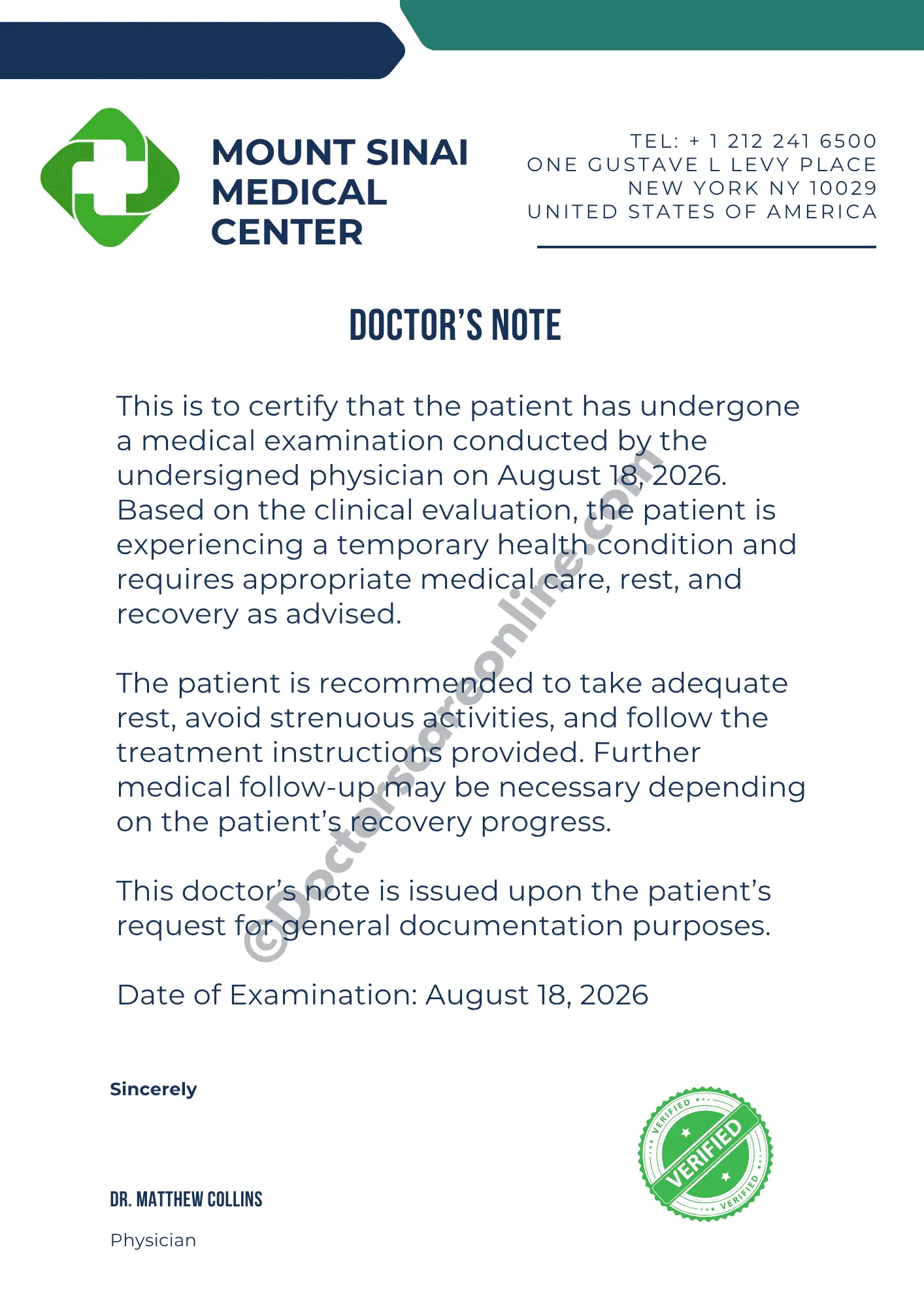
A legitimate doctor’s note should be connected to an actual medical evaluation and issued by an appropriately licensed or authorized healthcare professional.
Depending on the situation, documentation may contain:
- Patient identification
- Date of evaluation
- Relevant medical confirmation
- Recommended absence or restrictions, when applicable
- Return-to-work or school information, when appropriate
- Provider identification
- Practice or clinic information
- Provider signature or authorized authentication
Patients should never modify an issued medical document. If information is incorrect, contact the provider or support team to determine the appropriate correction process.
Help With Registration, Login, Payment, or Website Questions
Online healthcare should be straightforward to access. If you have a technical or account-related problem, you can use the website’s chatbox to ask for assistance.
You can contact support through the chatbox if you need help with:
- Creating an account
- Logging into your account
- Accessing your appointment
- Understanding the checkout process
- Payment-related questions
- Technical difficulties
- General website navigation
- Questions about your order or consultation status
The support team can help with website and account issues. For questions about your symptoms, diagnosis, treatment, medication, or medical condition, speak directly with the healthcare provider.
Why Consultation-Based Documentation Is Different
A consultation-based approach places the medical evaluation before the documentation decision.
This means the provider can consider the patient’s reported symptoms, relevant medical history, functional limitations, and other available information before determining whether a doctor’s note is clinically appropriate.
This approach also gives patients an opportunity to discuss their health concern rather than relying solely on a self-reported request for documentation.
The result is a process centered on medical evaluation, appropriate documentation, patient privacy, and professional judgment.
Frequently Asked Questions
Q: Can I request a doctor’s note before speaking with a healthcare provider?
You can request a consultation and explain why you need medical documentation, but whether a note is issued depends on the healthcare provider’s assessment. A request alone does not guarantee that documentation will be provided.
Q: Can my consultation be canceled if telehealth is not appropriate for my condition?
A provider may determine that an online consultation is not suitable for your particular symptoms or circumstances and may recommend in-person care or another healthcare service instead.
Q: Will my employer automatically receive information from my online consultation?
Medical information should be handled according to applicable privacy requirements and the provider’s privacy practices. Patients should review the applicable privacy notice and understand what information may be disclosed and under what circumstances. HIPAA provides privacy protections for covered health information, subject to its rules and exceptions.
Q: What happens if my payment goes through but I cannot access my consultation?
If you experience a payment or appointment-access problem, use the website’s chatbox to contact support. Provide the relevant account or transaction information requested by the support team, but avoid sending sensitive medical information through an unsecured channel.
Q: Can a healthcare provider refuse to issue medical documentation?
Yes. A healthcare provider may decline to issue a doctor’s note when the available medical information does not support the request, when the requested documentation would be inaccurate, or when the provider determines that another form of care or evaluation is necessary.
Medical Disclaimer: This information is provided for general educational purposes and does not replace professional medical advice, diagnosis, or treatment. A doctor’s note should only be issued by an appropriately licensed or authorized healthcare provider after an appropriate medical evaluation.
Telehealth availability, provider licensing, informed-consent requirements, privacy obligations, and medical-documentation rules can vary by state and individual circumstances.


Reviews
There are no reviews yet.