

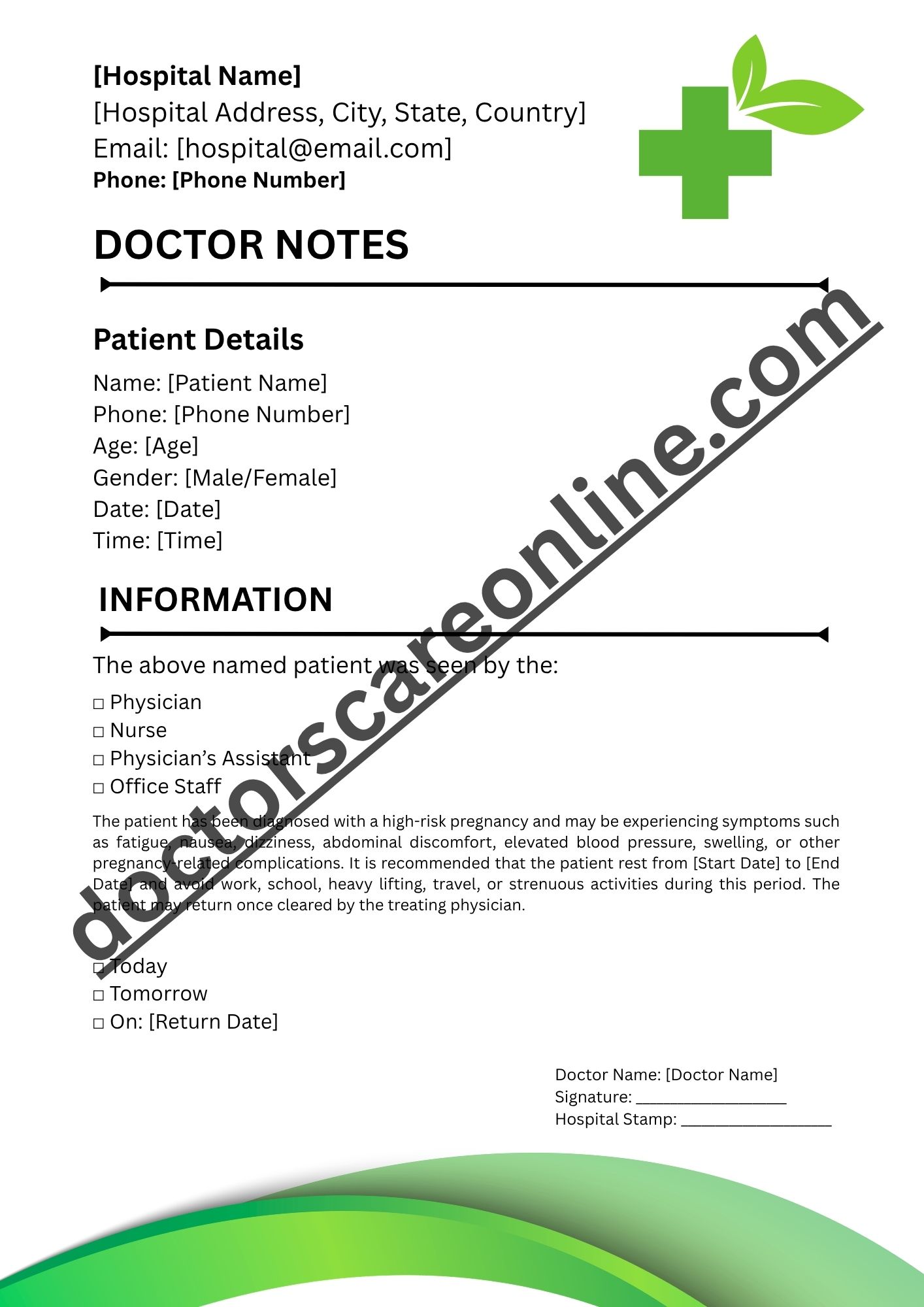
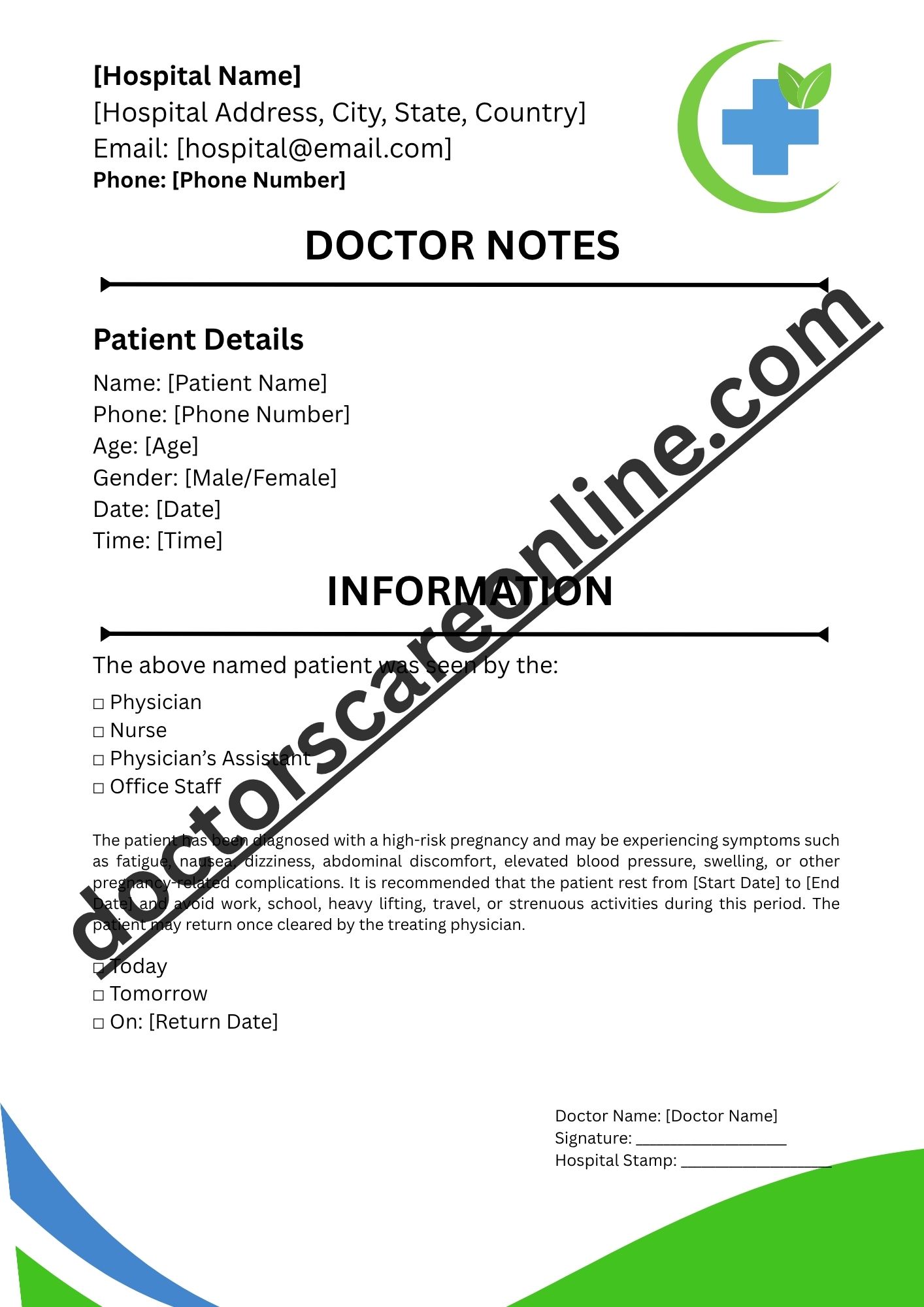
A high-risk pregnancy can bring additional medical concerns that require closer monitoring than a typical pregnancy. In some cases, your healthcare provider may recommend changes to your daily routine, workplace responsibilities, or school attendance to help protect your health and your baby’s development. A Doctor’s Note for a High-Risk Pregnancy serves as official medical documentation explaining these recommendations.
Whether you need time away from work, temporary job modifications, permission to work from home, or accommodations at school, a doctor’s note helps communicate your provider’s medical advice. The purpose of the note is not simply to excuse an absence—it supports necessary adjustments that reduce potential risks during pregnancy.
This guide explains when a doctor’s note may be needed, what information it typically includes, common pregnancy complications that may require work restrictions, and how to request documentation from your healthcare provider.
When Is a High-Risk Pregnancy Serious Enough for a Doctor’s Note?
Doctor’s Note for a High-Risk Pregnancy requires time away from work or school. Many individuals continue their normal routines with regular prenatal care. However, if your condition increases the risk of complications or makes daily activities unsafe, your healthcare provider may issue a doctor’s note recommending restrictions or leave.
A note may be appropriate in situations such as:
- High blood pressure during pregnancy (gestational hypertension)
- Preeclampsia
- Placenta previa
- Placental abruption risk
- Cervical insufficiency
- Preterm labor symptoms
- Multiple pregnancies (twins, triplets, or more)
- Severe gestational diabetes requiring close monitoring
- Hyperemesis gravidarum causing significant dehydration
- Fetal growth restriction
- Chronic heart or kidney disease
- Autoimmune disorders
- Blood clotting disorders
- Recurrent pregnancy loss requiring additional precautions
- Pregnancy complications following fertility treatment
The decision depends on several factors, including:
- Severity of your condition
- Current pregnancy stage
- Nature of your work or school activities
- Physical demands of your daily routine
- Risk of worsening complications
Only your healthcare provider can determine whether medical documentation is appropriate for your situation.
Common Reasons Someone May Need a High-Risk Pregnancy Doctor’s Note
A doctor’s note for a high-risk pregnancy may be needed when pregnancy-related complications require temporary work restrictions, medical leave, or other accommodations. Some of the most common reasons include:
- Early maternity leave when pregnancy complications make it unsafe to continue working before the expected leave date.
- Workplace accommodations such as light-duty assignments, reduced hours, or modified job responsibilities.
- Work-from-home recommendations to reduce physical strain, long commutes, or workplace exposure.
- Frequent prenatal appointments that require excused absences for ultrasounds, fetal monitoring, and specialist visits.
- Temporary medical leave when symptoms or complications prevent you from safely performing daily responsibilities.
- Hospitalization during pregnancy for monitoring or treatment of serious pregnancy-related conditions.
- School or college accommodations, including excused absences, assignment extensions, or exam rescheduling.
- Activity restrictions such as avoiding heavy lifting, prolonged standing, excessive walking, or strenuous physical work.
- Pregnancy-related travel restrictions when your healthcare provider advises against business or personal travel due to medical risks.
- Support for medical leave or disability benefits by providing documentation required for pregnancy-related leave or benefit applications.
- Recovery after pregnancy complications or medical procedures before returning to work or school.
- Protection for physically demanding jobs where workplace duties could increase pregnancy-related risks.
- Flexible scheduling to accommodate ongoing treatment, prenatal care, or recommended rest periods.
- Compliance with employer or school documentation requirements when official medical verification is needed for absences or accommodations.
- Updated medical restrictions if your condition changes and your healthcare provider recommends extending or modifying your existing work or activity limitations.
Medical Conditions That Often Require Work Restrictions During Pregnancy
The following table outlines some common pregnancy complications and the types of work modifications that may be recommended. Restrictions vary depending on the individual’s condition and medical evaluation.
| Medical Condition | Possible Work Recommendation |
|---|---|
| Preeclampsia | Reduced activity or medical leave |
| Gestational Hypertension | Shorter workdays and regular monitoring |
| Placenta Previa | Avoid lifting, prolonged standing, and strenuous activity |
| Hyperemesis Gravidarum | Temporary leave due to severe nausea and dehydration |
| Gestational Diabetes | Flexible schedule for glucose monitoring and meals |
| Multiple Pregnancy | Reduced physical workload and more frequent rest |
| Short Cervix | Activity limitations based on provider recommendations |
| Preterm Labor Risk | Temporary leave or significant reduction in physical activity |
| Severe Anemia | Reduced physical exertion until symptoms improve |
| Heart Disease During Pregnancy | Modified duties with close medical supervision |
Not everyone with these conditions will require leave, but work adjustments may be necessary depending on symptom severity.
Symptoms That May Support Medical Leave During a High-Risk Pregnancy
Symptoms alone do not automatically qualify someone for medical leave. However, persistent or severe symptoms may indicate the need for further evaluation and temporary work restrictions.
Some symptoms that warrant prompt medical assessment include:
- Vaginal bleeding
- Persistent abdominal pain
- Severe pelvic pressure
- Frequent uterine contractions
- Severe headaches
- Blurred vision or vision changes
- Significant swelling of the face or hands
- Persistent dizziness or fainting
- Difficulty breathing
- Severe nausea and vomiting leading to dehydration
- Reduced fetal movement
- Continuous lower back pain associated with contractions
- Extreme fatigue that limits normal activities
Your healthcare provider will evaluate these symptoms alongside physical examinations and prenatal testing before deciding whether medical leave is appropriate.
Can You Work During a High-Risk Pregnancy?
Many individuals with high-risk pregnancies continue working safely throughout much of their pregnancy. The ability to work depends on your specific medical condition, overall health, and the demands of your job.
Your healthcare provider may consider several factors before recommending restrictions, including:
Nature of Your Job
Jobs involving heavy lifting, prolonged standing, repetitive bending, climbing, or physically demanding labor may increase pregnancy-related risks.
Workplace Environment
Exposure to harmful chemicals, radiation, excessive heat, infectious diseases, or hazardous materials may require additional precautions.
Work Schedule
Night shifts, extended working hours, and physically exhausting schedules can sometimes contribute to increased pregnancy stress.
Commute
Long daily commutes may become difficult if pregnancy complications worsen or frequent medical appointments are necessary.
Overall Pregnancy Health
Some high-risk pregnancies remain stable with regular monitoring, while others require significant activity modifications.
Your healthcare provider will recommend the safest approach based on your individual circumstances rather than applying the same restrictions to every high-risk pregnancy.
What Work Restrictions Can Be Included in a Doctor’s Note?
If continuing your regular job responsibilities could affect your pregnancy, your healthcare provider may recommend temporary workplace modifications instead of complete leave.
Common work restrictions include:
- No lifting above a specified weight limit
- Avoid prolonged standing
- Sit-down duties whenever possible
- Additional rest breaks during shifts
- Flexible scheduling for prenatal appointments
- More frequent hydration breaks
- Permission to carry water and snacks during work
- Work-from-home arrangements if appropriate
- Reduced working hours
- No overnight or rotating shifts
- Avoid repetitive bending or climbing
- Limit excessive walking
- No exposure to hazardous chemicals or infectious environments
- Temporary reassignment to light-duty work
- Excused absence during periods of medical treatment or hospitalization
These recommendations are designed to reduce unnecessary physical stress while supporting a healthier pregnancy. Employers often use this documentation to determine reasonable workplace accommodations consistent with company policies and applicable employment laws.
Can a Doctor Recommend Bed Rest During a High-Risk Pregnancy?
In the past, bed rest was commonly recommended for many pregnancy complications. However, current medical research shows that routine bed rest is not beneficial for most high-risk pregnancies and may even increase the risk of muscle weakness, blood clots, and emotional stress.
Today, healthcare providers recommend bed rest only in specific situations where they believe it may help reduce certain risks. More commonly, they suggest modified activity, meaning you may need to reduce physical exertion while still performing light daily activities.
Depending on your condition, your provider may advise you to:
- Spend more time resting throughout the day
- Avoid strenuous exercise
- Limit climbing stairs
- Avoid lifting heavy objects
- Reduce long periods of standing or walking
- Stay hydrated and follow nutritional recommendations
- Attend frequent prenatal monitoring appointments
If bed rest or reduced activity is medically necessary, your doctor’s note will clearly explain the restrictions and how long they should remain in place.
How to Book an Online Appointment for a Doctor’s Note (Workplace or School)
If you need a doctor’s note for a high-risk pregnancy to request workplace or school accommodations, you can usually schedule an appointment online with your healthcare provider or clinic. Here’s how the process typically works.
Step 1: Contact Your Healthcare Provider
Book an appointment with the healthcare professional who is managing your pregnancy, such as your:
- Obstetrician (OB-GYN)
- Maternal-Fetal Medicine (MFM) specialist
- Family physician (if providing prenatal care)
- Midwife (where applicable)
If you’re already receiving prenatal care, it’s often best to contact the same clinic so they have access to your medical history.
Step 2: Book Your Appointment Online
Many hospitals, clinics, and healthcare providers offer online appointment scheduling through their:
- Official website
- Patient portal
- Mobile app
- Online healthcare booking platforms
Choose an available date and time that fits your schedule and select a prenatal or follow-up appointment if applicable.
Step 3: Prepare Your Information
Before your appointment, have the following ready:
- Your photo ID (if required)
- Health insurance information
- Pregnancy medical records or recent test results
- Current medications
- A list of your symptoms
- Details about your job or school responsibilities
- Any forms your employer or school needs completed
Step 4: Discuss Your Work or School Needs
During the appointment, explain:
- Your pregnancy-related symptoms
- Your job duties or school schedule
- Any activities that worsen your condition
- Whether you need work restrictions, medical leave, remote work, or academic accommodations
Your healthcare provider will determine whether a doctor’s note is medically appropriate.
Step 5: Receive Your Doctor’s Note
If medically necessary, your provider may issue a doctor’s note that includes:
- Recommended work or school accommodations
- Activity restrictions
- Medical leave dates (if applicable)
- Follow-up appointment recommendations
The note may be provided:
- As a printed copy
- Through the patient portal
- By secure email (if offered by the clinic)
Step 6: Submit the Documentation
Share the doctor’s note with the appropriate department, such as:
- Your employer or Human Resources (HR)
- Your supervisor or manager
- Your school, college, or university administration
- Student disability or student services office (if applicable)
Submitting the documentation promptly can help ensure your accommodations or leave request is processed without unnecessary delays.
High-Risk Pregnancy: Do’s and Don’ts
Do’s
- Attend all prenatal checkups.
- Take prescribed medicines and supplements.
- Monitor blood pressure and blood sugar as advised.
- Eat a balanced, nutritious diet.
- Get adequate rest and sleep.
- Follow your doctor’s advice.
Don’ts
- Don’t skip medical appointments.
- Don’t take medicines without medical advice.
- Don’t smoke or drink alcohol.
- Don’t overexert yourself without medical guidance.
- Don’t ignore unusual symptoms.
- Don’t delay care for bleeding, severe abdominal pain, severe headache, or reduced fetal movement.
Doctor’s Note Validity for School and Workplace
| Purpose | Typical Validity Period | When an Updated Note May Be Required |
|---|---|---|
| Workplace | Valid for the duration specified by the healthcare provider, which may range from a few days to several weeks or until the next medical evaluation. | If work restrictions need to be extended, your condition changes, medical leave continues beyond the original dates, or your employer requests updated documentation. |
| School or College | Valid for the period recommended by the healthcare provider, covering medical absences, academic accommodations, or temporary remote learning as needed. | If accommodations continue beyond the original timeframe, your condition changes, the school requests updated medical documentation, or additional absences occur. |
Note: The validity of a doctor’s note is determined by the healthcare provider’s medical recommendation rather than a fixed number of days. Always follow your employer’s or educational institution’s policies regarding the submission or renewal of medical documentation.
What Information Is Usually Included in a High-Risk Pregnancy Doctor’s Note?
Although the format may differ between healthcare providers, most doctors’ notes include the essential information needed by employers, schools, or other organizations.
A typical doctor’s note may contain:
- Patient’s full name
- Date of medical examination
- Confirmation that the patient is under medical care
- Statement indicating pregnancy-related medical limitations (without revealing unnecessary private details)
- Recommended work or activity restrictions
- Expected duration of restrictions or leave
- Return-to-work date, if known
- Follow-up appointment recommendations
- Healthcare provider’s name and credentials
- Clinic or hospital information
- Provider’s signature
- Date the note was issued
Will the Note Mention My Diagnosis?
Not always.
Many healthcare providers keep your specific medical diagnosis confidential unless sharing it is necessary or you give permission. Instead, the note may simply state that medical restrictions are required due to pregnancy-related health concerns.
This approach helps protect your privacy while still providing the documentation your employer or school needs.
Can an Employer Verify a High-Risk Pregnancy Doctor’s Note?
Yes. Employers may verify that a doctor’s note is genuine, especially if it supports extended leave or workplace accommodations.
However, medical privacy laws generally limit the information that can be shared.
An employer may verify:
- Whether the note was issued by the listed healthcare provider
- The authenticity of the documentation
- Recommended work restrictions
- Dates of medical leave
Employers generally cannot request your complete medical records or detailed pregnancy diagnosis unless required under applicable laws or with your consent.
If additional documentation is needed for disability benefits or extended leave programs, your healthcare provider may complete separate medical certification forms.
How to Request a Doctor’s Note During Your Prenatal Appointment
If you believe your pregnancy is affecting your ability to work or attend school, discuss your concerns openly during your prenatal visit.
Step 1: Explain Your Daily Responsibilities
Describe your typical work or school activities, including:
- Standing for long periods
- Heavy lifting
- Long shifts
- Night work
- Frequent travel
- Exposure to chemicals or infections
Providing this information helps your provider understand how your routine may affect your pregnancy.
Step 2: Discuss Your Symptoms
Tell your healthcare provider about any symptoms you are experiencing, such as:
- Pain
- Bleeding
- Swelling
- Dizziness
- Fatigue
- Contractions
- Severe nausea
- Difficulty performing daily activities
Be honest and specific about how these symptoms impact your routine.
Step 3: Ask About Work Restrictions
Rather than requesting leave immediately, ask whether temporary work modifications would be safer for your pregnancy.
Examples include:
- Light-duty work
- Shorter shifts
- Flexible scheduling
- Remote work
- Additional rest breaks
Step 4: Request Written Documentation
If your provider determines restrictions are medically necessary, they can prepare a doctor’s note outlining your limitations and expected duration.
Step 5: Submit the Documentation Promptly
Provide the note to your employer, human resources department, school administration, or other required organization as soon as possible to avoid delays in accommodations.
Can a High-Risk Pregnancy Doctor’s Note Support Disability or Leave Benefits?
A doctor’s note may also be used when applying for pregnancy-related leave or disability benefits if medical complications prevent you from working.
Depending on your location and employer, documentation may support applications for:
- Short-term disability benefits
- Pregnancy disability leave
- Paid family or parental leave
- Employer-sponsored medical leave
- Temporary workplace accommodations
- Educational medical leave
Receiving a doctor’s note does not automatically guarantee approval for these benefits. Each program has its own eligibility requirements and may request additional medical certification before making a decision.
When Should You Contact Your Healthcare Provider Immediately?
While many pregnancy symptoms are mild and expected, certain warning signs during a high-risk pregnancy require immediate medical attention. Ignoring these symptoms could increase the risk of complications for both the pregnant individual and the baby.
Contact your healthcare provider or seek emergency medical care right away if you experience any of the following:
Heavy Vaginal Bleeding
Light spotting may occur in some pregnancies, but heavy bleeding similar to a menstrual period or accompanied by severe pain should always be evaluated immediately.
Severe or Persistent Abdominal Pain
Intense abdominal pain that does not improve with rest may be a sign of a serious pregnancy complication and should not be ignored.
Leaking Amniotic Fluid
A sudden gush or continuous leaking of clear fluid from the vagina before labor may indicate that the amniotic sac has ruptured prematurely.
Regular Contractions Before 37 Weeks
Frequent contractions or tightening of the uterus before full term may be a sign of preterm labor.
Severe Headache or Vision Changes
A persistent headache, blurred vision, flashing lights, or temporary vision loss may indicate high blood pressure or preeclampsia and requires urgent medical evaluation.
Swelling of the Face or Hands
Sudden or severe swelling—especially when accompanied by headache or vision changes—should be reported to your healthcare provider promptly.
Reduced or No Fetal Movement
If you notice your baby moving significantly less than usual after your provider has advised you to monitor fetal movement, contact your healthcare provider immediately.
Chest Pain or Difficulty Breathing
Shortness of breath that is severe, persistent, or associated with chest pain requires emergency medical attention.
High Fever
A fever during pregnancy, especially when accompanied by chills or signs of infection, should be evaluated as soon as possible.
Severe Vomiting With Dehydration
If you are unable to keep fluids down, experience dizziness, or notice signs of dehydration, seek medical advice without delay.
Important: Do not wait until your next scheduled prenatal appointment if you experience any of these symptoms. Contact your healthcare provider or visit the nearest emergency department immediately.
Common Mistakes to Avoid When Requesting a Doctor’s Note
Obtaining a doctor’s note is usually straightforward, but certain mistakes can delay the process or make it difficult to receive appropriate workplace accommodations.
- Waiting too long to schedule a medical appointment.
- Not explaining your work or school responsibilities.
- Requesting a note without a proper medical evaluation.
- Providing incomplete or inaccurate information about your symptoms.
- Ignoring your healthcare provider’s recommended restrictions.
- Missing follow-up prenatal appointments.
- Forgetting to submit required employer or school forms.
- Delaying the submission of your doctor’s note.
- Altering or modifying the medical documentation.
- Assuming every high-risk pregnancy automatically qualifies for leave.
- Not keeping a copy of your doctor’s note for future reference.
- Failing to report changes in your condition that may require updated documentation.
Tips for Managing Work During a High-Risk Pregnancy
If your healthcare provider determines that it is safe for you to continue working, taking a few practical steps can help reduce physical strain and support a healthier pregnancy.
- Follow your healthcare provider’s recommendations and adhere to all work restrictions or activity limitations.
- Attend all prenatal appointments to monitor your health and your baby’s development.
- Discuss workplace accommodations early with your employer if you need modified duties or a flexible schedule.
- Avoid heavy lifting and physically demanding tasks unless your healthcare provider says they are safe.
- Take regular breaks to rest, stretch, and avoid prolonged standing or sitting.
- Stay hydrated and eat nutritious meals throughout the workday to maintain your energy levels.
- Wear comfortable, supportive footwear if your job requires standing or walking.
- Monitor your symptoms and report any new or worsening concerns to your healthcare provider immediately.
- Manage stress by taking short breaks, practicing relaxation techniques, and maintaining a healthy work-life balance.
- Keep a copy of your doctor’s note and any updated medical documentation for your employer or HR department.
- Avoid workplace hazards, including exposure to harmful chemicals, excessive heat, or infectious environments when possible.
- Know when to stop working if your healthcare provider recommends medical leave or additional activity restrictions to protect your health and your baby’s well-being.
FAQs
1. Can I get a doctor’s note for a high-risk pregnancy?
Yes. If your healthcare provider determines that your pregnancy complications require work restrictions, reduced duties, or medical leave, they can issue a doctor’s note. The documentation explains the recommended accommodations based on your medical condition and helps employers or schools understand the adjustments needed to support a safer pregnancy.
2. Does a high-risk pregnancy qualify for medical leave from work?
A high-risk pregnancy may qualify for medical leave if your healthcare provider determines that continuing to work could affect your health or your baby’s well-being. Eligibility depends on the severity of your condition, your job responsibilities, your employer’s policies, and applicable leave laws. Some people may only need workplace accommodations, while others may require temporary or extended medical leave.
3. What work restrictions are common during a high-risk pregnancy?
Common work restrictions may include avoiding heavy lifting, limiting prolonged standing or walking, taking additional rest breaks, working shorter hours, avoiding night shifts, or performing light-duty tasks. In some cases, a healthcare provider may also recommend working from home if it reduces physical strain and is compatible with your job.
4. Can my OB-GYN provide a work excuse note during pregnancy?
Yes. An OB-GYN or another qualified healthcare provider managing your prenatal care can provide a work excuse note when medically necessary. The note may recommend time off, temporary work restrictions, or workplace accommodations depending on your pregnancy-related condition and overall health.
5. Can I work from home with a high-risk pregnancy doctor’s note?
Possibly. If your healthcare provider believes that working remotely would help reduce physical stress or support your pregnancy, they may recommend a work-from-home arrangement in your doctor’s note. However, the final decision depends on whether your employer can accommodate remote work based on your job responsibilities.
Related Post-




Reviews
There are no reviews yet.