
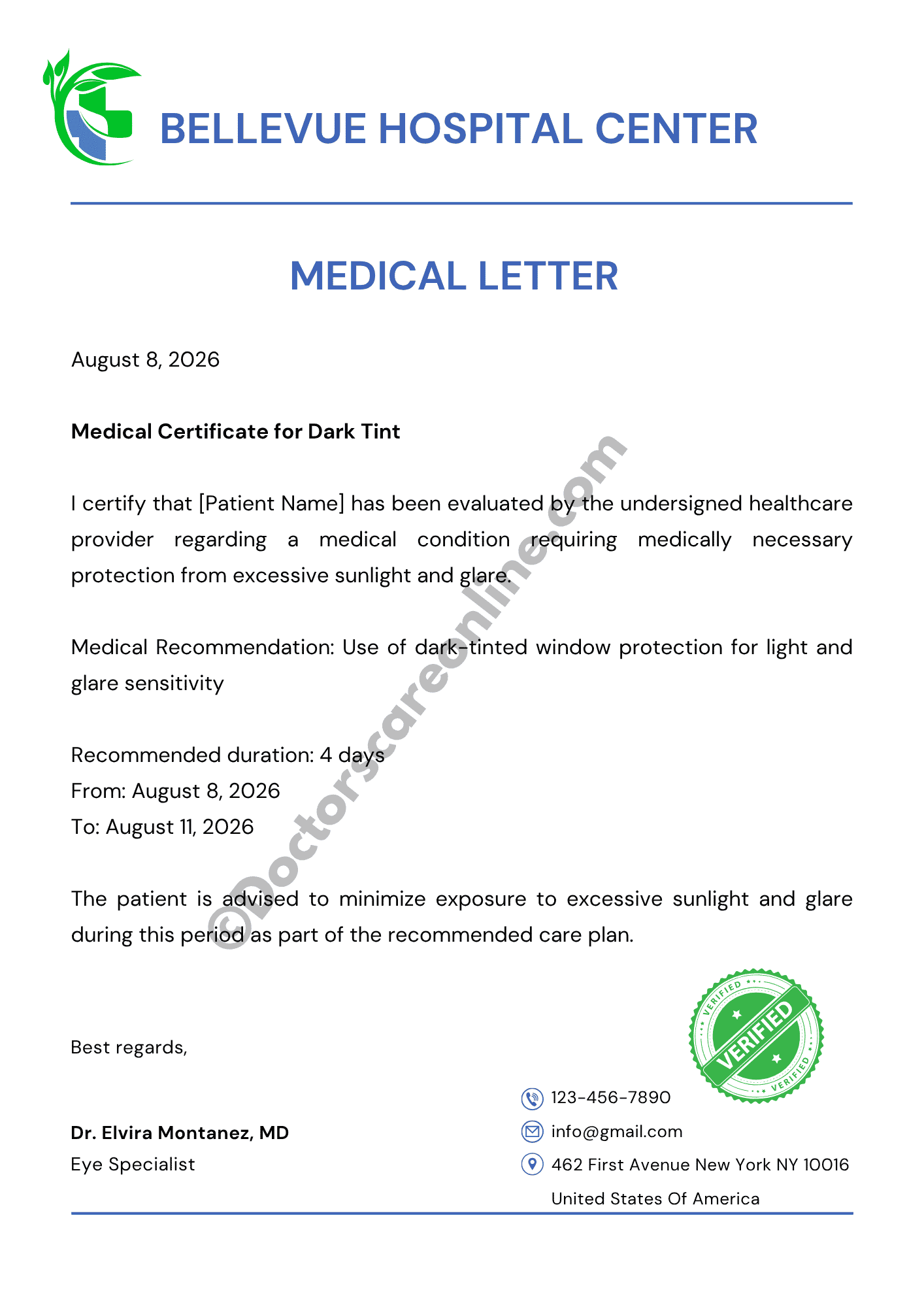
A doctor’s note for dark tint is medical documentation that may support a request for an automobile window-tint exemption when a healthcare provider determines that a darker window tint is medically necessary. Certain medical conditions can cause increased sensitivity to sunlight, ultraviolet (UV) radiation, glare, or bright light, and in some jurisdictions, eligible drivers may be permitted to use window tint that is darker than the standard legal limit.
Our website helps you connect with a healthcare provider through an online consultation where available. During the appointment, you can explain your symptoms, medical history, and reason for requesting documentation. If the provider determines that a medical exemption is appropriate after evaluating your situation, they may issue documentation according to applicable laws, regulations, and professional requirements.
Related Doctor Note :——
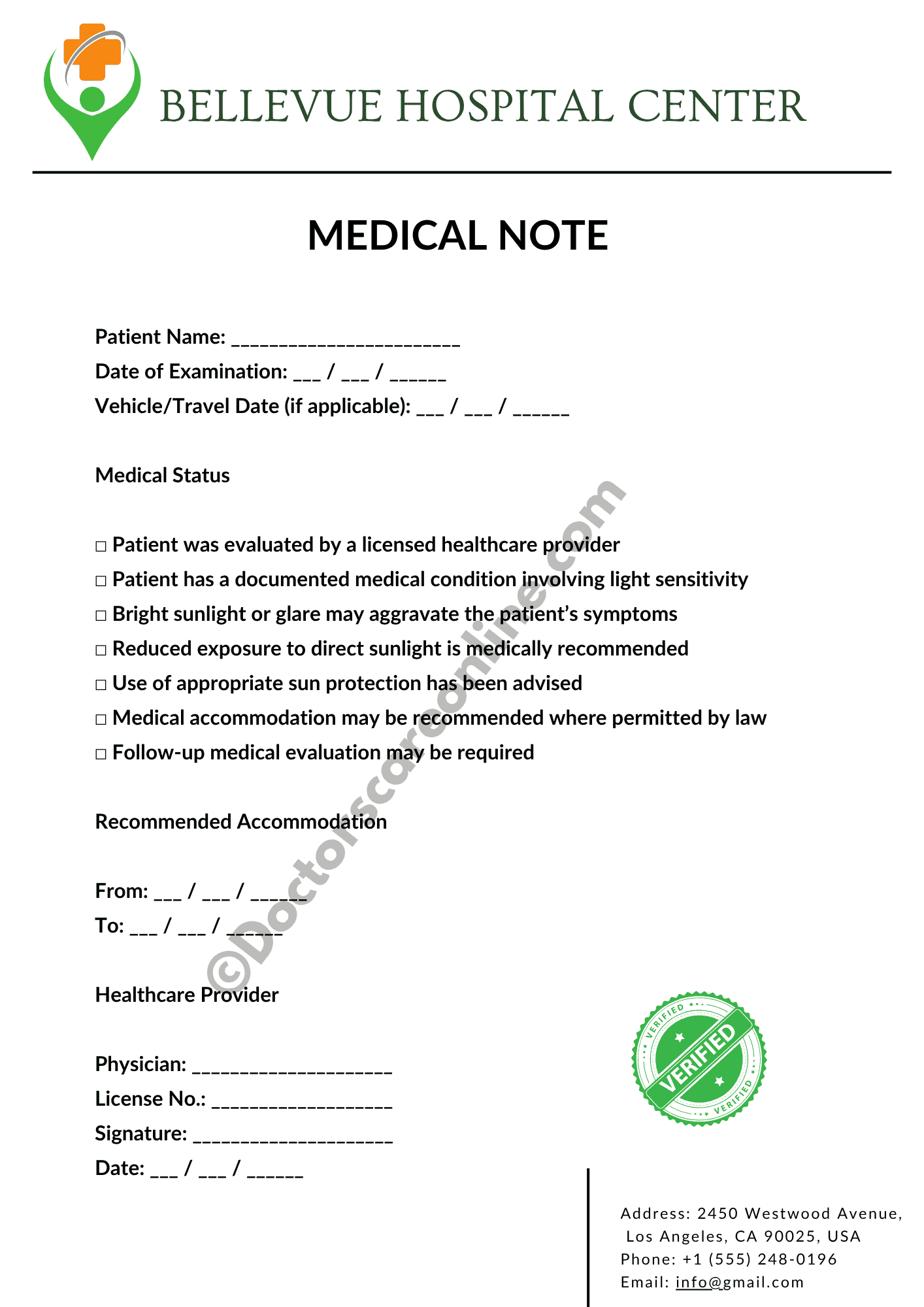
Printable Doctor’s Note for Dark Tint
A printable doctor’s note for dark tint can provide medical documentation when a healthcare provider determines that a patient has a health-related reason for requesting reduced exposure to sunlight or glare. In the United States, vehicle window-tint rules vary by state, and a medical exemption may require documentation from a licensed healthcare provider and approval from the appropriate state authority.
- Patient Information: The document may include the patient’s name and relevant identifying information.
- Medical Reason: A healthcare provider may document the medical reason supporting the request for darker window tint when clinically appropriate.
- Recommended Tint Level: If medically justified and permitted by state law, the provider may specify an appropriate tint level or light-transmission requirement.
- Medical Evaluation Date: The date of the healthcare evaluation may be included to establish when the recommendation was made.
- Provider Information: The note may include the healthcare provider’s name, professional credentials, and practice information.
- Provider Signature: A signature or other required verification may be included to authenticate the medical documentation.
- Vehicle Information: Some states may require vehicle details, such as the make, model, year, or license plate number, as part of an exemption application.
- State-Specific Requirements: Medical tint exemptions differ across the U.S., so patients should check the requirements of their state’s Department of Motor Vehicles (DMV) or other designated authority.
- Exemption Approval: A doctor’s note does not automatically authorize illegal window tint. The relevant state authority may need to approve the medical exemption separately.
- Keep Documentation Available: If a state grants a medical tint exemption, the driver may need to carry or display the approved documentation according to state requirements.
Why Might Someone Need a Medical Window Tint Exemption?
Some medical conditions can involve sensitivity to sunlight, bright light, glare, or UV exposure. In these circumstances, a healthcare provider may determine that additional protection is medically appropriate.
Possible reasons for requesting medical documentation may include:
- Photosensitivity: Increased sensitivity of the skin or eyes to sunlight.
- Light sensitivity: Medical conditions that make bright light uncomfortable or difficult to tolerate.
- Certain eye conditions: Some ocular conditions may involve increased sensitivity to glare or sunlight.
- Skin conditions: Certain conditions or treatments may make UV exposure particularly concerning.
- Medication-related photosensitivity: Some medications can increase sensitivity to sunlight.
- Recovery from certain medical procedures: A healthcare provider may recommend temporary protection when medically appropriate.
A medical provider must determine whether a particular condition actually supports a tint exemption. Having a condition or symptom does not automatically qualify someone for a legal exemption.
How Does an Online Doctor’s Appointment for Dark Tint Work?
An online appointment can provide a convenient way to discuss your medical concerns with a licensed healthcare provider where telehealth services are available.
Step 1: Choose an Online Appointment
Select an available appointment with a licensed healthcare provider who offers online consultations.
Step 2: Register or Log In
Create an account or log in to your existing account using the information requested by the platform.
Step 3: Describe Your Medical Concern
Explain why you are seeking additional protection from sunlight, glare, or UV exposure. Provide accurate information about your symptoms, medical history, medications, and relevant diagnoses.
Step 4: Complete the Medical Consultation
The healthcare provider will review the information you provide and determine whether your condition can be appropriately evaluated through telehealth.
Step 5: Follow the Provider’s Recommendation
The provider may recommend treatment, additional evaluation, an in-person examination, or other appropriate medical care.
Step 6: Receive Documentation If Medically Appropriate
If the provider determines that documentation supporting a medical window-tint exemption is justified, they may provide appropriate medical documentation in accordance with applicable requirements.
A medical note is never guaranteed simply because it is requested. The healthcare provider must make an independent clinical decision based on the patient’s circumstances.
Who May Benefit From a Dark Tint Medical Exemption?
A medical window-tint exemption may be relevant to individuals whose healthcare provider determines that reduced exposure to sunlight, glare, or UV radiation is medically necessary.
Examples may include people experiencing:
- Significant photosensitivity
- Medically documented light sensitivity
- Certain eye-related conditions
- Certain dermatological conditions
- Sensitivity associated with specific medications
- Other medically documented conditions involving sunlight or UV exposure
Eligibility is determined by the applicable local law and the healthcare provider’s medical assessment. Some jurisdictions may have specific lists of qualifying conditions, limits on tint darkness, restrictions on windshield or front-side windows, or special permit requirements.
What Information May Be Needed for an Online Consultation?
Providing complete and accurate information can help the healthcare provider understand your situation.
You may be asked about:
- Your symptoms
- When the symptoms started
- Your medical history
- Existing diagnoses
- Current medications
- Previous treatments
- Sensitivity to sunlight or bright light
- How sunlight or glare affects your daily activities
- Any previous medical recommendations regarding UV or light protection
- The reason you believe additional vehicle window protection is medically necessary
Do not provide inaccurate or exaggerated information to obtain documentation. The healthcare provider needs truthful information to make an appropriate medical assessment.
Is a Doctor’s Note Enough to Make Dark Window Tint Legal?
Not necessarily.
A doctor’s note or medical recommendation may be one part of the exemption process, but it does not automatically override vehicle window-tint laws.
Depending on your location, you may need to:
- Obtain medical documentation from a qualified healthcare provider.
- Complete a medical exemption or authorization application.
- Submit the required documents to the appropriate motor-vehicle or government agency.
- Obtain approval or a permit, if required.
- Follow the permitted tint percentage and vehicle-window restrictions.
- Keep the required documentation or permit with the vehicle.
Because requirements can change, check your state or local motor-vehicle authority before installing darker tint.
What Does a Medical Tint Exemption Usually Cover?
The permitted exemption can vary significantly by jurisdiction. Some areas may specify:
- Maximum or minimum visible light transmission
- Which vehicle windows can be tinted
- Whether the windshield can be tinted
- Whether front-side windows have different requirements
- Required medical certification
- Permit or decal requirements
- Documentation that must be carried in the vehicle
- Renewal or expiration requirements
For this reason, do not assume that a medical recommendation permits any particular tint percentage. Follow the exact requirements applicable to your location.
Doctor’s Note for Dark Tint vs. Personal Request
A personal statement explaining that sunlight bothers you is different from medical documentation.
A healthcare provider’s documentation is based on a medical evaluation and professional judgment. It may provide formal evidence that a specific medical recommendation is appropriate, subject to applicable laws.
This distinction is important when an agency, insurer, employer, school, or other organization requires professional medical documentation.
What Makes Our Online Service Useful and Trustworthy?
We aim to make the process of seeking legitimate medical documentation clear, convenient, and patient-focused.
- Licensed Healthcare Provider Evaluation: Our service connects users with healthcare providers for an appropriate medical consultation. Documentation is provided only when a healthcare provider determines that it is medically appropriate.
- Convenient Online Access: Online appointments can save time by allowing eligible users to consult with a healthcare provider remotely where telehealth is available.
- Clear Process: We provide a straightforward process for registration, appointment scheduling, consultation, and documentation when appropriate, so users know what to expect.
- Privacy-Conscious Approach: Medical information is sensitive. Users should provide accurate information through the secure channels provided by the service and review the platform’s privacy practices before submitting personal or medical information.
- No Guaranteed Medical Outcome: We do not promise that every user will receive a doctor’s note. The healthcare provider independently determines whether documentation is medically justified.
- Transparent Support: If you have a question about registration, login, appointment scheduling, payment, your order, or another website-related issue, you can contact our support team through the website chatbox. Our support team can help with platform and service questions and guide you through the appropriate next steps.
What If You Have a Registration, Login, or Payment Problem?
If you are having trouble creating an account, logging in, completing payment, scheduling an appointment, or understanding the ordering process, you do not need to figure it out alone.
You can use our website chatbox to ask questions about:
- Registration problems
- Login issues
- Appointment scheduling
- Payment or checkout problems
- Order-related questions
- Website navigation
- General service information
For privacy and security, never send passwords, full payment-card numbers, or other sensitive account credentials through chat.
How Long Is a Doctor’s Note for Dark Tint Valid?
There is no universal validity period.
The validity of medical documentation depends on the healthcare provider’s recommendation and the requirements of the government agency or jurisdiction handling the window-tint exemption.
Some exemptions may require:
- A current medical certification
- A government-issued permit
- Periodic renewal
- Updated documentation
- Documentation kept in the vehicle
- Compliance with a specific exemption period
Always verify the current requirements with your local motor-vehicle authority.
Can You Get a Doctor’s Note for Dark Tint Online?
In many locations, you may be able to discuss your medical concerns with a licensed healthcare provider through telehealth. Whether an online provider can issue documentation depends on the provider’s clinical judgment, the nature of your condition, telehealth regulations, and the requirements of your jurisdiction.
If an in-person examination is necessary, the provider may recommend an in-person appointment instead.
An online consultation should be treated as a genuine medical evaluation—not simply a way to obtain paperwork.
What Should You Do After Receiving Medical Documentation?
Receiving documentation from a healthcare provider may not be the final step.
After receiving your medical recommendation:
- Review the document for accuracy.
- Check your local window-tint exemption requirements.
- Determine whether an official application or permit is required.
- Submit the documentation to the appropriate authority when necessary.
- Wait for approval if the jurisdiction requires authorization before installation.
- Follow the permitted tint specifications.
- Keep any required permit or documentation with your vehicle.
Do not install illegal window tint based solely on a doctor’s recommendation.
Common Mistakes to Avoid
When requesting or using medical documentation for dark window tint, avoid these common mistakes:
- Assuming every medical condition qualifies for an exemption
- Assuming a doctor’s note automatically makes tint legal
- Installing tint before receiving required government approval
- Using documentation that does not meet local requirements
- Providing inaccurate medical information
- Altering medical documentation
- Ignoring tint limits for specific vehicle windows
- Failing to renew an exemption when required
- Assuming another state’s exemption rules apply to your location
- Using outdated information about local tint laws
How to Make Your Online Consultation More Helpful
You can make your appointment more productive by preparing your medical information beforehand.
Keep relevant details available, including:
- Your current symptoms
- Relevant medical records
- Medication information
- Previous diagnoses
- Previous recommendations for light or UV protection
- Questions you want to ask the healthcare provider
- Information about how sunlight, glare, or UV exposure affects you
Be honest and specific during your consultation. This allows the healthcare provider to make a more informed clinical decision.
Frequently Asked Questions
1. What medical conditions may qualify for a window tint exemption?
Eligibility varies by jurisdiction. Some locations recognize certain conditions involving photosensitivity, light sensitivity, UV sensitivity, or specific eye or skin conditions. A healthcare provider must determine whether your individual medical circumstances support a recommendation, and the relevant authority determines whether you qualify for a legal exemption.
2. Can I use a medical tint exemption in another state?
Not necessarily. Medical window-tint exemptions are governed by the laws and requirements of the applicable jurisdiction. If you travel or move to another state, check that state’s rules to determine whether your existing documentation or permit is recognized.
3. Can I choose any tint percentage if I have a medical exemption?
No. A medical exemption does not necessarily allow unrestricted tint. The applicable law may specify exactly how dark the tint can be and which windows may be covered. Always follow the limits stated by the relevant authority.
4. Do I need a government permit in addition to a doctor’s note?
Some jurisdictions require a separate application, permit, decal, or authorization in addition to medical documentation. Requirements differ by location, so check with your local motor-vehicle authority before installing darker tint.
5. What happens if my medical tint exemption expires?
If your exemption or supporting documentation expires, you may need a new medical evaluation, updated documentation, or a renewal application. Driving with tint that no longer meets the applicable legal requirements could result in penalties.
Medical Disclaimer: This page provides general educational information and is not a substitute for professional medical advice, diagnosis, or treatment. A doctor’s note or medical certification should only be issued by a licensed healthcare provider after an appropriate medical evaluation.
A medical recommendation does not automatically qualify a vehicle for a window-tint exemption. Tint laws, medical exemption criteria, permitted tint levels, application procedures, and documentation requirements vary by state and jurisdiction and may change over time. Always verify current requirements with the appropriate local motor-vehicle or government authority before installing or modifying vehicle window tint.

Reviews
There are no reviews yet.