
A doctor’s note for short-term disability is medical documentation provided by a licensed healthcare professional after evaluating a patient’s health condition and functional limitations. Depending on the circumstances, the documentation may explain why the patient is temporarily unable to perform essential job duties, requires time away from work, or needs temporary workplace restrictions.
Short-term disability (STD) benefits are generally provided through an employer-sponsored or individually purchased disability insurance plan. The requirements for qualifying for benefits, submitting medical evidence, and determining the length of a disability period depend on the specific insurance policy and applicable rules.
Related Doctor Note :——
You can also visit:
- Doctors Note for Allergies
- Doctors Note for Limited Work
- Doctor’s Note for Work From Home
- Unlimited Doctor’s Notes for 1 Year
Printable Doctor’s Note for Short-Term Disability Templates
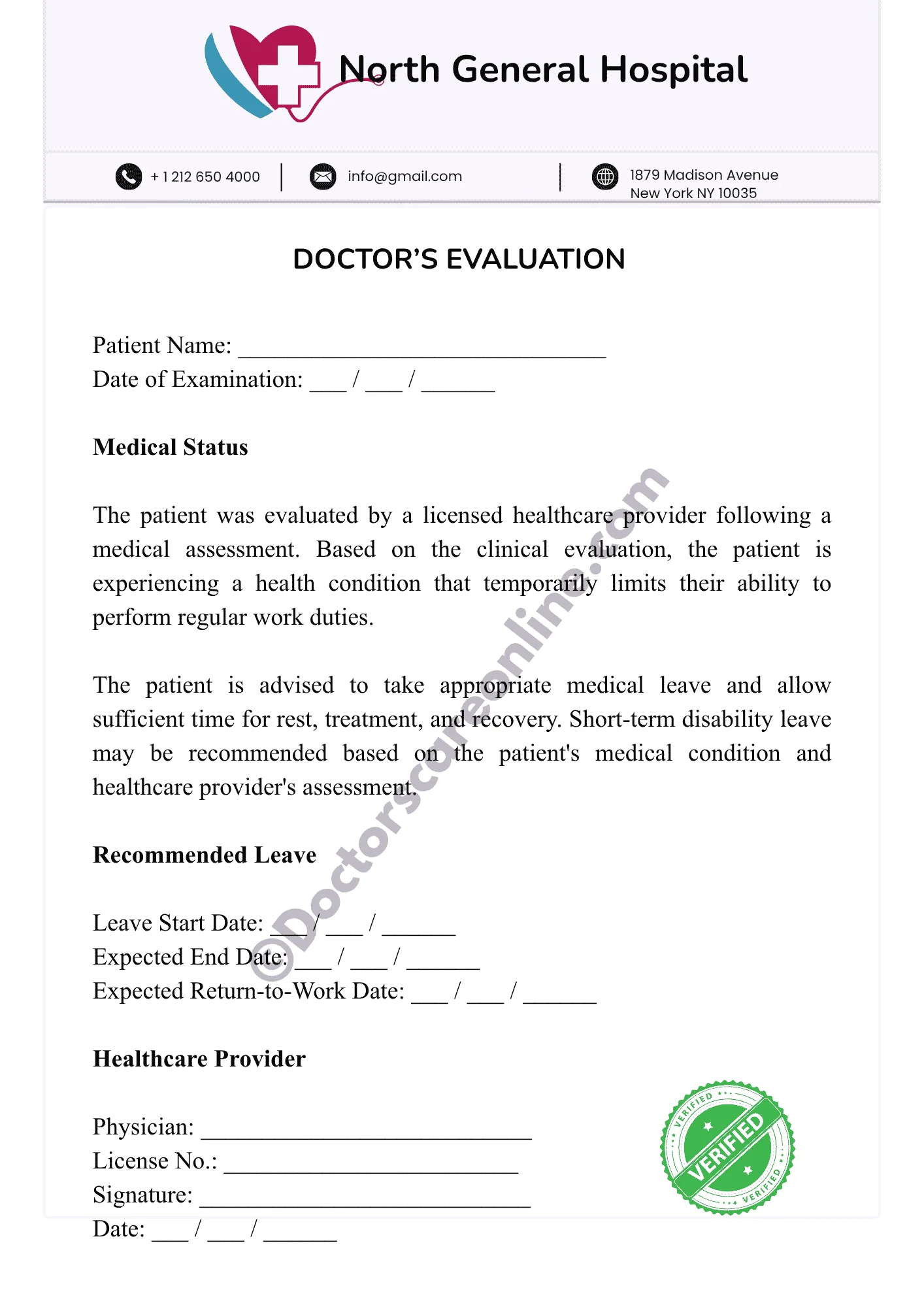
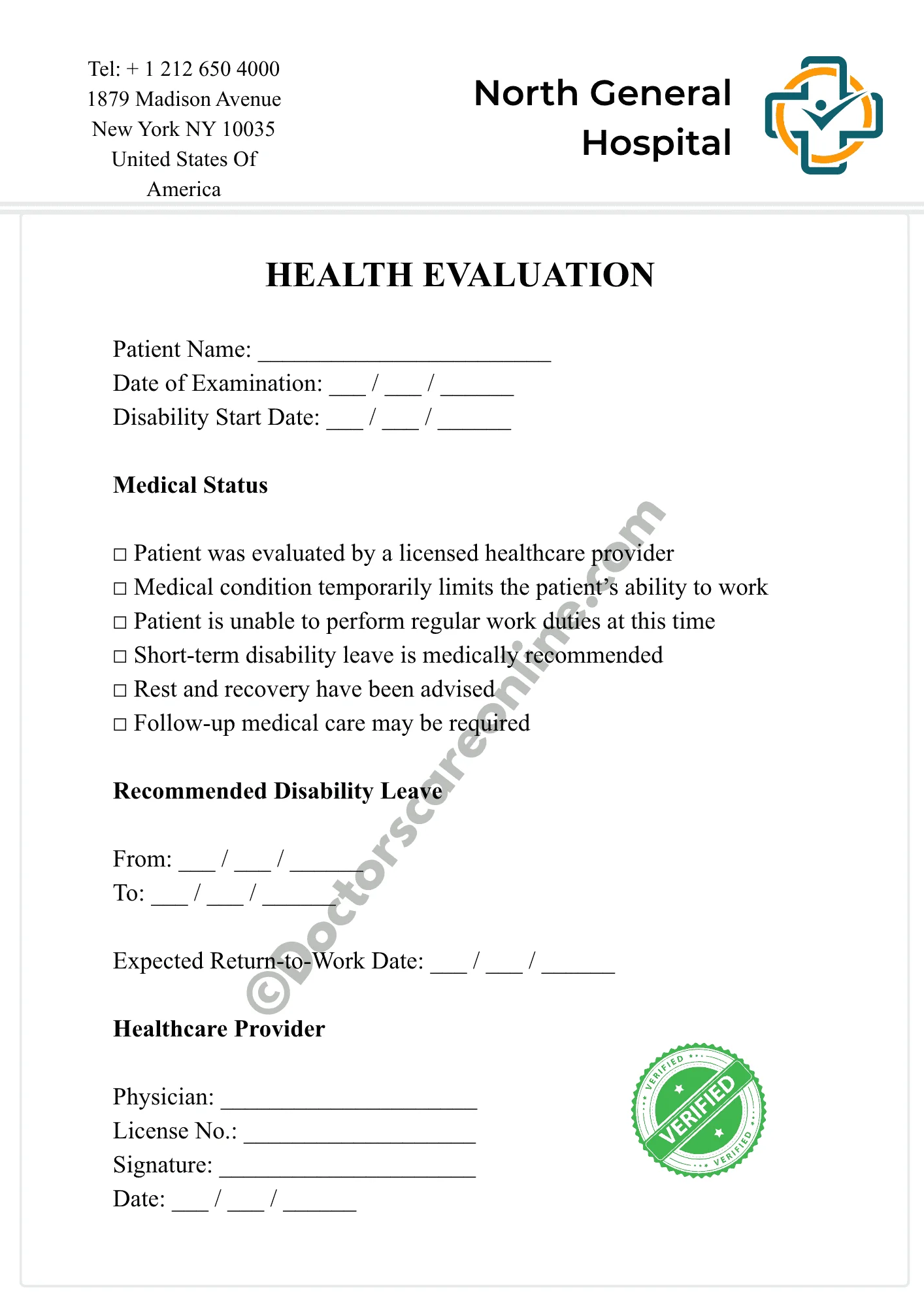
A short-term disability doctor’s note is written medical documentation that may describe a patient’s medical condition, functional limitations, recommended absence from work, restrictions, or expected recovery period.
The documentation should be based on an actual medical evaluation. Depending on the patient’s circumstances, a healthcare provider may determine that the patient:
- Cannot temporarily perform certain essential job duties
- Needs medical leave from work
- Can work with temporary restrictions
- Requires reduced hours or modified duties
- Needs additional evaluation or follow-up care
- May be able to return to work on a specified date
- Requires continued restrictions until reassessment
The exact information included depends on the healthcare provider’s clinical judgment and the documentation requirements of the relevant employer, insurer, or benefits plan.
When Might You Need a Doctor’s Note for Short-Term Disability?
Medical documentation may be requested when a health condition temporarily prevents an employee from performing their regular occupational duties.
Situations may include:
- Recovery after surgery
- Serious illness or infection
- Musculoskeletal injuries
- Severe back or neck problems
- Migraine or other disabling headaches
- Pregnancy-related medical limitations
- Recovery after an accident
- Mental health conditions requiring medically supported leave
- Chronic-condition flare-ups that temporarily affect function
- Physical limitations that prevent safe performance of essential job tasks
The reason for leave and the employee’s functional limitations should be accurately assessed by a healthcare professional.
Short-Term Disability vs. FMLA: What’s the Difference?
Short-term disability and the Family and Medical Leave Act (FMLA) are not the same type of protection. The difference are given below :
|
Aspect |
Short-Term Disability (STD) |
FMLA |
|
What It Is |
An insurance or employer benefit that may replace part of an employee’s income when a qualifying medical condition prevents them from working. |
A federal law that provides eligible employees with job-protected leave for qualifying family and medical reasons. |
|
Main Purpose |
Provides income replacement during a qualifying disability or medical absence. |
Provides job-protected leave for qualifying family and medical situations. |
|
Pay |
May provide partial wage replacement, depending on the disability plan. |
Generally provides unpaid leave under federal law. |
|
Eligibility |
Depends on the employer’s or insurance plan’s terms and eligibility requirements. |
Depends on factors such as employee eligibility, employer coverage, and the qualifying reason for leave. |
|
Medical Documentation |
A healthcare provider may need to provide medical information or certification required by the disability plan. |
An employer may require healthcare-provider certification for certain FMLA leave requests. |
|
Job Protection |
STD itself does not necessarily provide job protection; protection may come from another law or policy. |
Provides job-protected leave when the employee meets applicable FMLA requirements. |
|
Can They Be Used Together? |
Yes, an employee may potentially receive STD benefits while using FMLA leave for the same medical condition. |
FMLA leave may run concurrently with STD when the applicable requirements are met. |
|
Requirements |
Follow the specific requirements of the employer’s or insurer’s disability plan. |
Follow FMLA eligibility, notice, certification, and other applicable requirements. |
|
Important Note |
Coverage, benefit amount, waiting periods, and duration vary by plan. |
FMLA requirements can vary based on the employee, employer, and circumstances. |
|
What to Check |
Review the employer’s STD policy and insurance plan documents. |
Review employer policies and applicable federal or state leave requirements. |
What Can a Doctor Document for Short-Term Disability?
A healthcare provider may document medically relevant information needed to explain the patient’s ability to work.
Depending on the situation, documentation may address:
- The date of medical evaluation
- The relevant medical condition or diagnosis, when appropriate
- Functional limitations
- Restrictions affecting work activities
- Recommended period away from work
- Estimated duration of limitations
- Expected return-to-work date, if reasonably determined
- Whether follow-up evaluation is necessary
- Whether modified duties may be appropriate
Medical documentation should contain accurate information supported by the provider’s evaluation. A provider should not certify a disability period that is not medically justified.
Functional Limitations That May Affect Your Ability to Work
Short-term disability decisions may involve more than the name of a medical condition. Functional limitations can help explain how the condition affects an employee’s ability to perform specific work activities.
Examples include difficulty with:
- Standing for extended periods
- Walking or climbing
- Lifting or carrying
- Bending, reaching, or twisting
- Sitting for prolonged periods
- Operating machinery
- Driving as part of a job
- Maintaining concentration
- Performing repetitive movements
- Maintaining a regular work schedule
The relevant limitations depend on both the patient’s condition and the essential functions of their particular job.
What Information Should You Have Before an Online Doctor Appointment?
Preparing relevant information can make an online medical consultation more useful.
Before your appointment, consider having:
- A description of your symptoms
- When the symptoms started
- Whether the condition is improving or worsening
- Previous diagnoses related to the current problem
- Current medications and treatments
- Relevant medical history
- Recent injuries, procedures, or surgeries
- Information about your daily limitations
- Your job title or a description of your essential duties
- Any work restrictions already provided by a healthcare professional
- The dates or deadlines associated with your leave request
If your employer or disability insurer has supplied a specific medical certification form, keep it available and ask the provider whether it can be completed based on the evaluation.
How to Get a Short-Term Disability Doctor’s Note Online
Online medical appointments can provide a convenient way to discuss certain health concerns with a licensed healthcare provider when telehealth is clinically appropriate and available in your location.
1. Register for an Account
- Create an account using the information requested by the healthcare service. Use accurate contact and identification details so your appointment and medical records can be associated with the correct patient.
2. Log In and Select an Appointment
- After registration, log in and select an available appointment appropriate for your medical concern.
3. Provide Your Medical Information
- Describe your symptoms, medical history, current treatment, and how the condition affects your ability to perform your job.
4. Complete the Medical Consultation
- Speak with the licensed healthcare provider during your scheduled appointment. The provider may ask questions about your symptoms, limitations, medical history, and work activities.
5. Receive Medical Guidance
- The provider may recommend treatment, follow-up care, an in-person examination, diagnostic testing, activity restrictions, or other appropriate medical care.
6. Receive Documentation When Medically Appropriate
- If the provider determines after the evaluation that medical documentation is appropriate, they may issue a doctor’s note or other documentation consistent with their clinical judgment and applicable requirements.
An online consultation does not guarantee that a doctor’s note or disability certification will be issued.
Can an Online Doctor Complete Short-Term Disability Forms?
In some circumstances, a licensed healthcare provider may be able to complete or provide information for short-term disability paperwork after an appropriate evaluation.
Whether a provider can complete a particular form depends on:
- The type of form
- The information requested
- The provider’s ability to evaluate the condition
- Applicable telehealth requirements
- The patient’s medical circumstances
- The provider’s professional policies
Some forms may require information that cannot be established through a remote consultation alone. In that situation, the provider may recommend an in-person evaluation or additional testing.
What Does a Short-Term Disability Medical Certification Usually Include?
Requirements vary by disability insurer, employer, and benefit plan. When medical certification is requested, it may include information such as:
| Information | Purpose |
|---|---|
| Patient identification | Confirms whose medical condition is being documented |
| Date of evaluation | Establishes when the provider assessed the patient |
| Medical information | Describes the relevant health condition when required |
| Functional limitations | Explains how the condition affects work-related activities |
| Recommended leave period | Indicates medically supported time away from work |
| Work restrictions | Describes activities the patient should temporarily avoid |
| Expected return date | Provides an estimated return date when medically appropriate |
| Follow-up requirements | Indicates whether additional evaluation is needed |
| Healthcare provider information | Identifies the professional completing the documentation |
The exact requirements should be confirmed with the employer, insurer, benefits administrator, or organization requesting the documentation.
How Long Can Short-Term Disability Leave Last?
There is no single nationwide period that applies to every short-term disability claim.
The length of a disability period may depend on:
- The patient’s medical condition
- Severity and functional impact
- Expected recovery
- Treatment response
- Occupational requirements
- Medical follow-up
- Employer policies
- The terms of the disability insurance plan
- Applicable state or federal requirements
A healthcare provider may recommend an initial period of leave and reassess the patient if additional time is medically necessary.
Avoid assuming that a doctor’s note automatically determines how long disability benefits will be paid. Benefit duration is governed by the applicable plan and eligibility requirements.
Can You Work With Restrictions Instead of Taking Full Disability Leave?
Sometimes. If a healthcare provider determines that a patient can safely perform certain duties but should temporarily avoid others, medical documentation may recommend modified work.
Possible restrictions may involve:
- Reduced lifting requirements
- Limited standing or walking
- Reduced repetitive movements
- Additional breaks
- Modified schedules
- Reduced physical workload
- Temporary remote work, when medically appropriate and operationally feasible
- Avoiding specific activities that could interfere with recovery
Whether an employer can provide modified work depends on the job, workplace policies, medical restrictions, and applicable employment laws.
For disability-related accommodations, the EEOC explains that employers may request appropriate medical documentation in certain circumstances, while medical information must generally be handled confidentially.
What If Your Employer or Insurance Company Requests More Information?
A request for additional information does not necessarily mean your original documentation was invalid. The employer, insurer, or benefits administrator may have specific forms or certification requirements.
If additional documentation is requested:
- Review exactly what information is missing.
- Contact the healthcare provider who evaluated you.
- Provide the relevant form or request to the provider.
- Ask whether additional evaluation is necessary.
- Submit the completed documentation according to the applicable deadline.
- Keep copies of documents you submit for your records.
Do not alter a doctor’s note or medical certification yourself. If something is incorrect, ask the healthcare provider to correct or reissue the documentation.
Protecting Your Medical Privacy
Medical documentation often contains sensitive information. Only provide the information that is required for the particular purpose, and use secure channels when submitting medical records or forms.
For covered employers, the EEOC states that employee medical information must generally be kept confidential and maintained separately from ordinary personnel files, subject to limited exceptions.
Your specific privacy rights and disclosure requirements can depend on the situation, the type of information involved, the employer, the insurer, and applicable law.
How Our Online Doctor Service Can Help
Our online healthcare service is designed to make access to a medical consultation more convenient when your health concern is appropriate for telehealth.
You can use the service to:
- Request an online medical consultation
- Explain your symptoms and functional limitations
- Discuss how your condition affects your work
- Connect with a licensed healthcare provider where services are available
- Receive medical guidance based on your individual situation
- Ask whether medical documentation may be appropriate
- Receive documentation when a provider determines that it is medically justified
Our service does not replace an emergency department, urgent in-person evaluation, or other immediate medical care when your symptoms require hands-on assessment.
Most importantly, a doctor’s note is based on a healthcare professional’s evaluation. We do not promise, sell, or guarantee medical certification without an appropriate clinical assessment.
Why Patients Can Use Our Website With Confidence
Choosing an online healthcare service involves more than finding a convenient appointment. Patients should know what to expect from the process and how their information is handled.
Our service is designed around a consultation-first process:
- Medical evaluation comes first: Documentation is considered only after an appropriate healthcare consultation.
- Licensed healthcare professionals: Medical decisions are made by qualified healthcare providers rather than by an automated system.
- Clear process: Patients can understand the steps involved in registration, appointment scheduling, consultation, and documentation.
- Patient-focused communication: You can explain your symptoms and concerns directly during the consultation.
- Privacy-conscious approach: Medical information should be handled through appropriate secure processes.
- No guaranteed outcome: A provider determines whether a note or other documentation is medically appropriate.
- Convenient online access: Telehealth may reduce the need to travel for certain types of medical consultations.
These features help users understand what the service does and, equally importantly, what it does not promise.
Need Help With Registration, Login, Payment, or Your Order?
If you experience a problem while using our website, you do not have to figure it out alone.
You can contact our chatbox if you have a question or issue related to:
- Creating an account
- Logging into your account
- Password or account-access problems
- Booking an appointment
- Payment or checkout issues
- Questions about your order
- Difficulty accessing available services
- General website questions
- Questions about the next step in the process
Our support chat can help guide you through website and account-related questions. For medical questions, your healthcare provider should be consulted because customer support cannot diagnose conditions, recommend treatment, or decide whether medical documentation is clinically appropriate.
What to Do After Receiving a Doctor’s Note
Once you receive medical documentation, review it carefully before submitting it.
Check that:
- Your identifying information is accurate.
- The examination or consultation date is correct.
- The recommended leave or restriction period is accurate.
- Work restrictions are clearly stated when applicable.
- The provider’s information is present where required.
- The document has been completed according to the relevant request or form.
Submit the documentation through the method specified by your employer, insurer, school, or other organization.
If your condition changes, contact a healthcare professional rather than changing the document yourself.
Important Things to Know Before Requesting Short-Term Disability Documentation
A medical note and an approved disability claim are different things.
A healthcare provider can evaluate your medical condition and provide documentation when medically appropriate. The organization responsible for your short-term disability benefit may separately determine whether you qualify under the applicable plan.
Before submitting a claim, check:
- Your short-term disability policy
- Waiting or elimination periods
- Required claim forms
- Medical certification requirements
- Submission deadlines
- Employer procedures
- Insurer contact information
- Whether additional medical records are required
Keeping these requirements in mind can help reduce avoidable delays.
Frequently Asked Questions
1. Does a short-term disability doctor’s note guarantee disability payments?
No. Medical documentation can support a disability claim, but approval of short-term disability benefits is generally determined under the applicable insurance policy or benefit plan. The healthcare provider and benefits administrator have different roles.
2. Can I use the same doctor’s note for my employer and disability insurer?
Not necessarily. An employer and disability insurer may request different information or use separate forms. Before submitting the same document to both, check each organization’s documentation requirements.
3. What happens if my short-term disability claim is denied?
If a claim is denied, review the written decision and the instructions for requesting reconsideration or appealing the decision. The applicable procedure and deadline should be provided by the insurer or benefits administrator.
4. Can my doctor change my disability end date if I have not recovered?
A healthcare provider may reassess your condition and update medical documentation when continued restrictions or leave are medically justified. Any extension should reflect the provider’s current clinical assessment rather than an automatic extension.
5. Can I request short-term disability documentation for a condition that is not visible?
Yes. A medical condition does not have to be visibly apparent for a healthcare provider to evaluate it. What matters is the individual’s medical condition, symptoms, functional limitations, and the provider’s clinical assessment. Employment documentation requirements may differ depending on the circumstances.
Medical Disclaimer: This information is provided for general educational purposes and is not a substitute for professional medical advice, diagnosis, or treatment. A doctor’s note, medical certification, or short-term disability documentation should be issued only by an appropriately licensed healthcare professional after an appropriate medical evaluation. An online consultation does not guarantee that a doctor’s note, disability certification, leave recommendation, or benefits approval will be provided.
Reviews
There are no reviews yet.