
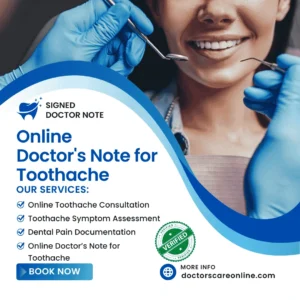
An online doctor’s note for toothache is medical documentation that may be provided following an online healthcare consultation when a healthcare professional determines that the patient’s symptoms warrant documentation. A severe toothache can make it difficult to work, attend school, concentrate, sleep, or manage normal daily activities. If your dental pain affects your ability to meet these responsibilities, an online doctor’s note for toothache may provide legitimate medical documentation after an appropriate healthcare evaluation.
Our service is designed to make the process of connecting with healthcare providers more convenient for people in the United States. Instead of spending unnecessary time trying to arrange an appointment, eligible users can use our online platform to request a medical consultation and discuss their symptoms with a healthcare professional.
If the provider determines that medical documentation is appropriate, they may issue a legitimate doctor’s note based on their clinical assessment. A doctor’s note is not automatically provided simply because it is requested or purchased; it should reflect a healthcare professional’s independent medical judgment.
Related Doctor Note :——
You can also visit:
- Doctors Note for Limited Work
- Doctors Note for Wisdom Teeth
- Doctor’s Note for Work From Home
- Unlimited Doctor’s Notes for 1 Year
Why Might You Need a Doctor’s Note for Toothache?
A toothache can range from mild discomfort to severe dental pain that interferes with everyday responsibilities. Documentation may be useful when your symptoms prevent you from safely or comfortably performing normal activities.
Common situations include:
- Missing work: Severe tooth pain may make concentrating or completing job responsibilities difficult.
- School absence: Students may need documentation when dental pain interferes with attendance.
- Dental appointment: You may need time away from work or school to seek dental treatment.
- Post-treatment recovery: Certain dental procedures can temporarily affect normal activities.
- Severe symptoms: Swelling, significant pain, or difficulty eating may require prompt professional attention.
- Work limitations: A healthcare provider may recommend temporary restrictions when symptoms significantly affect functioning.
Whether documentation is appropriate depends on an individual medical assessment rather than the request alone.
Common Causes of Toothache
Tooth pain can have several possible causes. A healthcare professional or dentist may need to evaluate the symptoms to determine what is causing the discomfort.
Possible causes include:
- Dental cavities: Tooth decay can expose sensitive areas of the tooth and cause pain.
- Tooth infection: An infection can produce persistent pain, swelling, tenderness, or sensitivity.
- Dental abscess: A collection of infection around a tooth or gum can cause significant pain and swelling.
- Gum disease: Inflammation or infection affecting the gums may contribute to dental discomfort.
- Cracked or damaged tooth: A damaged tooth can hurt when chewing or when exposed to hot or cold temperatures.
- Tooth sensitivity: Exposure of sensitive tooth structures may cause short, sharp pain.
- Impacted wisdom tooth: A wisdom tooth that does not emerge properly may cause pressure, pain, or gum inflammation.
- Dental trauma: An injury to the mouth can damage a tooth and cause ongoing discomfort.
- Loose or damaged dental restoration: Problems involving fillings, crowns, or other dental work can sometimes cause pain.
A symptom alone cannot establish the underlying diagnosis. Professional evaluation may be necessary.
Toothache Symptoms That May Need Professional Evaluation
Not every toothache requires emergency treatment, but persistent or significant symptoms should not be ignored.
Consider seeking professional medical or dental evaluation if you experience:
- Persistent or worsening tooth pain
- Pain that interferes with sleeping
- Significant sensitivity to hot or cold
- Pain when chewing or biting
- Swollen gums
- Facial or jaw swelling
- Fever accompanying dental pain
- Pus or an unusual taste in the mouth
- Difficulty opening your mouth
- Pain following dental trauma
- Symptoms that continue despite basic self-care
A healthcare professional can determine whether you need dental care, medical treatment, or further evaluation.
When Toothache May Be a Dental Emergency
Some dental symptoms require urgent attention rather than simply obtaining documentation.
Seek urgent or emergency medical care if tooth or mouth symptoms are accompanied by:
- Difficulty breathing
- Difficulty swallowing
- Rapidly increasing facial or neck swelling
- Severe swelling around the mouth or jaw
- Signs of a serious infection
- Major facial trauma
- Uncontrolled bleeding
- Severe symptoms that are rapidly worsening
A doctor’s note should never be used as a substitute for urgent treatment when emergency symptoms are present.
Can You Get a Doctor’s Note for Toothache Online?
In some circumstances, you may be able to discuss toothache symptoms through a telehealth appointment with a licensed healthcare professional.
During an online consultation, you may be asked about:
- When the toothache began.
- Where the pain is located.
- How severe the pain is.
- Whether the pain is constant or intermittent.
- Whether there is swelling or fever.
- Whether you have difficulty eating or sleeping.
- Any recent dental treatment or injury.
- Medications or treatments you have already tried.
- Whether the symptoms are affecting your work or school responsibilities.
The healthcare professional will determine whether your condition can be appropriately assessed through telehealth. If an in-person dental examination is necessary, you may be advised to visit a dentist or other appropriate healthcare facility.
If medical documentation is clinically appropriate, the provider may issue it according to applicable requirements and their professional judgment.
How Our Online Doctor’s Note Service Helps You
Our platform is designed to make the process of seeking an online healthcare consultation more convenient and straightforward.
Convenient Online Access
- Request a consultation without unnecessarily visiting multiple offices.
- Complete the initial process online.
- Describe your symptoms and concerns from a convenient location.
- Access healthcare support remotely where telehealth is available.
Healthcare Evaluation
- Your symptoms can be discussed with a healthcare professional.
- The provider can determine whether telehealth is appropriate.
- The provider decides whether documentation is medically justified.
- Additional in-person dental or medical care can be recommended when necessary.
Legitimate Documentation
When a healthcare professional determines that documentation is appropriate, the note should reflect the actual consultation and professional assessment.
This approach is different from simply obtaining a document without medical evaluation.
Why Our Website Can Be Useful and Trustworthy for Users
Choosing an online healthcare documentation service requires more than convenience. Users should understand how the process works and what they can expect before completing a consultation.
Our platform focuses on providing a straightforward online experience by helping users:
- Understand the consultation process before starting.
- Provide relevant information about their symptoms.
- Connect with available healthcare services where offered.
- Obtain documentation only when medically appropriate.
- Receive clear instructions regarding the next steps.
- Get assistance when they encounter account, payment, or technical difficulties.
Clear Process
We aim to make each step easy to understand, from starting the online process to completing the consultation and receiving any documentation determined appropriate by the healthcare provider.
Healthcare Professional Review
A legitimate medical note should be based on an actual healthcare evaluation rather than being generated solely because a customer requests one.
Privacy and Security
Patients should use secure devices and private environments when discussing health information online. U.S. Department of Health and Human Services telehealth guidance emphasizes protecting patient health information and using appropriate privacy and security safeguards.
Convenient Customer Support
If you have a question or experience an issue with our website, you do not have to figure everything out yourself.
You can use our chatbox to ask about:
- Registration problems
- Login difficulties
- Payment issues
- Appointment-related questions
- Website or technical problems
- Questions about the online process
- General service-related concerns
Our support team can help guide you through the appropriate next step.
What Happens During an Online Toothache Consultation?
The exact process can vary, but an online consultation generally follows a straightforward sequence:
| Step | What Happens |
|---|---|
| 1. Start | Begin the online consultation process |
| 2. Account | Register or log in if required |
| 3. Information | Provide relevant personal and symptom information |
| 4. Consultation | Discuss your symptoms with the healthcare professional |
| 5. Assessment | The provider determines whether online evaluation is appropriate |
| 6. Recommendation | You may receive medical advice or be directed to in-person care |
| 7. Documentation | If medically appropriate, the provider may issue documentation |
| 8. Follow-up | Follow any recommended treatment or dental evaluation |
Telehealth guidance recommends preparing relevant health information and checking your technology before a virtual visit to help the appointment run smoothly.
What Information Should You Provide About Your Toothache?
Accurate information can help the healthcare professional better understand your symptoms.
Before your consultation, consider noting:
- Date the toothache started
- Location of the affected tooth or area
- Severity and frequency of pain
- Whether pain is triggered by eating or drinking
- Sensitivity to hot or cold
- Gum or facial swelling
- Fever or chills
- Difficulty chewing
- Difficulty sleeping
- Recent dental procedures
- Previous dental problems
- Recent injury to the mouth
- Medications or treatments you are taking
Do not exaggerate or conceal symptoms. Providing accurate information helps the provider make an appropriate clinical decision.
Doctor’s Note for Work Due to Toothache
A severe toothache may temporarily interfere with job responsibilities, particularly when the pain affects concentration, sleep, eating, speaking, or physical comfort.
Depending on the medical assessment, documentation may indicate:
- A need for temporary absence
- A recommended recovery period
- A return-to-work date
- Temporary activity limitations
- A recommendation to seek dental treatment
- Follow-up requirements
Whether you need time away from work depends on your symptoms, occupation, medical assessment, and employer’s documentation policies.
Doctor’s Note for School Due to Toothache
Students experiencing significant dental pain may have difficulty attending classes, completing assignments, taking examinations, or participating in normal school activities.
A healthcare provider may provide appropriate documentation when the student’s symptoms warrant it.
Depending on the situation, documentation may help explain:
- A school absence
- A missed examination
- Temporary activity limitations
- A recommended recovery period
- The need for follow-up care
Students and parents should also check their school’s specific documentation requirements.
Doctor’s Note vs. Dental Treatment
It is important to understand that a doctor’s note is documentation, not treatment for the underlying dental problem.
A note may document a medical evaluation or recommended absence, but it does not:
- Repair a cavity
- Drain a dental abscess
- Replace a damaged tooth
- Treat advanced gum disease
- Perform dental surgery
- Replace an examination by a dentist when one is required
If your symptoms suggest a dental problem, you may still need an appointment with a licensed dentist for diagnosis and treatment.
How Long Can a Toothache Doctor’s Note Cover?
There is no universal number of days that applies to every person with tooth pain.
The appropriate period depends on factors such as:
- Severity of symptoms
- Underlying medical or dental issue
- Functional limitations
- Type of work or school responsibilities
- Treatment or dental procedure involved
- Recovery progress
- Healthcare provider’s clinical judgment
The provider determines whether time away from work or school is medically appropriate and, if so, the recommended duration.
What Can Make an Online Consultation More Effective?
You can make your virtual appointment easier by preparing beforehand.
Before the appointment
- Use a reliable internet connection.
- Choose a private location.
- Keep your identification and relevant medical information available.
- Make a list of your symptoms.
- Note medications and allergies.
- Have your questions ready.
- Check your camera and microphone.
- Join the appointment on time.
HHS telehealth guidance similarly recommends checking visit details, preparing questions and medications information, and testing the device and internet connection before a virtual appointment.
What If You Cannot Register, Log In, or Complete Payment?
Technical or account problems can be frustrating, especially when you are trying to arrange healthcare.
If you experience a problem with:
- Registration
- Login
- Password or account access
- Payment
- Appointment process
- Website functionality
- General service questions
use the chatbox on our website to contact support.
When contacting support, avoid sending unnecessary sensitive medical information through a general chat unless specifically requested through an appropriate secure process.
Our support team can help explain the next steps or direct you to the appropriate assistance.
Privacy and Personal Health Information
Online healthcare involves sharing personal and health-related information, so privacy is an important consideration.
Users should:
- Use a private location for their consultation.
- Avoid discussing sensitive health information over public Wi-Fi when possible.
- Use a password-protected device.
- Confirm that they are communicating through the intended healthcare platform.
- Review the website’s privacy policies before submitting information.
HHS guidance notes that telehealth visits involve privacy and security considerations and recommends appropriate safeguards for protecting health information.
What Makes Medical Documentation Legitimate?
Legitimate medical documentation should be connected to an actual healthcare encounter and professional assessment.
Important characteristics include:
- A real patient-provider interaction
- Appropriate clinical evaluation
- Accurate patient information
- Date of evaluation
- Appropriate provider information
- Recommendations based on clinical judgment
- No alteration or falsification of the document
A user should never edit, forge, or misrepresent medical documentation.
What You Should Not Do With a Doctor’s Note
For your own protection and to maintain the integrity of medical documentation:
- Do not alter dates.
- Do not change medical recommendations.
- Do not add a diagnosis that the provider did not document.
- Do not change the provider’s restrictions.
- Do not submit a document belonging to another person.
- Do not use documentation for a purpose that contradicts the provider’s recommendations.
- Do not rely on a doctor’s note instead of seeking urgent care when serious symptoms are present.
How to Use Your Doctor’s Note
Once you receive legitimate medical documentation, follow the requirements of the organization requesting it.
For work
- Submit it through your employer’s approved process.
- Follow any stated deadlines.
- Follow the provider’s restrictions.
- Return to work according to the recommended plan.
For school
- Submit the documentation to the appropriate school office.
- Follow the institution’s absence policy.
- Ask about any missed assignments or examinations.
Requirements can differ between employers, schools, and jurisdictions, so always check the applicable policy.
Frequently Asked Questions
1. Can a toothache make it difficult to work even if there is no visible swelling?
Yes. Tooth pain can affect concentration, sleep, eating, speaking, and overall comfort even when swelling is not obvious. A healthcare professional can evaluate your reported symptoms and determine whether further medical or dental assessment is appropriate.
2. Can I request documentation for a missed dental appointment?
The appropriate documentation depends on the circumstances and the healthcare professional’s assessment. If you need proof related to a dental visit, ask the dental or healthcare provider who evaluated you what documentation they can legitimately provide.
3. Will an online provider always be able to diagnose the cause of my toothache?
No. Some dental conditions require an in-person examination, dental imaging, or other assessment that cannot be completed through telehealth. An online provider may recommend an in-person dentist when remote evaluation is insufficient.
4. Can toothache be caused by something other than a dental problem?
Yes. Pain around the jaw, face, or teeth can sometimes have causes that are not limited to the teeth themselves. A healthcare professional can help determine whether dental evaluation or another type of medical assessment is appropriate.
5. What should I do if my toothache keeps returning after it temporarily improves?
Recurring tooth pain should not simply be ignored. Arrange appropriate dental or medical evaluation to identify the underlying cause, particularly if the episodes are becoming more frequent, severe, or associated with other symptoms.
Medical Disclaimer: This content is provided for general informational and educational purposes only and does not replace professional medical advice, diagnosis, or treatment.
An online doctor’s note should only be issued following an appropriate evaluation by a qualified healthcare professional. Documentation is not guaranteed simply because it is requested or purchased. The healthcare provider determines whether a note is medically appropriate based on the individual’s circumstances and clinical judgment.
Reviews
There are no reviews yet.